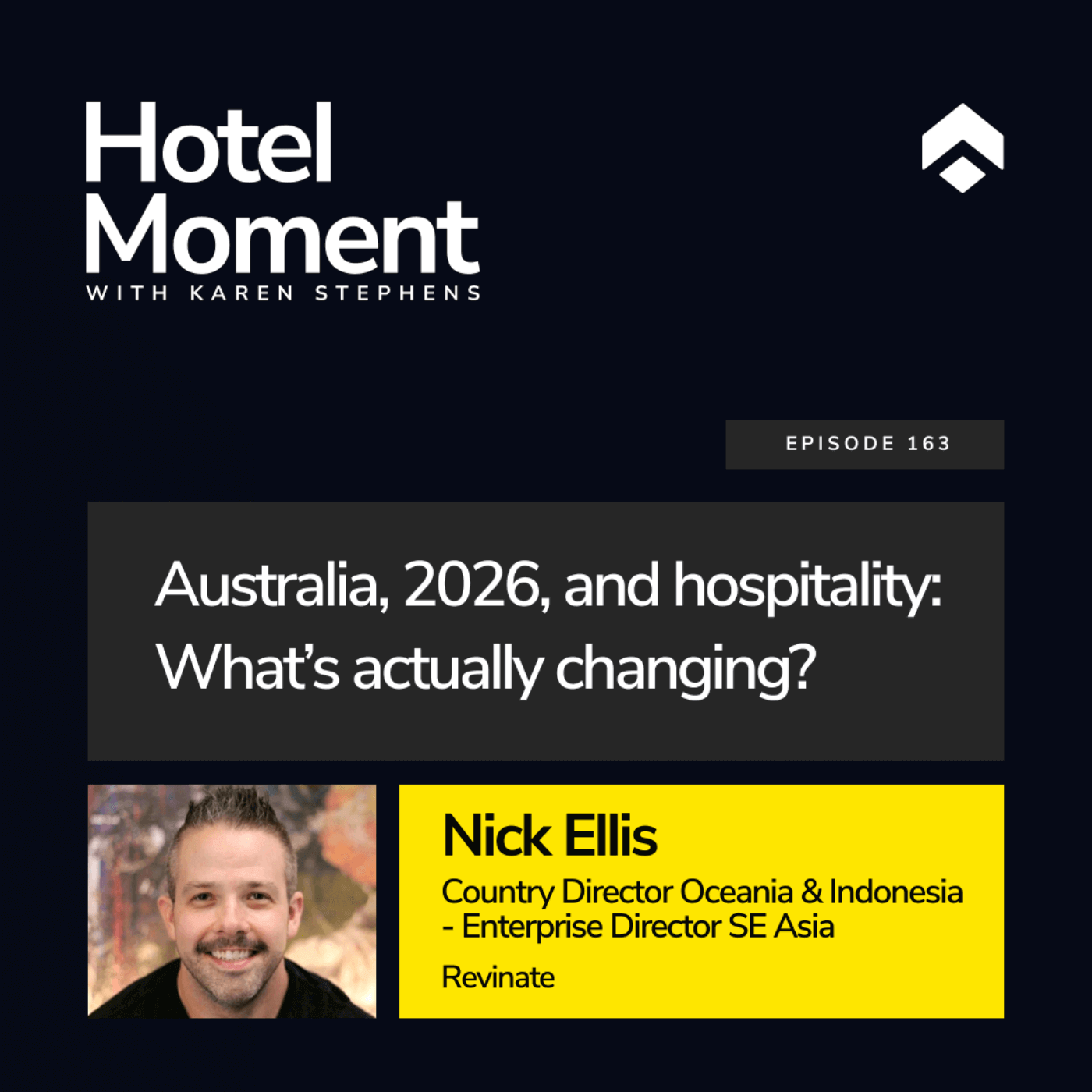
Hotel Moment
WITH KAREN STEPHENS


Episode 163
Australia, 2026, and hospitality: What’s actually changing?
In this episode of Hotel Moment, Dylan Cole, Managing Director of EMEA, is joined by Nick Ellis, Country Director Oceania & Indonesia – Enterprise Director SE Asia, to unpack what hospitality trends for 2026 actually look like in Australia — a market defined by high operating costs, strong domestic travel, returning APAC demand, and an incredibly diverse mix of properties.
They discuss why Australian hoteliers take a more commercially savvy approach to personalization, using guest data to drive direct bookings, increase on-property spend, and deliver relevance in the moments that matter. With lean teams and little tolerance for complexity, the conversation highlights why data must be activated in real time — not reviewed after checkout.
Tune in to hear why in Australia, success in 2026 isn’t about copying global playbooks — it’s about practical execution that works on the ground and delivers measurable results.
Media
Legacy systems can’t keep up with the Australian market
How a CDP fits into your 2026 revenue strategy
Be ready for real-time revenue opportunities
Use the data you have without missing a revenue opportunity

Meet your host
Karen Stephens
As Chief Marketing Officer at Revinate, Karen is focused on driving long-term growth by building Revinate’s brand equity, product marketing, and customer acquisition strategies. Her deep connections with hospitality industry leaders play a key role in crafting strategic partnerships. Karen has more than 25 years of expertise in global hospitality technology and online distribution — including managing global accounts in travel and hospitality organizations such as Travelocity and lastminute.com
As the host of The Hotel Moment podcast, she interviews top players in the hospitality industry. Karen has been with Revinate for over 11 years, leading our global GTM teams. Her most recent transition was from Chief Revenue Officer, where she led the team in their highest booking quarter to date in Q4 2023.
Watch the video
Transcript
Australia, 2026, and hospitality: What’s actually changing?
Official Transcript
[00:00:00] Nick Ellis: In Australia, like we’re commercially savvy, we have to be with the high cost of doing business in Australia. So personalization, we use it to get guests to book direct, knowing what they’re going to buy, encouraging spending while they’re on property.
[00:00:17] Intro: Welcome to the Hotel Moment Podcast presented by Revinate. This is your podcast to understand how technology can shape every moment of the hotel guest’s experience. Tune in to explore cutting-edge technologies and to hear from experts who are shaping guest experiences. It’s 2026 and I’m Dylan Cole, the Managing Director of Revinate Europe. Along with Karen Stephens, we’ll be bringing you a fresh perspective on what matters most to hoteliers. Hey everyone, welcome back. I’ve got someone very cool with me today. I got a real Aussie because today we’re talking about Australia. And we’ve been covering the rising trends in hospitality this year. And now we’re shining light on Australia and how those trends are showing up there. So today I’m joined by the legendary Nick Ellis, who you all know and love. He spends a lot of time in the trenches with hotels across Australia and APAC. And Nick will tell you that if you show up to a call with a deck that has global best practices, the Australians will turn off immediately because it doesn’t land in that market. It’s a very special place. And it needs to be treated as such.
[00:01:22] Nick Ellis: Thanks, crikey, mate. I appreciate the honesty. And it’s kind of true, Aussie hoteliers are practical people. They’ll probably be the first one to tell you that they may know of Nick Ellis, but they probably don’t love him, so if something you present sounds great on a deck, but it really doesn’t work on a busy Sunday morning checkout period with a short staffed front desk, then they can sense straight away that that’s not gonna happen.
[00:01:46] Dylan Cole: Exactly. So that’s what I look forward to getting into with you today, talking about things that actually apply to the Australian market. Just to recap, we’ve already covered the five big hospitality trends shaping 2026. Those are personalization, tech stacks, real-time data, privacy, and guest engagement. So today is really about translating those trends into what makes sense for hotels operating in Australia. And again, not in theory, but in reality, right, Nick?
[00:02:13] Nick Ellis: That’s so true, 100%. And I guess like, Australia’s not a copy and paste market. We’ve got a couple of really defining traits. You know, Australia on a global stage is one of the world’s most aspirational destinations. So you know, that means international demand is still returning, but it’s not our bread and butter. You know, it is strong domestic travel. For those internationals, we do compete on a world stage. But we’ve got some of the highest labor costs on the planet. So that means when we’re looking at competing internationally or even for domestic, it’s really around like full levels of service. Personalization is key. It’s not just like being able to throw a bulk quantity of staff. We’ve also got a really unusual hotel mix, really, like, you know, that it ranges from 500 room CBD towers to remote resorts where, you know, Wi-Fi is as aspirational as the destination itself.
[00:03:06] Dylan Cole: Yeah. And we’ve talked about this before. I would love some aspirational Wi-Fi sometimes in my life, a quick break from technology. So that sounds pretty great. But I think as we kind of guide today’s conversation instead of asking ourselves what should we be doing in 2026, I think the question is more like what’s worth the effort? Because there’s a lot of things you can be doing with your time, your resources, but what is actually worth the effort. And I think we should start off with trend number one, which is personalization. Personalization unfortunately turns some hoteliers off when they hear that immediately because we hear it everywhere. But the truth is in Australia it’s actually becoming very practical.
[00:03:49] Nick Ellis: A hundred percent. And this isn’t sort of fancy subject lines or knowing a favorite pillow, although that’s always nice. In Australia, like we’re commercially savvy, we have to be with the high cost of doing business in Australia. So personalization, we use it for getting guests to book direct, knowing what they’re going to buy, encouraging spending while they’re on property. We use it to make loyalty feel less like a point spreadsheet and more like a genuine relationship. It’s just so important because it’s really how to set yourself apart from your competitor and the next hotel that’s fifty meters down the street.
[00:04:23] Dylan Cole: Right. Guests sure do have a lot of options. So we gotta do it the right way. And I think that comes to the next point is hoteliers have a lot of data. But the question is really like what do we do with it now? You can collect it, but if you don’t have a plan, what are you gonna do? So we’ve written a lot about this in our blogs. We talk about it a lot, you and I, but hotels are sitting on a ton of valuable data. But oftentimes it’s used after the stay and not in the moment. Again, oftentimes after the moment’s already passed, you know?
[00:04:54] Nick Ellis: Yeah, it was sort of one of my pet hates as a GM. I sort of noticed, you know, every guest we had in our building would hand every single staff member a little tiny piece of that jigsaw puzzle of who they were and what they loved and what they were looking for. And everyone had these tiny little jigsaw puzzles, but no one had that complete picture and was able to put them all together and create that experience. It’s always been so difficult. It’s like choosing something simple like upselling, why it’s so important. You know, there’s such a sweet spot around using that information before arrival, during the stay, not three weeks later. But again, it was great knowing that, you know, it’s all well and good to know a guest’s favorite whiskey loaded somewhere in your data platform. But if you can’t walk up to the bar and just get served that whiskey, then really creating those memorable moments on property.
[00:05:41] Dylan Cole: Yeah. If you have the data, you better have a plan for it, better be able to use it. And I think that brings us to our next topic, which is the technology itself. So unified tech stacks are gaining traction in Australia. And as much as us on the tech side would love to think it, it’s not because all of a sudden hoteliers suddenly love technology, right? No, it’s probably the total opposite.
[00:06:02] Nick Ellis: They’re either totally tired of it or don’t understand it or sort of still sticking their head in the sand. But at the end of the day, like teams are short staffed. No one wants to log into multiple systems to answer one question. I think as hoteliers, we’ve been trained over decades of experience from growing up in the industry that tech is expensive to connect and difficult to talk to each other. Disconnected tech makes friction, right? So friction shows up as longer queues, slower responses and frustrated staff. What I really love now is, you know, all this kind of infrastructure, this it exists in other industries, but in hotels we’re new to adopting it and it’s such a business change. It’s such an opportunity on the verge of sort of greatness and our next big scene.
[00:06:47] Dylan Cole: Well, I think that’s when we can kind of talk about this bright shiny light in the distance. Oh, what is that light? Well, it’s the customer data platform. So you can use that or hoteliers can use that as their foundation. It’s one guest profile, it’s clean data, and then that is connected to the rest of your ecosystem through APIs. And it’s really exciting. And again, it’s that shiny light that’s there. It’s there now.
[00:07:11] Nick Ellis: It really is. It’s so exciting for me as a career hotelier slash tech nerd. It’s just practical, it’s flexible, it’s powerful, no unnecessary drama. I’d call it a bit of an Aussie solution, really, but you know, it’s a bit deeper than that because hotel groups who run multiple properties, it means you can change parts of the stack in and out without everything falling over. It really sort of it powers so much in the background, but it’s still easy to use and I’m so excited by what’s coming in that data out. And, you know, I always refer back to that instance of the bartender knowing that your favorite drink, but ensuring that the front desk know that as well. So when you rock up, they’re like, “Hey Nick, we’ve got a piña colada waiting for you. We’re so excited to welcome you back.” And being able to surface those insights that you’re collecting, it’s such an awesome opportunity for hotels to really understand the guests, but then also deliver on it. We have this saying in hotels that guests don’t remember what you did for them, they remember the way you made them feel. And it’s really quite a powerful thing and data really drives that because it drives that experience, right?
[00:08:18] Dylan Cole: Yeah, I agree. And I think that is a great segue to the next point, which is that real-time data is what matters and that is a big trend. So hindsight isn’t what pays your bills, it’s real time data and how you use it. So Nick, how are you seeing that play out in Australia?
[00:08:36] Nick Ellis: Yeah, it’s really like I guess even here it’s so much more critical because conditions just change so quickly. We’ve sort of got a massive population on tiny pinheads. So when you get things like weather or events or flight disruptions, changing market conditions, like you’ve got to react instantly. I can turn on the news and I can see stories about a flood and a heat wave and a cyclone and a bushfire all before the first break. Taylor Swift announcing a concert and the entire city is selling out within an hour. I remember but again back when I was a GM and leaving a hotel in the afternoon at 5 p.m. and we were sitting at 30% for the evening and then two hours later I get an automated email saying that we had now sold all inventory and were shut for the evening, full. I walked in the next morning and I was like, “Oh, what happened? How did we actually sell out?” Turns out the US Navy had parked an aircraft carrier in the harbor and the entire city had filled within the space of two hours and no one knew it was happening because it was a top secret visit. And you know, we thought, oh great, we’ve done a hundred percent. We weren’t expecting it. And of course the bosses were just like, “Hey but you sold every room at lead in rates. What are you doing? Why didn’t anyone react? Why didn’t anyone yield?” And like that cost us a lot of money leaving that on the table. So I guess if you’re reviewing the performance after checkout, you’ve just like missed the opportunity.
[00:09:54] Dylan Cole: Yeah, for sure. That’s a great story. You’re right. You filled the rooms, but did you optimize it? So great example of how real-time data could have helped in that instance. I think a few more practical applications for real-time data would just be things like adjusting offers while guests are still on property, being able to respond to issues before they actually become online reviews, because once they’re up, you ain’t taking them down. We all know that. And I think the other thing that relates is that you can make smarter operational decisions on the fly. I think a lot of times we get obsessed with dashboards and the tech, but it’s not really about the tech, it’s about that data and using it at the right time and making the right moves for your property or your group.
[00:10:37] Nick Ellis: It’s just so true. And like when you’ve got that real-time updates happening, it just means your teams aren’t guessing. They’re reacting with context. And you employ all these people throughout your business who are sort of best in what they do, but at the end of the day, unless they’ve got the picture of what’s happening at the time, they’re just making a decision with a little limited piece of a puzzle. Again, like your bar supervisor knowing how many sales you’ve had in the past hour and does that warrant the amount of staff that they’ve got on right now? Or you know, profiles updating in real time, firing off like book direct next time emails every single time an OTA guest checks out, for example. It’s really a big shift in how hotels operate. And again, it’s super exciting because it’s happening kind of in front of us right now.
[00:11:22] Dylan Cole: Yep. And if we want to operate in this world and squeeze margin out of this tough environment we’re in, we need to be really smart and be able to react quickly. All right. Well, hey, that’s an exciting topic. I’m gonna switch over to something that doesn’t sound as exciting on the surface, but is actually extremely important, and that’s privacy because guests are paying attention to this. Everybody’s paying attention to this in the world today. Nick, how are you seeing privacy play out in Australia?
[00:11:50] Nick Ellis: Yeah, look, it’s front and center, privacy and data security. You know, quite recently any Australian will tell you the list of top tier, blue ribbon, Australian massive companies, government agencies that are appearing on the front page of the news because of data breaches. Like it is front and center of mind. It’s really critical. I think generally speaking, Aussies like, I personally don’t mind sharing my information as long as it’s kind of clear why. I’m happy to give a bit about me if I’m going to get something back. But I’ve got to be in control. I’ve got to understand how you’re going to use it. And I’ve got to have final say and understand that. But I think generally speaking, we’re pretty accepting. We just don’t want to be that guy. And no one wants to be that business on the front page of the newspaper and no one wants to be that guest who’s now having to change your driver’s license because it’s been stolen, right?
[00:12:39] Dylan Cole: Yeah. And I think that unfortunately, not everybody’s thinking about how much privacy or data protection can affect a brand’s reputation. But it’s a big deal and you should really be thinking about that when you make your technology decisions. But when we talk about personalization and privacy at Revinate we know that those two things actually move in tandem. So you can’t get one right and then ignore the other because guests will certainly notice and they will notice not in a good way when those things aren’t happening together.
[00:13:26] Nick Ellis: A hundred percent. And look, no one will do business with a brand they don’t trust, right? Totally not.
[00:13:35] Dylan Cole: Alright, Nick, well that brings us to our fifth and final trend. I’ll let you take that one away, please.
[00:13:26] Nick Ellis: Yeah, easy. I guess I see like it’s around pulling everything together. So the move from sort of isolated guest communications to like a full journey orchestration. Guests don’t think in those stages. They don’t follow a flow chart to understand where they’re at in a purchase funnel. They don’t really care which system sends which message. They just want everything to make sense. So it’s super important to take that sort of holistic view. I guess is to, you know, what does that journey look like? Put yourself in your guests’ feet. Are your different platforms, are they sending out everything that’s on brand? Are their messages not conflicting each other? What do you think?
[00:14:02] Dylan Cole: Yeah, I agree. I don’t think guests really care what technology you’re using, but they care about the experience. But we still see a lot of hotels that we talk to today kind of are stitching together different platforms in order to achieve that guest journey. So they have a different platform for email, a different one for messaging, a different one for feedback, also for loyalty. The thing is that when those tools are connected, ultimately it does result in a smoother experience for that guest. Even though they don’t know what the technology is, they’ll feel it in their experience. And the other thing you can’t forget about, especially in today’s world where hiring good staff and keeping your hotel staffed is important. You need to provide good tech so that your staff are having a good experience and are able to have a productive day when they’re on property or working, right? And I don’t know. How do you feel about that, Nick?
[00:14:52] Nick Ellis: Absolutely. And I guess if I sort of spoke to and talked to like the biggest challenges to doing hotels in Australia is like the cost of labor, but first and foremost, before that, it’s where the team coming from. It’s the quality and it’s the availability of team. That value proposition and becoming an employer of choice is like more critical now than ever before, you know, employee experience is just as important as guest experience. And I’ve seen firsthand when the tools are connected and the tech is easy and the experience feels smoother, like the team enjoy it. Smoother means more efficient and for hotels, efficient means profitable. You know, it’s kind of just a win-win. It’s you give your people the tools they need to do the most awesome job and just let them go and do it, right?
[00:15:40] Dylan Cole: Yep, absolutely. Take care of your people, they’ll take care of you. I think that’s how the saying goes. Hundred percent. Hundred percent. So let’s wrap it up. Before we do that, I do want to highlight that we have our 2026 hospitality benchmark report launching very soon. And for those that know, that comes out every year and it’s a great report. Nick, what’s in that report?
[00:16:02] Nick Ellis: I guess I love it as an ex hotelier. It’s really because I read it and I understand like how is my performance trending? Where am I at year on year? How do I compare to similar properties and markets? How are the markets trending? And really it’s giving me insights as to like how, what are those trends? What are those things that other people are doing? Where do I need to focus next? It’s really like removing that guesswork, adding a bit of clarity. Set my sights on if I want to be best in the business, well I better understand what everyone else is doing, right? So how do I beat them if I can’t measure them? Yeah, absolutely.
[00:16:36] Dylan Cole: Well, cool. Thanks for that. And I guess to wrap things up, a few takeaways for our Australian friends is number one, you don’t need to chase every trend. Number two, you don’t need more tools and you definitely don’t need another system that almost integrates.
[00:16:55] Nick Ellis: A hundred percent. Like it’s around that connection, right? It’s you need better connections. You need better timing, a better guest experience that actually feels joined up. You need to feel connected to the team. The team need to feel connected to the tech, connected to the guests. It’s really connectivity and timing.
[00:17:12] Dylan Cole: Well, thanks for that, Nick. And thanks to our audience. Hopefully that was valuable and helpful. All right, everybody. Well, thanks for listening to the Hotel Moment podcast. Please check out Revinate’s blog and hospitality strategies for more and we will see you next time.
[00:17:29] Outro: Thank you for joining us on this episode of Hotel Moment by Revinate. Our community of hoteliers is growing every week and each guest we speak to is tackling industry challenges with the innovation and flexibility that our industry demands. If you enjoyed today’s episode, don’t forget to subscribe, rate, and leave a review. And if you’re listening on YouTube, please like the video and subscribe for more content. For more information, head to revinate.com/hotelmomentpodcast. Until next time, keep innovating.
Episodes
Hotel Moment
WITH KAREN STEPHENS
Subscribe for updates on your favorite platform