Hotel Moment
WITH KAREN STEPHENS


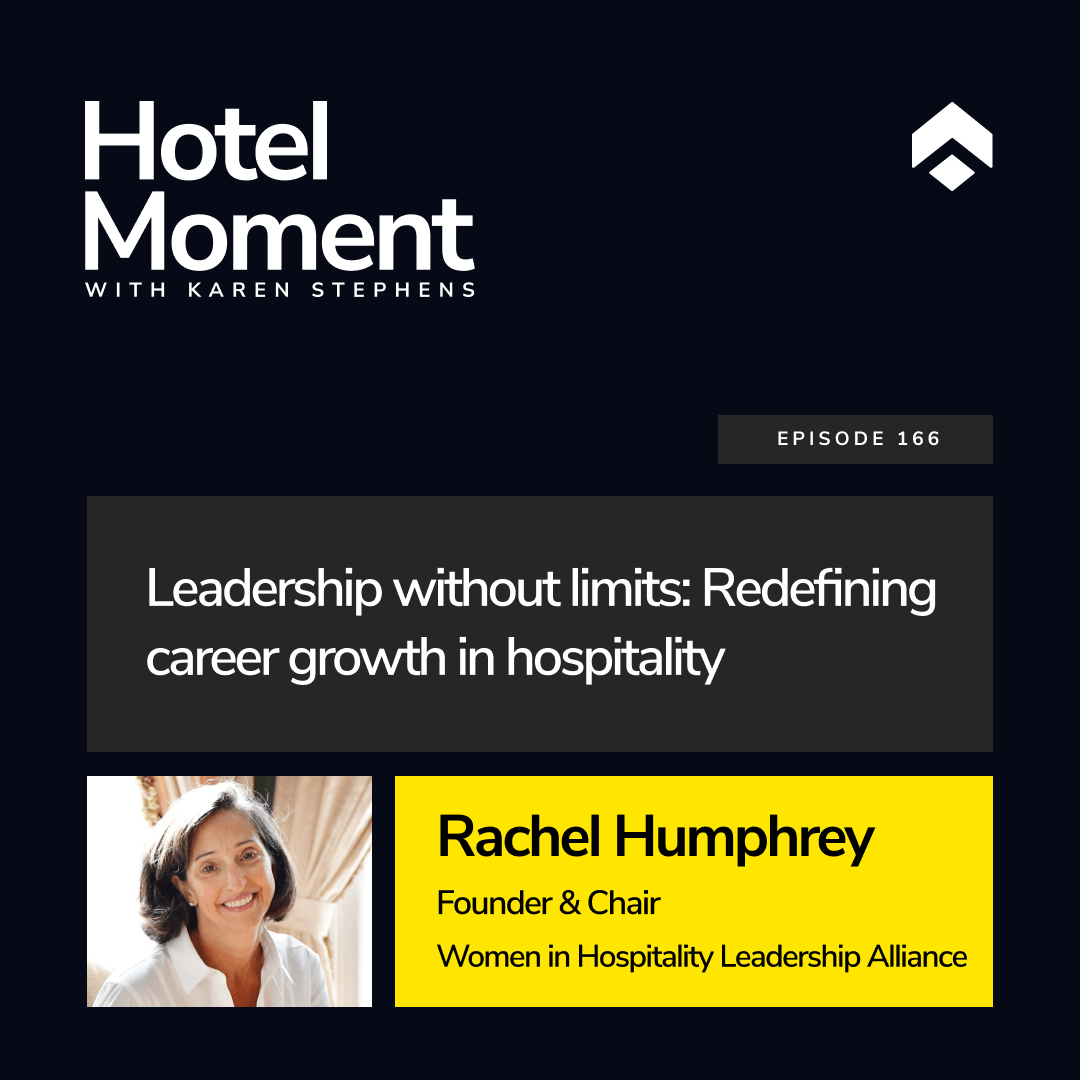
Episode 166
Leadership without limits: Redefining career growth in hospitality
In this episode of Hotel Moment, Revinate CMO, Karen Stephens, sits down with Rachel Humphrey — Founder and Chair of the Women in Hospitality Leadership Alliance, co-founder of the award-winning Personal Stories podcast, and former executive leader at AAHOA — to explore what leadership really looks like in hospitality today.
From trial lawyer to COO, interim CEO, and EVP, Rachel’s journey shows that success in hospitality isn’t linear, but intentional. She shares how fear, curiosity, and imposter syndrome became unexpected accelerators, and why the diversity of professional backgrounds across the industry is one of hospitality’s greatest strengths. Rachell will challenge you to rethink talent development, broaden access to leadership journeys, and recognize that today’s industry leaders come from many different paths.
Tune in to hear why non-linear careers are becoming the norm in hospitality, and how transferable skills can unlock leadership opportunities.
Media
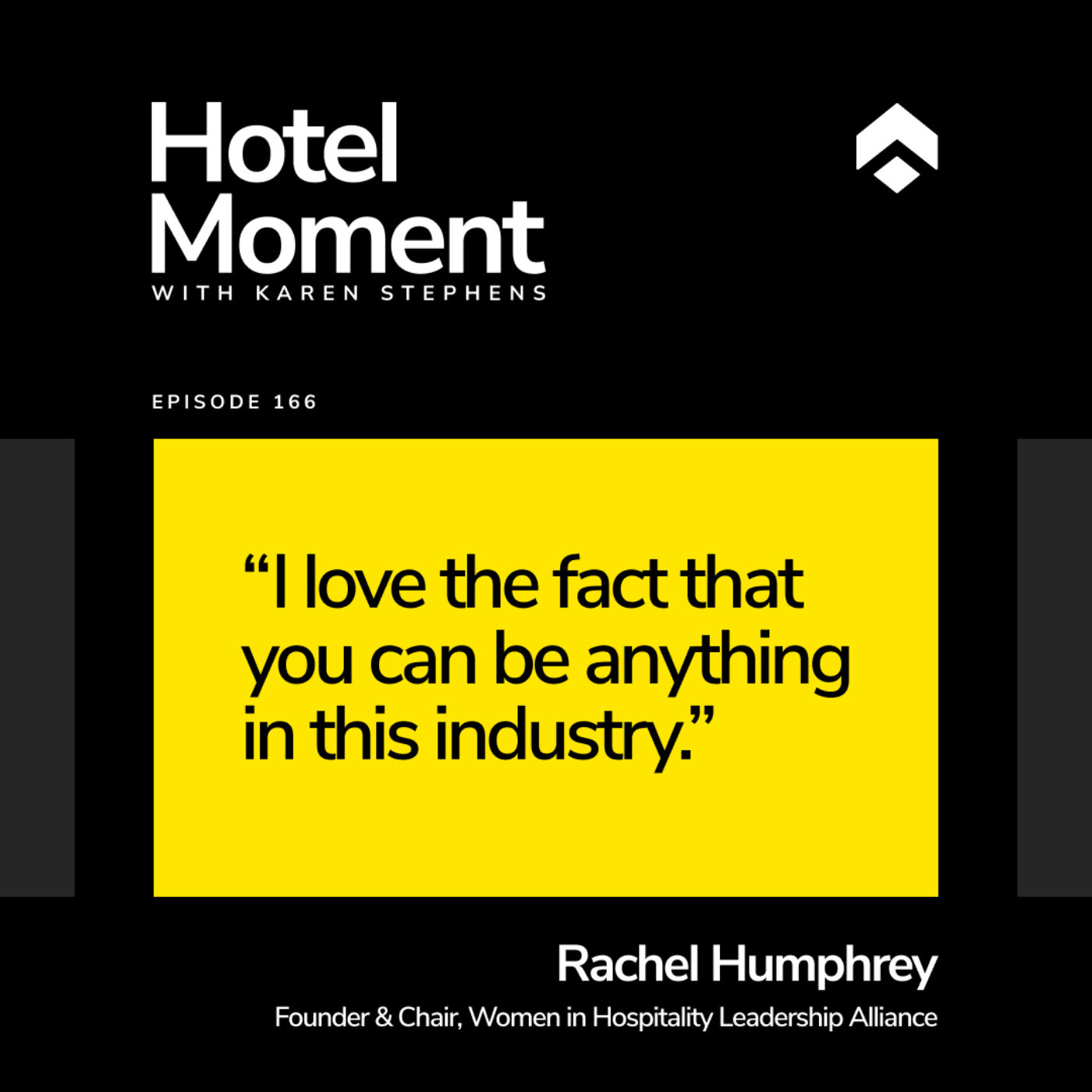
Hospitality’s endless career opportunities
What hospitality needs to accelerate growth
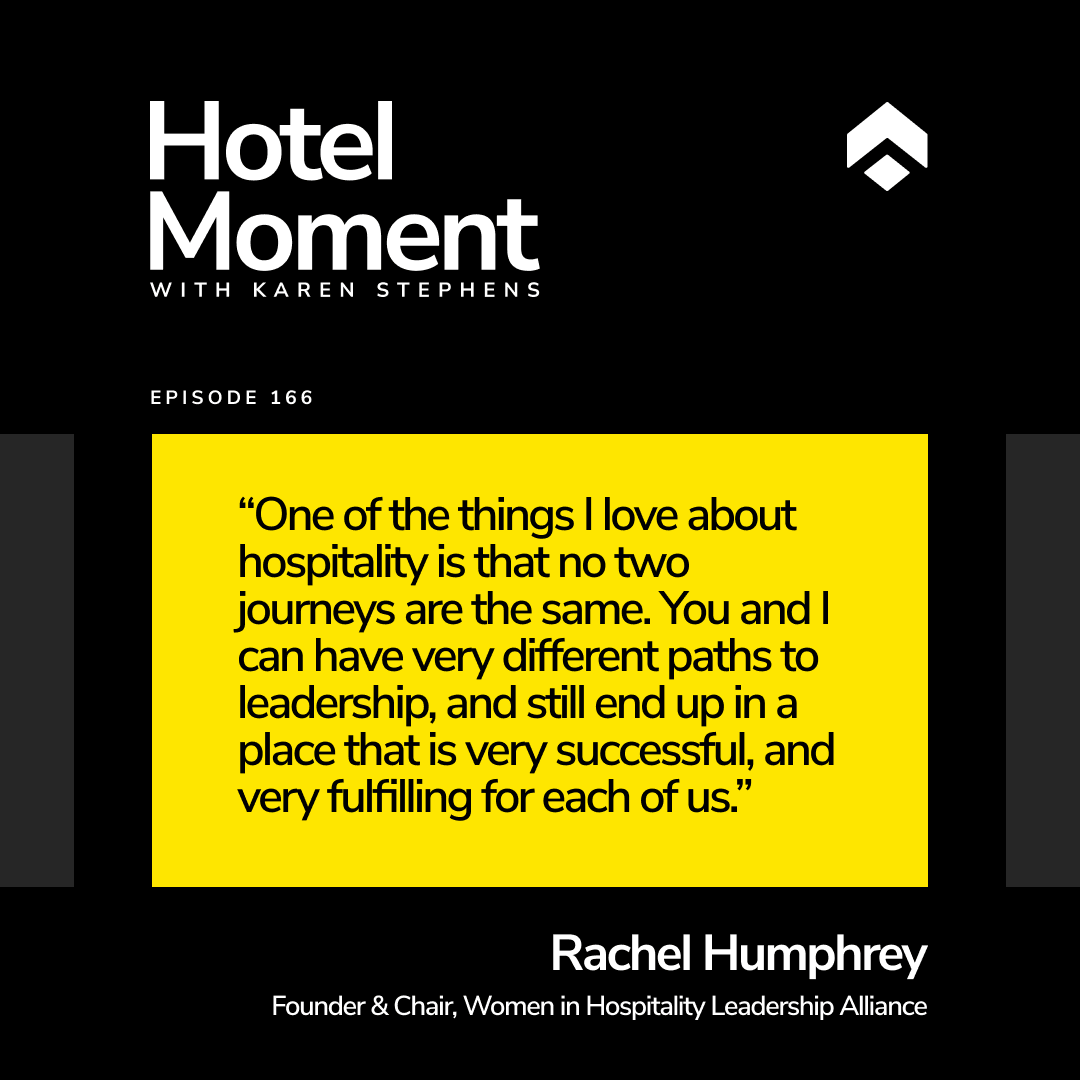
Finding your fulfillment in hospitality
Why technology is more important now than ever
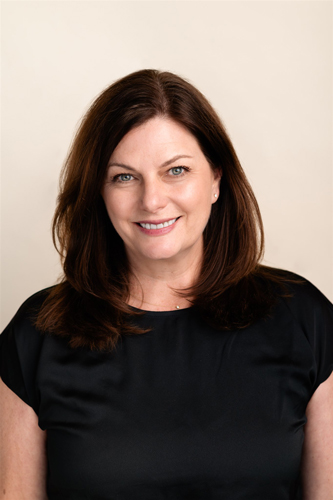
Meet your host
Karen Stephens
As Chief Marketing Officer at Revinate, Karen is focused on driving long-term growth by building Revinate’s brand equity, product marketing, and customer acquisition strategies. Her deep connections with hospitality industry leaders play a key role in crafting strategic partnerships. Karen has more than 25 years of expertise in global hospitality technology and online distribution — including managing global accounts in travel and hospitality organizations such as Travelocity and lastminute.com
As the host of The Hotel Moment podcast, she interviews top players in the hospitality industry. Karen has been with Revinate for over 11 years, leading our global GTM teams. Her most recent transition was from Chief Revenue Officer, where she led the team in their highest booking quarter to date in Q4 2023.
Watch the video
Transcript
[00:00:00] Rachel Humphrey: One of the things I love about hospitality, as you mentioned, is that no two journeys are the same. You and I can have very different paths to leadership and still end up in a place that is very successful and very fulfilling for each of us.
[00:00:19] Intro: Welcome to the Hotel Moment Podcast, presented by Revinate, the podcast where we discuss how hotel technology shapes every moment of the hotelier’s experience. Tune in for our guest episodes where we explore the cutting-edge technology transforming the hospitality industry and hear from experts and visionaries shaping the future of guest experiences. Alongside our conversations with guests, we have episodes for you, hosted by Revinate’s Brenna Turpin, on resources available to you all. These resource-packed episodes have granular advice on overcoming industry and operational challenges so you can emerge as a hotel superhero. Whether you’re a hotelier or a tech enthusiast, you’re in the right place. Let’s dive in and discover how we can elevate hospitality together.
[00:00:19] Karen Stephens: Hello and welcome to the Hotel Moment Podcast. I’m your host, Karen Stephens, the Chief Marketing Officer of Revinate. And today we’re excited to welcome Rachel Humphrey, a connector, storyteller, and leading advocate for women in hospitality leadership. Rachel is the founder and chair of the Women in Hospitality Leadership Alliance and co-founder and host of Personal Stories, a hospitality podcast, where she spotlights the real human journeys behind hospitality leadership. With a unique path that took her from a legal career to serving as COO, interim CEO, and EVP at AAHOA, Rachel is deeply focused on building community, opening doors, and creating meaningful access for women across the industry. She’ll also be moderating our Women in Leadership panel at NAVIGATE this year. NAVIGATE is happening in Phoenix, Arizona on April 14th through the 16th at the Wigwam, which is a truly stunning property. So head on over to Revinate.com/NAVIGATE to get your tickets, and we’ll put the link in the show notes. But today, Rachel is here to share why personal stories, mentorship, and representation matter now more than ever. Welcome to the podcast, Rachel. It’s a real pleasure to have you here.
[00:02:12] Rachel Humphrey: Thanks, Karen. Thank you for inviting me. I appreciate it. And I am looking forward to talking a little bit today.
[00:02:17] Karen Stephens: You know, I am ready to jump into this discussion. So as I mentioned in the introduction, you’ve really had a varied career and I’d love to really talk about the striking contrast in your journey. You started out kind of in a legal profession. So from suits and legal briefs to hotel lobbies and podcast microphones, tell me a little bit about how you got from there to here and what is it about hospitality that drew you in?
[00:02:41] Rachel Humphrey: Yeah, you know, you hear this story all the time that it may not have been a very intentional route for me. I had been a trial lawyer for a little bit over 20 years. I was having a lot of burnout. I wasn’t loving the practice areas that I was in. Our firm had to pivot in a lot of ways. I had a family at that point that I had not had when I started off in my legal career. And I had had a very niche practice in one aspect of it, which had been franchise law, which was mostly representing hotel owners that I had loved. And after about twenty years I had never looked for a job, with a job. I think I was one of the only people I knew at the time. And I knew that that didn’t really suit my personality. And so I did the terrifying move of just going in one day and resigning. I spoke to my family and I walked away from a practice that I had been at a long time doing exactly what I knew how to do. And I started just exploring. I started talking to a lot of lawyers, “Tell me what you do. Tell me what you do day in and day out. How did you get there? What do you like about it?” I had a real interest in nonprofit work, but most law firms might do some nonprofit work, but the nonprofits themselves don’t have general counsels or legal departments because they just don’t have the funding except for some of the bigger ones. And I happened to be talking to someone one day and she said, I don’t know if you know this, but I am a former trial attorney and she was in executive leadership at a trade association and I didn’t know that and she started talking about transferable skills and all of the ways that lawyers make great association executives. I’d never heard the term association executive before, but I started looking around and I saw that AAHOA, which is the largest hotel owners association in the country, was looking for someone with a specialty in franchise work. They weren’t looking for a lawyer. And I reached out and I said, I have a lot of knowledge on franchising, a lot of it in the hotel space. And to their credit, they created an incredible opportunity for me. And so I actually at the time thought that I was leaving the legal profession. I ended up leading a lot of AAHOA’s legal work as well, but taking on an executive role at AAHOA where I spent a little bit over seven years on their leadership team there. And that’s what really got me into this aspect of hospitality. I got to be at a lot of the conferences, work on partnerships and collaboration with people in very different fields. You know, in the legal field you’re talking to a brand legal department, or maybe a real estate transaction, something like that. But on the AAHOA side, there was advocating at the federal and state level. There was working with supplier partners. There was working with brands, going to the conferences, meeting with management companies, all these aspects of the industry I really didn’t know anything about and was really an incredible opportunity. I absolutely loved it. And then you mentioned the podcasting now. In 2021, I had the incredible privilege to retire, which I never thought I would do. My family never thought I would do. But I knew that I wanted to do something to stay connected in the industry. And so David Kong, who at the time was the longest running CEO of a global brand, Best Western, was also retiring. And he had this really beautiful idea to share the very personal journeys of our industry’s leaders, not talking trends or data or things that are important in the industry, but really talking about the people behind the people. And asked me to join him and it’s been incredible. Lan Elliott, Dorothy Dowling have also joined that podcast. And then I founded the Women in Hospitality Leadership Alliance out of an opportunity to bring together organizations doing incredible work to elevate women in the industry. We don’t take on initiatives of our own, but we bring together these thirty-three organizations to collaborate and amplify one another with a goal of moving the needle a little bit farther and a little bit faster. So pivoting a whole bunch of times along the way, it’s my 32nd year since I graduated from law school and I view it as three very different chapters of a career.
[00:06:53] Karen Stephens: Yeah, that’s great. And I want to dig into each of those a little more separately because I do have questions around each of those features. But I want to start, I want to go back to when you made that first leap. So you mentioned you’d quit your job without another job. I did it. So that right there is really a symbol of bravery. I think a lot of us out there think about I don’t know if this is the right fit for me. This doesn’t really align with who I am. And you’ve spoken candidly about fear and how that can really prevent people from maybe realizing what they could really do. So can you talk a little bit about fear of failure and how being a motivator, that can be a motivator for someone rather than a deterrent to help you take that step, or I guess the way to say it is sometimes I feel like that anxiety is what propels you to make a move and they could be very rewarding. So love to hear your thoughts on that.
[00:07:43] Rachel Humphrey: Yeah, I mean I had a tremendous amount of fear in walking away. You know, my husband and I have a family. We have financial obligations. I did not plan for it. I literally, on a Friday evening had a change in my childcare starting Monday and I panicked because like many working parents, you know, I didn’t have a backup plan there and I started thinking I have wanted to make a move for a long time, but I’m never going to. I’m not gonna look for a job with a job. I don’t know what else I would wanna do. And I don’t want to say that I felt stuck, but I really didn’t see a different path forward for myself. And so that fear was not motivating. That fear was legitimate. Oh my gosh, Monday if I go in and resign, I will not have a paycheck. I’ll be somebody in my hiring. I’ve always looked for people who don’t have jobs with a question mark. Like why would I hire someone who doesn’t have a job? To me that’s a little bit suspicious. But now I was gonna put myself into that same universe. But I knew that nothing was going to change if I didn’t take it. I didn’t see it as brave Karen, I will tell you, or courageous. I do looking back on it I think it was an incredible risk. But I also knew that the life that I was living at that time was not sustainable for me. And some of it was traffic. I’ve talked about this a lot. I didn’t move houses, but over the 20 years at this firm, my commute had changed from 40 minutes to an hour and forty minutes in one direction with Atlanta traffic. It was one thing to not be home for dinner because I was in court. It was another because I was sitting on the highway. I was missing a lot of things for the girls that I knew my time with them at home was limited and didn’t want to miss anymore. So there were a lot of factors at play, but I didn’t see another way to make that change. I think what was terrifying for me is despite what people think about me I am not extroverted. I do not like to reach out to people I don’t know. I don’t like to go to small networking events to meet people. And so how do you network for a new role when the last thing you want to do is call up a stranger and ask them to have coffee with you. But I also knew that type of fear, there was no other way around it. If I wanted to look for a new opportunity, I was going to have to put myself out there. The fear thing though, I think has on the other side had a huge impact on how things played out for me. When I started at AAHOA, like I mentioned, they had created this incredible leadership opportunity for me. But I have never worked in a company before. I had only been at law firms, which are our own animal. They function very differently. I had never been in a non-legal role, you know, since before I left for college for the most part. And I was terrified of not being successful in this new role. It was so scary to take on something new. And when I become afraid, I lean into superpowers. And one of them I know is that I work really hard. I’m really curious. And I have an ability to learn whatever I thought I needed to learn to be successful. And so I started asking everybody, “What do you do in your department? How does it interact with my department? What is your background that led you to this thing that you’re doing? Tell me about everybody else on your team.” And suddenly, out of a fear of failing, quite frankly, because I wanted to make sure that I was going to be successful, at some point I became the person at AAHOA who knew more about all of the other departments, all of the other people on our team, all of the different functions that we had, plus what I brought to the table on the franchising side, on the owner side, on the legal side. And that is when an opportunity was presented to me to consider our newly opened role of Chief Operating Officer, which I didn’t know what those words meant. I thought operations was more logistics of like trains getting from one station to another. But really that happened not because I set out to say, “Oh, I’m gonna learn everything because I want to climb through the ranks,” but I want to learn everything because I don’t want to let anybody down. I don’t want the people who took this chance on me to be disappointed. I don’t want to present myself to an industry unsuccessfully. And so that fear became the motivator for me to really lean into this new role and try to be the best at the time. It was Vice President for franchise relations that I could be. That then led to the chief operating officer and then the interim CEO role. So I definitely view in hindsight that as a product of the fear that I stepped foot in the door there that first day.
[00:12:18] Karen Stephens: Yeah, that’s wonderful. I think a fear, another way to phrase it, I think that a lot of people encounter is imposter syndrome. You get promoted or moved into a role and then you’re like, oh my gosh, do I really deserve to be here? And I love the idea of leaning into your superpowers. There is a reason why you are there. And if you double down on that you can grow and you do deserve to be there, which I think is so cool. For our listeners that are not familiar with AAHOA, can you just give us the two-second, it’s an organization, but what exactly is it?
[00:12:45] Rachel Humphrey: Yeah, AAHOA is a trade association which represents nearly twenty thousand members, people who are hotel owners in the United States. And for most trade associations, you are providing advocacy efforts, education, member benefits, conferences, but we are geared specifically toward hotel ownership.
[00:13:07] Karen Stephens: Okay, great. And I’m gonna throw a bone to my listeners out there who work for technology companies. So if you’re a vendor, it sounds like this is the kind of organization you really want to get close to. Is that a true statement or how can technology vendors work more closely with an organization like that? Because really it’s owners that hold the purse strings ultimately for a lot of those decisions.
[00:13:27] Rachel Humphrey: Well, I mean that’s exactly it. If you’re looking for the decision makers, you’re looking for the people who are owning and operating the hotels. AAHOA has the largest hotel owner trade show in the world each year. There are events throughout the country, especially as suppliers also the ability to get involved in advocacy efforts at the state and local level, the federal level really protecting the interests of hotel ownership and the hospitality industry at the legislative side. If you have a subject matter expertise on technology or something, the ability to get involved with education, whether it be webinars or in person events or workshops to really educate owners and their teams about different opportunities. I mean in this day and age, especially Karen, as margins are shrinking and the ability to have efficiencies with technology, technology is so interesting because it changes so quickly. And everybody knows hospitality is slow to innovate. Part of that is because there are lots of different brands with different technology needs and models, lots of different hotels with different needs and models. And so for technology especially, there’s a great opportunity to get in front of 20,000 hotel owners to really share ways that owners can improve operations, ownership, whatever aspect of the industry that technology touches.
[00:14:46] Karen Stephens: I love that. So it’s a great organization and what a journey there. I mean amazing. So I would love to pivot now. Let’s talk about the podcast. So it is an award-winning podcast, award after award, rated number one in a lot of cases. So it’s called Personal Stories. And as you mentioned, this is really an area, it’s a bit of a fireside chat where you’ve got hospitality leaders that talk about their journey, which I absolutely love. I think when we started this conversation, you know, and I asked you about how you got into hospitality, your comment was well, it wasn’t exactly a straight line, right? So tell me a little bit about this podcast and why do these personal stories, you know, why do they create connection and momentum within the community to help kind of people coming up see what their trajectory could be?
[00:15:33] Rachel Humphrey: Well, I think there’s a couple things. You know, the format of the podcast, we have four interview hosts, as I mentioned, David Kong, Dorothy Dowling, Lan Elliott, and myself, and we do all our own sourcing and recording and whatnot. So I reach out to people in the industry that I have either known for a long time or who I’ve just met who have a really incredible story to share. And in some ways, that is access. I am very fortunate. I have the ability to go to a conference, to pick up a phone and speak to someone, but not everybody has that access. So we have this very free, no membership, no pay, anything else firewall, where you can just go and learn about these incredible leaders that are shaping the industry. And I think that that’s really important. One of the things I love about hospitality, as you mentioned, is that no two journeys are the same. You and I can have very different paths to leadership and still end up in a place that is very successful and very fulfilling for each of us. And I think that that’s a really special thing about this industry and something that’s really special to share. I also love the fact that you can be anything in the industry. I tell people this all the time. The hospitality industry in and of itself isn’t a career. It’s an industry. But if you want to be an accountant, if you want to be a social media marketer, if you want to be a lawyer, if you wanna be in sales, you can pick any career, literally just about in the world, and then decide that hospitality is the industry that you want to be in. And I think that that also is really special. But you mentioned imposter syndrome earlier. And I think one of the things I really love about the podcast is that when you are listening to guests talk, regardless of what level of their career they’re at, you’re gonna find something relatable. Somebody that says something about finding balance between their career and their personal life, something about taking risks, something about public speaking. I think that people are always surprised to hear about the imposter syndrome that I have or the fear of public speaking that I have because I do it a lot. I may present in a very confident way, but behind the scenes I have a lot of those things. And I think that when people hear stories that are relatable or they hear what Rachel says she’s nervous for public speaking. I told you I was nervous to talk to you today. But how do I overcome that? What are some of the strategies that I use? So you’re both finding people who are relatable, but you’re getting very hands-on practical advice of how those leaders have tackled those different things. And the topics we cover change every time based on who we’re speaking with. You know, we cover people from all segments of the industry, which is also very relatable. We cover globally. And so I think that this community that you’re talking about, feeling connection, it isn’t just for rising leaders. We hear a lot of other C-suite leaders hearing their stories or the personal stories of other C-suite leaders that maybe they’ve seen at conferences, but they don’t know, or from a business development standpoint, I hear all the time, “Oh, I was about to have a meeting with Karen and I listened to your podcast to get to know her a little bit better.” But I think this idea of building community, we’re an industry of people. And so getting to really see the human side of those people is one way that we can build community and one way that we can also watch as people empower themselves for leadership to really hear. Not everybody has it together every second of every day. Not everybody had that path. I was actually yesterday at a college event and one of the people who’s in operations at a global brand in the C suite, he said he was a philosophy major and the entire room, and there must have been four hundred people in the room, laughed. Because nobody thinks a philosophy major is going on to be in operations at a global hotel brand. But that’s the exact type of personal story that I think then people are like, “Wait. I could do that too then. There’s no limitations for me.” And I think anytime we get to hear something that reminds us that we are not limited or that we don’t have only a few options to pick from can be really empowering to figure out what we want next.
[00:19:46] Karen Stephens: Yeah, I love that. They expand. They expand your own realm of possibilities. I think it’s great. You’re talking about collaboration and community. And the other thing I really love about hospitality is how many women that we have in hospitality that are real powerhouses. And I’ll just tell everybody Rachel is going to be joining us at NAVIGATE in Phoenix in April, and she is hosting a roundtable for us at the very end, a panel, Women in Leadership. And the reason we chose Rachel for that is because she has the Women in Hospitality Leadership Alliance. So can you tell us a little bit about that organization and what it serves to do?
[00:20:21] Rachel Humphrey: Yeah, the Women in Hospitality Leadership Alliance is a consortium of 33 organizations that are doing incredible work in hospitality to elevate women into more leadership opportunities, whether that is on the ownership side, whether it is on the corporate business side. And the idea there really to me came coming out of COVID. We kept hearing “Stronger together, stronger together”. And as I started talking to some organizations shortly after I retired to see if there was any way that my voice, my relationships, my influence could be helpful, I started realizing that there was an opportunity for these organizations to be collaborating with each other, that we are never going to be on opposite sides of anything, that we don’t need to duplicate efforts, that there are probably open lanes that would be great for someone to tackle or an organization to tackle. So the Alliance really was born out of the idea of how do we support each other as organizations. So if you’ve got organizations that can collaborate on conferences, on educational opportunities, sharing newsletters, amplifying LinkedIn messaging, whatever it is, then that would make each of those organizations stronger in a non-competitive way. Along the way, I mentioned us not having our own initiatives, it became evident that we were hearing over and over the frustration about the lower numbers of women taking the stage at industry conferences as podcast guests being quoted in trade publications. And so an opportunity came out for us to create the first ever Women in Hospitality speaker directory, which launched only a little over a year ago, and we now have almost 2,000 women globally in it. So we can no longer accept hearing people say that there are no women in those roles because as you know, Karen, women have subject matter expertise really across every facet of this industry. And it was really just providing exposure. You know, representation and visibility matter a lot in career trajectories. Public speaking is one way that women will get more visibility. More women on stages leads more women to think that those opportunities not only to speak, but those titles are available to them on the path that they are following. And so our goal is to work with conference organizers, podcast hosts, the trade press, people sourcing for advisory boards, things like that to help provide more names and more opportunities. And then we work with them also on their conferences as they’re sourcing particular panels or particular speakers to really help identify an entirely new group of potential speakers for those topics.
[00:23:06] Karen Stephens: I absolutely love it. It really is like the who’s who. I mean it’s so fun to go in and just see some of, you know I’ve also been in hospitality for a long time to see some of my former bosses, colleagues, mentors. I mean, it’s fantastic. So if somebody wants to be a part of the directory or how do they apply or get access or what’s the method there?
[00:23:24] Rachel Humphrey: Yeah, the directory is intended to be inclusive. So as long as you are female with a functional role in hospitality, and that can be anything. I say that because if you’re a professional keynote talking about something, but it isn’t maybe specific to hospitality, our goal is to really be showcasing the great voices within the industry. But you go to our website, which is WHLAlliance.org, there’s a contact us button in there. You contact me, you let me know that you are interested in being added. It works through LinkedIn, so I encourage everyone to make sure their LinkedIn is fully updated, both in terms of current roles as far as interest in speaking goes, that type of thing. So when conference organizers or others go to your LinkedIn, they can see a lot about you. And that’s all you have to do. I’ll send you an email letting you know I got your email that you’re in the directory. You’ll get a link to go in and edit it in any way, and then once a year we send it out to all of the people who are in it to ask them just to update any information that might be due. We don’t do any marketing. We don’t share email addresses with organizers. But really it’s intended to be an incredible resource to strengthen the industry. So anyone who’s interested, and sometimes I get emails from people saying I’d like to be in it, and great news, they already are. So it is a great reminder for people as well to check in. But it couldn’t be any easier to be in it.
[00:24:46] Karen Stephens: Oh, I love that. And I have one closing question for you. You mentioned the Alliance has been together just over a year, is that right?
[00:24:55] Rachel Humphrey: The alliance started in 2021. The directory is a little bit over a year.
[00:24:57] Karen Stephens: Great. So when you look five years ahead, so you’ve had about five years in. When you look five years ahead, what would meaningful success for the Alliance be for you as it evolves?
[00:25:07] Rachel Humphrey: I hate giving this answer, but it’s the true one. It would be that none of those organizations had to exist anymore because there would just be such great parity and equality at the leadership level. But really I think from an Alliance standpoint, it is that each of those organizations is given the best opportunity to be successful in its strategic initiatives and what its mission is. As I mentioned, each one has a very different focus in the industry. But as I look five years down the road, you know, I continue to hope for maybe a little bit more rapid improvement than we’re seeing today. Unfortunately, I think in the last year, we may have seen some steps in the wrong direction. I would like to see those corrected and then maybe accelerate faster than we have seen in the past. I think it’s important there’s a couple narratives that I would also like to see us dismiss. One is that the advancement of some means the demotion of others. That is not the case in any way. I don’t think that you have to be looking at the advancement of women as anyone who is unqualified. We are not talking about hiring or promoting people that aren’t qualified for the roles, but rather being open to strengthening leadership teams, advancing women. I think, you know, one of the things we see is that those in charge of hiring decisions now, whether they be boards, C suites, other things tend to hire people they know. This industry, as you know, is very small in some ways, big in others, but small in some ways. So really being more open-minded and creative in hiring processes, but it doesn’t mean that we’re looking to place unqualified people in those roles. And so really dismissing some of the narratives that keep that progress from happening. As far as conference organizers go, we would love to see 50% underrepresented women, whether it be women or race, nationality, whatever it is, on conference stages. There’s certainly plenty of incredible subject matter experts out there that that number should not be a challenge for anybody to achieve really in any category of subject matter expertise. So I have a lot of goals in five years. I don’t know if that’s more than can be done, but that’s what I would love to see for sure.
[00:27:18] Karen Stephens: That’s so great. You know, you started out saying that you’re in retirement. It doesn’t sound like retirement to me. It sounds like you’re living your best professional life now that you’re kind of doing your own show and you have all of these different organizations and initiatives that you’re doing. So it’s really been fun to talk to you today, Rachel.
[00:27:34] Rachel Humphrey: Well, I appreciate that. As I will tell everybody, retirement by definition may only mean not getting a paycheck or having any income. I’m not sure what it means. But it is an incredibly fulfilling way to spend time with people that I love in an industry that I love doing things that feel really good for me that I hope will make an impact on the industry and on one person. You know, if I hear one person tell me a great story after listening to the podcast, that feels great. So from a personal fulfillment standpoint, it doesn’t feel like work and it certainly doesn’t preclude me from doing all the other things I’ve been loving doing in retirement. And it’s fun. I get to come to your conference in a couple of months. I’ll meet a whole group of new people. I’ll get to share some great voices from the stage there. So all good. Nothing taking away from retirement for sure.
[00:28:23] Karen Stephens: That’s right. Well we look forward to continuing the conversation. Rachel will be moderating our Women in Leadership panel on the closing day of NAVIGATE in Phoenix. So we will see you in April. Thank you, Rachel.
[00:28:33] Rachel Humphrey: Thanks, Karen, for having me. I appreciate it.
[00:28:40] Outro: Thank you for joining us on this episode of Hotel Moment by Revinate. Our community of hoteliers is growing every week and each guest we speak to is tackling industry challenges with the innovation and flexibility that our industry demands. If you enjoyed today’s episode, don’t forget to subscribe, rate, and leave a review. And if you’re listening on YouTube, please like the video and subscribe for more content. For more information, head to revinate.com/hotelmomentpodcast. Until next time, keep innovating.
Episodes
Hotel Moment
WITH KAREN STEPHENS
Subscribe for updates on your favorite platform