Hotel Moment
WITH KAREN STEPHENS


Episode 161
Recast: The latest hospitality trends for 2026: Five themes reshaping the guest experience
As the industry enters 2026, the conversation is shifting from insight to action. This week on Hotel Moment, we’re re-running our episode with Revinate CMO Karen Stephens and Marketing Coordinator, Brenna Turpin, to revisit the five forces poised to define the next phase of hospitality, and why this year is the inflection point hoteliers can’t afford to miss.
The takeaway is unmistakable: Collecting data is no longer a competitive advantage. The hotels that will lead in 2026 are those activating their data in real time — turning intelligence into decisive action across marketing, operations, and the guest journey.
This moment represents more than incremental change and a reset in how hotels engage guests, orchestrate technology, and deliver measurable value. After years of gathering insights, the industry is moving into an era of true execution: anticipatory service, personalized engagement at scale, faster decision-making, and a single, connected view of the guest.
Tune in to explore the trends that will separate leaders from laggards in the year ahead. For hotel executives planning how to win in 2026, this conversation sets the agenda.
Media
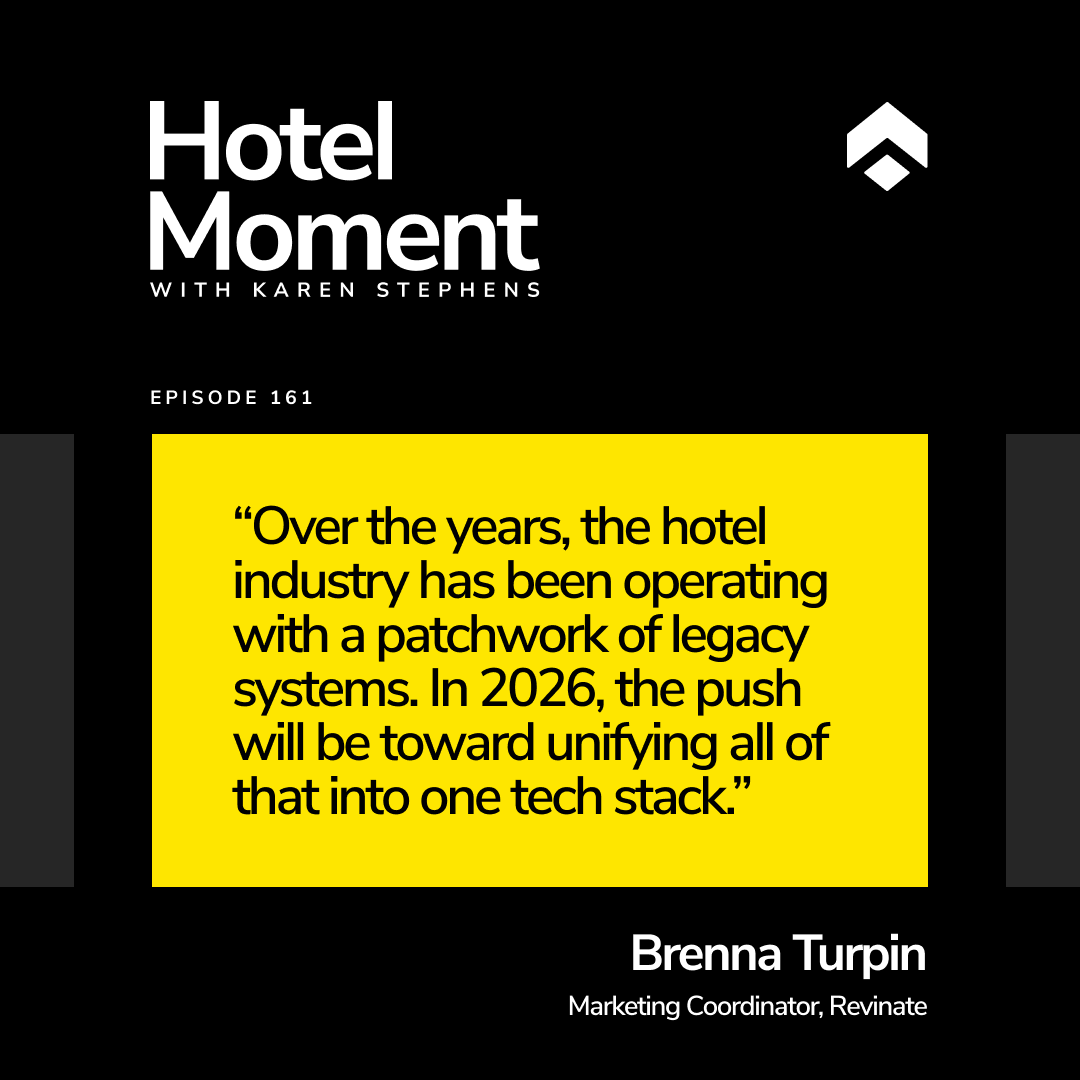
Legacy systems are out, unified tech stacks are in
The data activation gap and how to close it
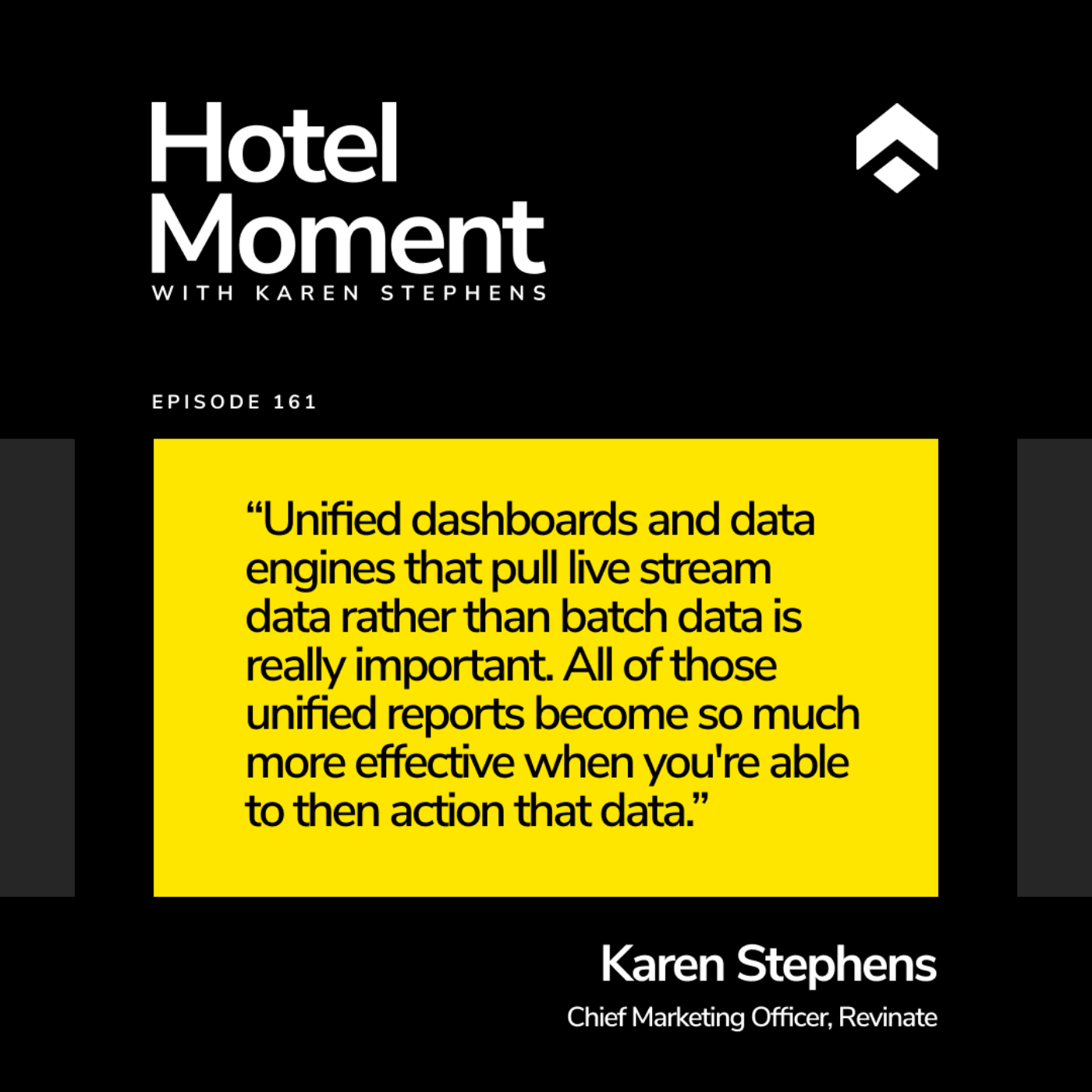
Jumpstart and streamline operations with real-time dashboards
Guest expect more personalization that ever before

Meet your host
Karen Stephens
As Chief Marketing Officer at Revinate, Karen is focused on driving long-term growth by building Revinate’s brand equity, product marketing, and customer acquisition strategies. Her deep connections with hospitality industry leaders play a key role in crafting strategic partnerships. Karen has more than 25 years of expertise in global hospitality technology and online distribution — including managing global accounts in travel and hospitality organizations such as Travelocity and lastminute.com
As the host of The Hotel Moment podcast, she interviews top players in the hospitality industry. Karen has been with Revinate for over 11 years, leading our global GTM teams. Her most recent transition was from Chief Revenue Officer, where she led the team in their highest booking quarter to date in Q4 2023.
Watch the video
Transcript
[00:00:04] Intro: Welcome to the Hotel Moment Podcast, presented by Revinate, the podcast where we discuss how hotel technology shapes every moment of the hotel guest’s experience. Tune in for our guest episodes, where we explore the cutting-edge technology transforming the hospitality industry and hear from experts and visionaries shaping the future of guest experiences. Alongside our conversations with guests, we have episodes for you hosted by Revinate’s Brenna Turpin on resources available to you all. These resource-packed episodes have granular advice on overcoming industry and operational challenges so you can emerge as a hotel superhero. Whether you’re a hotelier or a tech enthusiast, you’re in the right place. Let’s dive in and discover how we can elevate hospitality together.
[00:00:04] Karen Stephens: Hello and welcome to the Hotel Moment Podcast. I am your host, Karen Stephens, the Chief Marketing Officer of Revinate. And today we have a special treat for you. I’m joined by Brenna Turpin, who’s on our marketing team and also does the Hotel Moment podcast. Welcome, Brenna.
[00:00:04] Brenna Turpin: Hey Karen, nice to have both of us.
[00:00:04] Karen Stephens: I know, right? We’re excited because together we’re like, hey, we’re wrapping up the year and we really want to hit on what are the hospitality trends that are coming for 2026. So are you excited, Brenna, to jump into this?
[00:00:04] Brenna Turpin: I am. There’s a lot going on.
[00:00:04] Karen Stephens: So much going on. So as we come into the new year, hoteliers are really navigating a complex interplay of guest expectations, operational pressures, and an evolving technology. So we’ve had a watershed year for digital transformation, and the next frontier is not just about adoption, but it’s about action. So we’ve got to weave together guest experience, operational agility, and data driven decision making.
[00:01:43] Brenna Turpin: Yeah, and that’s why we’re here. We want to spotlight the key trends, what’s holding hoteliers back and what’s driving them forward and how they can leverage the trends to their advantage.
[00:01:52] Karen Stephens: Great. So let’s jump right in. Let’s start with hyper-personalization. So hyper-personalization was definitely a theme last year. But now it’s really taking center stage.
[00:02:02] Brenna Turpin: Yeah, and I think it was Carlo Del Mistro from Ennismore who predicted last year that hyper personalization this year would be really, really big. So Carlo goes—
[00:02:12] Carlo Del Mistro: Hyper-personalization. 2023 AI exploded, but nobody was really using it. 2024, lots of companies started playing around with AI, but I think 2025 we have a number of different pilots to actually really using AI, big data, not only to look at historic data on our guests or our visitors, but also having contextual and real-time information. So we can customize promotions, offers, pricing based on what the user is doing in that moment on our site.
[00:02:46] Karen Stephens: Brenna, I just love Ennismore’s loyalty to the program, and I think Carlo really hits it on the head with what guests are truly looking for.
[00:02:53] Brenna Turpin: Yeah. So what do you think is gonna make hyper-personalization mainstream this year?
[00:02:57] Karen Stephens: Well, you know, I think the bottom line is guests expect more than a name and greeting, you know. Hello, Brenna, here’s your offer. They really expect tailored stays, meaningful upsells, and experiences that anticipate their needs. So it’s really about show me that you know me and market to me as if you know what I’m gonna want pre, post, and during stay. And in 2025, many hotels laid the groundwork for personalization, collecting those preferences and stay histories, piloting targeted campaigns and running analytics. But the full orchestration across the guest journey didn’t yet become mainstream. So Brenna, you spend a lot of time talking to all of our podcast guests. So fun fact, Brenna is the one who does all of the interviews before I do the interviews. So she writes all of the scripts. So Brenna, what is your crystal ball? What do you think is gonna make hyper personalization even more mainstream as we come into the new year?
[00:03:48] Brenna Turpin: Sure. Well data collection is always an ongoing process for every hotelier, but I think it’s really going to shift from just purely collecting the data, just getting it from the guest and really translating it to actual personalization. So how can you get something from pre-arrival to post-stay to really connecting everything across the guest journey, that through line, and then creating your campaigns after that. So what are the real-time triggers that you can send pre-arrival to get the guests to respond and participate in that upsell? I think there’s gonna be a lot of use of generative AI to create some of that messaging, but I think the real piece to tie everything together is gonna be once you collect that data, where are you storing it? How are you gonna spread that out, a unified platform? And lastly, I think there’s going to be a shift from one size fits some to one size fits one. So again, really making it tailored to each guest. So kind of comes down to when you create your segments, really narrowing down instead of creating broad segments, really tailoring your offers and experiences to each guest. And in 2025 this year has been about guest data accumulation. 2026, I think, will be the year of guest data activation.
[00:04:56] Karen Stephens: And I think that that’s so exciting, Brenna. So we’ve talked a long time about how it’s so important, so critical that you get all of your siloed data into one place. And then when you think about the speed at which AI has taken kind of front and center across all industries in 2025, but I think you’re exactly right. As we go into 2026, the one size fits one is actually going to be possible. And it’s something, you know, we whiteboarded out at Revinate five, six years ago, thinking about how do you really hyper-personalize. And I remember at the time thinking, well, that sounds like a pipe dream. I mean, how complicated is that, right? But with AI, all of that is really becoming possible. If you have your data in a central location.
[00:04:56] Brenna Turpin: Right. That’s the key there.
[00:04:56] Karen Stephens: Exactly. And that really brings us to our next trend. So we just talked about it, the importance of putting all of your stuff in one place. So the next trend is unified tech stacks and microservices based platforms.
[00:05:49] Brenna Turpin: We know that over the years the hotel industry has been operating with a patchwork of systems, legacy systems, really. PMS over here, RMS over here, and a bunch of guest engagement tools. And it seems like in 2026 the push is gonna be unifying all of that into one tech stack and replacing the legacy systems that are really no longer serving you or helping with that unified data collection. So what do you think that’s going to look like in practice, Karen?
[00:06:16] Karen Stephens: Well, you know, actually our friends over at Intelity, they just put out a report called Future Forecast: Hospitality Tech Predictions for 2026, which we will link in the show notes. And they did a really good job of explaining what that is going to look like. So fun fact, only about half of hoteliers are using mostly integrated tools. That means cloud APIs and microservices, microservice architectures, that’s a big technical word, are enabling more flexible tech deployment and faster innovation. So as we talked about, it’s really moving quickly, not only the tech platforms that can enable hoteliers, but also industry consolidations and partnerships are driving the move towards more end-to-end platforms. And I think about that a lot. We have a lot of partners and different technology companies in the ecosystem on this show. And we’ve said over and over again that everybody has to play well in the sandbox so that the end user, the hotelier, has a truly rounded out tech stack.
[00:07:14] Brenna Turpin: Yeah. So what this kind of looks like visually is CDP is kind of gonna be the anchor. And then adding things that kind of come alongside that with your APIs and such.
[00:07:22] Karen Stephens: Yes, you hit it on the head. Using a CDP as your tech stack anchor is the best move. So before I go into why, I do want to explain what the difference is between a CRM and a CDP. So I think the main thing to keep in mind with a customer data platform, this is something that is really industry agnostic, right? So Revinate has a CDP that is bespoke for the hospitality industry. And what I mean by that is that we have all the connections. What a CDP does at its core, it brings in different data sources, consolidates all of that data into single guest profiles. So it synthesizes all of the data across those connections and says, okay, this is Brenna and she has stayed in your hotel, golfed on your golf course, gone to the spa. We know you love a spa, Brenna. And we put all of that onto a single profile. And then you’re able to activate that data across different channels. So the CRM, if you think about it, is really the activation layer, right? So a CRM allows you to understand how your guests are interacting with your emails, how they’re interacting with your phone calls. Are they clicking and booking? What is your open rate? All of that stuff happens within a CRM. So the way we like to think of it at Revinate is that we’ve got a CRM inside of a CDP. Because not only do we collect all of that siloed data into a single guest profile, but we also allow you to activate it in email and other channels. So that’s really the difference.
[00:08:50] Brenna Turpin: Bottom line is things to look for are a unified tech stack that breaks down the data silos, enables faster innovation, and reduces that vendor lock-in, helps everybody work well together with your partners and really allows hoteliers to adapt quickly to changing guest behaviors and just their business models and business goals in general. That seems like that’s gonna be the goal.
[00:08:50] Karen Stephens: That’s the goal.
[00:09:10] Karen Stephens: Okay, let’s talk about the third one. So data analytics and real time decisioning.
[00:09:15] Brenna Turpin: Yeah, I feel like all we say is data, data, data. But it has long been a hot topic in hospitality, but many hotels still use it retrospectively. So in 2026 the emphasis is really going to be on growing towards real-time operational decision making.
[00:09:31] Karen Stephens: Oh yeah. This is probably one of the most exciting trends, I think, for me, because as you said, we’re not just talking about what happened in the past. Because by the way, after COVID, everything got blown out the window. You used to be able to kind of predict what happened the year before, how that would stack up for occupancy, ADR, etc. And then with COVID, we just saw things go crazy. So now how do you forecast accurately, right? How do you look forward using all of the data and analytics you have? So occupancy forecasting, dynamic pricing, staffing optimization, guest behavior triggers, and event-based intervention. So what do you think about all that?
[00:10:09] Brenna Turpin: Well it’s getting kind of wild. Something really niche. I mean, some hoteliers are using real time data from local events, weather, foot traffic, and other travel data to adjust demand forecasts and revenue strategy, which speaking of weather, Karen, do you remember I think it was last year, Nick Kavanaugh, he was the founder and CEO of Sensible Weather.
[00:10:28] Karen Stephens: Yeah, you know what? He was on the podcast in 2024, but yeah, they have a really interesting platform. And what he talked about was an automated reimbursement for bad weather affecting travel plans and how they’re using that technology for weather prediction and customer reimbursement, which is, I mean, if you think about taking the holiday of your lifetime, but what if a storm moves in, what happens then? So it’s just a little extra protection. And the way that they do that was really exciting.
[00:10:54] Brenna Turpin: Yeah, he’s saving people a lot of money and he’s getting so much data out of that about when travelers are more likely to cancel and rebook and the rebooking is really gonna help hoteliers.
[00:11:04] Karen Stephens: Yeah. And again, we talked about earlier why unified dashboards and data engines that pull live stream data rather than batch data is really important. So if you think about Sensible Weather and their platform, they’re looking at all of the weather maps, channels, using historic information, predictive information, and all of those unified reports become so much more effective when you’re able to then action that data.
[00:11:28] Brenna Turpin: For sure. And you’re a foot in the door for more revenue too and delivering what your guests want and when they want it.
[00:11:34] Karen Stephens: Absolutely. And you know, Brenna, I am going to take a minute to do a little bit of a shameless plug here on Revinate CDP because we just upgraded all of our customers who are on our email marketing CRM platform to the CDP. So now they’re in a position to integrate all of those different data sources. And we’re really excited about it. They’ve talked about how blown away they are by how it ingests, cleans, and unifies and enriches fragmented data all in real time. So we’ve got a lot of actionable reports that are in there and the profiles, the identity resolution on those profiles is happening all the time. So when you think about all of that data that gets collected, to circle back again on the value of a CDP is that if you have a scalable platform, you don’t know what inputs are going to be important to you in the future. So we talked about Sensible Weather. Maybe you’re applying weather, maybe you’re applying something that the guests are doing on property. Every day there’s new technology innovations and new data sources and you need to be able to plug all of those into one system so that you can perform identity resolution, understand what the guests want, but also understand what’s happening within the ecosystem itself. So that’s what makes actionable insight so important and so critical.
[00:12:44] Brenna Turpin: Right. And you’re a foot in the door for more revenue too, delivering what guests want and when they want it.
[00:12:49] Karen Stephens: Absolutely. Okay. So Brenna, that brings us to our next prediction. What do you have to say about cybersecurity and privacy?
[00:12:57] Brenna Turpin: Well, Karen, it was a trend last year and it’s going to be a trend for 2026. Because bad actors are evolving. They’re getting smarter, and so are their attacks. It’s on everybody’s mind. It’s on every guest’s mind because it’s not just a trend for hospitality. This is a trend that extends across industries. And it’s also for individual importance. We’ve all had to become more privacy aware and privacy literate in our own lives, and hotels have had to step that up even more so.
[00:13:23] Karen Stephens: Right. And as guest data becomes richer, including behavioral, location data, et cetera, the risks and stakes at privacy, security, and compliance escalate. Meanwhile, regulatory frameworks such as GDPR in Europe, CCPA in California, and all the equivalents worldwide continue to evolve.
[00:13:41] Brenna Turpin: Okay, Karen, so with all that said, how are hoteliers gonna outsmart the bad guys?
[00:13:46] Karen Stephens: Well for starters, hotels are going to need to transparently explain how they use data for opt-in, opt-out controls within their secure infrastructure will gain loyalty. So you’ve got to make sure you’re using a platform that’s got best in class security embedded. And for hotels using Internet of Things and in-stay systems and connecting their rooms, they must treat each sensor, each device, and each integration point as a potential vulnerability. So that’s a lot. But unified data is going to have to be at the very top of hoteliers’ priority list because dirty fragmented data is an open door that welcomes cyber attacks. They also need to monitor their vendors. So all of that is to say when it comes to collecting more data, that requires justification, guest consent and clear use cases, not simply collecting it because you can. So don’t get overconfident because that’s where mistakes happen.
[00:14:38] Brenna Turpin: Right. And so Karen, if anything, this sounds like this is the year hoteliers will need to be more vigilant, viewing technology with added privacy and safety measures as a must-have instead of a nice to have. So to the hotelier just looking to adopt new tools in 2026, you know what to look for.
[00:14:56] Karen Stephens: That’s absolutely right. And I think we could just underscore that it’s not just one piece of it is making sure that you’re using secure technology platforms. And as I mentioned, you understand what your vendors are using and what their security apparatus looks like. But then you also need to train your frontline staff because that is normally where the vulnerabilities occur. And as you said, kind of at the top, the bad guys are getting more sophisticated. So if you don’t have a plan in place to train your frontline staff against how to spot those attacks and not fall for them, that’s something you’re really gonna need to put in place. So let’s talk about the fifth trend, which is all around guest communication and engagement platforms as they evolve into orchestration hubs. So what’s that all about?
[00:15:36] Brenna Turpin: Yeah, so Karen, before we get into this trend, I think we should talk about one word first. And that word is seamless. Guests want and have always wanted a seamless experience from booking to check-in to in-stay to check out to post-stay. And any disruption in any parts of that process is what hurts satisfaction.
[00:15:56] Karen Stephens: Right. So we said that this trend is all about guest communication and engagement platforms. And what we’re talking about is how these platforms are evolving to create a seamless guest experience because they’re really more like, here’s the big word, orchestration hubs. So they go beyond chatbots and mobile apps and instead orchestrate booking, pre-arrival, in-stay communications, upsell, feedback, and loyalty all within a seamless orchestration flow.
[00:16:22] Brenna Turpin: Right. Because previously engagement was siloed, separate email, separate marketing tools, separate messaging apps, and feedback systems. So now the shift is toward a connected guest journey platform.
[00:16:33] Karen Stephens: And how I think you’re going to see that manifested in 2026 and beyond is more hoteliers that are adopting AI chatbots and virtual concierge that do more than just sit on your website and interact with the guests. They can actually see the full guest history, current state context and can trigger offers and services that are again personalized, dare I say, hyper-personalized based on the data that they’re accessing. So for example, a mobile app guest portal that integrates real-time request handling, upsell offers, feedback capture, and tie into property systems. You could have guest engagement platforms that are not just reactive to guest requests, but proactive in suggesting services, detecting behaviors. And I think there’s also an opportunity for hotels to start adopting an API-first approach to make things on the operational side of the house seamless for you and your guests. Now, I want to say all of that AI is important, but we do want to stress that guest experience and true interaction with guests, we still believe as a company is human-led. So you need to have some things that are responded to by AI and access to the same data that your humans on property and in call centers would use to service that guest when they call in. So it’s got to be a coupling of those things, right? And lastly, I think if you talk going back to the API strategy, APIs enable real-time data exchange and automation at scale. So there’s no question about that. So we talked about vendors being able to play well in the sandbox, this is what we’re talking about. You have APIs that reduce operational burdens to get information from one system to the other, and they enable stronger, broader connections through automation to create, wait for it, a seamless guest experience.
[00:18:16] Brenna Turpin: So what you’re saying is that 2026 will be the time that hoteliers are taking a bird’s eye view of the whole guest journey and stop filling the holes where disruption can happen. So being less reactive and more proactive. But then also communication from a place that funnels communication for booking, pre-arrival, in-stay communication, upsells, feedback and loyalty all in one place.
[00:18:33] Karen Stephens: That’s exactly right. So Brenna, this has been so fun. Thanks. I’m loving this format. So normally we do this separately so it’s been great. So to close it out, the hospitality industry in 2026 really stands at a pivot point. The initial wave of digital adoption is behind us, and the next phase is all about real-time activation and embedding personalization deep into the guest journey and operations.
[00:19:01] Brenna Turpin: Okay, Karen, just to list out all the trends we covered so far in this episode, number one is hyper-personalization across the guest journey. Number two was unified tech stacks. Number three was data analytics and real-time decisioning. Number four, this is a big one, stronger emphasis on cybersecurity, privacy, and compliance. And number five was guest communication and engagement.
[00:19:23] Karen Stephens: That’s it. That’s a wrap. So 2026 offers a chance for hospitality leaders to leap ahead and deliver stays that feel not just comfortable but remarkably personal, seamless and intelligent. Thanks for the time, Brenna. I appreciate it.
[00:19:23] Brenna Turpin: Thanks, Karen. We have to do this again. We get both of us at the same time.
[00:19:23] Karen Stephens: I know. We’ll see you next time and see you in 2026.
[00:19:23] Outro: Thank you for joining us on this episode of Hotel Moment by Revinate. Our community of hoteliers is growing every week, and each guest we speak to is tackling industry challenges with the innovation and flexibility that our industry demands. If you enjoyed today’s episode, don’t forget to subscribe, rate, and leave a review. And if you’re listening on YouTube, please like the video and subscribe for more content. For more information, head to revinate.com/hotelmomentpodcast. Until next time, keep innovating.
Episodes
Hotel Moment
WITH KAREN STEPHENS
Subscribe for updates on your favorite platform