Hotel Moment
WITH KAREN STEPHENS


Episode 162
European hoteliers: Here are your 2026 hospitality trends
In this episode of the Hotel Moment podcast, Revinate Europe Managing Director Dylan Cole looks at the hospitality trends shaping 2026 through a distinctly European lens.
The themes may be global, but the pressures behind them are not. From the UK & Ireland to DACH, Northern and Southern Europe, Dylan breaks down how personalization, tech stacks, real-time data, privacy, and guest engagement solve very different problems depending on where you operate and why that context matters when it comes to prioritization.
This conversation moves beyond theory and into reality. It explores how hotels are using personalization to protect margins, build trust, and drive in-stay revenue; why operations teams are pushing for simpler, more connected systems; and why acting on real-time insight is becoming essential as guest behavior changes faster than ever.
With privacy and trust underpinning every interaction, and guest communication evolving into fully connected journeys, this episode helps European hoteliers cut through the noise and focus on what to activate first in 2026 without adding unnecessary complexity.
Media
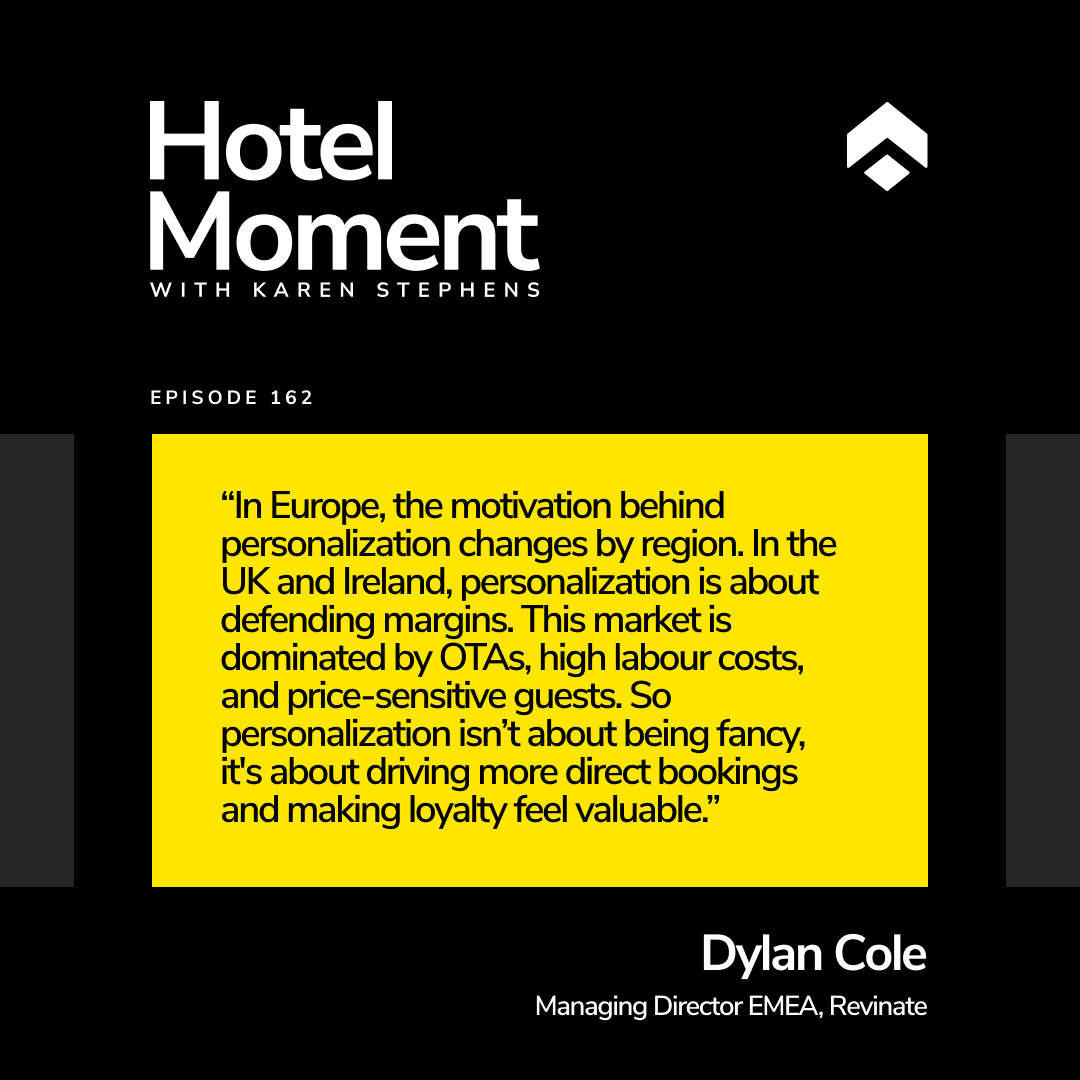
The motivation behind personalization
Reduce fragmented guest communication in 2026
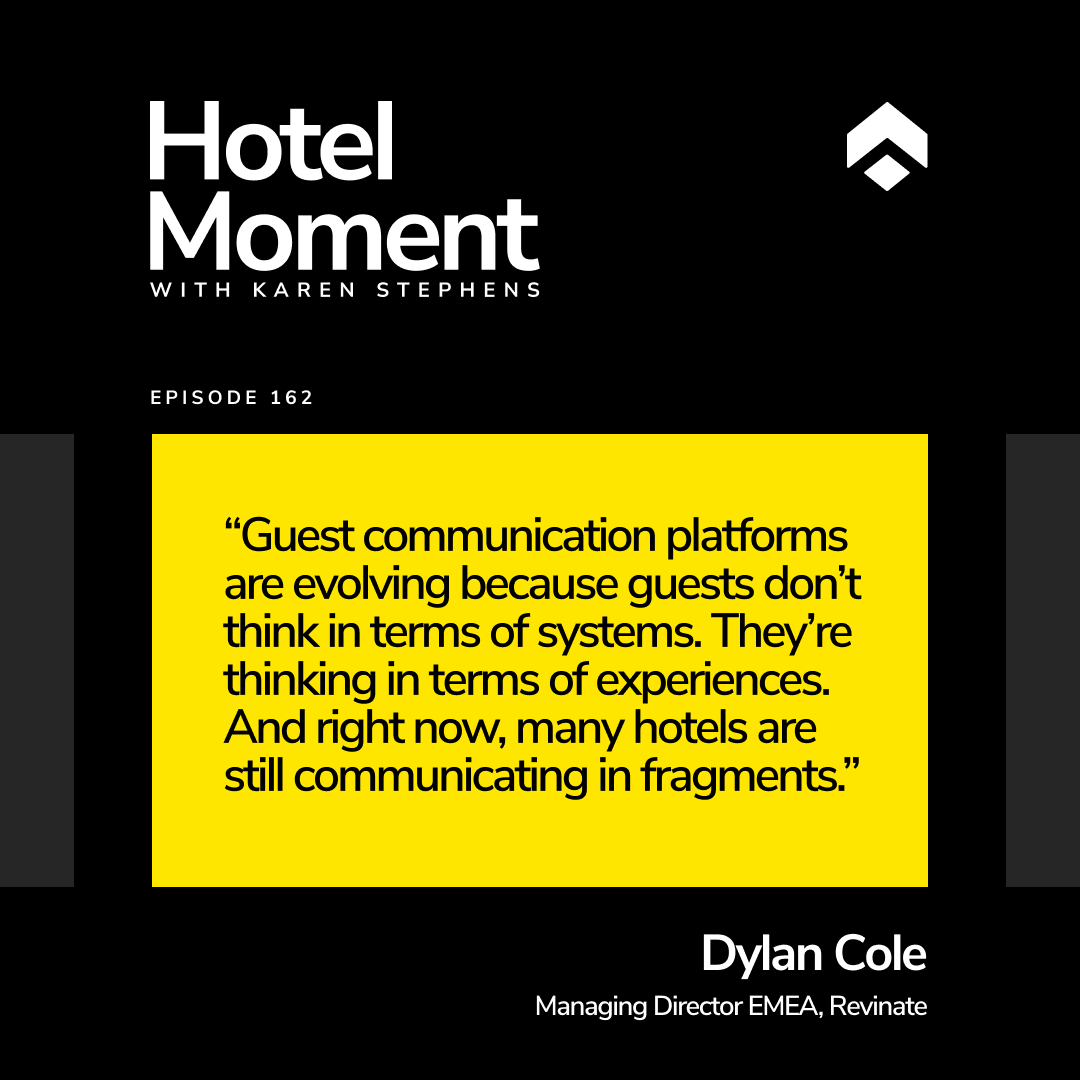
Guests think in terms of experiences
Make faster, reliable decisions

Meet your host
Karen Stephens
As Chief Marketing Officer at Revinate, Karen is focused on driving long-term growth by building Revinate’s brand equity, product marketing, and customer acquisition strategies. Her deep connections with hospitality industry leaders play a key role in crafting strategic partnerships. Karen has more than 25 years of expertise in global hospitality technology and online distribution — including managing global accounts in travel and hospitality organizations such as Travelocity and lastminute.com
As the host of The Hotel Moment podcast, she interviews top players in the hospitality industry. Karen has been with Revinate for over 11 years, leading our global GTM teams. Her most recent transition was from Chief Revenue Officer, where she led the team in their highest booking quarter to date in Q4 2023.

Meet your host
Dylan Cole
Dylan Cole began his career as a TV personality in South Korea. He then brought his love for travel and technology to Revinate where he played a vital part in establishing Revinate’s position in the US market, followed by the Asia Pacific region and now in Europe. Dylan is currently the Managing Director of Revinate Europe and is based in Amsterdam.
Watch the video
Transcript
[00:00:04] Intro: Welcome to the Hotel Moment Podcast presented by Revinate. This is your podcast to understand how technology can shape every moment of the hoteliers experience. Tune in to explore cutting-edge technologies and to hear from experts who are shaping guest experiences. It’s 2026 and I’m Dylan Cole, the managing director of Revinate Europe. Along with Karen Stephens, we’ll be bringing you a fresh perspective on what matters most to hoteliers.
[00:00:37] Dylan Cole: Hey everyone, it’s Dylan here. This year we are truly going global with this podcast. I’ll be swapping frequently with our OG host, Karen Stephens, so you hear a lot more from hoteliers in Europe, Asia, and Australia. Strap in, lots of fun conversations on the cards. A little bit more about me. I’ve been with Revinate for over 13 years now, so Karen and I go way back. I’ve been all over with Revinate, working out of our New York, San Francisco, Singapore, and now Amsterdam office. Add to that my experience of being a TV host in South Korea. So when I say we’re going global and gonna have some fun, you can count on that. Now last year we had some amazing guests on the show. We shot up to the rankings of number three on Apple Podcasts for Hotel Tech. Good job, team. We’re gonna beat that this year with all the exciting conversations lined up. On to today’s episode.
[00:01:22] Dylan Cole: If you’re a regular subscriber, you’ll know that we just covered the five big hospitality trends shaping 2026, which are hyperpersonalization, unified tech stacks, real-time decisioning, cybersecurity and privacy, and the evolution of guest engagement platforms. That conversation was intentionally big picture and we talked about what’s changing across the industry as a whole. But as any hotelier will tell you, these trends present differently depending on where you’re actually operating. So hoteliers in London, Munich, Stockholm, or the Amalfi Coast aren’t losing sleep over the same things, obviously. Let’s do a reality check on that today. Let’s look at those trends through the lens of what holds true for European hoteliers, and let’s try to answer the question of which of these hits home the hardest for you and which of them deserves the most attention.
[00:02:14] Dylan Cole: Before we dive in, it’s worth saying something quite obvious is that Europe is not one market. If you’re from the industry, you’ll know that hoteliers across Europe are all dealing with different things like regulatory pressures that are different, labor realities, different levels of digital maturity, and very different guest expectations. So these trends, hyperpersonalization, unified tech stacks, real-time decisioning, cybersecurity and privacy and the evolution of guest engagement platforms. Well, they solve different problems across UK and Ireland, DACH, Northern and Southern Europe. But I think we should start off with a trend that most hoteliers know best, and that’s personalization. So it’s obvious everybody wants personalization, but depending on the market, you’ll want it for different things.
[00:03:00] Dylan Cole: Hyperpersonalization is everywhere right now, and broad segmentation, it just doesn’t cut it. Micro-segmentation is the trend, and that is what cuts it. And hotels that win are the ones that use guest data intelligently. But here’s what’s interesting in Europe. The motivation behind personalization changes by region. So for example, in the UK and Ireland, personalization is really about defending margins. The market is dominated by OTAs, high labor costs, and price-sensitive guests. So personalization isn’t about being fancy, it’s about driving more direct bookings, making loyalty actually feel valuable, and obviously selling the right upsell to the right guest at the right time. If you’re not activating guest data here, you’re going to feel it straight in your P&L.
[00:03:50] Dylan Cole: Now jump over to the DACH region and the conversation changes quite a bit. Guests still want relevance, but they want it done with clear consent and they want to make sure that values are driven with the communications. They don’t want any creepiness. So you got to make sure that you’re dropping in that line about data privacy in your conversations, your communications, and that you’re leaving that opt-in button pretty prominent for those guests. Now, if we look at Northern Europe, expectations are quite high from guests and the tolerance for friction is low. That means generic communications, they’ll stand out immediately. Personalization here is tied closely to the brand and your credibility. And if you’re a brand that guests have trusted enough to give their data, they expect you to deliver the right messages using that data.
[00:04:37] Dylan Cole: Now let’s look at Southern Europe. Hoteliers, especially in resort destinations, can use personalization as a powerful in-stay revenue lever. Basically, it’s how you drive experiences, it’s how you increase on property spend, it’s how you maximize peak demand without discounting. It’s all the same trend, it’s just completely different drivers. Next up on the trends list are tech stacks. And here’s why tech stacks are getting simpler for everyone. Unified tech stacks sound like a trend that should be driven by the IT department, but in Europe they’re actually being pushed by the operations team. So for example, in the UK and Ireland, we’re seeing that teams are quite lean, in fact, really lean, and there’s no appetite from our customers to juggle five different systems that don’t talk to each other. In fact, unified tech stacks here mean less manual work, faster execution, and fewer things breaking at the worst possible moments. In DACH, the issue is scale and structure. In portfolios, they usually have multiple properties, multiple stakeholders, and they all have complex reporting requirements. Disconnected systems don’t just slow things down, they create a risk. A unified modular stack brings order without forcing massive system replacements.
[00:05:53] Dylan Cole: Now let’s go over to Northern Europe. Again, they tend to be further along digitally, but that brings a different challenge, which is staying flexible. Unified stacks allow hoteliers to evolve without getting locked into yesterday’s decisions. And finally, in Southern Europe, tech stackification is becoming essential for managing seasonality, mixed-use properties, and rapidly changing staffing models. The common thread is that it’s not about new tech, it’s about less friction ultimately, which then leads us to our next trend, which is that data is only useful if you’re moving fast.
[00:06:32] Dylan Cole: Another big global theme is real-time data and decisioning. And honestly, this is where a lot of hotels feel the gap the most. In the UK and Ireland, real-time data is about survival. Labor is expensive, guest behavior changes quickly, and if you can’t react in the moment, you are going to absorb unnecessary costs. In DACH, real-time data supports precision, better forecasting, and fewer surprises. So smarter decisions will actually hold up when they’re put underneath scrutiny. Now in Northern Europe, expectations are already high, as we said before, so static reports will feel outdated, and real-time visibility is becoming the baseline. And finally, in Southern Europe, real-time insights allow you to tell value while guests are still on property, especially when demand shifts with weather or events. Across Europe, this is the bottom line. If you’re only looking at last month’s performance, you’re already behind.
[00:07:30] Dylan Cole: Now let’s look and talk about the trend that quietly underpins all the others, privacy and trust. Privacy isn’t just about compliance in Europe. It’s your brand. In DACH and Northern Europe, guests actively assess how brands handle their data. Transparency matters and consent matters and also restraint matters. In the UK and Ireland, guest awareness is also rising fast, and trust increasingly influences repeat bookings and loyalty. In Southern Europe with so many international travelers coming, strong data protection is just a simple expectation. So what’s different in 2026 is that privacy can’t be treated separately from personalization. Hotels have to do both and do them both well. In Europe, trust isn’t a legal checkbox. You can’t treat it like that. You have to think of it as a brand promise. So our last trend here is this. From guest communication to guest orchestration, guest communication platforms are evolving because guests don’t think in terms of systems. They’re thinking in terms of experiences. And right now many hotels are still communicating in fragments. They have one system for email, another for messaging, another for feedback. So across EMEA, that fragmentation creates friction for guests and staff. Unified engagement platforms bring everything together, from pre-arrival, in-stay, post-stay. And in UK and Ireland, this helps drive revenue. In DACH, it supports structured compliant communication. In Northern Europe, it meets the high digital expectations. In Southern Europe, it enhances experiential differentiation. Different reasons, same outcome, a smoother journey.
[00:09:15] Dylan Cole: So if you’re a European hotel leader listening to this, here’s the big takeaway. The hospitality trends for 2026 are solving very real problems and very regional problems. The opportunity now is prioritization. Which trend addresses your biggest pressure point? Where can you simplify instead of adding more? And where can you activate what you already have? You don’t have to throw yourself into buying more technology in 2026. Think about connecting the dots and moving faster because of it. If you want to go deeper into these trends, we have a full guide to the latest hospitality trends of 2026 with practical insights designed to help you move from strategy to execution. Thanks for spending time with me on the Hotel Moment. I’m Dylan, and I’ll see you next time.
Episodes
Hotel Moment
WITH KAREN STEPHENS
Subscribe for updates on your favorite platform