Hotel Moment
WITH KAREN STEPHENS


Episode 169
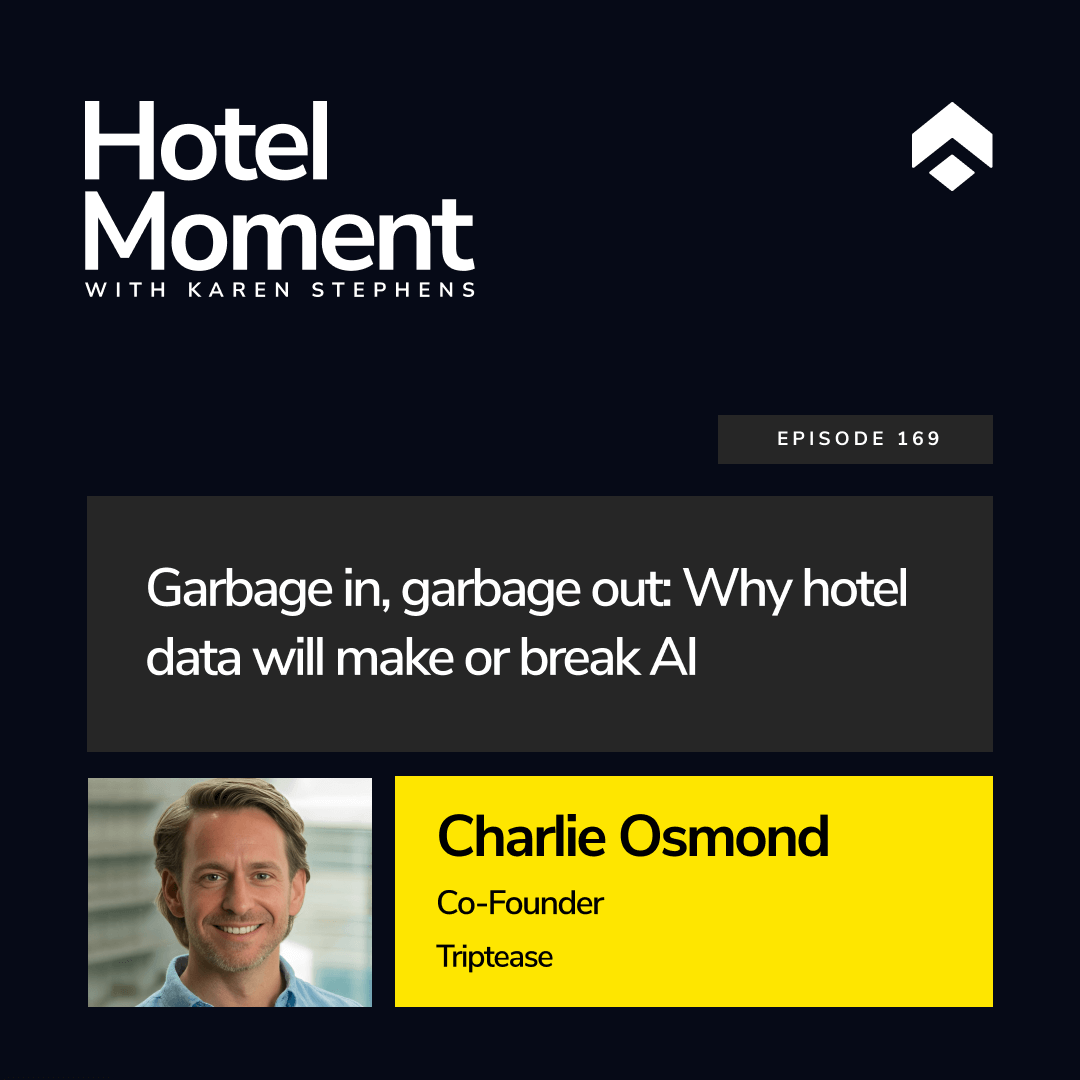
Garbage in, garbage out: why hotel data will make or break AI
In this episode of Hotel Moment, Dylan Cole, Revinate’s Managing Director in EMEA, sits down with Charlie Osmond, Co-Founder of Triptease, to tackle a question every hotelier needs to know: As AI transforms how guests search and book, is your data ready?
In an AI-driven world, the real differentiator isn’t the tool, but the data behind it. Clean, precise, connected data sharpens targeting, personalizes at scale, and drives confident decisions. Messy or incomplete data doesn’t just limit performance; it sends the wrong signals, attracts the wrong guests, and turns weak strategy into bigger problems.
Dylan and Charlie discuss the future of direct bookings, why clear guest personas matter more than ever, and how hotels risk becoming right for everyone and end up resonating with no one.
Tune in to hear why better data isn’t optional.
Media
How make the right decision every time
What’s coming for the direct booking channel?
Do you have the right kind of data?
Understanding guest spend

Meet your host
Karen Stephens
As Chief Marketing Officer at Revinate, Karen is focused on driving long-term growth by building Revinate’s brand equity, product marketing, and customer acquisition strategies. Her deep connections with hospitality industry leaders play a key role in crafting strategic partnerships. Karen has more than 25 years of expertise in global hospitality technology and online distribution — including managing global accounts in travel and hospitality organizations such as Travelocity and lastminute.com
As the host of The Hotel Moment podcast, she interviews top players in the hospitality industry. Karen has been with Revinate for over 11 years, leading our global GTM teams. Her most recent transition was from Chief Revenue Officer, where she led the team in their highest booking quarter to date in Q4 2023.

Meet your host
Dylan Cole
Dylan Cole began his career as a TV personality in South Korea. He then brought his love for travel and technology to Revinate where he played a vital part in establishing Revinate’s position in the US market, followed by the Asia Pacific region and now in Europe. Dylan is currently the Managing Director of Revinate Europe and is based in Amsterdam.
Watch the video
Transcript
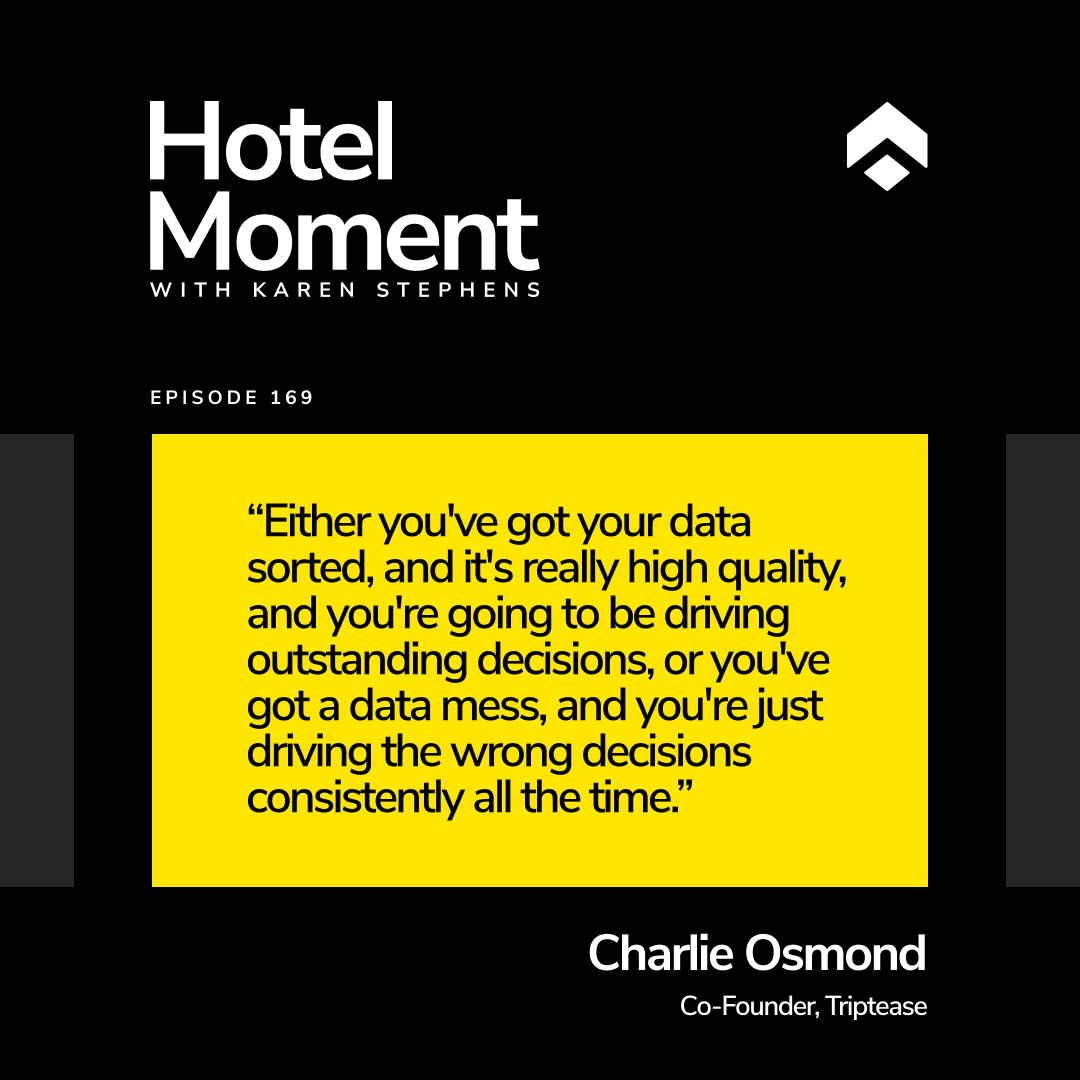
[00:00:00] Charlie Osmond: Either you’ve got your data sorted and it’s really high quality and you’re going to be driving outstanding decisions, or you’ve got a data mess and you’re just driving the wrong decisions consistently all the time.
[00:00:14] Intro: Welcome to the Hotel Moment podcast presented by Revinate. This is your podcast to understand how technology can shape every moment of the hotelier’s experience. Tune in to explore cutting-edge technologies and to hear from experts who are shaping guest experiences. It’s 2026 and I’m Dylan Cole, the managing director of Revinate Europe. Along with Karen Stephens, we’ll be bringing you a fresh perspective on what matters most to hoteliers. Welcome to the Hotel Moment. Today we’re joined by Charlie Osmond, Co-Founder of TripTease, the leading platform helping hotels grow direct bookings through personalization and smarter use of guest data. Since founding TripTease in 2013, Charlie has worked closely with hoteliers around the world to understand how guests shop, book, and make decisions online. With AI now reshaping the booking journey and acting as a new middle layer between guests and hotels, Charlie brings a clear, practical perspective on how hotels can stay visible. protect revenue and use clean data to their advantage rather than losing control to intermediaries. Welcome to the show, Charlie. So before we get into AI and booking journey, I think it’s good we take a little step outside of hospitality maybe for a second. We know you’ve run a lot of marathons in a lot of places that most people have never even traveled before. We’re all curious what kind of draws you into those challenges and does that mindset show up in how you’ve built and grown TripTease?
[00:01:38] Charlie Osmond: I always promised myself I’d never run a marathon. I thought it was like bad for your knees. And then when I moved to New York, I accidentally entered the New York marathon and got an invite. And so I did it and it changed everything for me. The main thing, I guess, I found that after running one, if you want to run more, everyone kind of has the same ones they want to do. I realized I wanted specifically to go in a different path. So I looked for — and my goal was to find a marathon I could win. That was the first goal. And I was like, I have to travel to pretty far away places to go and do that. So Kazakhstan, North Korea. I haven’t won one yet, but, um. But yeah, just I think I find it more fun to use it as a way to explore parts of the earth I wouldn’t get to otherwise.
[00:02:19] Dylan Cole: That’s really cool. North Korea, huh? Yeah, that was mental. That’s wild. Cool. Well, I guess sort of shifting then more towards TripTease and hospitality, but still like curious about your passion. So you’ve obviously been a bit obsessed with how guests behave online, especially that moment where they decide to book. So I guess what originally fascinated you with that decision point and how has that insight or that kind of obsession shaped the way you’ve built TripTease over time?
[00:02:51] Charlie Osmond: I’ve always been interested in behavioral psychology, like why people do things. I think that’s just always been inherent in me and how marketing and messaging relates to that. But really the kind of the original idea of TripTease came from personal struggle and pain. I realized that the single thing in my life that made me most upset and unhappy each year was planning travel. I couldn’t understand how if I was gonna go away with my family for six days, I would seem to spend four weekends worth of work just doing the planning for it. It just didn’t make any sense. And I find it so frustrating that — given that the time, so it seems a while ago now, like over ten years ago — travel was by far the number one thing people spent money on online. And it was like the biggest online industry then. And yet it was such a clunky, horrible experience. And it just felt like there’s a problem there that I wanted to go solve for myself and everyone else.
[00:03:40] Dylan Cole: Yeah, it was challenging when you were booking your North Korea marathon trip.
[00:03:47] Charlie Osmond: That actually — that gets really easy because there’s only one way in. Don’t do the official tour, you don’t get to make it because they track you around the country. You have to always be with someone. You can’t ever go out anywhere on your own.
[00:03:58] Dylan Cole: Right. There’s only one way to book that trip. Well cool. So thanks for sharing that. I guess moving into sort of today’s world, AI is becoming increasingly the middleman in the booking journey. We’re seeing that. We’re all seeing that. So from your perspective, how real is the risk for hotels to lose control over the guest relationship, kind of as AI-driven conversations start to replace more traditional discovery and booking paths?
[00:04:24] Charlie Osmond: So I don’t think it’s a risk of losing the guest relationship. After all, like the best place for the guest relationship to flourish is on-site and on property. In terms of losing it during the marketing experience, yeah, I think there’s a risk of that. Overall — I feel pretty excited about what lies ahead in terms of the direct channel because I actually think the OTAs are the ones who are more likely to get disrupted and challenged. Not in the short term, but I think in the midterm. And everything that I see month after month in terms of innovations in AI and agents and the way people use them leads me to feel we’re heading more and more in that way where the individual hotelier, the individual website can do better. So actually I overall kind of see it as a good thing. I think there are loads of ways in which there’s a risk that the hotelier loses insight, information, data about guests who are doing things on their website, what they’re interested in, where they’re gonna buy. So there’s a load of signals, but I think most hoteliers aren’t actually using those signals very well at all, if at all, today anyway. And I think there’s ways to replace them. So there are things that we can do that actually allow us when interacting with an agent to actually almost learn more about a guest than the guests would tell us if they were just on the hotel website. And some of the evolutions recently we’ve seen just in the last few months with WebMCP — I think lead us to a place where that’s possible. So I’m really excited about — actually there’s gonna be more data and more to be able to grab and more interactions and more ways to personalize in the future than there are even today.
[00:06:00] Dylan Cole: Right. But we gotta be at the forefront of that and gotta be thinking about how to actually not take a backseat to it, but make sure that we’re investing and thinking about how to be at the forefront of it. And I guess what does that shift mean for hotels and what do they need to be thinking about now in terms of visibility and differentiation going forward if those — again, two things, discovery and booking — are kind of collapsing into one flow?
[00:06:17] Charlie Osmond: Yeah, I think the first thing that’s worth saying is that there are massive shifts happening and coming, but right now in 2026, fewer than like one or two percent of bookings are gonna come to you from ChatGPT. Now it might be partly involved in some of the upstream recommendations and initial thinking, but you know, you’re not actually gonna get many bookings in 2026 from it. And it’s not going to change that much behaviour. I think that’s worth always stipulating before we go down the exciting hype changes. The other thing worth noting is there are many different customer types and it will undoubtedly — even five years from now — there will be certain customer groups or certain trip types where going to the website, having a full website experience, seeing images and the like is gonna still remain something that people really want to do. So I think there’s not just one type of guest. Anyway, having said all that, yes, huge changes afoot. And I think very exciting ones, not least because one of the sort of purposes of an agent kind of needs to be to deliver against the needs of the individual user. And in terms of delivering individual needs, yeah, that comes down to personalization and really understanding what are the hot buttons, what are the things for this particular guest, what are they looking for, what makes one hotel great for them but not for another person. And so when I think about it — that’s really what the agents are trying to be solving, because if they can’t do that well, people won’t use them, right? So they have to be delivering what each individual guest wants. So with that in mind, it actually to me makes me think, well, there’s even more deliberate desire to go and understand different properties — who they are great for and in what circumstances. And so I guess that kind of brings me a little bit into your world of thinking. Part of the opportunity today and going forwards, I think, is that more than ever, understanding your ideal guest profile or your key persona — maybe it’s like five to ten different key types of guests that for your property absolutely always have a great time, get what they want in what they kind of expect and desire from a stay, and maybe from a hotel point of view, also are big spenders one way or another. So that core set of personas, being able to really clearly articulate that, having the data internally but also that you can make external about why you fit for these people, I think leads to a really exciting kind of future for hotels. Because the agents are trying to understand what are the personas that fit — is the guest I’ve got who’s asking me questions going to be right for this hotel. And so being able to have that data and then articulate that back to agents, I think is really exciting. So yes, there’s this kind of collapsing, but it doesn’t mean there isn’t a need for even more data interactions and flowing between the different systems.
[00:09:07] Dylan Cole: Definitely. And I guess that does lead me into my next question, which you’ve sort of answered right now, but — I guess what I should say is we’ve seen you be pretty vocal about unified clean data, which you’ve just mentioned. That’s been a big thing that you’ve always pushed. And I think why our companies have such synergy and will continue to have even more over time. But as the journey kind of simplifies — and I know I’m recognizing what you just said, it’s not completely merged, there’s still a lot of nuance to it — but as the journey simplifies and these things come together, what do you think starts to break first in the guest journey when data is siloed or unreliable or when it’s dirty? Like where do you think hotels start to see the impact of not doing that right immediately?
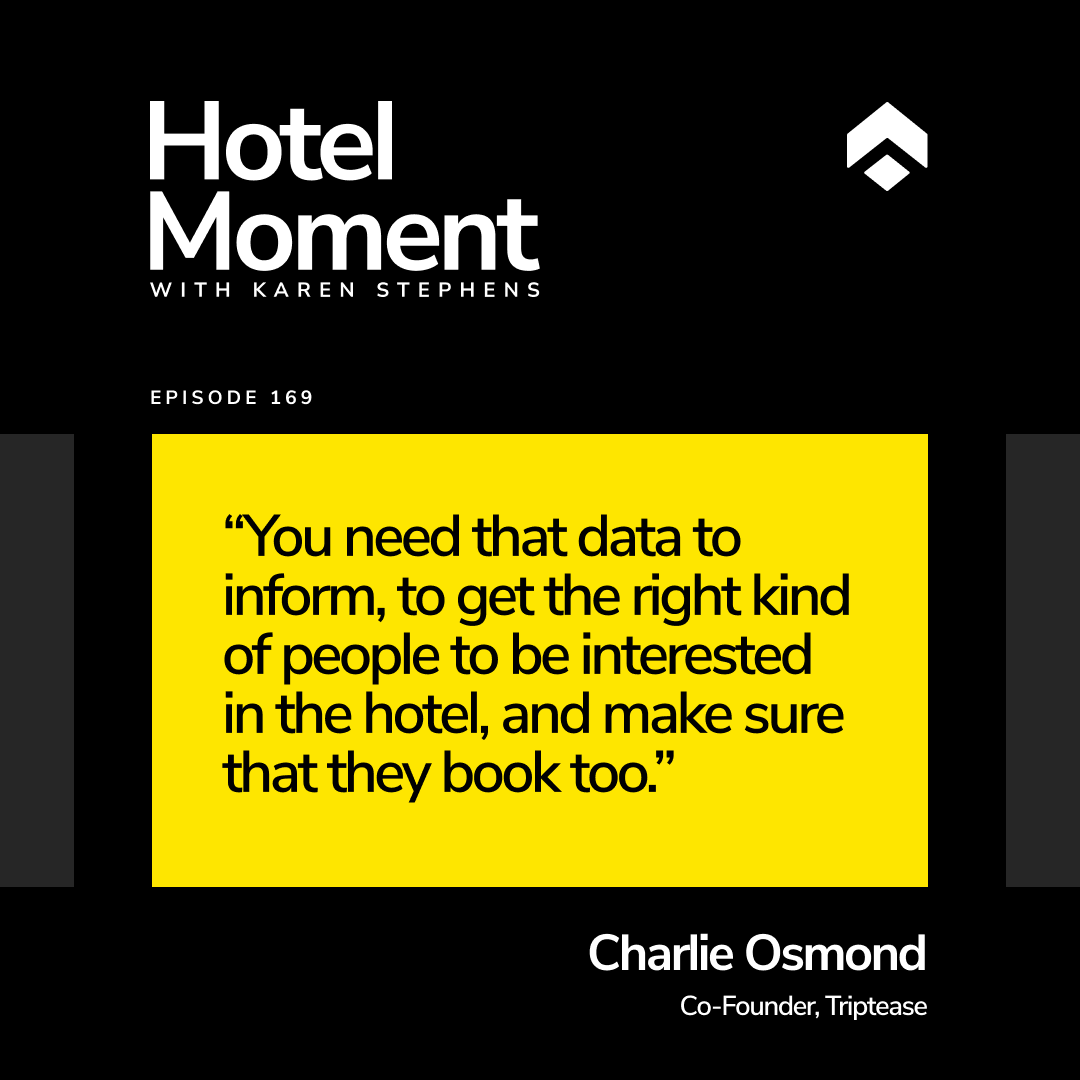
[00:10:00] Charlie Osmond: That’s a really interesting, challenging way to think about it. So I guess perhaps I’ll break it into two different sides. So first of all, one of the things we help hotels do is have really great data-driven marketing that brings the right people to the website. So if that data isn’t good and if that data isn’t real time, then your ability to optimize advertising spend and to get really effective and efficient ads massively diminishes. So for example, you know, what happens that we see as absolutely critical when you’re bidding on a metasearch is you need to know: does the hotel for this itinerary right now have the best price? If the hotel has the best price, you bid very differently for that person running a search versus if the hotel doesn’t — if the hotel’s being beaten by Booking.com by a dollar. Completely different bidding strategy, completely different ROI, by knowing that data and having that data. So your ability — and that scales in many different ways — but your ability to have really effective advertising is instantly hit if the data’s not good. And then when it comes to actually converting people or getting the right people to book on your hotel, I think that’s another really interesting area where yes, things are collapsing, but that doesn’t mean there isn’t an increased opportunity to use data to both help the guest book the right hotel and help the hotel persuade the right kind of guests to stay there. And so I think that again, if you are not clear and precise and accurate with your data, then either you’re gonna be telling agents who are out there looking for hotels that your hotel’s right for everyone, which then means it’s not right for anyone — and that’s kind of useless, so not being defined. Or you’re gonna define the wrong ICP and the wrong personas are going to be targeted, in which case you’re going to get people coming to the website who aren’t going to be very happy, not prepared to pay as much, don’t spend as much on F&B when they’re on the property. So in a sense it’s almost like not having much of a brand, right? You either have a brand that stands for something and then you’ll attract the right kind of people to it — and obviously you’ll lose some people who aren’t then right for it — or you have a brand that kind of stands for nothing and you just kind of are in a sea of mediocrity. You’re like a price on a pin on a map and that’s not a great place to be, I think, as a hotelier. So yeah, I think you need that data to inform, get the right kind of people interested in the hotel and make sure that they book too.
[00:12:09] Dylan Cole: I think when we go to — let’s say we’ll be at ITB next month — the word AI will be everywhere, I’m sure of it. But at the end of the day, if the data behind the scenes isn’t clean and unified, then all of your great plans for it will not come to fruition. I think one of the stories that Bryson tells — for those who don’t know, Bryson, Revinate CEO — tells often. He talks about this grocery store that had this idea for an AI agent that could recommend recipes for you based on their inventory in the store. Well, they didn’t map it very well and all of a sudden the thing was recommending Windex mixed with spaghetti sauce mixed with toothpaste. So it’s like again, like the idea can be great, but if the data behind it isn’t appropriately mapped or set up or unified, then you know.
[00:13:00] Charlie Osmond: Yeah. I mean, I think data’s always been important to be able to make decisions and move forwards. I feel like in an ever accelerating AI world, it only becomes more important. Not like a little bit more important, but like 10x, 100x, 1000x. We now have the ability for systems to be making so many new more nuanced calculations and decisions — that either you’ve got your data sorted and it’s really high quality and you’re going to be driving outstanding decisions, or you’ve got a data mess and you’re just driving the wrong decisions consistently all the time. So the speed and opportunity to be pulling different data from different systems is like never before. And the ability to then apply intelligence to that in the form of LLMs to make decisions for you is like never before. There’s only going to be an acceleration of that. But if what’s going in at the beginning is rubbish, then you’re in a really bad place. And it’s something I actually kind of worry about a bit in the industry because I don’t know about you and your experience, but when we were starting up the business like twelve years ago — we wanted to get an integration with Oracle Opera back then and they made it so hard and so expensive. And it felt like to me and all the other entrepreneurs, founders who were doing stuff in hotel tech as we spoke about what we were doing, we just could see that the whole industry was held back because there were some players in the industry who wanted to hold on to their data or wanted to run a payment or a costing system for it that meant it just wasn’t feasible for innovation to happen.
[00:14:24] Dylan Cole: And you mean from the hotelier side, by the way, right? With the Oracle licenses.
[00:14:28] Charlie Osmond: Exactly, those licenses, exactly. And sorry, I’m not here just to have a go at Oracle — I really want to call it out because that’s a decade or more that we went through as an industry where we really slowed down innovation. Now they saw it — I guess you mentioned Mews, right? They saw Apaleo, Mews and others coming and they realized they had to open up their APIs and they’ve done a really good job of that. So well done to them. They’ve changed the business model, they found other ways to charge. That means innovation is now possible. But my God, did we suffer for 15, 20 years. And my worry today — with again like that accelerating value and importance of data — is that because for other reasons now, there are other incumbents who are putting their arms around their own data, worried about it. Or they’ve been bought by private equity who’s saying we want blood out of the stone, or they’re nervous because we’ve all seen in the last few months software businesses freaking out, losing their share price because what’s the future of a software business if AI is gonna vibe-code everything for you? So suddenly these other software businesses in our industry are getting scared about where are we gonna make money. And they’re making APIs not available. They’re making APIs, but they’re putting prices on them that are so high because they see that this might be the only way to sustain their revenues. That again, I’m worried that in this moment where the data should be released, where the opportunity is vast, that actually we will be held back because there are certain players who are fighting a business model that they just want to maintain. And the reason I guess I bring this up is because I think hoteliers — you know, they do these RFPs, what’s my booking engine, my CRS gonna be, whatever? And they perhaps don’t spend enough time asking the question: how do you as a vendor charge other vendors? Like how open are your systems? There has never been a more important time for that question and for forcing, pushing your CRS to give you real data openness. So it’s one of my concerns. I feel like we could be held back, and that’s the kind of thing that would mean the industry doesn’t take this opportunity to accelerate compared to say the OTAs — is actually that individual vendors one by one lock down things.
[00:16:14] Dylan Cole: It’s really interesting. More recently in RFPs we are starting to see people asking about that, but definitely not nearly enough. And maybe there weren’t as many use cases for pulling data out of a product like the Revinate API, but we are starting to see more of it, which is good.
[00:16:38] Charlie Osmond: And don’t get me wrong, right, there’s really good reasons why vendors should be able to charge for some data feeds. Like if we push our data to Revinate, that’s valuable. If Revinate pushes data to us, that’s valuable, and it costs money for us to maintain those. But there’s like a standard rate and then I’ve just seen some vendors out there in the last few months multiplying by ten the rate of connectivity and they’re really doing it to try and prevent people using the connection at all. And that’s just taking things backwards.
[00:17:03] Dylan Cole: No. And you’ve seen the way that Mews has been able to grow their business through being open and being available and making partners a big part of their play and it’s all good. So hey, shifting real quick — I think this is a good question on top of this — as we think about AI-powered personalization and cleaner data, okay, we all know this sounds great, but like are there any metrics that you have in mind that a hotelier should be thinking about to know that this investment and work is actually paying off for them?
[00:17:30] Charlie Osmond: I think the simplest way is you can run a marketing campaign. Let’s say it’s an email campaign or a personalization campaign with some messages that you might put on your website. It’s really easy to send an email to your entire database and see what the click-through rate and the conversion rate and unsubscribe rate is. And it is really easy to do that when you target those segments a little bit — you know, okay, these are the people who like golf, these are the people who come for Christmas, these are the whatever — and you tailor those emails and you see today extraordinary differences in open rate, click-through rate. Like, it’s a good question, but I kinda like — we’ve solved for that already, right? Everybody believes it, don’t we know that if you give me something I’m interested in, I’m much more likely to remain subscribed, book, and the like. And I’ve seen Revinate data, I’m sure, that shows that — you did that with emails and we see the same when we personalize experiences on the website or in advertising.
[00:18:17] Dylan Cole: It’s human nature and you’re right. Oh, I guess so then to summarize kind of your point, it’s conversion rates, it’s click-through rates, it’s all of these things, hopefully driving higher numbers on things that we’ve been doing for a long time. Is that a fair summary?
[00:18:34] Charlie Osmond: Yeah, and running the personalized campaign and comparing it to a non-personalized one, I think the results are very clear.
[00:18:42] Dylan Cole: So kind of future thinking as we sort of come to our final few questions, but looking at the next twelve to eighteen months — what are the most practical steps a hotel can take right now to protect their direct revenue, kind of reduce leakage to OTAs, and I guess stay competitive as AI reshapes the booking journey as we know it?
[00:19:02] Charlie Osmond: Well, so the first things are probably the non-AI ones, because if it’s about wanting great performance the next twelve to eighteen months, a lot of that comes down to doing the basics well. And I spoke to a hotelier yesterday who arrived at a business a year ago and it was great because there were so many basic things to fix and I hear that again and again. So I don’t want to go away from — like there’s core things that you need. You need a website that is clean and updated and a booking engine that’s got a good flow, high conversion rates, and you have really good parity. Like you’ve got to get those things in place. You’ve got to make sure that you’re presenting your price on metasearch and getting clicks there. Like there’s some basics like that. In terms of being ready for AI, I mean, I think this has been really interesting because in the last year, I feel like we’ve seen a few different key things vendors were trying to sell around AI, particularly as it addresses the guest booking journey. And our view was the things that were being pushed weren’t really ready for prime time yet and weren’t ready for most hotels to adopt. I mean, the obvious one, right, is ChatGPT brings out an app store. And there are people out there saying, oh, hey, hotelier, we’ll get you on ChatGPT, we’ll get you in the App Store. But what they fail to mention is the process is someone has to be in ChatGPT. They have to know to ask for the brand of the vendor and then that has to show the hotel. So it’s like — no one’s doing that. It’s just not gonna happen. And that’s two people a year. It’s just not worth investing in. So I feel like some of the innovations that were kind of like early last year were selling things that aren’t actually going to deliver any value. And another one — I think maybe people would be surprised to hear this — is the tools that you can pay for that show whether you’re likely to be recommended. Like it seems like a really sensible thing to do. Am I going to be recommended? Can I work on my AEO so that I get more recommended? But the accuracy of those is so poor that the data’s more likely to lead you the wrong way than the right way. And I say poor because just one particular fact — right? If I go into ChatGPT and put in a request, first of all, it’s nothing like the keywords I used to use two years ago on Google. No one is using those six words in a search. We’re using 24 words on average. But secondly, the results I get in ChatGPT running a search myself are completely different to if I use the API — the ChatGPT feed to all of these vendors who are doing thousands of searches a day. Like they just give you completely different results, they run searches in a completely different way. So you’re looking at the wrong data. So I think that’s like where we’ve been. I feel like now, however, there’s more clarity. And focusing on like obviously really good standard SEO behaviors. And we’re looking very carefully at now some of the MCP capabilities that you can put on your website, on your booking engine. So I think Apaleo, Mews and others with their Nexus integrations — they’ve got MCP now and I think looking at whether or not agents are actually going to use those and seeing what the take-up is over the next few months is one of the things that we’re watching out closely for.
[00:21:50] Dylan Cole: It’s really interesting — to your point, it’s hard to believe we’ve already lived through a lot of the — I mean it’s just so much more development to happen and so much more to change over time, but we’ve already lived through some of the initial hype, some of it. And to your point, I think now we are getting a little bit more clarity on what actually matters, where should we spend the time, because I think everybody had that initial push of like, oh my god, I’m not on ChatGPT. My business is going under. But you’re right. There’s starting to be a little more clarity. Definitely a lot more to go.
[00:22:19] Charlie Osmond: Yeah, I would say it’s like the one thing that — coming back to where we started — that you absolutely will get value from year after year after year in AI, if you start with it now and just keep improving the quality of your data. If you’re doing that, if you’re connecting up your systems — your PMS with your CRM, CDP, and more — and you’re making sure that you’re taking out duplicates. Your ability to have the data that you need to power the AI systems of the future — like that’s the most important thing to focus on first.
[00:22:45] Dylan Cole: Thank you for that. And as a final question, I want to phrase this in a way like — we have our old school hotelier who wants to interact by shaking every guest’s hand coming through the door, does not love technology, sees it as a threat to the personal touch, right? What would you say to that hotelier that gives you the most optimism about this AI world we’re stepping into in terms of the guest experience? Like what would you say to that hotelier to gain their favor in this new world we’re venturing into?
[00:23:12] Charlie Osmond: It’s interesting. Actually I’m split — like on one side, to that traditional hotelier who may have a great brand where people really value personal relationships and customers who come back to that hotel every year. It might be that driving direct bookings, driving success in ChatGPT simply isn’t important to them because they’ve got like a brand and they’ve got — like happy guests who talk to friends and that’s how they get their business. So it might be that that old school hotelier should stick to what they are doing because it’s amazing and it’s the opposite of what everyone else is going to do. So I don’t want to always tell everyone to follow the herd. But if they wanted to sort of embrace it and there was an option, I guess maybe one of the things I always think of is — the way you just described that hotelier, right? They’re focused on their guests. I’d bet you that great hotelier treats people differently based on how they show up at the hotel. They look at them across the lobby and they think, that person’s stressed, or that person’s happy, or that person needs a coffee, or whatever it is, and they go and speak to each individual and personalize that experience — because that’s what we do as humans. We know it’s important. And so all we’re doing with AI is we finally have the tools where we can look for the data signals of each individual instead of walking through the lobby — like arriving on the hotel website. We can look for the signals. And we have the ability with the computing power to make the decisions in a computer that that hotelier is making naturally and instinctively after forty years of doing the job. We can now do that online in a way we couldn’t before because we can do it at scale and get to like real one-to-one marketing in a way we couldn’t before. So it’s kind of — we’re just doing what he does so well and we’re just trying to make it online.
[00:25:00] Dylan Cole: I think you nailed that question. And I agree completely. So let him or her take care of the guests in the hotel and let AI and the great technology that’s being built do this same personalization online for you. I don’t want to summarize you, but I just did, and I think it’s a great point. So with that, we can wrap it up, but thank you so much for your time, Charlie, and I look forward to seeing you at ITB this year. Can’t wait. See you then. See ya.
[00:25:24] Outro: Thank you for joining us on this episode of Hotel Moment by Revinate. Our community of hoteliers is growing every week, and each guest we speak to is tackling industry challenges with the innovation and flexibility that our industry demands. If you enjoyed today’s episode, don’t forget to subscribe, rate, and leave a review. And if you’re listening on YouTube, please like the video and subscribe for more content. For more information, head to Revinate.com/hotelmomentpodcast. Until next time, keep innovating.
Episodes
Hotel Moment
WITH KAREN STEPHENS
Subscribe for updates on your favorite platform