Hotel Moment
WITH KAREN STEPHENS


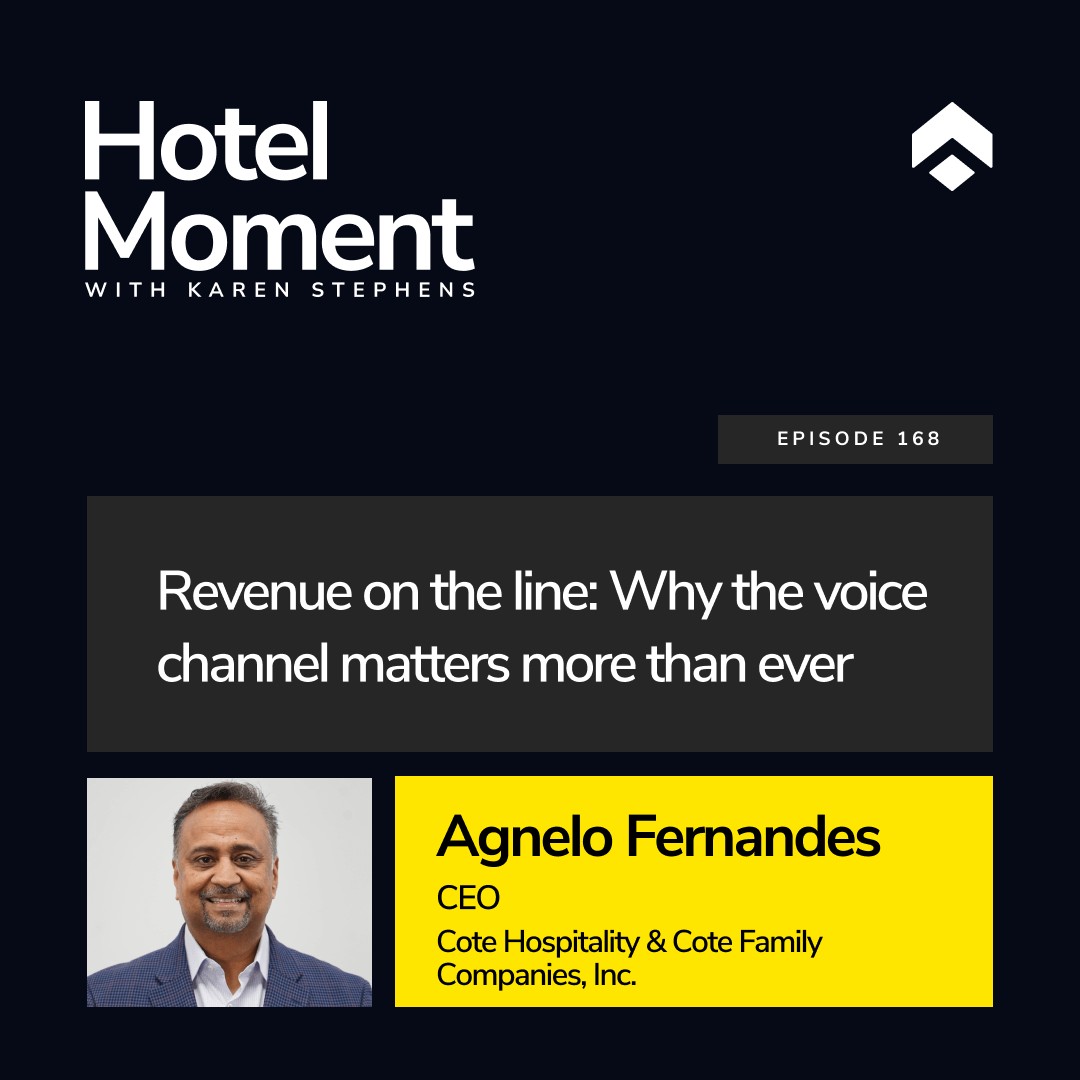
Episode 168
Revenue on the line: Why the voice channel matters more than ever
Your website and app shape your brand, but they’re not the whole story. Today, your most powerful brand interactions often happen over the phone, and many hotels are leaving money on the table by treating calls like a cost center instead of revenue inventory.
In this episode of The Hotel Moment podcast, Revinate CMO Karen Stephens and Agnelo Fernandes, CEO of Cote Hospitality, dive into why high‑intent booking calls get buried in service noise, how unified guest data empowers agents to convert instead of transact, and how separating revenue‑focused conversations from routine requests can unlock more direct bookings. They also dig into the role AI and guest data platforms play in giving agents the context they need to close with confidence.
If you’re ready to rethink your voice strategy, this one’s worth your time.
Media
Better data, better calls
How to staff your call center during peak season
Treat the voice channel like inventory
How does a CDP support the voice channel?

Meet your host
Karen Stephens
As Chief Marketing Officer at Revinate, Karen is focused on driving long-term growth by building Revinate’s brand equity, product marketing, and customer acquisition strategies. Her deep connections with hospitality industry leaders play a key role in crafting strategic partnerships. Karen has more than 25 years of expertise in global hospitality technology and online distribution — including managing global accounts in travel and hospitality organizations such as Travelocity and lastminute.com
As the host of The Hotel Moment podcast, she interviews top players in the hospitality industry. Karen has been with Revinate for over 11 years, leading our global GTM teams. Her most recent transition was from Chief Revenue Officer, where she led the team in their highest booking quarter to date in Q4 2023.
Watch the video
Transcript
[00:00:00] Agnelo Fernandes: We treat voice as a strategic channel, that it’s staffed appropriately, that it’s fed by unified guest data, and then prioritize for true revenue moments, rather than letting some of the operational noise drown it out and then we lose sales.
[00:00:18] Intro: Welcome to the Hotel Moment Podcast, presented by Revinate, the podcast where we discuss how hotel technology shapes every moment of the hotelier’s experience. Tune in for our guest episodes, where we explore the cutting-edge technology transforming the hospitality industry and hear from experts and visionaries shaping the future of guest experiences. Alongside our conversations with guests, we have episodes for you, hosted by Revinator Brenna Turpin, on resources available to you all. These resource-packed episodes have granular advice on overcoming industry and operational challenges so you can emerge as a hotel superhero. Whether you’re a hotelier or a tech enthusiast, you’re in the right place. Let’s dive in and discover how we can elevate hospitality together.
[00:01:03] Karen Stephens: Hello and welcome to the Hotel Moment Podcast. I am your host, Karen Stephens, the Chief Marketing Officer of Revinate. And today we are thrilled to have Agnelo Fernandes, a visionary leader and CEO of Cote Hospitality. With over two decades of experience in luxury hospitality, he’s been an expert at elevating brands in operations, marketing, and brand development. What I love most about Agnelo is his commitment to culture and mentorship. He’s inspired so many young professionals, as you well know if you listened to his last episode on Hotel Moment. But today I’m excited to have Agnelo back on the podcast to talk about the release of our 2026 Hospitality Benchmark Report. This is our 11th year releasing the report and we’ve gathered data from our products and platform with over 12,500 customers. And we’ve analyzed 2 billion emails, 28 million guest reviews, 4 million calls, and 22 million text messages. The report dives into tactics for email, voice, messaging, and web channels, and even breaks down performance by hotel size and class. So whether you’re a boutique hotel or a luxury flagship, you can see how you stack up. Right now, Agnelo is going to be talking to us about the data we’ve uncovered specifically for the voice channel. Agnelo, welcome back to the podcast.
[00:02:21] Agnelo Fernandes: Thank you, Karen. It’s great to be back here. It’s good to see you again.
[00:02:24] Karen Stephens: Good to see you again. You know, Agnelo, you’re one of my favorite customers, I gotta tell ya. I love a lot of our customers, but we just so enjoy the partnership and the insights that you bring to our team. So I have to say I think one of the coolest things about our partnership is that we get feedback coming back from you just as much as we give advice coming your way, and that makes things really cool.
[00:02:45] Agnelo Fernandes: Likewise. Thank you for the partnership, and yeah, we’re excited about what’s been happening and what’s to come in 2026 with Revinate as a partner. So thank you.
[00:02:53] Karen Stephens: Absolutely. You know, there is so much happening and I think today we want to talk specifically about the data that we’ve seen in 2025. So this is our Benchmark Report from 2025. But I think what’s exciting, and what you alluded to there, is there’s so much changing and moving in 2026. So I think we can apply the lens on both sides. So today we’re going to talk specifically about the voice channel, but really interested to hear anything that you have in terms of trends.
[00:03:21] Agnelo Fernandes: Absolutely, for us one of the things that I try to keep a tab on is our macro trends, and obviously you’ve got a lot of data that we find within our organization that we talk about. But when I look outside and think about voice specifically, it is a premium inventory. And I tell my team this all the time. It’s like, literally like gold today. So let’s protect it, let’s prioritize it. Let’s connect it to our CDP. I don’t believe voice is declining. There’s a lot of conversations going on around it and I truly feel that it’s actually maturing in that sense. Because when you think about today’s customer and their expectations, they wanna be talked to the way they wanna be talked to. It’s not the way we wanna talk to, right? Long ago we found out that we don’t own our brand anymore, it’s our customers. So today it’s even more escalated than it was before. But our benchmarks show that the calls are still converting very strongly. But we are under pressure during peak times. There’s no question about it. The call volume goes up, especially during peak periods. But that’s also blending in service calls and what I call lower conversion calls, because service calls don’t necessarily translate directly into revenue. So maybe there’s an indirect way when you try and build ancillary revenue. But I still believe that voice is extremely valuable. But it’s getting harder to get it right. And I think that if we at Cote Hospitality are gonna win, then for us it’s gonna be with that mindset that we treat voice as a strategic channel, that it’s staffed appropriately, that it’s fed by unified guest data, and then prioritize for true revenue moments rather than letting some of the operational noise drown it out and then we lose sales. So I feel like, you know, by treating it as a premium inventory and protecting it, I think we change the game. So that’s how we look at winning in 2026.
[00:05:08] Karen Stephens: Yeah, so let’s talk about that a little bit. You mentioned, you know, kind of summertime is when things go a little bit bananas. So talk a little bit about how you think about staffing for that. Because what we do see is that the call volume overall increases, but conversion actually drops a little bit there. And I think to your point, some of that could be because you actually have a lot more guests on property. There’s a lot of other reasons why people are calling. But can you tell us how you think about prioritizing and staffing during those periods?
[00:05:36] Agnelo Fernandes: Right. So in my experience, peak season will break most vanilla staffing models, right? Most of the times we are protecting margins and we are looking at how we control, especially labor. But I think by rethinking staffing, there are sort of two frames that you want to look at in terms of how do you staff? One is triaging calls into what is revenue and what is service. And so most times in my opinion, and I truly believe this, not only because of my intuition, but it’s also data that proves it — the calls that come in, if they are not divided between the two, then you’re losing potential revenue. I don’t believe that there is a demand issue. I think the call volume is still very strong, especially in the resort market and where it’s kind of a higher tag on each sale. Second piece is sort of scaling staffing into two layers. One being a revenue-focused layer where you have the best of the best, highly trained closers — those that can upsell — and then separate that from those that know how to service and support the guests with whether they need a towel or they need something in terms of information at the resort. So it’s just like going back to the sales analogy of the hunters versus the nurturers, right? I would like to keep the hunters up front and during peak seasons, you know, just making sure the revenue layer is never sort of diluted by the transactional work. And in my mind that requires rewriting the rules: script training, what are some of the feedback and fallback automation that we can lean on. So in this case, AI-assisted summaries and prioritizing call queues becomes really important. So some of the things that we have looked at operationally is again call triaging and routing — so making sure that if it’s a sales call, then it’s immediately diverted to the right people. And then also looking at sort of a different staffing model where you create sort of an on-call pool of revenue agents who can handle these bookings and upsells during the summer spikes in our cases. And then I think the training element is always critical, right? That’s something that we focused on — sales scripts and real-time coaching. So I think that’s where we’ve seen a big shift in how we’re approaching what I believe is really critical in terms of converting, especially during peak periods.
[00:07:53] Karen Stephens: Yeah, that’s great. And you know, you mentioned kind of at the top of the call the importance of having the voice channel hooked into a CDP, so that you can kind of harvest and use that data. So voice is a gold mine. It’s a gold mine because typically when people call in to make a reservation, it’s a really important vacation for them. It’s a really important trip. So I think if I compare it to something like — I’m going on a business trip, I’m gonna book that online, I know what I want. But if it’s a vacation for my entire family, I’m going to call in. So how important is it for that agent to have at their fingertips the ability to understand who this guest is, if we’ve seen them before, and really optimize making the booking exactly what it could be for the guest?
[00:08:36] Agnelo Fernandes: Oh no, absolutely. I think it’s paramount, right, in my mind. I think having that unified guest data and CDP, and then building an orchestration layer where they’re viewing the preferences of the guests based on what is needed — and not what is intuition — it’s just not one size fits all, right? So what has happened in our evolution over the past couple of years has been sort of truly taking this data, scrubbing it well, and then putting it into buckets that we believe now the agent has the ability to look at up front, and then they’re equipped — whether it’s a conversion strategy or a feedback strategy, it just depends on what the business needs are. So it’s absolutely critical for them to have this information at their fingertips. Otherwise it becomes more of a negotiation versus let me just truly book you this experience that you’re craving for. That’s why you called me in the first place. So we’re trying to see that being one of the big changes as we sort of move forward — the more information they have at their fingertips, the better equipped they are, the more confidence they have in terms of going for that conversion versus just making it transactional.
[00:09:42] Karen Stephens: Absolutely. You know, one of the big things on our roadmap that’s coming out in the first half of this year is a redesign of our lead form. So for those who aren’t Revinate customers, the lead form is really the UI that an agent is looking at when a booking comes in so that they can convert that booking, as Agnelo was saying. And our lead form is going to get even more robust in terms of being able to show how many stays the guest has had on property, what we know about their ancillary services, anything they’ve done from spa, restaurants, to golf — so all of that is gonna be more prominent. So that’ll help you convert. But I also think there’s so much gold in the bookings that don’t happen. So can you talk to us about — because sometimes people call in, they don’t convert then. But you’re still storing all that data. Can you talk a little bit about the lead capture and also the data for the non-bookers and what you do with that?
[00:10:32] Agnelo Fernandes: So that is just as critical, right? Because that guest — or that potential guest — has likely gone somewhere else or has made a decision not to travel. I hope it’s the second one and not the first one, because if we lost them we want to lose them for the right reasons. But typically that data is extremely important in sort of helping us build our gold mine, if you will. Because when we start thinking about somebody not wanting to choose us, we’ve got a list of questions that we ask them so that we can build the continuity when the next time we reach out to them. So let’s just say a guest calls and says, you know, I’m actually really interested in this wellness package that you’re promoting right now. When that happens and all of a sudden for whatever reason they decide that it’s not what they want to do right now — in that case, we do know that we can market to them, and the next time we have this package out there or this offering, it then becomes very easy for us to slice and dice and say this is who we’re going after. That’s one. Second piece is, you know, we do a lot of brand marketing and brand awareness too, and it’s not necessarily just pumping out offers. We want to tell them what’s going on. We want to tell them about save the dates. We want to tell them about our special events coming up. And I think that is where we’ve been able to build this emotional connectivity with not just our guests, but also our potential guests. And we’ve seen that they’ll say, well the last time I called, something happened, you know, whether it was a conflict of time or schedules. But we’re ready to come back this time. We’ve seen this happen time and time again. We pick them up on the calls we record. And I think that in itself is something that has helped us not only build a database, but build a quality database that we can now truly go after a guest that’s looking for what their preferences are versus us just giving them a random offer.
[00:12:18] Karen Stephens: Yeah, absolutely. So I love that. So you’re leveraging it both in any campaigns you’re doing on your website, in your emails, and also outbound calling strategies, right? So I think it’s important for people — if you’re thinking about your reservations team as a passive entity that just picks up the phone when it rings, as opposed to someone who’s actually going out when you have need periods — instead of going to an OTA, you’ve got a list of people who have expressed interest and you can call them and give them relevant offers.
[00:12:47] Agnelo Fernandes: And we find that a lot of folks like to hear directly from the brand, especially if you’re proactive and you’ve got a message that resonates with them. I’m not gonna call somebody if they’re a golfer and offer a wellness package, and vice versa. We do a lot of culinary events that feature our chefs and that’s something that’s common across our guest profile. But then for the most part, we know who the golfers are and who the spa goers are. And so we’ve been able to sort of segment that very effectively as we’ve started to build out a database that I think is very potent — and not for now, but really looking out into the future too.
[00:13:23] Karen Stephens: Well, that’s it, because you always have those opportunities to market to the guests in the future. And the more personalized you are, the better chance you have of actually converting them and surprising, delighting, and all of that, even when they get on property. So it’s very powerful. Well, another stat that floated up for me is that if we look at all of the — we have millions and millions of guest profiles now across all of our databases — and we’re still seeing obviously a lot of them have emails, but only 56% have a phone number on them. And that’s flat year on year, by the way. So we didn’t do any more capture of that in 2025. But how do you think about this? I mean, for me that is a huge missed opportunity. That’s 44% of your profiles that don’t have any phone numbers. And it’s not even just the voice channel with reservations. If you think about all of the messaging that’s happening. So how do you think about the importance, and what do you do for your team to make sure they’re capturing that? Do you have something in place to get phone numbers and emails?
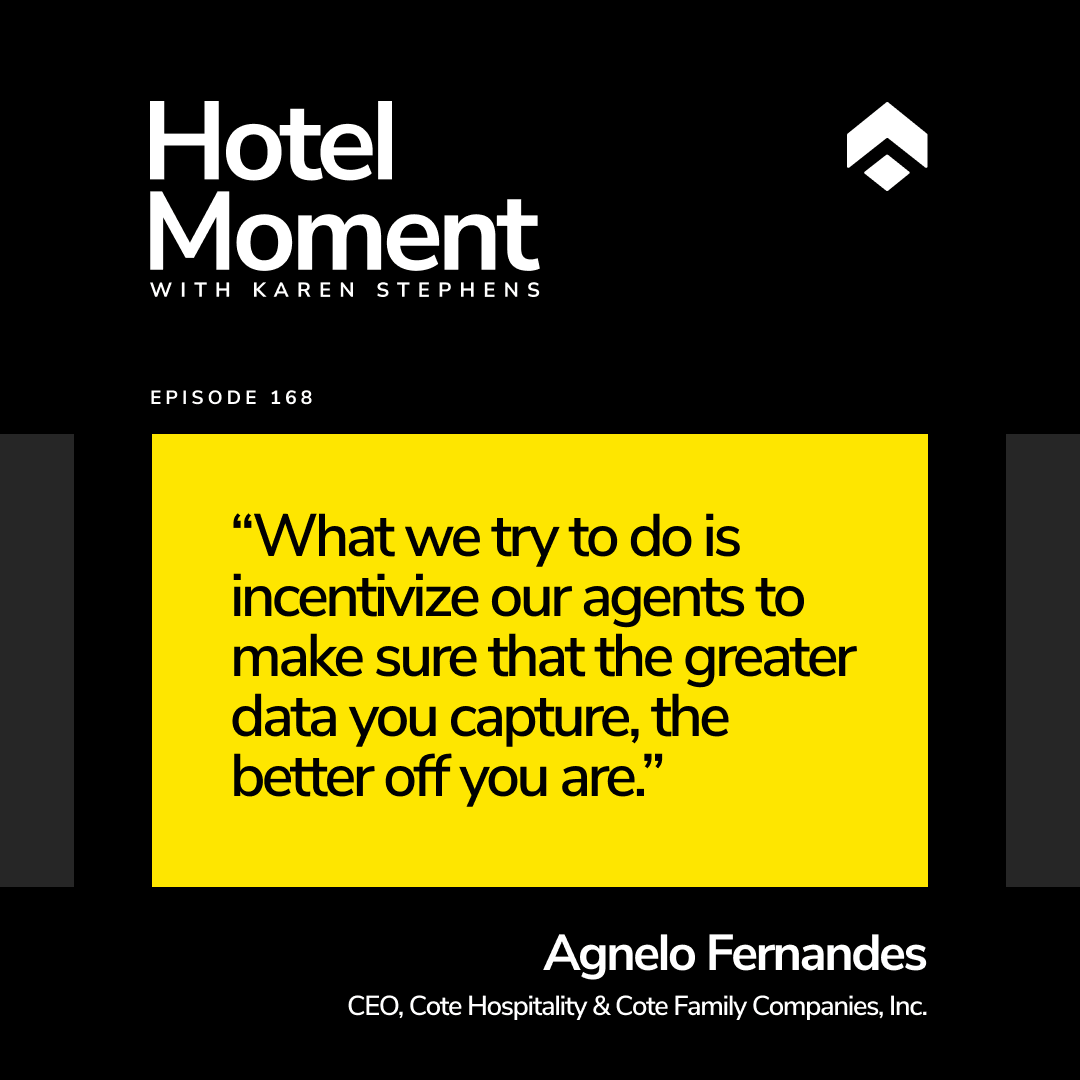
[00:14:20] Agnelo Fernandes: Yeah, I mean it’s just part of the script, right? Sometimes you will find people hesitant to give their phone numbers out. But I think one of the things that’s changed the game is the ability to market to people on either text messaging or the WhatsApp platform, right? So that’s becoming more and more prevalent. But people are still hesitant. We do ask the question and in some cases they’ll offer it up, and in some cases they’re like just connect with me on email and we’ll take it from there. The importance of the phone, as you said, it’s gonna get more and more critical. So what we try to do is we try to incent our agents to make sure that the greater data you capture, the better off you are. It’s just not necessarily getting an email and an address, but an actual phone number — then you can actually build your incentive bank if you’re able to capture all that data. I personally am one of those that still doesn’t want information on my phone. But I do travel a lot. So I’m now seeing a lot of people move to the WhatsApp platform. On the WhatsApp platform I’m able to filter messages and phone calls better than I can on my, let’s call it, Verizon or T-Mobile line. So it is a challenge. The only way to do it is to have it in the script. Make sure that they can ask the question at least twice without being intrusive. And then the third piece is agents — if they’re motivated, they will have a better opportunity to capture something as critical as a phone number.
[00:15:42] Karen Stephens: Absolutely. I think it’s interesting because, I mean, as the generations change — I’m the same. Like I don’t like to get blown up on my phone. So I like to talk to people on the phone. And certainly if I’m booking the vacation of a lifetime or I want to go have a culinary experience, I want to understand, and I would much rather talk to somebody than read a bunch of stuff. Text messaging is a little different, but I also recognize that I’m of a certain age and I think generations that are coming up are so used to that as a method of communication. So I think the upshot is you need to be available on all channels for all guests. It has to be an omni-channel approach. Otherwise you’re really missing a trick. Do you agree?
[00:16:21] Agnelo Fernandes: I totally agree. It needs to be on the channel — it’s how much information you can actually draw from them. What’s interesting though, is just talking to a bunch of students a couple of weeks ago, and they look at text messaging as, it’s annoying, they will block you out and all that good stuff. The two ways — not to get into social media, but TikTok obviously is where they all reside and spend most of their time — but they also seem to be very, very involved in WhatsApp, where filtering is a lot easier. And I think that’s honestly where it’s at. It’s giving them, or the customer, the ability to say I don’t want to hear this message, or I want to filter, I want to mute this message. On text messages, even if you mute somebody, there have been instances where people are getting through with different phone numbers and the like. But I do think that’s gonna evolve, Karen. I do believe that.
[00:17:13] Karen Stephens: It’s absolutely evolving. What we’re looking at is maybe a text is the way that we introduce a conversation, but then it goes to a web browser that’s branded — it becomes web chat where you can go in through on a laptop or on a mobile device. So it does allow people, instead of just getting kind of a weird short code and you’re not sure what’s going on there, we think about that evolution. So it’s very cool to think about how all of this is starting to intertwine. I mean, let’s get a little crystal ball about 2026, which is here. We’re moving through it pretty quickly. But as you start to think about the majority of calls that come into a reservations center are not bookings. They are service calls. I mean, anywhere between 16% to 34% of inbound calls are reservations, which means the rest of them are something else. So how are you starting to think about AI helping to filter out those calls and get to people still a great experience, but maybe not a human for some of those calls?
[00:18:12] Agnelo Fernandes: So I think that’s an astounding number, right? I mean, when you think about 16% to 34% are real booking needs — which is kind of, I infer that most of those other calls are service calls. But truly the revenue ones are the more precious ones, and just naturally speaking. I think the structural fix here is how do you separate the responsibilities and the tooling, right? So I would ensure that we give sales protected capacity along with the data that’s built on CDP right now, so they’re not wasting time, sixty to ninety minutes fishing for information. But this basic information, if done right, can be segmented in ways that I think enables people to focus on conversations that convert. Most of the time I find — when I listen to some of the calls — an agent, sometimes if they have not done their research like anything else, right, then you’re floundering on that call. But if you can understand what it means to protect sales time — dedicated revenue phones, prioritize call queues at peak times — the most important thing is the FAQ and leveraging AI to enable you to have information at your fingertips, whether it’s booking confirmation, housekeeping requests — sort of all of this can be handled by AI. And I think by segregating the two, making sure that your back-end information is AI-filtered — ’cause we’ve done that. I mean when we put together our FAQs when we started working with RezForce, our FAQ’s went ten notches up because we had it but it was fragmented, number one, and then sometimes even worse — outdated. So once you have that and you put it through an AI filter, we’ve seen a big difference. And I think especially during the peak seasons when the guest is a little more ready to book, there are times we want to make sure that we’re not slowing the process down. When they ask for something, we had that information at our fingertips. And so we’ve leveraged AI in several facets in terms of helping us to get to that point where conversion is possible.
[00:20:14] Karen Stephens: I love that. You know, one thing we’ve said over and over again, and I think this is important, is that AI doesn’t like data silos, right? AI is only effective if the data is clean, it’s synthesized, and it’s in one place, right? So that is kind of why we built a CDP to be able to do that. And I think as things are moving faster now than they ever have, the importance of having a repository of clean data that can be accessed — because honestly, six months from now, Agnelo, we don’t even know. This is how fast it’s moving, right? You and I could be having a very different conversation in six months about what is possible. Right. So if you don’t have your data in one place and you don’t start from that foundation, you’re never going to be able to access it. And I think that’s a point well taken. You want to have AI help agents to do what they do best, which is convert that call, and not spend time trying to figure out where the answer is.
[00:21:06] Agnelo Fernandes: Absolutely. And if you take it to another level in terms of thinking about — and this is what we’ve done — we’ve leveraged that FAQ database that we started when we sort of signed on with RezForce to leverage that as training material, because frontline staff knows this stuff, but sometimes you don’t translate that to the back-end. So this has become a repository not just for selling, but also flipping that around and using it for training. But clearly you first need to make the sale before you start training somebody. So understand the points on that.
[00:21:37] Karen Stephens: And I just want to clarify for our listeners, RezForce is Revinate’s on-call agent service. So when Agnelo’s team logs off, our team picks up, and they need to make sure that even if you’re calling somebody that doesn’t work at the hotel, it sounds like they do, because they have all the same information at their fingertips. That’s great. So looking ahead, as we think about the future of the voice channel, what investments or mindset shifts will separate hotels that grow voice revenue from those that quietly lose it?
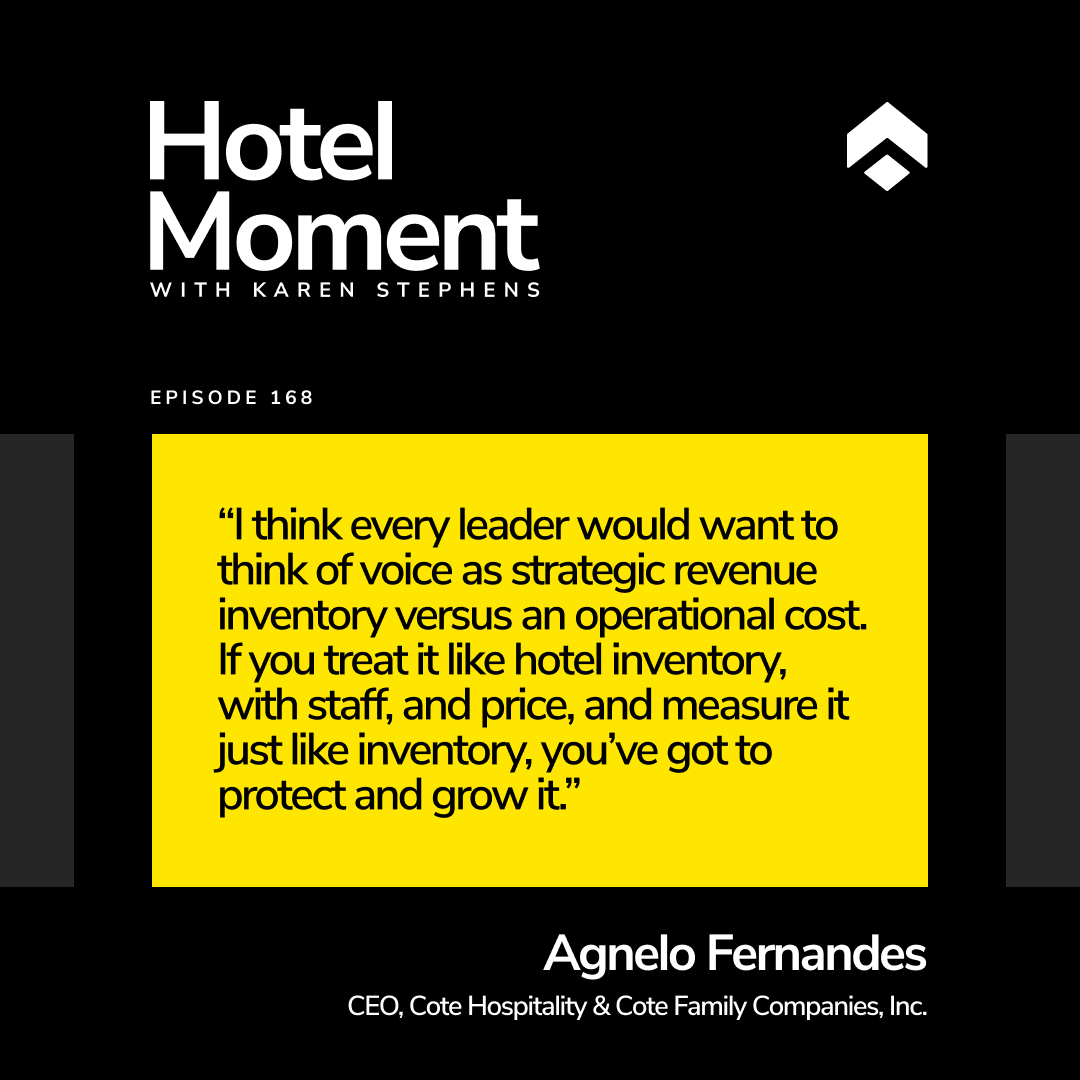
[00:22:06] Agnelo Fernandes: That’s a great question. In my mind, I think the key word that you used there is that mindset shift. There’s no question, and I think every leader would want to think of voice as that strategic revenue inventory versus that mindset of it being an operational cost, right? If you treat it like hotel inventory, we’ll staff and we’ll price and we’ll measure it just like inventory. But I think we’ve got to protect it and grow it. So the way I look at it is that if you have the mindset in place, then in terms of how you think of this as an investment — unified guest data and CDP, which I think is critical, and that kind of shows in all the trends that you’ve called out within your report — I think AI-assisted voice workflows, because AI can help with call prioritization. I think real-time agent prompts and post-call automation where you can see the booking links and the summaries. So agents are spending more time on selling versus doing the back-end work, right? And I think if you start with sort of safe, human-in-the-loop pilots, then I think that makes a big difference. So what do I mean by that? You maybe run a sixty-day revenue pilot project in your peak season and set it up just for revenue only as the queue, right? And then let your CDP feed the scripts, and you have these one-click booking links that we talked about when we use the phone. And I do believe the integration with operations — so that they understand that if you need to clear a service ticket, that’s different than distracting a reservations agent while he or she is converting a booking. And then measuring the lift in net revenue per call. But at the end of it, I look at it as — if you separate the roles, understand what is revenue, what is service. Upskill those that can hunt with that mindset of being a consultative closer, having those scripts at their fingertips, having those fallback strategies, so that they can convert. I think that to me is the game changer. Just sort of wrapping up my comments in that sense is — think of it as a strategic revenue inventory and not an operational cost. And then you’ll see that voice actually does what it’s supposed to do. And we’ve seen this over the years — it is the highest touch and highest profitable channel that you can own. And at the end of the day, if you own that customer, you own them for life. And I think that’s how you protect and grow it.
[00:24:32] Karen Stephens: I love it. Thank you so much, Agnelo. It’s a pleasure to see you and we will see you in Phoenix.
[00:24:36] Agnelo Fernandes: Sounds good. Thank you.
[00:24:42] Outro: Thank you for joining us on this episode of Hotel Moment by Revinate. Our community of hoteliers is growing every week, and each guest we speak to is tackling industry challenges with the innovation and flexibility that our industry demands. If you enjoyed today’s episode, don’t forget to subscribe, rate, and leave a review. And if you’re listening on YouTube, please like the video and subscribe for more content. For more information, head to revinate.com/hotelmomentpodcast. Until next time, keep innovating.
Episodes
Hotel Moment
WITH KAREN STEPHENS
Subscribe for updates on your favorite platform