The Revination
June 2026
Explore Revinate’s monthly digest of hospitality’s latest insights and tips. As hoteliers, we know you’re flooded with information. The Revination simplifies that noise, making it easier for you to focus on what’s happening in hospitality, why it matters, and what action you can take today. We also share our perspective on industry trends and highlighting the strategies driving game-changing results for hotels like yours. Subscribe on LinkedIn.

Why guest relationships are your summer superpower
Fewer people are traveling this summer. Yet, those who do travel are spending 17% more than last year. At the same time, the way travelers discover hotels is changing just as quickly. One in four travelers now uses generative AI to help plan trips, making AI-powered recommendations an increasingly influential part of the booking journey.
Every guest, every interaction, every opportunity matters even more.
The hotels that win this summer won’t be the ones chasing volume. They’ll be the ones building stronger guest relationships, delivering personalized experiences, and showing up wherever travelers are looking for inspiration and recommendations, from traditional search engines to AI-powered assistants.
Numbers that matter
Why every summer traveler is worth more in 2026
Only 45% of Americans plan to take a paid-lodging trip this summer, according to Deloitte’s 2026 Summer Travel Survey. While the traveler pool is shrinking, the guests who are traveling expect to spend 17% more than last year, averaging $4,069 per trip.
The takeaway? Fewer travelers are competing for hotel inventory, but each traveler represents a larger revenue opportunity.

Why it matters for hoteliers
When traveler volume declines, many hotels instinctively focus on filling rooms. But this summer’s data suggests a different strategy may be more effective.
Today’s travelers are spending more on accommodations, dining, experiences, and upgrades. That means maximizing the value of every booking is just as important as generating new demand.
The hotel heroes who come out ahead this season will focus on strengthening guest relationships before, during, and after the stay. Personalized offers, targeted upsells, and tailored communications can help turn a single reservation into a higher-value guest experience.
With fewer travelers in the market, every guest interaction carries more weight. Hotels that know their guests, anticipate their needs, and create memorable experiences will be better positioned to capture a larger share of traveler spending while building loyalty that extends beyond a single stay.
What’s Revinate’s take?
This trend reinforces a simple truth: relationships are the ultimate hospitality superpower.
When every booking matters more, guest data becomes one of a hotel’s most valuable assets. Understanding guest preferences, recognizing loyalty, and delivering relevant experiences help hotels create stronger connections and drive more revenue from every stay.
The future belongs to hotel heroes who use guest insights to deliver personalized experiences that guests actually value. In a market with fewer travelers, stronger relationships become a competitive advantage.
Trends that matter
One in four travelers now uses AI to find hotels. Here’s what that means for discovery.
One in four U.S. travelers now uses generative AI to help plan trips, according to Deloitte’s 2026 Summer Travel Survey. That’s up from 15% just one year ago — a 67% jump in a single year. Among millennials, adoption is even higher: 36% are already turning to tools like ChatGPT and Gemini for trip-planning guidance.

Why it matters for hoteliers
For a better part of the last decade, hotel discovery happened in two places: search engines and OTAs. Hotels optimized for Google. They competed on Booking.com. The playbook was well-worn.
AI trip planning doesn’t work the same way. When a traveler asks an AI assistant “where should I stay in Nashville for a long weekend?”, they don’t get 10 blue links. They get a recommendation — often just one or two — based on whatever data those models can access and synthesize.
The question hoteliers need to ask isn’t whether AI is changing discovery. It’s whether their hotel shows up when it does.
The answer depends on factors that have always mattered — review volume and quality, accurate property data, strong brand storytelling — but the stakes for getting them right are higher when the output is a recommendation rather than a ranked list.
What this shift looks like in practice
Search engines reward relevance across a broad set of signals. AI assistants reward clarity and confidence. A hotel with a weak digital footprint — inconsistent data across platforms, thin content, sparse or mixed reviews — is harder for an AI model to recommend with confidence.
Hotels that invest in a clean, consistent, well-documented presence are better positioned to earn visibility in AI-generated results. That means:
- Accurate, structured property data across every platform where travelers and AI models look
- Review depth and recency, which signal to AI models that a property is active and guest-vetted
- Clear, specific brand content that gives AI something concrete to work with when characterizing a property
None of this is entirely new. But the urgency is.
What’s Revinate’s take?
AI trip planning is one expression of a broader shift: guests are getting more direct paths to the properties they choose, and the hotels best positioned to earn that visibility are the ones with the strongest guest data foundations.
Clean guest data, reputation management, and consistent guest communication aren’t just internal tools anymore. They’re the raw material AI models draw from when deciding which hotels to surface.
Perspectives that matter

AI is reshaping how hotel teams market, sell, and engage with guests. Get the updated guide to see the biggest opportunities for your team — from personalization and guest messaging to predictive insights — so you can separate hype from strategies that yield real results.
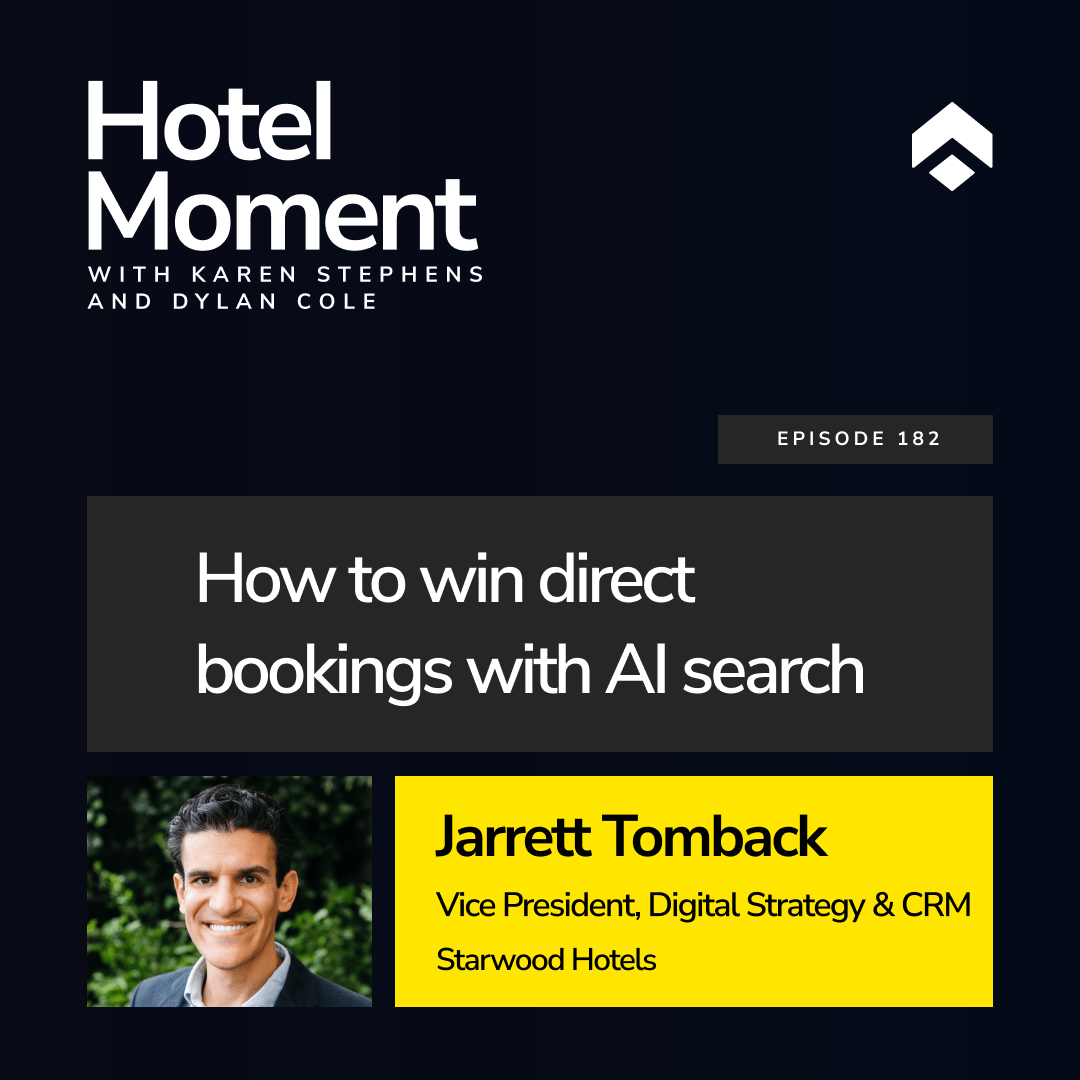
In this episode of Hotel Moment, Karen Stephens sits down with Jarrett Tomback, VP of Digital Strategy and CRM at Starwood Hotels, to explore how AI search is reshaping hotel discovery, direct bookings, and guest loyalty. From becoming the source of truth for AI platforms to building data foundations that drive visibility, they unpack what it takes to stand out in an AI-first world.