Hotel Moment
WITH KAREN STEPHENS


Episode 172
Is hotel marketing broken? Why siloed data won’t drive more revenue
Hotel marketers aren’t short on data. But they are short on connected data. And that’s why more emails, more campaigns, and more signals aren’t boosting revenue.
In this episode of Hotel Moment, Revinate CMO Karen Stephens chats with Evan Crawford of Pyramid Global Hospitality to show how siloed guest profiles are quietly sabotaging your results.
They dive into how connecting your data unlocks real personalization, why segmentation turns noise into revenue, and how AI only works when your foundation is solid.
The lesson is simple: Stop guessing. Start connecting.
Turning disconnected data into a unified strategy will position your hotel to drive more revenue, stronger engagement, and experiences guests actually notice.
Listen now and turn your data into your superpower.
Media
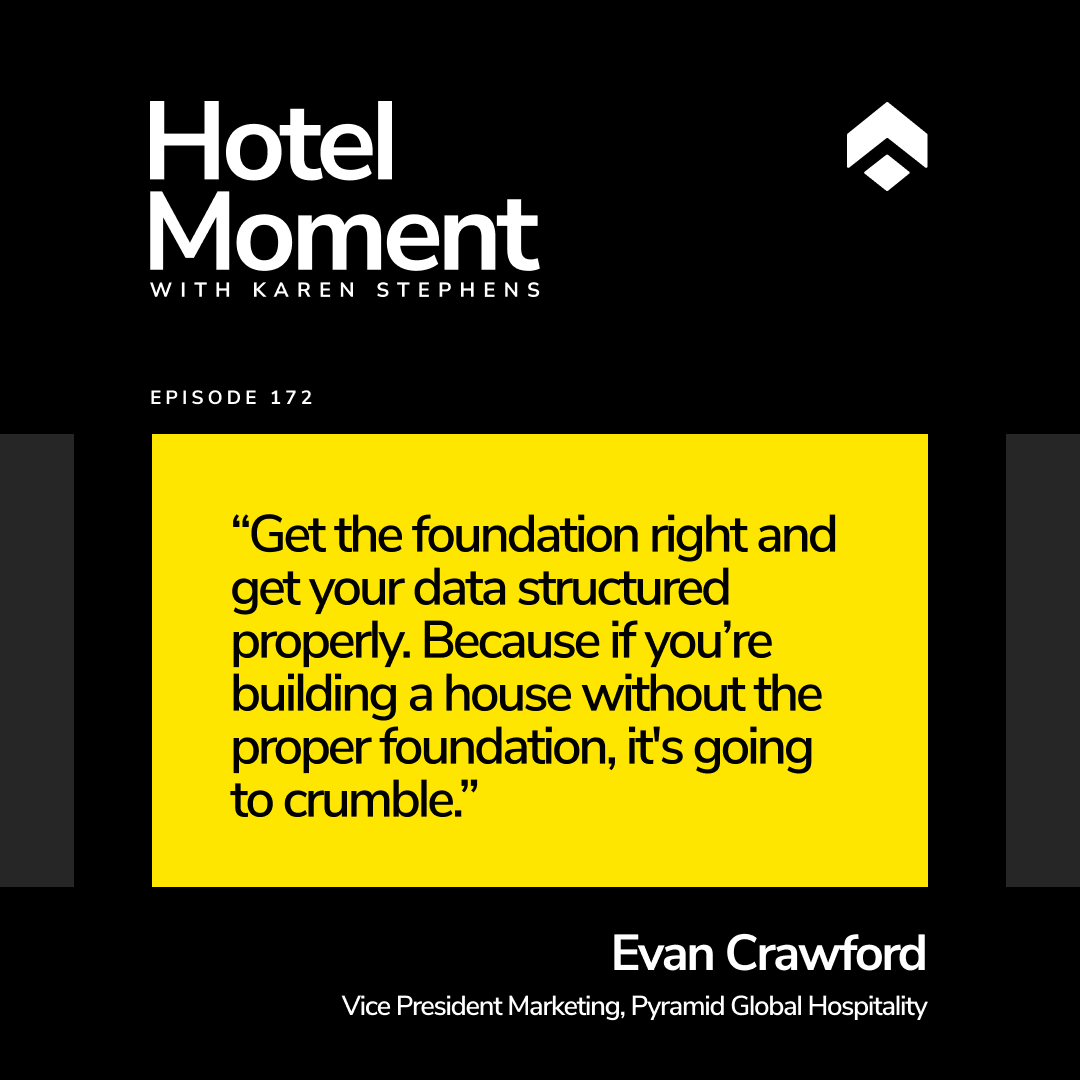
Data is your marketing foundation
Why data is the foundation of every hotelier’s success
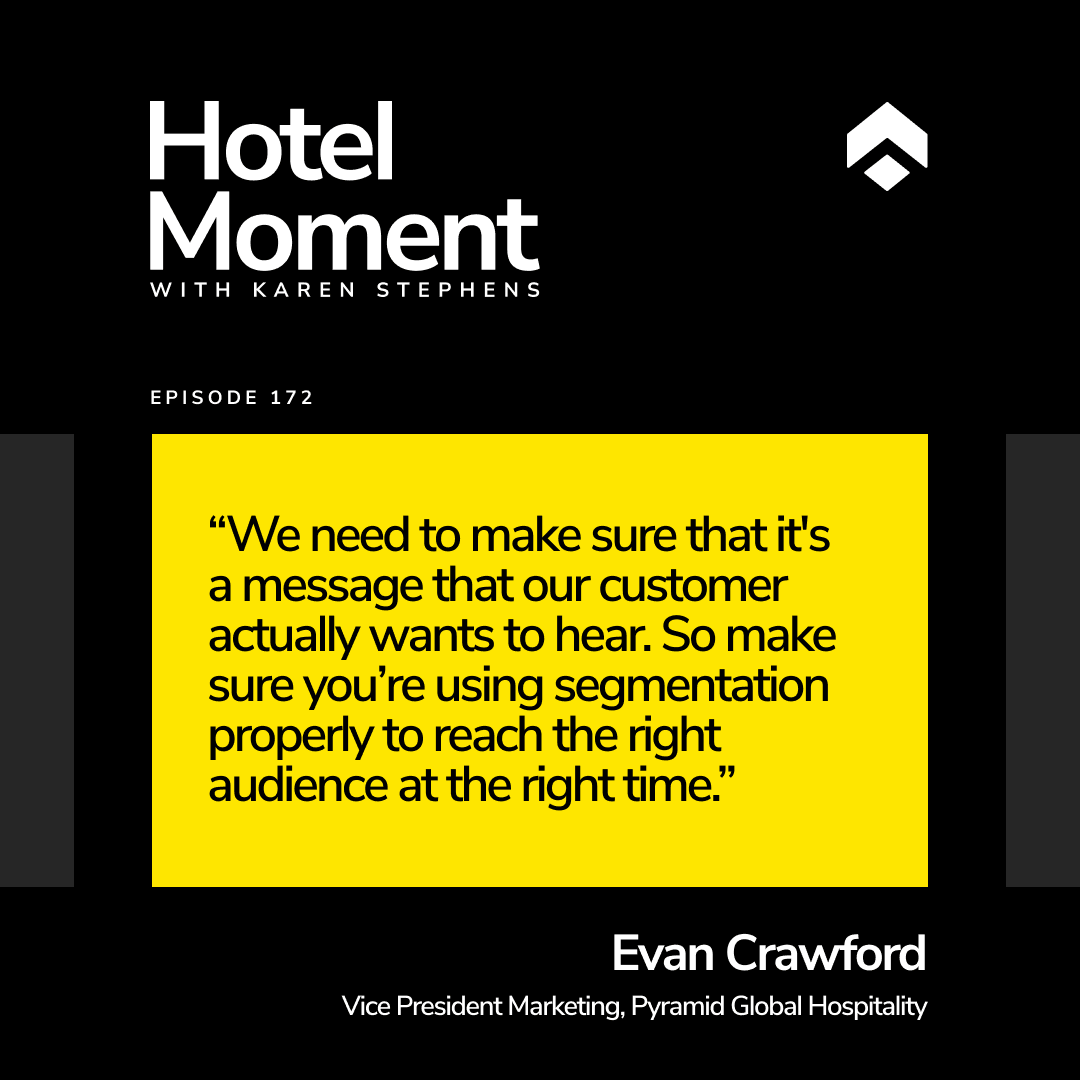
Timing is everything
The ultimate opportunity to eliminate data silos

Meet your host
Karen Stephens
As Chief Marketing Officer at Revinate, Karen is focused on driving long-term growth by building Revinate’s brand equity, product marketing, and customer acquisition strategies. Her deep connections with hospitality industry leaders play a key role in crafting strategic partnerships. Karen has more than 25 years of expertise in global hospitality technology and online distribution — including managing global accounts in travel and hospitality organizations such as Travelocity and lastminute.com
As the host of The Hotel Moment podcast, she interviews top players in the hospitality industry. Karen has been with Revinate for over 11 years, leading our global GTM teams. Her most recent transition was from Chief Revenue Officer, where she led the team in their highest booking quarter to date in Q4 2023.
Watch the video
Transcript
[00:00:00] Evan Crawford: We have so much data available to us, but that doesn’t mean we should just spray and pray and just send mass marketing to people all the time. It should just be crafted in a thoughtful way to make sure that the customer actually wants to act on the message we’re sending them.
[00:00:21] Intro: Welcome to the Hotel Moment Podcast, presented by Revinate, the podcast where we discuss how hotel technology shapes every moment of the hotelier’s experience. Tune in for our guest episodes where we explore the cutting-edge technology transforming the hospitality industry and hear from experts and visionaries shaping the future of guest experiences. Alongside our conversations with guests, we have episodes for you, hosted by Revinator Brenna Turpin, on resources available to you all. These resource-packed episodes have granular advice on overcoming industry and operational challenges so you can emerge as a hotel superhero. Whether you’re a hotelier or a tech enthusiast, you’re in the right place. Let’s dive in and discover how we can elevate hospitality together.
[00:01:06] Karen Stephens:Hello and welcome to the Hotel Moment Podcast. I’m your host, Karen Stephens, the Chief Marketing Officer of Revinate. And today we are thrilled to have Evan Crawford, Vice President of Marketing at Pyramid Global Hospitality, back on the podcast. The first time Evan was on was two years ago when we were live at our NAVIGATE conference in Miami. This year, NAVIGATE is taking place in Phoenix, and yes, Evan will be there again, but I’m so glad I got to catch up with him before that. He’s a strategic hotel marketing leader with an extensive background in driving revenue and growth and brand development. And he’s got quite an innovative approach to leveraging technology to enhance guest experience and optimize revenue streams. And you’ll probably pick that up during the conversation. Today, Evan and I break down some of the insights from Revinate’s 2026 Hospitality Benchmark Report, and Evan shares why hotels generate enormous volumes of data with our guest communication and feedback across messaging, reviews, and digital touch points. But the real opportunity lies in connecting these data streams and using AI to transform raw guest signals into actionable insights that improve experiences, reputation, and revenue. Hi Evan, welcome back to the podcast.
[00:02:15] Evan Crawford: Hi Karen. So glad to be here. Thank you so much for having me.
[00:02:19] Karen Stephens: Absolutely. You know, this is a wonderful time of year for all of us. It’s funny. We’ve got sales kickoffs, corporate kickoffs, NAVIGATE’s around the corner. And along with that, we also have our benchmark report that just released. So I really appreciate you carving out some time in between all those things to come talk to us again.
[00:02:35] Evan Crawford: Yeah, absolutely. It’s a pleasure. And there’s so much great data in the report. So great to be here.
[00:02:40] Karen Stephens: Yeah, let’s dig in. So what we wanted to talk about today was guest feedback. So this is an oldie but a goodie for Revinate. Obviously, our roots are in guest feedback. Over 16 years now we’ve been doing online reputation for hotels. So there’s so much feedback out there and I think we talk about this a lot about the importance of guest data. The issue is not getting guest data, it’s what you do with all of it. So can you talk to us a little bit about how Pyramid thinks about the importance of survey and reputation data and how to look at it?
[00:03:10] Evan Crawford: Yeah, I mean, I think from a range of different perspectives. I mean, obviously we want to make sure we’re mindful of guest feedback so we can enhance the customer experience. I think that’s first and foremost, so that’s the top priority. And we’re really trying to, through our partnership with Revinate and our own business intelligence tools, really make sure we’re aggregating that data and surfacing that clearly for ops leaders so they know what they can take action on. And it’s not just front and center for them, it’s also front and center for our senior leaders, so it’s an important point of conversation for them when they’re having conversations with the properties. So optimizing the customer experience is by far the top priority there. But also we know it is one of the primary cues and drivers of generative search. So as we’re looking at — you know, we’re in this kind of transition period as we’re going from organic search to GEO, or whatever acronym that people want to assign to it — but we know that people are using the large language models more and more for discovery, and guest feedback is central to what the models are using to give authority to websites and to content. So we need to be prioritizing it to make sure that we’re present and have a strong reputation when customers are searching a market for a product.
[00:04:34] Karen Stephens: Yeah, you’ve hit it on the head. The shift that is happening with AI and generative search, I mean it’s already happened and the speed at which it’s moving is pretty insane. So as you mentioned, as hoteliers, we’ve always leaned on guest feedback as being kind of the pinnacle to make sure that we’re delivering the right guest experience. But now when you’ve got LLMs that are combing all of that data to try and surface the right thing. So I’d love to understand — like, I know obviously you’re a customer of Revinate — when you started to think about getting all of these silos together, how are you using that data, not only for generative search and all of that, but are you also taking that data and putting it in other systems to understand better how to operate?
[00:05:13] Evan Crawford: Yeah, I think so. I mean, I think right, and Revinate — I mean, just thinking about how we’re segmenting data — I think is a key area where we’re thinking about who our net promoters are. How are we targeting those individuals versus those individuals who may be detractors and may need some service recovery before they’re willing to do business with us again? You know, I think there is a significant opportunity, as you talk about data silos, as we have our customer sentiment that we have coming to us through Revinate. But as we connect more platforms to Revinate, what are the messages that we’re receiving through those platforms — whether it might be a golf reservations platform or OpenTable or you name it that we can plug in — are there ways that we can pull that data in as well to augment or enhance the data that we have coming in on our customers and connect the dots between it? So, you know, if — maybe a customer left us a review on OpenTable and had a horrible experience at a restaurant, but all we know about them is that they love the hotel. Well, that’s not necessarily a fully baked set of data. We should probably know that they had a really poor experience in a restaurant, but other than that, they loved the resort. But if we’re not augmenting that guest profile to understand the complete customer experience, then we’re just missing a key data point there. So I think there are just opportunities, as we connect more and learn more about what we can do with it, and then AI comes in to inform us that we should know that. I think we’ve even talked about it when I’ve been on here before about AI being used as an efficiency for us and to help us make smarter decisions. And that’s an opportunity there where we might not see that right away without doing a tremendous amount of digging, but AI or machine learning could help us to understand that so we can take the right action.
[00:07:14] Karen Stephens: Absolutely. And it is so fascinating to me. I think you really hit it on the head there. The data for your guests lives in many different places. So it’s not only the hotel stay where they might fill out a survey or do a quick on-site NPS score or whatever. It’s the restaurant, it’s the golf, it’s all of that, and assembling all of that. And then thinking about AI being able to come in and surface insights or to even take action. But if your data isn’t clean — because AI can also hallucinate — so if you think you have a guest and you’ve got the wrong guest or you have the wrong set of data. You know, we explain this a lot, because people say, “Oh, well, AI will just replace all software out there,” and it’s like, well, hang on a minute, because AI is only as good as the foundation of data it’s sourcing from. So if your data’s not clean and synthesized, you’re really nowhere.
[00:08:02] Evan Crawford: Absolutely. And we talk about that all the time when we’re having any conversation around AI. There are a lot of shiny objects out there that I kind of liken to the days of talking about organic search optimization — you know, there were all these companies telling you that they could get you the number one ranking on Google, and they’ve got the magic formula to do that. And there are a lot of shiny objects like that right now in the AI space as well, telling you that AI is your savior. And what we’re really trying to focus on is making sure that we’ve got the right foundation, and that we’re getting — whether it’s our website data structured properly, of course through our CRM and CDP — making sure that that information is structured properly. But the foundation is key because if we’re building a house without the proper foundation, obviously it’s gonna crumble. So it’s vital.
[00:08:56] Karen Stephens: Yeah, that’s really the core. And I think, you know, as a vendor operating in this space, obviously we power the CDP and our kind of core proposition is that rich guest data. Our take is like, look, we gotta be able to power our native applications — you know, Revinate Marketing, Reservation Sales, all of that needs to be powered from our CDP. But we would really be missing the boat if we didn’t enable our customers to also activate that data wherever that might want to be activated, because our stance is you own the data. And you might want to take that and activate it through an AI platform, but we seek to be the source of data that is, for lack of a better word, clean and ready to rock. Instead of — I don’t think any vendors are going to be able to cover all use cases. I think what you have to do is know that, hey, whatever is going to interact with my guest data, the source of data is clean and ready to go.
[00:09:43] Evan Crawford: Yep. You need a central source of truth and you need that to be secure, and that’s the ball game right there.
[00:09:49] Karen Stephens: That is the ball game. So looking out, I’d love to hear — you know, we talk about what are all the cool things and this is a bit of crystal ball gazing, but it’s kind of fun, right? I know you must have sales calls from people all the time. So what are you seeing out there in the space? Is there any cool AI stuff that you’re seeing? Or is there stuff — you don’t have to name the vendor — where you’re like, “Oh my gosh, this would never work, you’re hallucinating with AI”?
[00:10:11] Evan Crawford: Yeah, no, I don’t know — I don’t even want to call it negative, but on the overpromising side, there are some things out there promising to really enhance your rankings through the large language models. And in some cases I’m sure that’s true. We’re doing some testing with a platform that kind of takes a different approach to things by really focusing on structure. It provides us a tremendous amount of data on how we’re performing — it’s testing a wide range of prompts about our hotels and how they turn up, and giving us feedback on the information from Claude to Perplexity to OpenAI, what is being given back through the large language models based on specific prompts, and then allowing us to go in and in some cases correct the answers and provide authority to the answers by feeding information back up to the large language models. So that’s really interesting to me because, again, it’s about that structure and the foundation of the data that you own. And so we know that, just like guest feedback, authority and credibility is one of the cues. So for us to be able to answer this wide range of prompts, it’s almost like a website’s FAQ page on steroids. So we’re going through and getting into the weeds on everything there is to know about our hotels and then saying, yes, that is true, that’s coming from us. So almost a way to seed the large language models. I find that to be really interesting. Obviously the commerce side of things, seeing how that evolves — you know, what Google does here in the coming months or years on the commerce side, making sure that hopefully the OTAs don’t get the inside track on some way to monetize these searches. But obviously commerce is huge because if we get an opportunity to actually transact within the large language models, that will change everything. But as it stands right now, again, going back to that foundational structure, there are a lot of tools leveraging MCP, which is a connection protocol that allows us to feed data right from sources directly to large language models. So there are a lot of platforms leveraging that in a variety of different ways. So yeah, I mean, there are a ton of products out there as you know.
[00:12:35] Karen Stephens: There are so many applications. But I want to touch on a couple of things. So for our marketers out there, I hope that you’re hearing here that what’s important is having original content. So whether that comes from reviews — that’s credible, original content that comes from reviews and surveys and feedback from your guests — or it comes in from your marketing team who are making sure that you’re describing the property and all the facilities to the best of your ability so that the prompts are picking up on the right thing. AI does not like AI-generated content. So let’s make sure that we know that. I think we’re always going to need the creative end to feed the models, which is really important. And then the other thing I wanted to mention — since I know you’re coming to NAVIGATE, it’s at a Pyramid property, it’s at the Wigwam in Phoenix — we’re going to have on stage with our CEO the Head of Google Applied Analytics, who’s going to be joining us to talk about kind of the future, already what we’re seeing with consumer trends, but how hotels can get on that train. It sounds like you’re already on the train, but how you can evolve as quickly as all of these models do. So I think it’ll be a really interesting conversation.
[00:13:38] Evan Crawford: Yeah, and I think it’s just — you talked about content, and understanding that when we’re crafting content, you’re speaking to the consumer, but you’re also speaking to that audience that is the large language model. So you have to almost think about that as part of your audience because, you know, instead of planting keywords everywhere like we used to do, we have to have this rich content that in some ways is written to answer potential prompts.
[00:14:05] Karen Stephens: Wow. It’s really a fascinating time, actually, Evan. I think some people get a little nervous with the speed at which everything is moving, but I think for those of us — and I mean you’re obviously in this camp — that are embracing it, what an exciting time to be in hotels. Fascinating.
[00:14:21] Evan Crawford: You know, I mean, I think in any industry it’s exciting. It’s maybe a little bit scary. But it’s funny because when we look at our data, obviously our primary source of revenue is not AI or the large language models. I mean, even our Revinate emails drive more direct last-click revenue than ChatGPT does at this point. Obviously Google being the number one source of business through traditional organic search. So it’s also — yes, we want to get ahead of this, we want to have the foundation, but we also can’t turn our back on the tried and true strategies that have made us successful historically. So, like any big transition or change in our business landscape, yes, we want to prepare and get our house in order, but it’s not just preparing for AI. In many ways, it’s doing marketing the right way in general. I mean, content marketing being a priority should have been a priority for a long time. This shouldn’t be new, so if we’re just now scrambling to say, “Oh my gosh, we need to develop content,” then we were doing it wrong for years before this.
[00:15:31] Karen Stephens: Right. Shout out to all my content marketers, right? So that’s great. So kind of going back to the benchmark report, when you think about getting this report, how does your team use it to make sure — hey, are we on pace? Are we looking at the right things? Like when you open this thing up, how do you kind of think about going through the insights?
[00:15:49] Evan Crawford: Yeah, I mean, obviously there’s a ton of data. I think some of the things that I pulled out was just the volume of emails and touch points that are both being sent and that are available to us — you know, the amount of people that are available to reach. And thinking about just being really thoughtful about how we approach communicating with our customers. Because some of the areas I looked at were that the volume is higher, engagement is high, but revenue through some of these channels is down in some cases. So I just think it’s important to put ourselves in the consumer’s shoes. I mean, I get a hundred text messages a day and all these marketing emails — and just being really thoughtful about how we communicate with people and make sure there’s truly something of value to communicate. I think we get on revenue calls sometimes and maybe there’s a need period and it’s like, “Oh, let’s just send an email, let’s get this message out to the masses and make sure they know how great this offer is that we’re putting out there.” But we can’t just do that over and over and over again. Each time you do it, the value proposition becomes a little less. And we need to make sure that it’s a message that our customer actually wants to hear. So making sure that we’re using segmentation properly, reaching the right audience at the right time. So yes, those are some of the key things, because we have so much data available to us, but that doesn’t mean we should just spray and pray and just send mass marketing to people all the time. It should just be crafted in a thoughtful way to make sure that the customer actually wants to act on the message we’re sending them.
[00:17:36] Karen Stephens: Right. Kind of going back to the top of the conversation, you’re collecting so much data across all of your different systems, and obviously you have loyal guests — they already love your property. So if you can demonstrate to them with the way that you communicate with them that you understand who they are — you know, do you know that they’re a golfer as opposed to someone who goes to the spa? Or maybe even know that they didn’t have the best experience last time, being able to send an email to correct that. I mean, let’s talk about that. It’s not always sunshine and rainbows. So how do you think about online reviews and service recovery when you have something that doesn’t go well?
[00:18:07] Evan Crawford: Yeah, I mean, you know, we talked about making sure we’re looking at detractors versus promoters and potentially crafting messages accordingly, or just making sure that — like if someone really hated their experience — there are some cases where someone just might not be coming back. You know? But we probably shouldn’t be sending them that warm, sunshine and butterflies email either. So making sure that we’re excluding those folks from lists so we don’t upset them even more when we send them some marketing message. But to your point, there is opportunity there. You know, it doesn’t always have to be an offer. It could be a personal note from the GM inviting them back and making it a bit more personal, acknowledging that their last experience may not have been ideal and we want to make it right. They’ve been loyal to us and we want to regain their trust. But again, it just goes back to making sure we’re segmenting properly so we can actually do that.
[00:19:06] Karen Stephens: Right. And I think we want to underscore — you want to do that privately. You can do that privately with email communications, and please do it publicly if they’ve left a review that is not so stellar. You know, it’s really important. Still our number one blog post to this day is how to respond to negative reviews. So I would just encourage anybody — that right there, showing that, hey, we acknowledge that maybe you didn’t have the best time and we’re gonna reach out to you, shows other people who are reading those reviews that the GM cares, that the property cares about the experience.
[00:19:34] Evan Crawford: Well, and what I always tell people when responding to negative reviews is that, in many cases, that response is not for the customer that actually left the review. That person may likely never be coming back to the hotel. But it can be used, as to your point, to acknowledge the concern and show genuine care. But it can also be used as a soft sales tool to talk about what the experience could or should have been like. If a customer writes a negative review and they’re complaining about the lack of amenities or the things to do in the area, that’s an opportunity for you to acknowledge that they didn’t have the best experience, but also, hey, here’s all the things we wish you would have experienced during your stay. So it’s an opportunity to highlight the positive. I always, whenever I’m coaching on negative review response — it’s always: acknowledge the concern, acknowledge specifically what the negative elements were so we can take accountability for that, but then transition to positive. If you can close the message with a positive tone, that’s key.
[00:20:36] Karen Stephens: That’s right. And as you said, it’s not only for the customer to let them know you heard them, but it’s for everybody who’s reading that review across all of these different channels. It’s tantamount. Well, Evan, lots going on out there. Really looking forward to seeing you in Phoenix just in a month’s time. So thank you so much for being on the podcast. It was great to see you.
[00:20:54] Evan Crawford: Yeah, it’s truly my pleasure. Thank you so much for having me, Karen, and look forward to seeing you in less than a month here.
[00:21:00] Karen Stephens: Less than a month.
[00:21:02] Outro: Thank you for joining us on this episode of Hotel Moment by Revinate. Our community of hoteliers is growing every week, and each guest we speak to is tackling industry challenges with the innovation and flexibility that our industry demands. If you enjoyed today’s episode, don’t forget to subscribe, rate, and leave a review. And if you’re listening on YouTube, please like the video and subscribe for more content. For more information, head to revinate.com/hotelmomentpodcast. Until next time, keep innovating.
Episodes
Hotel Moment
WITH KAREN STEPHENS
Subscribe for updates on your favorite platform