Hotel Moment
WITH KAREN STEPHENS


Episode 171
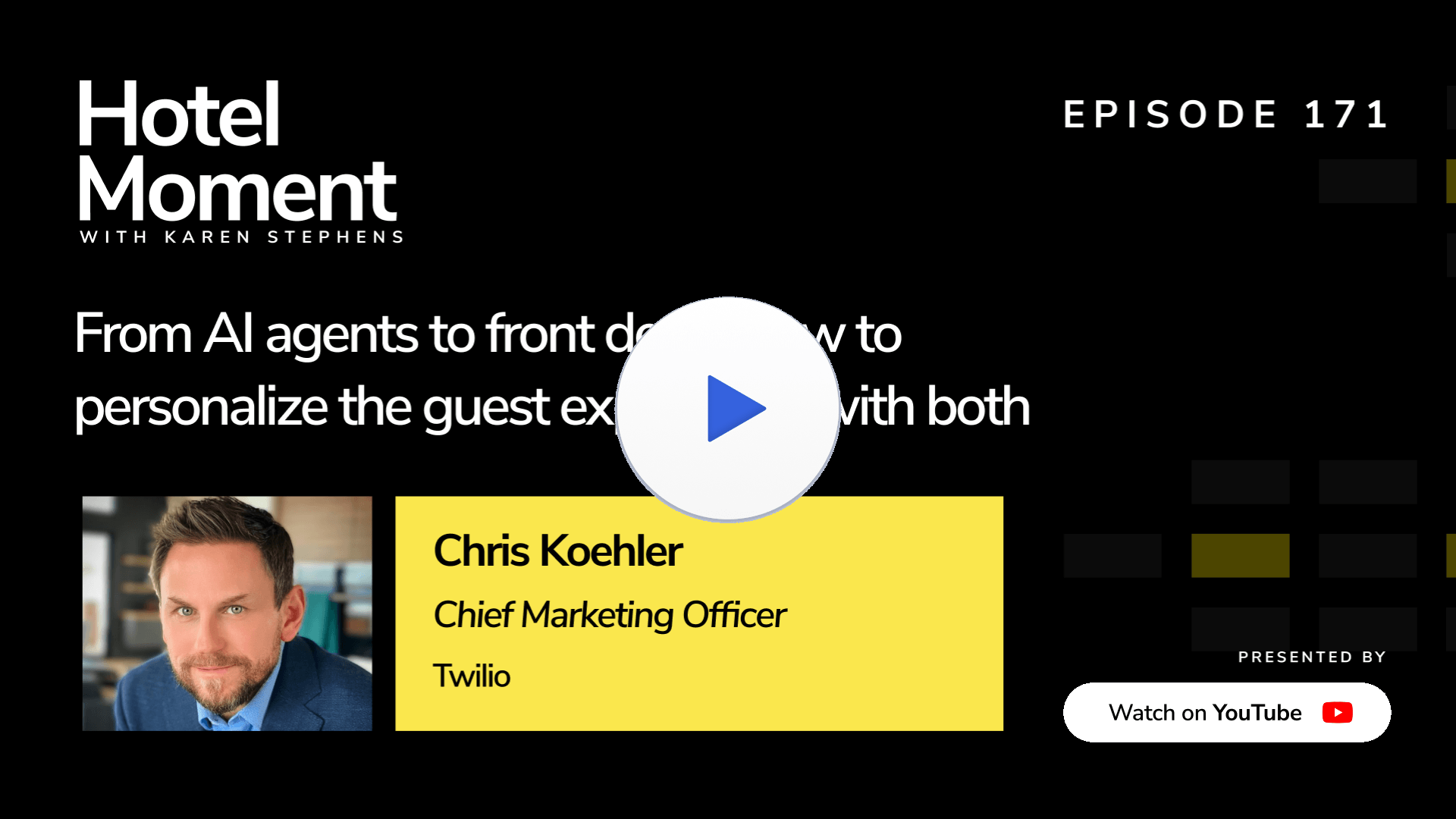
From AI agents to front desk: How to personalize the guest experience with both
Personalization has been every hotelier’s goal for years. But the challenge isn’t whether you have guest data, it’s whether you can actually use it when it matters.
In this episode of Hotel Moment, Revinate CMO Karen Stephens sits down with Chris Koehler, CMO at Twilio, to dig into why data acquisition — not data collection — is the real barrier to better guest experiences. They explore the growing gap between how brands think they engage with customers and how guests actually experience it — And how to close that gap with clean, connected guest profiles that give teams the context they need across every touchpoint.
They also look ahead to how AI will reshape the travel journey, from trip planning to booking. As AI agents become part of how guests interact with brands, hotels with the most accessible, unified guest data will be best positioned to personalize experiences and build lasting loyalty.
The future of hospitality personalization starts with getting your data ready to work for you.
Media
Choose clean data and eliminate your data problem
Collecting the context
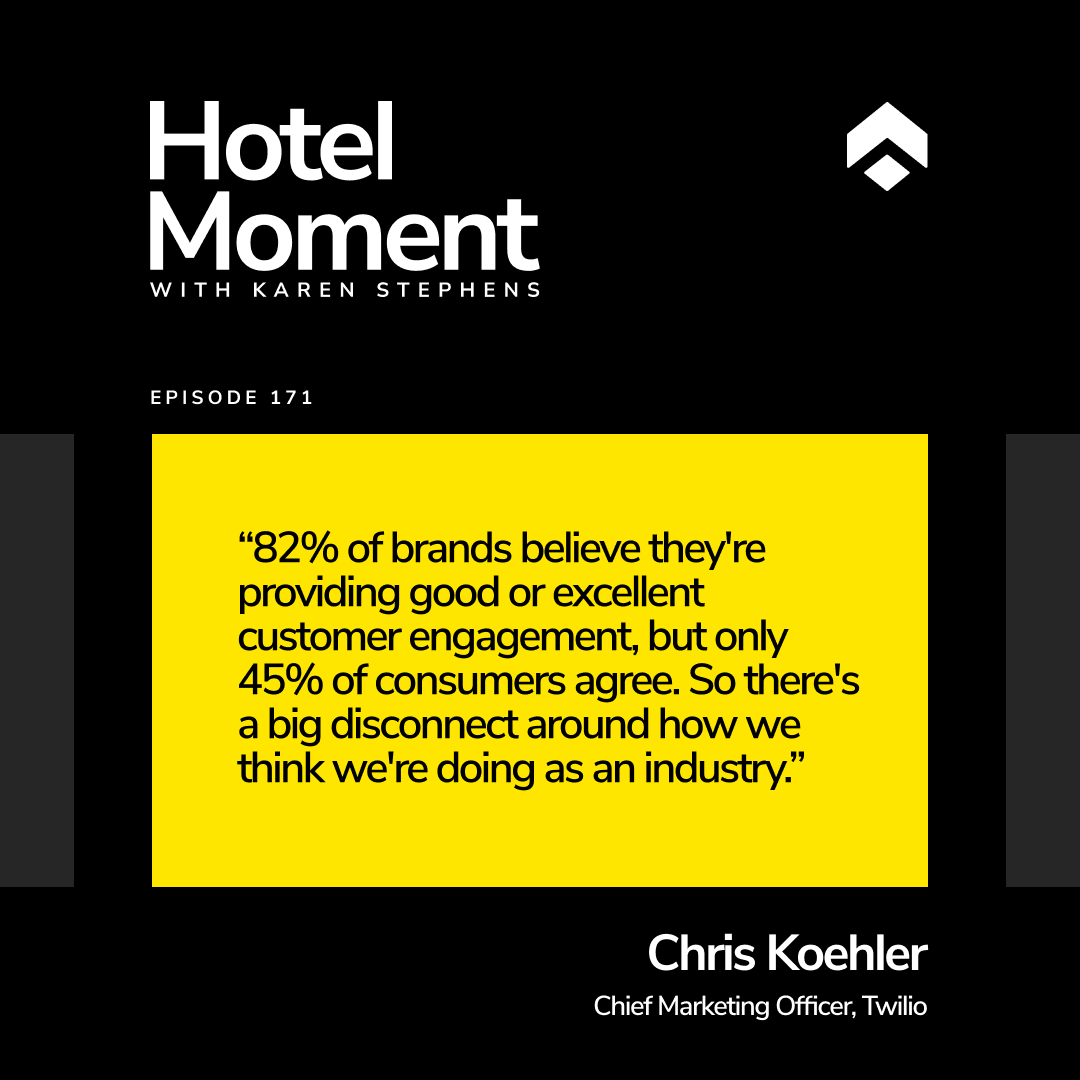
What your guests really think
Don’t waste it

Meet your host
Karen Stephens
As Chief Marketing Officer at Revinate, Karen is focused on driving long-term growth by building Revinate’s brand equity, product marketing, and customer acquisition strategies. Her deep connections with hospitality industry leaders play a key role in crafting strategic partnerships. Karen has more than 25 years of expertise in global hospitality technology and online distribution — including managing global accounts in travel and hospitality organizations such as Travelocity and lastminute.com
As the host of The Hotel Moment podcast, she interviews top players in the hospitality industry. Karen has been with Revinate for over 11 years, leading our global GTM teams. Her most recent transition was from Chief Revenue Officer, where she led the team in their highest booking quarter to date in Q4 2023.
Watch the video
Transcript
[00:00:00] Chris Koehler: Those that are gonna engage and be fully agentic, you know, not do any of the work themselves, that’s one segment. And then I think you’re gonna have those that value the human touch and the human experience almost as a luxury.
[00:00:17] Intro: Welcome to the Hotel Moment Podcast, presented by Revinate, the podcast where we discuss how hotel technology shapes every moment of the hotelier’s experience. Tune in for our guest episodes, where we explore the cutting-edge technology transforming the hospitality industry and hear from experts and visionaries shaping the future of guest experiences. Alongside our conversations with guests, we have episodes for you, hosted by Revinator Brenna Turpin, on resources available to you all. These resource-packed episodes have granular advice on overcoming industry and operational challenges so you can emerge as a hotel superhero. Whether you’re a hotelier or a tech enthusiast, you’re in the right place. Let’s dive in and discover how we can elevate hospitality together.
[00:01:02] Karen Stephens: Hello and welcome to the Hotel Moment Podcast. I’m your host, Karen Stephens, the Chief Marketing Officer of Revinate. And today we are joined by Chris Koehler, Chief Marketing Officer at Twilio, where he leads global marketing for one of the world’s most trusted consumer engagement platforms. With over 25 years of experience across marketing, analytics, customer success, and product leadership at companies like Twilio and Box, Chris has a deep understanding of how brands build direct, personalized relationships at scale. His work sits at the intersection of data, communication, and trust, making him uniquely positioned to help hospitality leaders understand how emerging technologies like AI can improve guest experiences without losing the human touch. And I think what you’re really going to enjoy about this conversation, listeners, is that Chris is exactly the kind of consumer and traveler that you want in your hotels. He’s an executive, he travels all the time, he takes great vacations to luxury properties with his family. So to hear his perspective on how he is embracing the new technologies to book travel and what you could do better to personalize his stay is really valuable. Welcome to the podcast, Chris.
[00:02:11] Chris Koehler: Thanks for having me. Excited to be here.
[00:02:14] Karen Stephens: You know what? It’s a pleasure to have you here. So for those of our listeners who don’t know, Twilio is a partner of Revinate. So they enable for us messaging and email across all of our platforms. So we have a lot to dig into here for technology and trends. But before we do that, Chris, I would love to start with you. So looking back on your career, what originally pulled you into the world of customer engagement and marketing?
[00:02:36] Chris Koehler: Yeah, I mean, I think I don’t know if it’s by design, but I’ve always been interested in sort of human behavior and psychology. I actually married a psychologist and she keeps me on the straight and narrow. But I think really digging into the human component of psychology — how do you create a great experience? What are those consumer expectations? And throughout my career I’ve worked in sort of marketing roles. I started out really understanding sort of segmentation and behavior and how do you talk and engage different audiences. I was very lucky in my career to sort of start there. And then I worked in all sorts of, I would say, marketing roles where it was all about how do I engage and understand consumer behavior, how do I create a great experience. And if you look at my background, I’ve been a marketer, I’ve been on the customer success side, I’ve been on the product side. And a lot of that is really like how do you create compelling experiences that customers get excited about your brand.
[00:03:35] Karen Stephens: That’s really interesting. I particularly like the customer success angle of it. So I’m also in marketing today, but I did spend a large portion of my career in success. So can you talk to me a little bit about — I mean, I think being that close to the customer, how does that help you inform what you do as a marketer?
[00:03:50] Chris Koehler: I mean, one hundred percent, because like, I think as marketers sometimes we get too far from the customer, right? We theoretically wanna understand the customer needs and wants, but when you’re spending time face to face — both the good and the bad, right? When I engage with customers, and I do this a lot today with Twilio customers, where I don’t want to just hear the good stuff, right? It’s always nice to engage with customer stories and the ROI and the value. But sometimes you need to understand the things that are not working so well, because that’s how we fix it. And I think there’s all too often — and what I encourage my team is: get off Zoom, get out of the office, get in front of customers and ask the hard questions. You know, how are we doing? What could we be doing better? Is this resonating with you? Give us feedback and you’ll be surprised at how valuable that is.
[00:04:37] Karen Stephens: I agree. So you work across brands across many different industries. So I mentioned you’re a Revinate — we’re one of your customers — but when you think specifically about hospitality, what stands out to you as uniquely challenging and uniquely powerful about how hotels engage with their guests?
[00:04:54] Chris Koehler: Uniquely challenging is context, I would say, because I’ll give you a perfect example. So I’m traveling this week. Went last night, checked into a hotel that I’ve been — smaller boutique hotel — I’ve been there ten times at least. And the person at the front desk says, have you ever stayed here before? And you’re like, yep, I have. And it was like, my goodness, just such an opportunity to say welcome back. And we’ve been talking about personalization in travel and hospitality for a very long time. And one of my jokes is the only personalization we often see when we stay in a hotel is your name on the TV, and nothing else. And I think there’s such an incredible opportunity to understand that context and create that personalized experience, but it’s been fairly elusive.
[00:05:42] Karen Stephens: Yeah, that’s so funny because, you know, I interview a lot of hoteliers on this podcast and everybody says, we just want to solve that one thing — just how do we recognize the guest when they come back? And unfortunately, historically the legacy systems for technology, there’s so much dirty data. So getting it all in one place, getting it clean so that you can activate it is really kind of the holy grail that we try to solve for our customers. But when you think about what brands should be paying attention to to go down that line — we think a lot about AI. So can you talk a little bit about AI agents and how they’re becoming a bigger part of the customer engagement process across industries?
[00:06:19] Chris Koehler: Yeah, we’re seeing a crazy, crazy acceleration of AI agents. And I think if you think about how consumer behavior has shifted just in the last — let’s say the last 18 months — where you wanted to travel and in the old days, it used to be, I’d go to a travel agent or I’d go to an aggregator and I’d say, hey, I want to go on a trip to Rome, please give me the flight options and the hotel options and I’ll bundle that and be excited about it. Then we moved into a world where the hotels went direct. We often found it ourselves, whether that was through Google or some referral from a friend, and Google was your friend on that front. Now with the advent of LLMs, that’s completely changed. And you’re not going to find a hotel — you’re going to create the full trip. And I’ll give you an example. So last year I spent a couple weeks in Rome with my family, and we basically trip-planned the whole thing through ChatGPT. Day-by-day itinerary, give us links to the museums, where we need to buy the tickets, what hotels should we stay in, which restaurants should we consider that are within walking distance. So consumer behavior is changing now. That’s sort of the first step as we see it. Where we’re starting to see more and more across industries is what’s the next place where AI starts to play — basically in the customer experience realm. More and more brands are creating AI agents for support, right? Whether that’s sales or service. And so you’re replicating the basic call center experience with an AI agent that ultimately you’re now engaging with AI. And this is becoming sort of more ubiquitous in the industry around that. I think the next iteration is you’re not going to be calling and trying to coordinate all of that — your personal agent is. And so we’re seeing a quick, especially on the, I think on the consumer side — you’re gonna see more and more of these agents and you may have your personal travel agent that you’ve created that understands all the context about you. What your budget is, what hotels you like to stay in, when you like to travel, the locations you want to travel — they create that really unique rich profile about you, that then they’re gonna go share and try to engage. And I think there’ll be a world where your agents will either engage with humans, or your agents will deal with the hotel’s agents and they’ll negotiate and work through that. That’s the future of where we’re headed.
[00:08:44] Karen Stephens: Yeah, I think that’s really interesting and it’s amazing, as you mentioned, how quickly that is evolving. So you just, as recently — I don’t know when you went to Rome, probably in the last six months — just recently were able to do that. Let me ask you, how much context did you give ChatGPT about your personal travel? I mean, how much did you have to prompt to get the itinerary that you got?
[00:09:06] Chris Koehler: I think if you think about on both sides, the context and the data is going to matter a lot. That’s what we’re seeing with a lot of our customers — is how do you share that rich profile data? Now, whether that profile of me as a consumer is owned by the hotel or the brand, or whether I create my own personal profile — we did quite a bit. Because again, we went in and we said, hey, this is the type of hotels that we like to stay in, here’s the type of travel, this type of restaurant, we want this cuisine. So I think over time you’ve got to do a lot of prompting to basically share your preferences. But now with context and memory, you have the model and the profile that’s built — it’ll have that for future trips as we work through it.
[00:09:48] Karen Stephens: Yeah, that’s right. So what we’re looking at at Revinate is the other side of the equation. So how does ChatGPT find the right hotel, find the right restaurant, find the right experience. And I really want to underline this for all of our listeners out there — AI is only good if it understands where the data lives. If the data is living in different silos and it’s not clean and synthesized, you’re not going to have access to it. So that’s what we spend a lot of time on the Revinate side of the equation, because we’ve been in this business for 16 years and we have all of the reviews and we have all of the guest data from everybody who stayed there. So when we think about this world of AI where the chatbot is planning the consumer’s activities, we’re looking to be the other side of that coin where we have all of the hotel data to make those matches. So that’s kind of where we are thinking about it coming together. And obviously we have software that handles call center agents and reservation teams for very high-end luxury properties. So you talked a little bit there about kind of the AI agents — when you think about AI combined with human agents and that connection, how do you see that evolving? And how does that become, for the consumer — should it be seamless? Should they understand the handoff? Like, how do you see that working in the future?
[00:11:01] Chris Koehler: Yeah, I mean, I think there’s going to be a world where today that’s probably — most of us experience that sort of disruption. You know, so you might be talking — think about I’m on a website and I’ve got a chat going with an agent and I’m giving all this context. And that chat agent can’t solve the problem. And it’s like, oh, you’ve got to call in and fix this. Those are usually across all industries a fairly disconnected experience. Or I call into the call center, I’m talking to the IVR, you know, an agent, and then it can’t solve the problem and it basically escalates to a human. And the most frustrating customer experience is when they say, oh, hi, I’m Joe, how can I help you? And you’re like, I’ve just spent the last 15 minutes explaining my whole problem and now I’ve got to do it again. Like that’s the worst. But that’s a data problem, as you described, because how do I collect all that context of the interactions and the conversations I’ve had, and ensure that there’s a seamless handover to that individual? And I think that happens in digital channels. It’s also going to happen in the merging of offline channels as well. So when the guest gets into the hotel and the experience — how do you collect that data and share that? So now you’re combining that entire profile that says, here’s the interactions Chris has had as a guest staying at our property — the whole digital experience plus the in-hotel experience. So I think that’s the future. It should be seamless. And we’ve got a lot of data that suggests that there’s still a pretty big disconnect around how consumers feel. We run this State of Customer Engagement report, and I’ll give you some stats. So 82% of brands believe they’re providing good or excellent customer engagement, but only 45% of consumers agree. So there’s like this big disconnect around how we think we’re doing as an industry, yet the consumer doesn’t agree with that. And one other stat that I’ll share is that 88% of consumers are more likely to buy from a brand if the engagement is personalized in real time. So again, massive opportunity, but often it’s a data and a profile problem of making sure you’ve got that context across the entire experience.
[00:13:09] Karen Stephens: Absolutely. It’s funny — it reminds me of when you’re talking to an AI agent on the phone and then you just start yelling, agent, agent, agent, just trying to get a human, and then you start from scratch. You’re like, okay, so I had to cancel my flight. So I think that really resonates with a lot of folks. I think the other thing that is interesting is that personalization — we often talk about that as a goal, but many guests are signaling fatigue around surface level tactics. So you mentioned, you know, okay, you have my name on the television, but I give you all of this data, and then what are you doing with it? So what does meaningful personalization look like for you at scale?
[00:13:46] Chris Koehler: Yeah, I was actually thinking about this this morning as I woke up in the hotel. And meaningful personalization to me — so again, this is a data problem, because how do you collect all of the signals that I’m giving as a guest throughout my stay? For instance, I drink a lot of coffee, and I have stayed at large hotel chains. I can give signals that say, don’t put one or two coffee pods and then two decafs — I never drink decaf. Ever. Ever in my life. So every time I stay in a hotel, I run out of coffee. And then often I’ll have to call down to the front desk saying, hey, could you bring me a couple more pods? That could be a signal that basically whenever I check into the hotel again — I’ve been at this hotel ten times, I’ve been at the large brands multiple times — a little personalized experience would be like, hey, we got a couple extra coffees so you don’t run out and have to call. That’s one example. The other is, inevitably I drink coffee and sparkling water. And every time I stay, if there’s a mini bar, I will drink whatever sparkling water is there. I’m not price sensitive. It’s just like, I love to drink sparkling water. Same concept. What if they just had a couple of bottles of sparkling water for me for loyalty and staying in the hotel? Those little things matter significantly — they really aren’t that expensive but would drive such brand loyalty for me because they know me around that. Another example — and I think often hotels believe they’re driving a personalized experience, but one other thing is I don’t drink anymore. And so sometimes I’ll stay at a hotel where they do have my data, you know, I’m very loyal to that brand. And I get into the room and they’ve got a bottle of wine for me. And I never drink it, right. And so again, that’s another signal that I’m giving — like, don’t actually leave the bottle of wine, don’t waste that personalization touch. So those are sort of the nuances of the in-guest experience. But then also, like we talked about at the beginning, when I show up, just welcome me back, right? You know, little things like that. The bar’s not that hard, right. You know what I mean? It’s not that hard. And even recognize, wow, you’ve been here quite a bit lately — hey, we’d like to do an upgrade since you’ve been here so often. Like, little things that basically demonstrate that they understand me as a consumer and I’ve chosen to stay and spend my money with their brand — little things like that make a huge difference.
[00:16:18] Karen Stephens: You hit on a couple of things that I think will resonate with our audience. First of all, loyalty isn’t about points necessarily — it’s about making sure that the stay is customized and tailored to you. And I love that you hit on — I mean, we’re talking about extra coffee, sparkling water — just being able to show, hey, we recognize that you’ve been here before and we want to welcome you back. So as you mentioned, the bar is — it’s a low bar. And the issue isn’t that they don’t have the data on you. They have the data. The data is everywhere. The data is when you come in on the booking, the data is the fact that you’re leaving wine in the room, that you’re always calling down. So the data’s not the problem. The problem is getting the data in a consumable format in front of the right team member at the right time.
[00:16:56] Chris Koehler: Yeah, 100%. And I think you hit on an important point where I think often the loyalty we think is based on points. And for some consumers, that probably is true. But for me, I’m a separate segment — like, I don’t care about the points. I care about the experience because I travel all the time in my role. And so for me, it’s less about the points. It’s more about, hey, do I have comfort and routine and familiarity because I’m on the road so often? That’s what’s gonna make me loyal, versus hey, I’ve got more points to stay more hotel nights, when I’m on the road all the time.
[00:17:31] Karen Stephens: And this is interesting because hoteliers, if you’re listening out there — it’s like when Chris does travel for leisure, when you travel for leisure, you want a customized experience. You’re not like, oh great, now I’ve got a bag full of points so I’m gonna go stay in this brand I always stay in, in Rome.
[00:17:47] Chris Koehler: No.
[00:17:49] Karen Stephens: Irrelevant for you.
[00:17:51] Chris Koehler: No, totally.
[00:17:52] Karen Stephens: Okay, so for hoteliers that are not deeply technical — because I do want to recognize, hey, you know, hospitality people love to be in this profession because they love the guest experience, they love providing all of that, so it’s not necessarily deeply technical people all the time — so with everything that’s happening so quickly, what’s the most important mindset shift they need to make when they’re thinking about engagement? Where do you start? You’ve got all these AI platforms, and what’s the most important thing that you could do today to start to shift your perspective?
[00:18:23] Chris Koehler: Well, I think one of the things I’ve always said is it’s really easy to get enamored with the technology and lose sight of the experience you’re trying to provide. So always ground yourself in what is the customer experience that you want to deliver, and technology is the supporting component of that. I think too often people get enamored by, oh, this cool technology, we can go do this, but it doesn’t mean that you should. So I think that’s one thing — ensure you’re grounded in the consumer. I think the other thing is it’s shifting so fast that you have to figure out a way to stay current, but not get overwhelmed with how quickly it’s evolving. So this week I’m bringing together a massive team here in San Francisco to address the problem of the ever-shifting changes and how consumers basically find our brand, or our customers find our brand. And you have to have people dedicated to thinking through — with all the change that’s happening, how do we adjust? What if — think about as a hotel chain or small boutique or whatever — what if people aren’t searching themselves? They’re not looking in the search engines and they’re not coming to your website anymore. What implication does that have for you? Are you set up and ready for a world where agents are your customers on behalf of your guests? How do you think through that dynamic and start preparing for it now — whether you go enable it, but get yourself prepared and thinking through it. That’s the world that’s coming upon us much, much faster than I think we realize.
[00:20:02] Karen Stephens: At the end of the day, if you want to be prepared for all of this, you’ve got to get your data straight. You’ve got to get it all in one place. And then you’ve got to start thinking forward. And the other thing I love to pick up on there — take the dedicated time to focus on it. So it sounds like you have members of your team who think about that. I’m sure everybody’s thinking about it, but do you have dedicated people that are just like, this is how we’re thinking about moving forward, and that’s what you’re doing this week?
[00:20:24] Chris Koehler: Yeah, totally. Because it’s not a part-time job. It’s like everything is shifting so fast. And if you don’t have people really thinking, waking up every day thinking about the changes that are happening, you’re gonna fall behind.
[00:20:36] Karen Stephens: So, Chris, one final question for you. As we think about how this is all going to evolve with AI agents, how do you think travelers are going to start to segment themselves as this continues to evolve?
[00:20:46] Chris Koehler: Yeah, I think there’s gonna be sort of a bifurcation. Those that are gonna engage and be fully agentic, you know, not do any of the work themselves — that’s one segment. And then I think you’re gonna have those that value the human touch and the human experience almost as a luxury. And so you may see a world where some brands are like, listen — and you’re even seeing it with Consumer Cellular, and Discover Card did that for a long time — is like, hey, if you call, you’re gonna talk to a human. So you’re gonna have this sort of bifurcation where some brands are going to say, we only deal with humans and non-technology, and then others are going to embrace this new agentic world.
[00:21:22] Karen Stephens: Right. Well, and that’s really important. And I think if you’re prepared as a hotelier, you understand where you fall in that spectrum. And you understand the handoff between the two. Because I think there’ll probably be a blend, right? I think even the luxury brands will obviously leverage AI, but having that human in the loop is always going to be really important and probably a premium offering.
[00:21:41] Chris Koehler: Yeah, and I think we’ll have human in the loop for quite a while. And it probably depends on the complexity of the transaction. We’ll see those ordering food and others — you’re already seeing that almost fully agentic — but we’ll get to that point versus more complex, higher-stakes transactions. You’re gonna want to have human in the loop for probably quite a while.
[00:22:02] Karen Stephens: For all that. Great. Wonderful. Well, thank you, Chris. It’s been a pleasure speaking to you.
[00:22:05] Chris Koehler: We appreciate it. Yeah, that was great.
[00:22:11] Outro: Thank you for joining us on this episode of Hotel Moment by Revinate. Our community of hoteliers is growing every week, and each guest we speak to is tackling industry challenges with the innovation and flexibility that our industry demands. If you enjoyed today’s episode, don’t forget to subscribe, rate, and leave a review. And if you’re listening on YouTube, please like the video and subscribe for more content. For more information, head to revinate.com/hotelmomentpodcast. Until next time, keep innovating.
Episodes
Hotel Moment
WITH KAREN STEPHENS
Subscribe for updates on your favorite platform