Hotel Moment
WITH KAREN STEPHENS


Episode 202
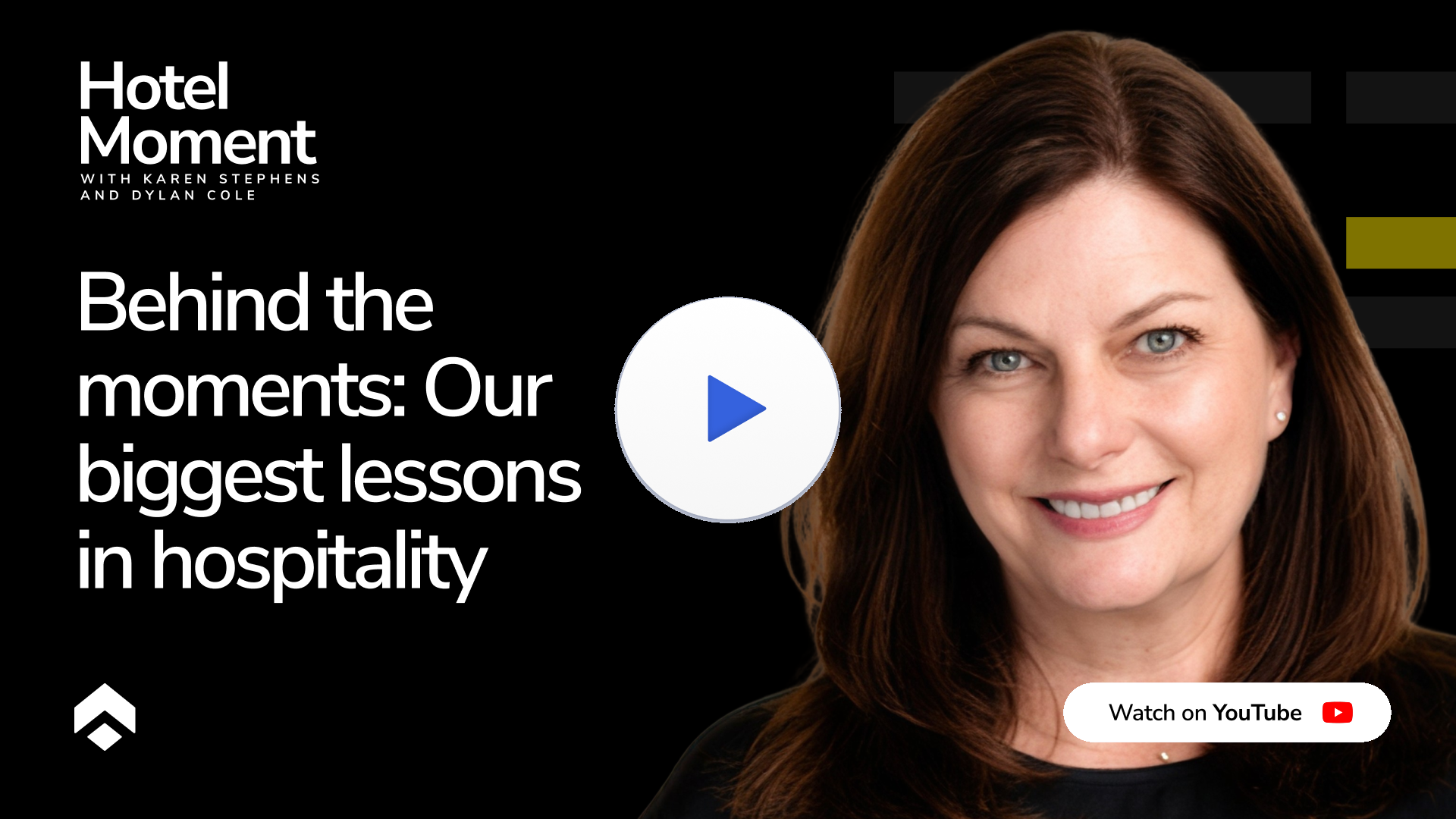
Behind the moments: Our biggest lessons in hospitality
What makes a hotel stay truly memorable?
It might be the warm welcome or the personal touches that give guests a reason to return. In this milestone episode of Hotel Moment, Revinate CMO Karen Stephens looks back on more than 200 episodes of conversations with hospitality leaders to explore what really drives a memorable guest experience and lasting loyalty.
Karen revisits insights from past guests to unpack why service is everyone’s responsibility, how human connection sets hotels apart from short-term rentals, and why cutting small amenities can quietly erode brand value.
Because great hospitality isn’t about checking every box. It’s about creating experiences guests remember, building relationships that last, and giving your team the data and tools to make every moment count.
Media
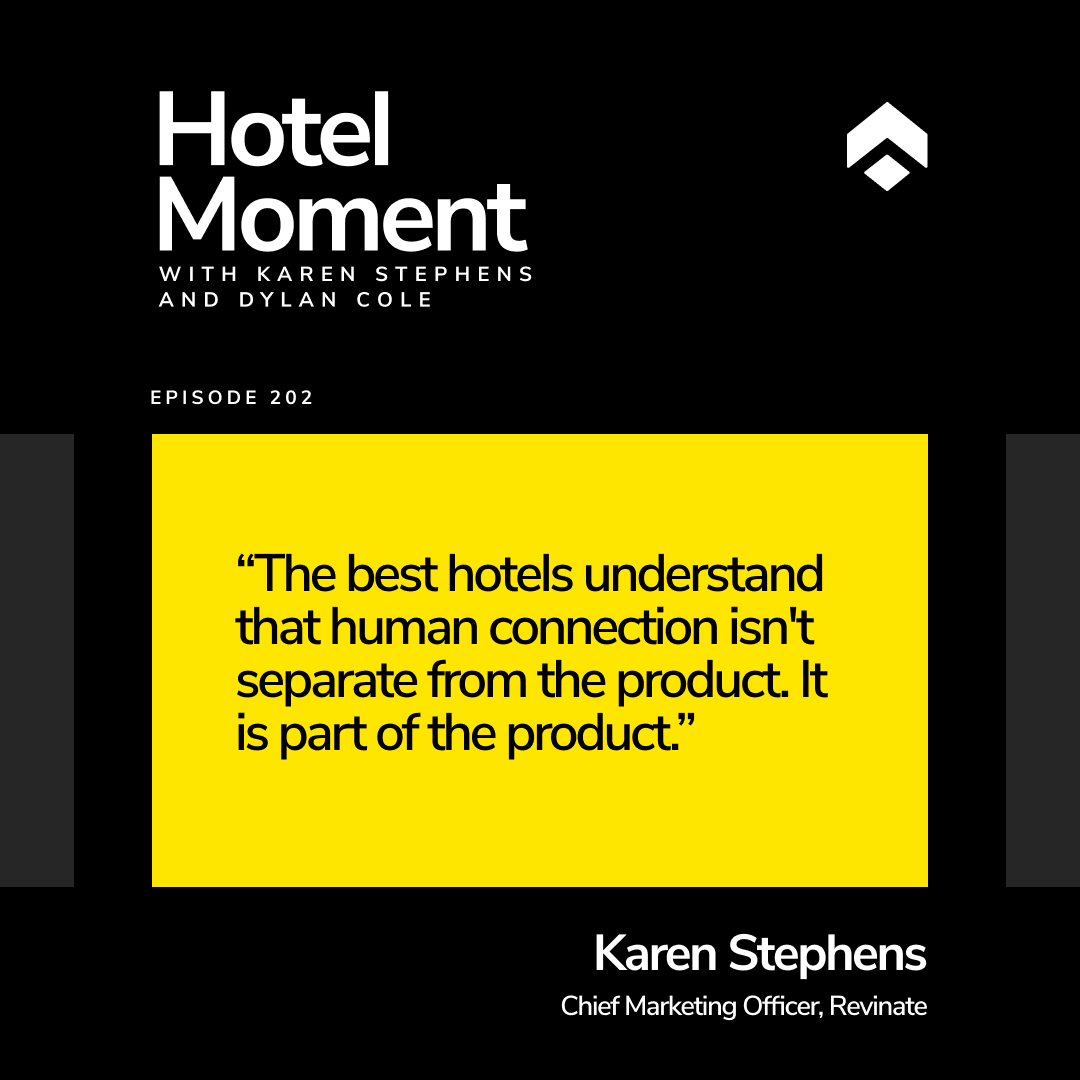
The human connection is essential
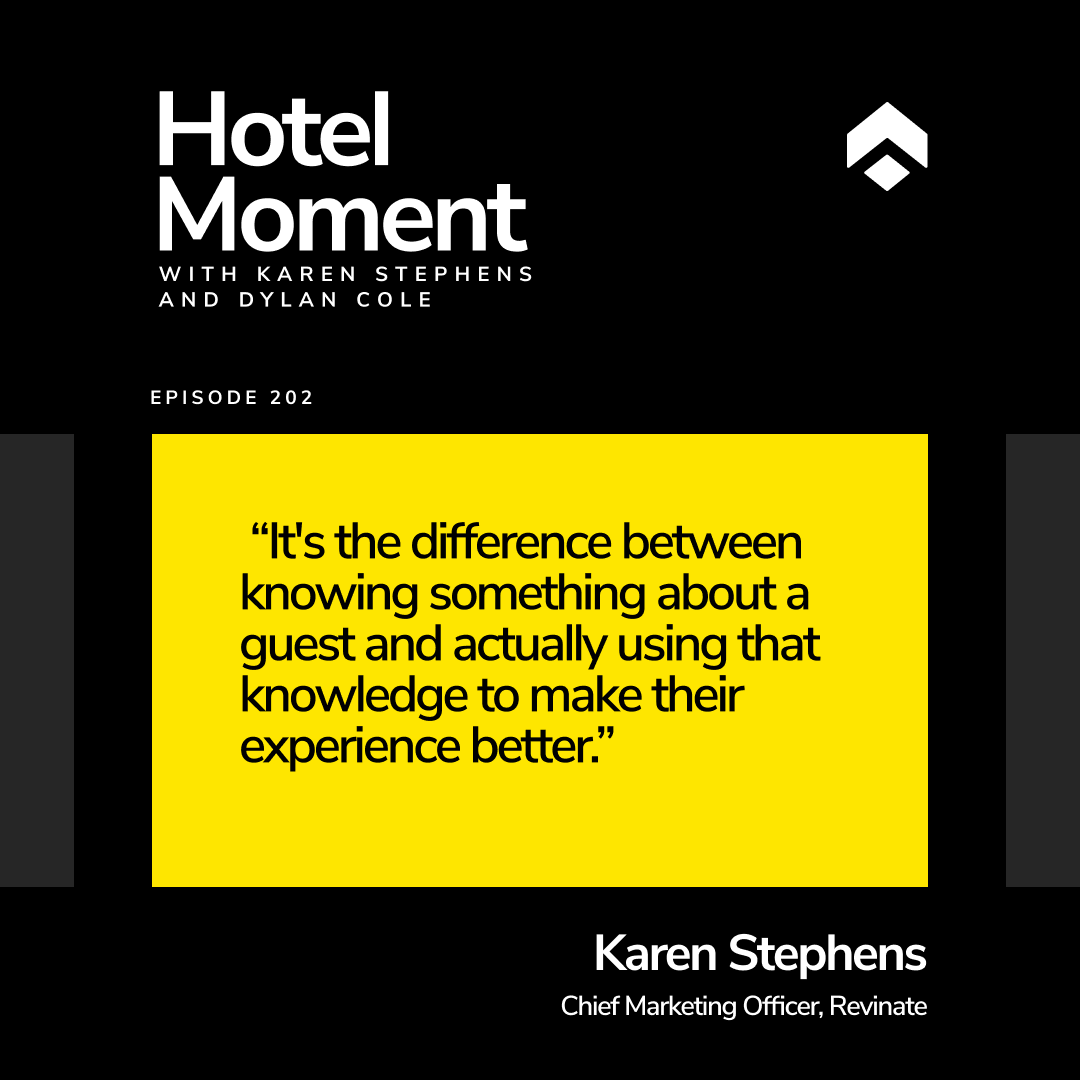
Activating guest data
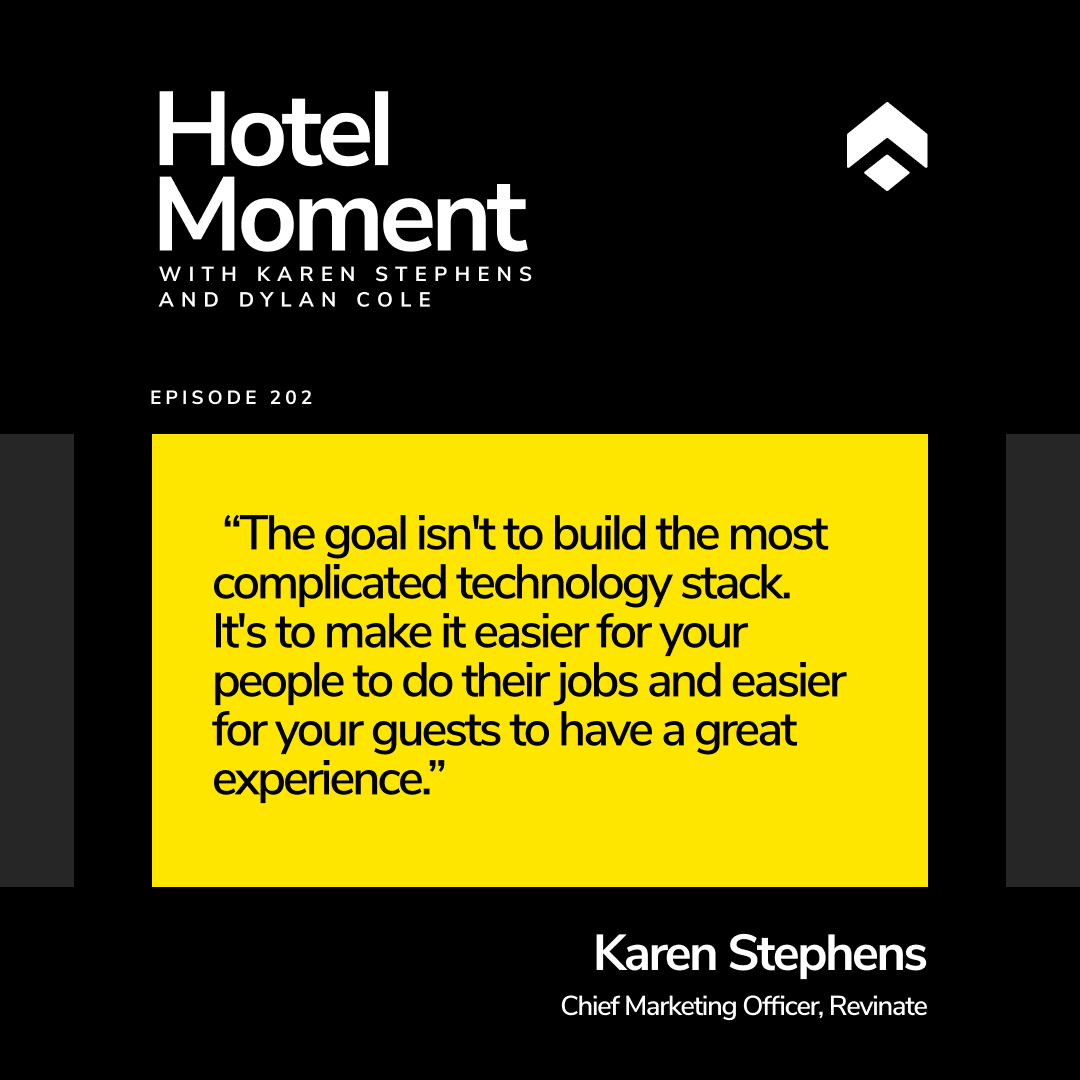
The goal of hospitality tech
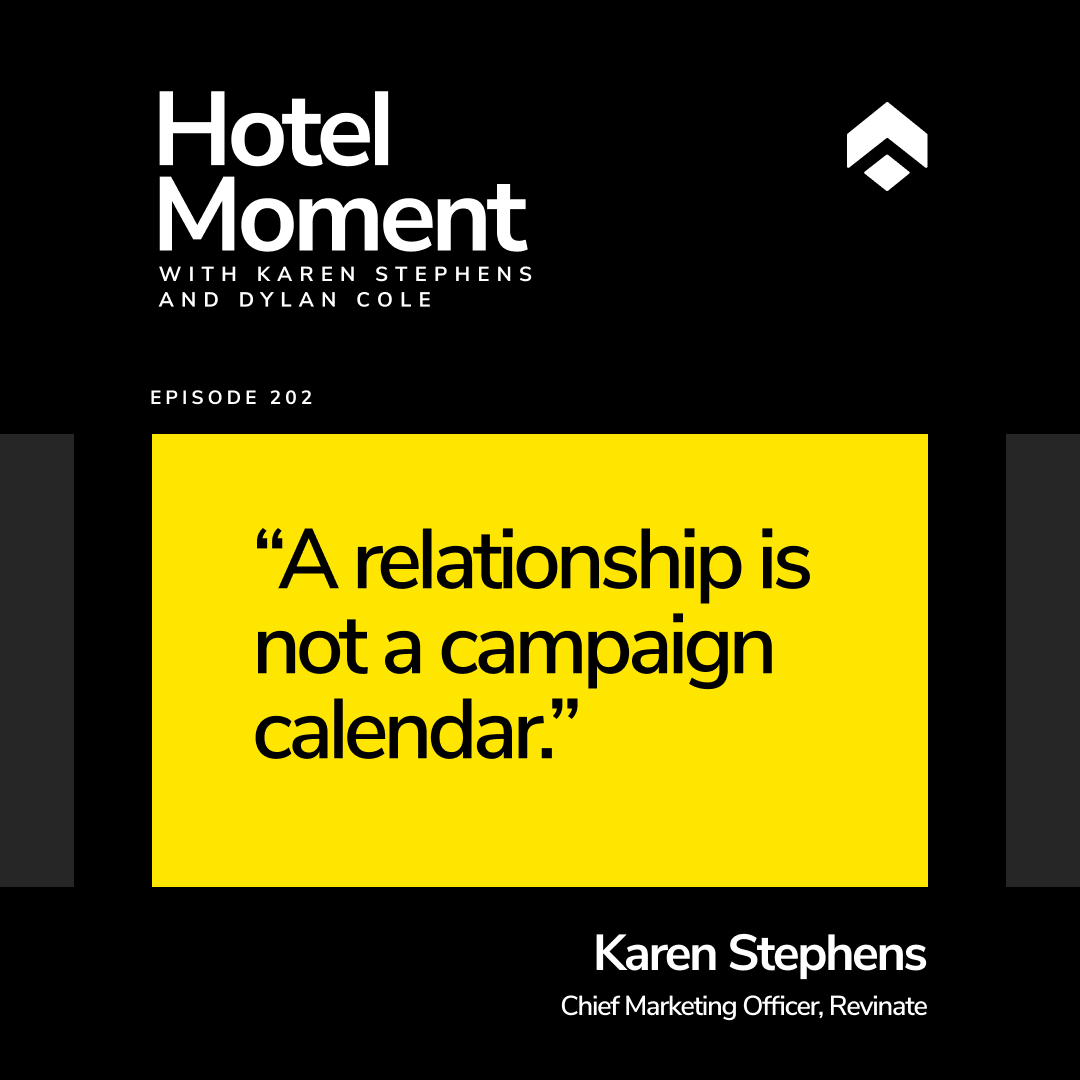
Nothing replaces a real relationship

Meet your host
Karen Stephens
As Chief Marketing Officer at Revinate, Karen is focused on driving long-term growth by building Revinate’s brand equity, product marketing, and customer acquisition strategies. Her deep connections with hospitality industry leaders play a key role in crafting strategic partnerships. Karen has more than 25 years of expertise in global hospitality technology and online distribution — including managing global accounts in travel and hospitality organizations such as Travelocity and lastminute.com
As the host of The Hotel Moment podcast, she interviews top players in the hospitality industry. Karen has been with Revinate for over 11 years, leading our global GTM teams. Her most recent transition was from Chief Revenue Officer, where she led the team in their highest booking quarter to date in Q4 2023.
Watch the video
Transcript
[00:00:00] Karen Stephens: The goal isn’t to build the most complicated technology stack. It’s to make it easier for your people to do their jobs and easier for your guests to have a great experience. Welcome to the Hotel Moment Podcast presented by Revinate. I’m Karen Stephens, Chief Marketing Officer, joining you from sunny San Francisco, California.
[00:00:18] Dylan Cole: And I’m Dylan Cole, Managing Director of Revinate Europe, calling in from Amsterdam.
[00:00:23] Karen Stephens: This is the podcast where we explore how technology shapes every moment of the hotelier’s experience and more importantly, how the right technology delivers real outcomes for hotel teams and guests alike.
[00:00:33] Dylan Cole: From revenue strategy and guest communication to operations and marketing, we sit down with the people transforming hospitality around the world.
[00:00:42] Karen Stephens: Depending on the conversation, sometimes it’ll just be me behind the mic,
[00:00:46] Dylan Cole: and sometimes it’ll be me bringing a European perspective and stories from across the global hospitality industry.
[00:00:52] Karen Stephens: Whether you’re a hotelier, a tech enthusiast, or just curious about where hospitality is headed,
[00:00:56] Dylan Cole: you’re in the right place. Let’s get into it.
[00:01:01] Karen Stephens: Hello and welcome to the Hotel Moment Podcast. I’m your host, Karen Stephens, the Chief Marketing Officer of Revinate, and this episode is going to be like watching your favorite home videos, full of nostalgia. So today we’re revisiting the conversations that challenge the status quo, spark new ideas and got us thinking differently about hospitality. If you’re new to Hotel Moment, consider this your front-row seat to some of hospitality’s biggest thinkers. And we’ve covered a lot of ground. We’ve reached over a million people, passed 201 episodes, which I can hardly believe, and have the chance to talk with some incredible hoteliers, entrepreneurs and hospitality leaders from all over the world. How cool is that? One of my favorite parts of hosting this show is getting to ask the questions that go beyond the day-to-day. What are the biggest challenges facing hoteliers? What is changing our industry? And what does the future of hospitality look like? Because as much as we love a good industry report, there’s nothing quite like hearing directly from the people who make things happen. This year I’ve also really enjoyed hosting alongside Dylan Cole and having his perspective on the EMEA hotel market. It’s been great comparing experiences and exploring how things differ across regions, from guest expectations and distribution to technology and the challenges hoteliers are navigating every day. It’s also a reminder that while hospitality looks different around the world, making people feel welcome and understood is universal. And we’re not just looking back. We’ve also got some big plans for next year and I’m really excited about what’s ahead. So let’s just say we’ve got plenty more of conversations to have and some fantastic people we’d love to bring on the show. But first, today we’re revisiting some of those conversations that have stuck with us, covering everything from guest experience, loyalty to personalization, technology, and the idea of shaping the future of hospitality. And I think you’ll notice that even though these conversations happen with different people at different times, there’s a lot of themes that connect in really interesting ways. So let’s take a little trip down memory lane and revisit some of those moments that have made Hotel Moment what it is today. Let’s get into it. So let’s start with the thing that sits at the center of absolutely everything we discuss on this show, the guest experience. It’s funny, we have entire conferences devoted to technology, revenue optimization, distribution, marketing, automation, and operational efficiency, and those things matter enormously. But when you strip everything back, hospitality is still about how you make somebody feel. And one of those conversations I keep coming back to is the idea that service isn’t just the responsibility of the person standing at the front desk. Because think about your own experience as a guest. You might have a wonderful check-in, but if your room isn’t ready, your dinner reservation has been lost, or nobody seems to know what’s going on when you need help, that one great interaction doesn’t magically fix everything. The guest doesn’t experience your organizational chart, they experience your hotel. So let’s hear from Geoffrey Tofetti on what service really means.
[00:03:59] Geoffrey Tofetti: There’s misconceptions and inconsistencies around what is service. A lot of people, and we’ve encountered them, they believe that the people talking to the guests directly are responsible for service. And I say it goes way beyond that. It’s every single person that affects their experience. And if we could get to a more holistic view of that, and I think obviously the super lux hotels get this completely, but a huge swath of the market does not. They don’t understand that a piece of garbage in the parking lot might be more detrimental to service than someone being rude at the front desk. It’s really how does the guest perceive it? But optimizing every aspect of the guest’s experience from the moment they touch your brand, whether it be the first phone call, the website, all the way through to the walk up to the hotel, the lobby condition, the room, all of that is service. And I think it’s often scapegoated to the couple of people talking to the guest that you might get A bad review.
[00:04:57] Karen Stephens: I love that perspective because it puts a responsibility for service where it belongs, across the entire organization and at every touchpoint of the guest journey. It raises a really important question for all hotel leaders. How do you build a culture where everybody understands the role that they play in the guest experience, even if they never have a direct conversation with a guest? That takes leadership, communication and a lot of coordination behind the scenes. It also means recognizing that your people are your differentiator. And that brings me to a conversation with Sims Foster of Foster Supply Hospitality who talked about something that I think is particularly important as hotels compete with short-term rentals and all the alternatives available to travelers today. You can create a beautiful space, you can have a fantastic design, you can offer a wonderful home away from home. But what happens when somebody arrives?
[00:05:47] Sims Foster: As much as you can brand your short-term rental and create this thing and it feels good when you check in, it’s still an empty house as far as human beings, right. The biggest thing is just that human connection that when somebody comes in and they meet Will or Saudi or Anastasia, any one of our people, and they connect with that human being that reminds them of the real power and joy and specialness of staying in a hotel, right?
[00:06:17] Karen Stephens: Yeah, that’s what guest experience is all about. That line about an empty house really says it all. A room can be beautiful, a rental can be beautifully designed. Technology can make the arrival process seamless. But there’s something special about being welcomed by a real person who makes you feel like you’re in the right place. And the best hotels understand that human connection isn’t separate from the product, it is part of the product. Now there’s another side of that conversation. We talk about creating guest experiences, but we also have to talk about the decisions that can quietly undermine them. Stuart Greif from Forbes Travel Guide made a powerful point about the temptation to cut costs without considering what those costs actually do to the guest experience. Because saving money on paper and creating value for your business aren’t always the same thing.
[00:07:02] Stuart Greif: As a leader, you can always find a way to cut a little cost. But the question is, are you death by a thousand cuts denigrating the guest experience so much that especially for a lot of your hotels that are independent or lifestyle, that essentially you’re taking away what makes you unique and differentiated in the guest experience that creates memories or wants them to stay. And so yeah, you can cut a bunch of things to save money and look great for 12 months, but gradually it becomes a self-fulfilling prophecy that kind of circles the Drain and ironically undermines the ROI and the investment, the asset for real estate to begin with. So I think while the two sometimes seem opposite or this tension, the reality is if you give somebody a great experience, they’re going to come more often, they’re going to pay more, they’re going to recommend you more, and that hotel is going to feel that energy, and your employees are going to feel that when they’re given the tools and support to do it.
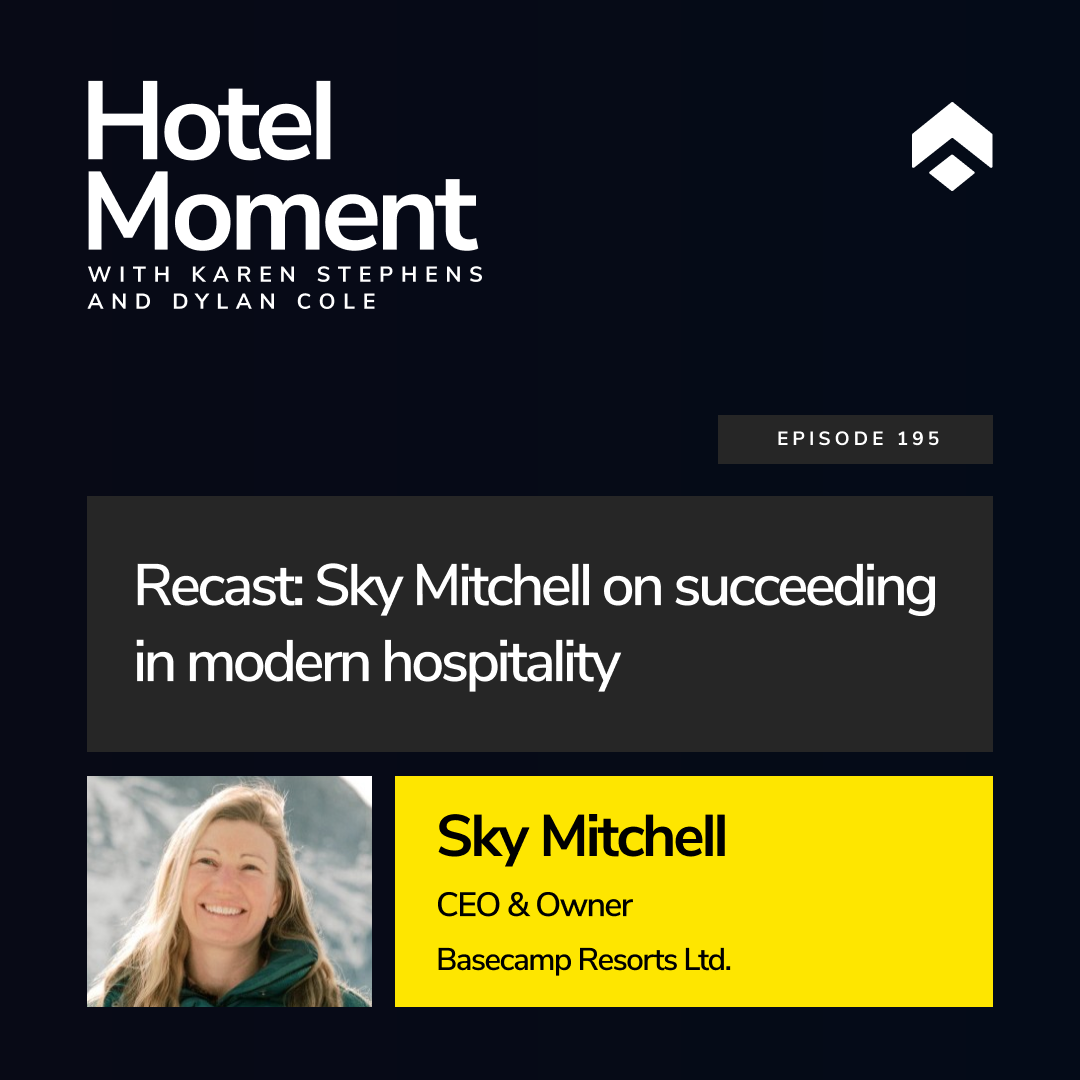
[00:07:58] Karen Stephens: Death by a thousand cuts is such a memorable way of putting it, and I think it’s particularly relevant in an environment where hotel leaders are constantly balancing labor costs, operating expenses, investment decisions, and guest expectations. Of course, financial discipline matters. Nobody’s suggesting that hotels should spend without thinking. But the real question is, what are you protecting and what are you willing to sacrifice? If you remove the little things that make your property distinctive, you may save a little time in the short term while giving guests fewer reasons to choose you next time. And that takes us naturally into another question. What does an exceptional experience actually look like today? Because guest expectations are evolving, and the hotels that stand out are the ones that are willing to rethink what they are offering. One of the things I’ve loved about our conversations over the years is hearing how entrepreneurs look at a familiar hospitality concept and ask, what if we did this completely differently? Sky Mitchell, for example, has been rethinking what a hotel experience can be through the Everwild Nordic Spa concept. Instead of simply adding another amenity to the list, she’s exploring the rituals, traditions, and emotional experiences that can turn wellness into something guests genuinely travel for.
[00:09:11] Sky Mitchel: Originally, we were like, oh, let’s expand the hotel. We’ve got an acre and a half of extra land that when we bought the Holiday Inn and converted it to Mountain House, we’ll just use some more units or hoteliers. That’s like a natural thing. And I had been to one or two Nordic spas at the time and was like, these are kind of neat, you know, and I’m not very spiritual and very like anything like that, which I want to be more of. But anyway, I was like, it’s such a great experience. I want to go and build a Nordic spa on this site. And then we just went from there, and since that moment, which was a few years ago, have developed not only a spa design, a brand and all that, but developed a deeper understanding of, like, rituals and why people do this and what’s the history of song and all this stuff that we’re going to bring into the guest experience.
[00:09:55] Karen Stephens: So I love that she’s thinking about the story behind the experience, not just the physical space. It’s the difference between saying we have a spa and creating something that gives people a reason to visit, something they want to tell their friends about, and perhaps something they’ll come back for every year. And that’s a valuable lesson for any hotel, regardless of size or price point. You don’t necessarily need to build an entirely new concept. You need to understand what makes your property meaningful to the people you want to attract. For some hotels, that might be wellness. For others, it could be food, art, local culture, music, outdoor adventure, or simply the feeling of belonging somewhere. We heard a fascinating example from Jordi Solé at UMusic Hospitality, where entertainment isn’t just something happening near the hotel. It’s central to the guest proposition.
[00:10:41] Jordi Solé: We are entertainment with a room. That’s how we call ourselves. Technology is very important for several reasons. First, personalization is key, at least for all hoteliers, but also is key for us because we integrate music into this personalization. And also we use both our own direct channels where we bundle packages. We sell, of course, the room, but with a ticket at our theater, also with more curated and crafted experience for the fans, like a meet and greet with the artist, like a backstage spa. So we, we bring those experiences, musical experiences, with the package. And then if you’re going to go to first row and meet the artist, then you stay with us at the suite. And then you get this package, you get the premier access and the crafted experience for you as a special guest that stays with us.
[00:11:30] Karen Stephens: Now, that’s an interesting way to package a stay. You’re not just selling a bed for the night. You’re selling access, memories, and an experience that connects the guests to something they’re passionate about. And notice how personalization is woven into that proposition. The room is part of the experience, but the experience can extend into the tickets, backstage access, and the opportunities that mean something to a particular guest. And that brings us to luxury, because for a long time, the industry tended to define luxury through physical things. The grand lobby, the expensive materials, the extensive amenity list, the room category. But is that how guests still define it? Shannon Knapp, president and CEO of the leading hotels of the world, offered a perspective that really challenges the traditional view.
[00:12:16] Shannon Knapp: Luxury has changed so significantly over the last, let’s call it 20, 25 years. I think in the past, especially on the hospitality side, the hotel side, the hotels almost used to dictate what luxury was. We defined the standards of luxury, and we told that to the consumer. And we demonstrated that in the experience to the consumer. But what has evolved and changed so significantly is that luxury now is such a personal experience. It really is about what is important to me as a traveler, as a person. And what is luxury to me might be completely not luxury to you. And I think that that is both a challenge and an opportunity in our business. I mean, we certainly see this reflected in the guests that stay with leading hotels. Not only do they absolutely love their traditional palace hotels in our portfolio, like The Ritz Paris or like The Lowell here in New York City, but they’re also really interested in hotels that meet different criteria for luxury these days based on who they are. You know, maybe having different experiences being with a hotel in a remote location or a hotel that offers a hyper-authentic experience that is authentic to its destination. Or maybe they want to stay at a really small intimate hotel that maybe doesn’t have all the traditional five-star amenities, multiple F and B outlets, or maybe not a central lobby, for example, but something that’s a little bit more homelike. They embrace different kinds of architecture and design. We see obviously, and I know again, this is a trend that we’re all seeing in the industry, but this shift towards a focus on holistic wellness and sustainability as interest. So I think the definition of luxury over the last several years has evolved to be much more of an n of 1. In a way, what is luxury to me and how will I express that in the choices that I make with the hotels that I stay in?
[00:14:07] Karen Stephens: So I think that is such an important shift. Luxury isn’t a checklist that every hotel has to complete. It’s an understanding of what a particular guest values. For one traveler, it might mean privacy and total tranquility. For another, it can mean being in the middle of a vibrant city, surrounded by culture and activity. And for someone else, it might mean having every detail anticipated so they don’t have to think about a thing. And what that means is that we can’t assume we know what our guests want simply because we know what category our hotel sits in. We have to listen, we have to observe, we have to ask. And we have to be willing to challenge our own assumptions. Which brings us to a question that has enormous implications for hotel strategy. If guest expectations are changing, who exactly is the guest we’re trying to serve? It’s so important to know, because not every guest will want the same thing. And that’s precisely the point. We need to understand the relationship, not just the transaction. And speaking of relationships, Bashar Wali challenged one of the most persistent misconceptions in hotel technology, that customer relationship management is simply about sending people emails and asking them to come back.
[00:15:14] Bashar Wali: I think people throw that word around and they don’t know what it means anymore. CRM isn’t sending a guest an email to have them come back and stay. It’s a complex journey from beginning to end to build customer relationship management. We think about it transactionally. I have a need here. I’m going to send you an email to come stay with me. That’s not relationship nurturing. Relationship nurturing is having a dialogue with you ongoing in any different way. Whatever that means. A newsletter or whatever. It’s not always about, look at me, look at me, come by me, come by me. So I think we need to better define CRM in our industry broadly and what it means. Back to this ultra customization issue. You should know everything about me, but what are you doing with that information? Nothing. As far as I’m concerned, Nothing.
[00:15:53] Karen Stephens: So, yes, Bashar, a thousand times yes. A relationship is not a campaign calendar. It’s not just sending an email because it’s been six months since somebody stayed with you. It’s understanding the context of that guest relationship with your property and communicating in a way that makes sense. Sometimes that means inviting them back. Sometimes it means sharing something useful. Sometimes it means recognizing that now isn’t the right time to make an offer at all. And sometimes it means simply remembering who they are when they walk through the door. Which sounds obvious, doesn’t it? But Chris Koehler, chief marketing officer at Twilio, shared a story that demonstrates just how often the industry gets it wrong.
[00:16:33] Chris Koehler: Last night, checked into a hotel, smaller boutique hotel. I’ve been there 10 times, at least. And the person at the front desk says, have you ever stayed here before? And you’re like, yep, I have. And it was like, my goodness, it’s just such an opportunity to say welcome back. And we’ve been talking about personalization in travel hospitality for a very, very long time. And one of my jokes is, you know, the only personalization we often see when we stay in a hotel is your name on the TV and nothing else. And I think there’s such an incredible opportunity to understand that context and create that personalized experience, but it’s been fairly elusive.
[00:17:17] Karen Stephens: Yeah, that’s so funny, because I interview a lot of hoteliers on this podcast, and everybody says, we just want to solve that one thing. Ooh, that one hurts a little bit, doesn’t it? A 10th visit, and the hotel asks whether he’s day before. I mean, come on. This is what every hotel is trying to solve. The information existed, the relationship existed, but somehow the knowledge never made it to the person who could have turned it into a meaningful moment. And this is where personalization gets really interesting. It’s easy to talk about personalization as a marketing tactic. We can personalize the subject line, put somebody’s name in an email, or send a birthday message. But real personalization is about making the guests feel recognized throughout the journey, whether it’s before arrival at check-in, during their stay, or when they return months later. It’s the difference between knowing something about a guest and actually using that knowledge to make the experience better. And that requires more than good intentions. It requires people, processes and information to work together. Andrew Ladd, VP of Marketing at Nova Hotels and Resorts, talked about how much information hotels can gather across their digital and in-person touchpoints.
[00:18:24] Andrew Ladd: We’re in such a really great and unique position as they go through the customer journey to continue collecting information about them as a person and how we can better service them right from restaurant to spa to minibar and their preferences on a beverage. Like those little touchpoints. Some people might find it creepy that you know what kind of beverage they like to drink, but other people love it. They show up and you’ve got a Diet Coke or you’ve got a Gatorade waiting for them because that’s what they had last time. I mean, those little touchpoints I think in surprise and delight is a big term as of late. Just provide that next level of service.
[00:18:59] Karen Stephens: So think about how many opportunities there are to learn something useful about a guest. A booking, a phone call, a restaurant reservation, a spa visit, a preference shared with the front desk. Conversation with a member of the team. Each interaction can tell us something, but only if we can connect those dots appropriately and use the information responsibly. And I want to stress that last point. Collecting data for the sake of collecting data isn’t the goal. Guests should feel that sharing information benefits their experience, not that they’re being monitored. The real opportunity is to make the experience more relevant while respecting the guest trust. And that leads to another question. If we have all the information, how do we make sure it actually works? So let’s talk about the unglamorous side of innovation for a moment. I know nobody wants to spend a dinner party talking about data governance, but Dimple Jethani, CIO and Aramark Destinations made a compelling case for why getting the foundations right matters so much. Because we can talk about artificial intelligence, predictive analytics, personalization, and all the exciting things technology promises to do. But if your information is fragmented across disconnected systems, even the most clever technology is going to struggle.
[00:20:13] Dimple Jethani: Master data management matters. How I track it. If I decide to implement a system and I let it be standard all and I don’t integrate it, my master data has just been ruined. I may have captured the data, but it’s not as meaningful anymore. It’s a little more challenging. Can I get there? Can I still find out about you? But not as easily. And I think if we step back, put some data governance in, understand what we want together, we’ll get there. There will always be challenges. We’re humans. Nothing’s ever perfect, but I think that’s number one. And then bringing the technology to bear to support that and make it easy, we have to make it easy.
[00:20:44] Karen Stephens: There’s a lesson there for every technology leader and every hotel executive who’s been tempted by the latest shiny tool. So before you ask what technology can do, ask whether your organization has the foundations to make it useful. Can your teams access the information they need? Do different departments share a consistent understanding of the guest? Are systems working together or have we created another silo? Because the goal isn’t to build the most complicated technology stack, it’s to make it easier for your people to do their jobs and easier for your guests to have a great experience. And that’s particularly relevant now, as AI changes how people search for information, compare options, and plan travel. So the opportunity is enormous. Technology that produces more information without helping people act on it can leave teams with even more complexity. And we need to ask a simple question, does this actually make the experience better? Technology can also be used to help address problems that go way beyond marketing revenue and guest experience. And I think I would call it kind of the underbelly of hospitality that we don’t always want to look at. But it’s important that we can be helpful. So with that, let’s talk about Georgine Muntz, the CEO of Visual Matrix, who shared an example of technology being used to help hotel teams document suspicious activity and identify patterns that could help assist in combating human trafficking. It’s a sobering subject, but I think it’s an important reminder of the role hotels can play in their communities.
[00:22:14] Georgine Muntz: There was even a new lawsuit today. Millions and millions of dollars being lost in lawsuits related to trafficking. Even though hoteliers absolutely don’t typically want this business, they just don’t have a way to stop it because it’s dangerous. Like, don’t want to put your hotel staff in front of somebody who’s a criminal and have them try to prevent this activity. So we thought, well, we can do this behind the scenes. And as soon as we started thinking like that, I started networking and saying it out loud, just putting it out in the world. And you would be amazed at how many people have now come in and said, we get it. We want to help, too. We’re doing this, we’re doing that. And in that process, I found a couple of companies. One is called Dark Watch, and they’re aggregating data around these criminal activities. So one of our goals is to integrate with their data and send even more data to them so that when we see suspicious activity in a room or at the front desk, our team members using our system can safely document what they saw and say saw something suspicious, this happened, and send that in. And then it can be matched with other data, like known names, phone numbers, and emails of these criminals. So we started thinking, we can do more if we think bigger. And it kind of came from this. How can we innovate? What’s new under the sun? Because a PMS, it needs to do all the things the hotel needs to do. It’s very, very much a standard that has to be a certain way. But if we add these other benefits, not only will we bring in technology solutions, but maybe we can help solve a massive crime problem that’s going on right under our noses.
[00:23:50] Karen Stephens: This is a powerful example of thinking beyond the immediate operational task. Technology can help teams share information, identify patterns, and escalate concerns through appropriate processes without expecting individual employees to put themselves in danger. And it shows that innovation isn’t always about making something faster or more profitable. Sometimes it’s about making a workplace safer and helping an industry respond to a serious human problem. That is part of what makes hospitality such an interesting industry to cover. The challenges are commercial, operational, technical, and deeply human all at the same time. And speaking of commercial challenges, let’s turn to two topics that are always close to a hotelier’s heart. Loyalty and profitability. So let’s start with a question. What makes somebody loyal to a hotel? Is it the points? The status? The room upgrade? The complimentary breakfast? Those things are certainly helpful. But some of the most interesting loyalty programs we’ve discussed on this show have challenged the idea that loyalty must follow a traditional formula. Diego Calvo of the Concept Hotel Group discussed a program that recognizes people who engage with the brand, even if they haven’t spoken. Spent a night at one of its hotels, and I think that tells us something important about how loyalty can be built.
[00:25:04] Diego Calvo: We are working very strong to launch our loyalty plan also with Revinate now at the beginning of April. And so we are creating different levels because we want the people to feel not only of a loyalty plan, I want the people to feel part of the lifestyle we offer in the hotels also. So we are starting with that plan now to increase also our direct sales. Yep, 100%. It’s not like you’re points-based traveling for business loyalty program. You’re trying to create a community. And from what I understand, the tiers are going to be called the local, the insider. Am I allowed to say this? You can say 100%. We’re going to launch it. Yeah. I mean it’s going to call the Conference Society and then we’re going to have the Insider, the regular, the Resident and the Collective. And then we have one special the Local. Because we do a lot of cultural events into the hotels and it’s people coming to our places that are not staying with us. They just from Ibiza and they come to our live music events or to our arts exhibitions. So that will be just for the locals where I think very interested because we are connecting, let’s say our guest list events platform. We are connecting this to revenue so we can control how many times an external client is coming to our events. Which is super interesting. And then we also doing the collective level. This is going to be just people we going to choose because we say that they can be like ambassadors from us. Like let’s say, okay, I’m meeting, I’m doing a trip and I’m meeting this cool artist. Maybe never stay with us, but it’s okay. You’re going to be the collective. People is going to be more choose one by one, let’s say for the collective. For the others. Resident will be like 20 room nights. We see more the number of nights more than the production of revenue. Okay. Because maybe we have someone that really loves the brand. The park can only come in low season because he cannot afford come in August. But I really appreciate that he’s coming back with us. So we creating the levels depending the numbers of room nights. I understand because you don’t want to just because of somebody’s budget. If they’re loyal, we want to respect that and make sure they’re being taken care of.
[00:27:19] Karen Stephens: I love that approach because it recognizes that a relationship with a hotel can begin long before a booking. Somebody might attend an event, visit an exhibition, enjoy a restaurant or become part of a Local community around the property and a guest who returns every year during the quieter season can be incredibly valuable. Even if they don’t spend like a peak season seasoned traveler. It makes you think differently about what loyalty actually means. Citizen M is another great example. After this recording, they were acquired by Marriott. But we really want to highlight this approach because it’s truly innovative. They really took it from a different direction with a paid subscription model that gave members access to specific benefits.
[00:27:58] Casper Overbeek: There’s three things to say about this. The first one is that we made it a paid subscription and the paid subscription made. That is we ask for a commitment, but you get instant access. And we are not the only one with some kind of guaranteed or semi-guaranteed formula. But we say if you’re willing to pay, we will give it to you. The second part has to do with the availability itself. That was one of the biggest discussions because we didn’t know what we would say yes to. So we said 48 hours in advance, we can still manage it with our reservations, demand and revenue management game, so to speak. And up till now, I think we had one day on an event in San Francisco that we were. I had to say no. But for the rest, we always found a way. So we prove it worked. And we now have like 45,000 members that are very, very active. So yeah, that we solved then the rate parity on the OTAs. Yeah, that’s interesting, but we already left that a while before. So we already said to OTAs we no longer guarantee and we are sort of accepting the consequences of that. And actually the LTA’s were not so concerned. Well, I cannot speak on their behalf, but because we had it in a closed environment and where you had like a paid setup, like real subscription model. Yeah, basically it was a little bit less threatening for the game that they play. So I think we’ve sort of found the sweet spot that has been stress-tested over time and that is now something that definitely works for us.
[00:29:34] Karen Stephens: That’s a great example of how there isn’t one universal blueprint for loyalty. Some guests love points and rewards. Others want convenience, flexibility or guaranteed access. Some want to feel like insiders, while others simply want a straightforward exchange of value. So the question for hotel leaders is not what is the trendiest loyalty program, it’s what relationship are we trying to build and what would make that relationship worthwhile for our guests. And there’s a commercial side to that too. So every time a hotel gets a repeat booking through a third party, it needs to consider the cost of that. Distribution channel and whether there’s a better way to maintain that relationship directly. Mark Winchell from Pacific Hospitality Group offered a memorable metaphor for managing that balance.
[00:30:18] Marc Winchell: It was like turning that faucet off for OTAs. It’s easy just to dial it up. We’re slowly turning that faucet off and we’re incentivizing guests to book direct.
[00:30:30] Karen Stephens: I like the faucet analogy because it recognizes that distribution isn’t an all-or-nothing decision. Third-party channels can be valuable for reaching new audiences and filling rooms, but hotels also need a strategy for building that direct relationship, encouraging repeat bookings and also understanding the guests that they work so hard to attract. So the trick is simply not to turn one channel off. It’s to understand when each channel makes sense and how to earn more of the relationship over time. And that takes us back to something we’ve heard throughout this episode. Loyalty isn’t just a marketing metric, it’s the result of an entire experience. You can’t automate your way out of a disappointing stay, and a points balance won’t necessarily compensate for an experience that feels impersonal. The strongest loyalty strategies bring together the right proposition, a good experience, relevant communication, and a genuine understanding of the guest. Before we wrap up, I want to revisit two conversations that remind us that hospitality has a much bigger role to play than simply providing somewhere to sleep. First, Aradhana Khowala, CEO of Aptamind Partners, challenged us to think about the difference between sustainable and regenerative tourism. There’s a distinction worth exploring because the conversation around travel increasingly includes the impact we have on the places we visit.
[00:31:51] Aradhana Khowala: Historically, tourism has been extractive as an industry. I know speak about sustainability, but if you are not adding back more than you take net net, you are extractive as an industry. Regenerative growth and it’s not just in tourism, it’s in all kinds of businesses is where you add back to a place more than you take. And that’s not just to the place, it’s adding or building businesses that are actually enriching or adding to the ecosystem, empowering the communities and prioritizing human well-being alongside profit. So it’s not just an idealistic dream, it’s becoming a business imperative. And increasingly, businesses that fail to adopt this mindset will have to pay a price in the long run, either through reputational damage, environmental harm or social backlash. It’s going to come. So at some point we’re going to see leaders realizing that they need to change their mindset that only values volume and actually Make a leap into how do you actually prioritize values. So it’s not just about thinking how fast you want to grow. How do you grow in a way which is right? It’s good for the people, it’s good for the planet. And that doesn’t mean you’re abandoning the financial success.
[00:33:13] Karen Stephens: The idea of giving back more than you take is a powerful one. Hotels are part of destinations and they depend on local communities, natural resources, cultural heritage, and people who make those places special. And as destinations face challenges ranging from environmental pressures to overtourism, the question of how tourism contributes to a place becomes increasingly important. It’s not a challenge with one simple answer. Every destination has its own circumstances and every property has different opportunities to contribute. But it does encourage us to think beyond occupancy and revenue alone and consider the long-term health of the destinations that make hospitality possible in the first place. And finally, I want to touch on leadership, because every conversation about the future of hospitality eventually comes back to the people, the teams we build, the ideas we encourage, and the leaders we develop. Emily Goldfischer, founder and editor-in-chief of HER Tellier, discussed reverse mentoring and how experienced professionals and younger colleagues can learn from each other.
[00:34:16] Emily Goldfischer: I mean, one of the heartening things I see is that women who are at this kind of upper levels or even BP mid-level managers, they’re very intentional about making sure women who are in the early stages of their careers have a different experience than they’ve had. So I feel that women are very eager to mentor younger women. And also this idea of reverse mentoring is like, as you get further along in your career, like you can learn also from people that are in the early stages of their careers. The overall theme of mentorship is you can learn from others who have either trod in your footsteps or can show you the way. I feel like there’s a lot happening in that area, particularly with the big brands. Hyatt, one of our partners, has their women at Hyatt program. ISG has their Women Rise program, which also is another partner of ours. So it’s really exciting. And I mentioned Marriott also has been great with flexibility. And Hilton also. There is a very conscious effort, I feel, from the industry to help women with things like mentorship to provide them leadership training. That’s another skill that women maybe didn’t get in previous generations. I do feel that companies have a real focus now on being more inclusive and really equipping women with the skills and strategies they need to help shape their careers.
[00:35:53] Karen Stephens: I love this because it challenges the idea that learning always has to flow in one direction. Experience matters, and the knowledge you gain from years of working in hospitality has incredible value. But so are fresh perspectives and new ways of communicating, and the willingness to question how things have always been done. And in an industry navigating technological change, evolving guest expectations, and a challenging, changing workforce, leaders who create space for that exchange have a real opportunity to build stronger teams. You don’t have to agree on everything. In fact, some of the best conversations come from disagreeing respectfully and asking better questions. And perhaps that’s one of the reasons I’ve enjoyed hosting the hotel amendment so much. Every guest brings a different perspective, and every conversation gives us another opportunity to learn. So what have all these conversations taught me? And maybe taught you? Well, if there’s one thing that I take away from revisiting these clips, it’s that hospitality is an industry that never stands still. We’re rethinking what luxury means. We’re creating experiences that go beyond the room. We’re exploring new models for loyalty and finding better ways to use technology, and learning how to build relationships that last longer than a single stay. We’re also being reminded that the fundamentals matter just as much as ever. Know your guests, look after your people, make thoughtful decisions about where you invest, don’t confuse collecting information with understanding someone, and never lose sight of the human being on the other side of the transaction. That’s what makes these conversations so valuable to me. Our guests don’t always agree with each other, and they don’t all approach hospitality in the same way, but they challenge us to look at familiar problems differently. And when I think about the journey of the show from our early conversations to more than 201 episodes and over a million people reached, I’m genuinely grateful. Getting to speak with hospitality leaders from around the world has expanded my perspective and challenged my assumptions and reminded me how much creativity and determination there is in this industry. And we’re not finished yet. Not even close. We’ve got big plans for next year. New conversations, new perspectives, and plenty more questions about this remarkable industry and how it will continue to evolve. So if you’ve been listening for years, thank you for being a part of our story. And if you’ve only just joined us, please go back through the archives. There are some absolute gems waiting for you. Subscribe wherever you listen to podcasts and share this episode with someone who loves hotels as much as we do. Come along with us for the next chapter as we head into 2027. Thank you for listening, and remember the best moments in hospitality are the ones that make people feel something. We’ll see you soon. Thank you for joining us on this episode of Hotel Moment by Revinate. Our community of hotels is growing every week, and each guest we speak to is tackling industry challenges with the innovation and flexibility that our industry demands. If you enjoyed today’s episode, don’t forget to subscribe, rate and leave a review. And if you’re listening on YouTube, please like the video and subscribe for more content. For more information, head to Revinate.com/HotelMomentPodcast. Until next time, keep innovating.
Episodes
Hotel Moment
WITH KAREN STEPHENS
Subscribe for updates on your favorite platform