Hotel Moment
WITH KAREN STEPHENS


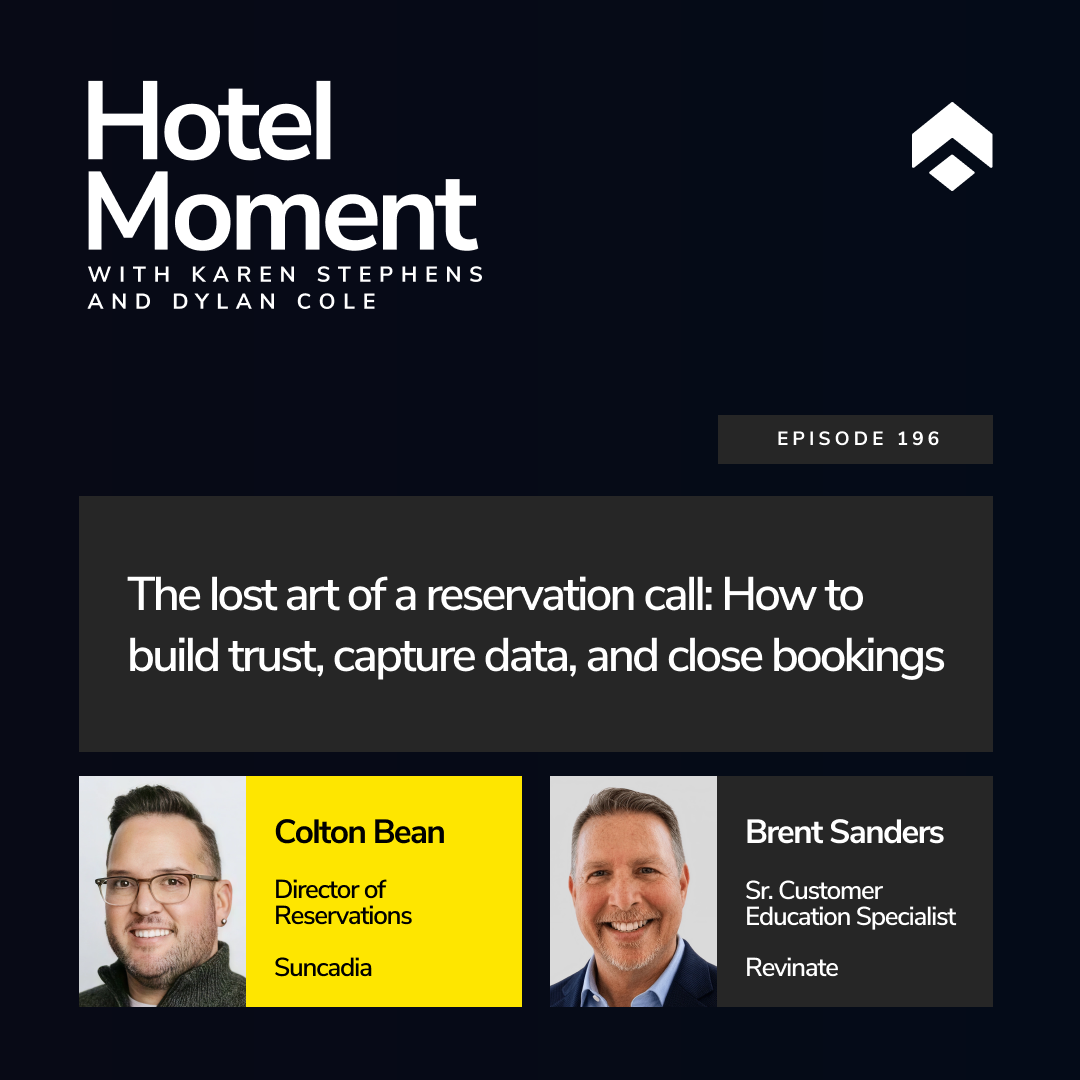
Episode 196
The lost art of a reservation call: How to build trust, capture data, and close bookings | a Revinate webinar
What if your next direct booking is hiding in a phone call your team already answered?
In this episode of Hotel Moment, Brent Sanders sits down with Colton Bean, Director of Reservations at Suncadia Resort, to talk about how reservation teams can turn everyday calls into opportunities to build trust, capture valuable guest data, and drive direct bookings.
Colton shares how Suncadia trains agents to ask better discovery questions, capture a caller’s name, trip motivation, and phone number naturally, and use firsthand property experience to make personalized recommendations that go beyond simply quoting rates.
It’s a practical look at why the reservation call still matters, and how the right combination of human connection, guest data, and technology can turn a phone inquiry into a long-term guest relationship.
Media
One simple trick
The power of information
The heart of reservation calls
Personalized calls make you likeable
Meet your host
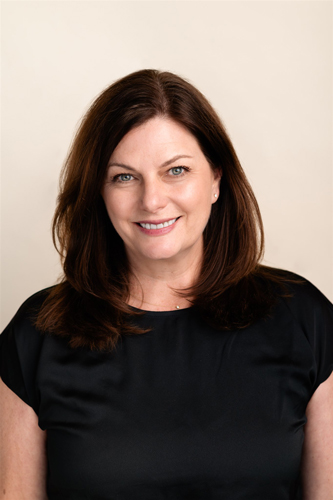
Karen Stephens
As Chief Marketing Officer at Revinate, Karen is focused on driving long-term growth by building Revinate’s brand equity, product marketing, and customer acquisition strategies. Her deep connections with hospitality industry leaders play a key role in crafting strategic partnerships. Karen has more than 25 years of expertise in global hospitality technology and online distribution — including managing global accounts in travel and hospitality organizations such as Travelocity and lastminute.com
As the host of The Hotel Moment podcast, she interviews top players in the hospitality industry. Karen has been with Revinate for over 11 years, leading our global GTM teams. Her most recent transition was from Chief Revenue Officer, where she led the team in their highest booking quarter to date in Q4 2023.
Watch the video
Transcript
[00:00:00] Colton Bean: At the end of the day, people buy from people they like. So if you just say, “I got an in for you, I made this a personalized experience that nobody else got today,” they’re gonna be like, “Wow, that’s really cool.” Even if they don’t book this time, they’ll think about it the next time and be like, “That was cool. They had me. They had my back on that.”
[00:00:21] Karen Stephens: Welcome to the Hotel Moment Podcast presented by Revinate. I’m Karen Stephens, Chief Marketing Officer, joining you from sunny San Francisco, California.
[00:00:29] Dylan Cole: And I’m Dylan Cole, Managing Director of Revinate Europe, calling in from Amsterdam.
[00:00:33] Karen Stephens: This is the podcast where we explore how technology shapes every moment of the hotelier’s experience, and more importantly, how the right technology delivers real outcomes for hotel teams and guests alike.
[00:00:44] Dylan Cole: From revenue strategy and guest communication to operations and marketing, we sit down with the people transforming hospitality around the world.
[00:00:52] Karen Stephens: Depending on the conversation, sometimes it’ll just be me behind the mic.
[00:00:56] Dylan Cole: And sometimes it’ll be me, bringing a European perspective and stories from across the global hospitality industry.
[00:01:02] Karen Stephens: Whether you’re a hotelier, a tech enthusiast, or just curious about where hospitality is headed.
[00:01:09] Dylan Cole: You’re in the right place. Let’s get into it.
[00:01:11] Brent Sanders: Welcome, everyone, and thank you so much for joining us today. Today, we’re going to be walking through original industry research that we did here at Revinate and what actually happens when guests call luxury and upscale hotel reservation lines. I’m so happy to be joined today by Colton Bean from Suncadia Resort to discuss how hotels can move past that sort of transactional rate quoting and start turning phone calls into long-term guest relationships, which is what we’re trying to do. So I think we start off by introducing ourselves to the folks who have joined the webinar, and I’ll do that first. My name is Brent Sanders, and I work for Revinate. I’m part of the education and training team at Revinate. I have spent 13 years working with Reservation Sales platforms, with reservation teams, and with Revinate customers. It’s my favorite thing in the world to do. And I’ve had the chance to work with Colton, so I know we’re in for a really good conversation. We invite you all to sit back and enjoy. Colton and I are obviously going to go through the findings of what’s happening, but we’re also going to leave you with some nuggets that you can take back and enjoy. Colton, why don’t you introduce yourself to the group?
[00:02:32] Colton Bean: Well, I’m Colton Bean. I am the Director of Reservations at Suncadia Resort. I’ve been here about a year and a half now. I’ve been in the hospitality industry over 20 years now and I’m super excited to be here. Revinate has really curated some fantastic data that’s really eye-opening about the reservations call process. So I’m really, really excited to talk about it today.
[00:02:57] Brent Sanders: Excellent. Thank you very much, Colton. And with that, we might as well dive in. So let’s just dive right into the meat of what our presentation is today. And here’s the roadmap of where we’re going to be for the next 45 minutes. First, we’re going to set the stage with the methodology behind our mystery shopping research. We’re going to dive deep into three critical operational gaps that we found: the contact capture gap, the discovery and engagement capture gap, and finally the infrastructure gap. In addition, all along the way, Colton and I will be sharing practical, non-proprietary best practices that you all can take back to your teams immediately. We want this to be impactful for you. We’ve seen the good, the bad, and the ugly. And Colton, I know, has driven top-notch performance out of his team. So we’re going to lean on him heavily to share some of the things that he’s done that have made the changes. So having said all of that, let’s begin. Every phone call, as you know, that comes into your property starts with thousands of marketing dollars in search engine optimization, paid search, social ads, rate parity management. They’re all designed to do one thing: make the phone ring in reservations. But what actually happens once the phone rings and it lands with your reservations team? Maybe it doesn’t even land with your reservations team. Today we’re going to dive into the research that we did across 308 calls to 135 different, unique luxury properties. This all happened last year. And I should mention none of these properties used the Revinate platform. But I think it’s really, really eye-opening to understand what happens when you spend all that money to make the phone ring, what happens on the other side when the guest finally reaches the property. Well, our first finding exposes what happens when high-value callers are calling in and somehow being treated like anonymous strangers. It’s heartbreaking, I know. But here’s the first finding. It’s a staggering one, and we’re just going to take a moment, because 92% of those unbooked calls that we shopped, zero contact details were collected. Not a name, not an email address, nothing. There were conversations that were had, but blind conversations — nothing personalized. What’s really concerning to me, I mean there’s so many things concerning, what’s really concerning to me is what happens when that high-value guest hangs up. It’s done. The caller hangs up and is gone forever. Now, Colton, I’m really interested to know what crossed your mind when you saw that 92% statistic.
[00:06:07] Colton Bean: I mean, yikes. Like as anybody in Reservation Sales, like that gives me the heebie-jeebies. Like that’s wild. We know how much money goes into getting those calls coming direct and how much better that direct experience is for the guest journey for just everything — higher ADRs for those bookings. So it’s tough to see that because like you just said, it’s dead. Once that person leaves, you have no way to follow up. You have no way to remarket. You have no information on why, who they are, what they are. It is shocking.
[00:06:41] Brent Sanders: Right, so let’s reframe this a little bit. Tell me what this looks like at Suncadia. How is your team going about capturing this data? What do they typically capture? And just reframe this. Now, I’m not looking for your statistic. What I want to know is what does it look like, because I guarantee you you don’t have 92% of these calls without any contact details. So tell me what it looks like at Suncadia a little bit.
[00:07:09] Colton Bean: Yeah, so obviously this goes into call compliance and lead hygiene. And so having that dedicated call criteria so that the agents are asking those discovery questions, so we’re getting a lot of that information as these calls are coming in, even if it is a non-booked call or we don’t have availability or whatever the case may be. Just getting the data was just half the battle, and then getting it into the CRM to be able to be used later is the other half. But with Suncadia, we have had Revinate for quite a while now. So our agents are pretty familiar with the system itself, but it’s getting the why behind it. Why are we asking for this? What are we gonna do with it? Why do I have to ask for an email? Why do I have to get a phone number every single time? Why? What’s the purpose, you know? And I think it’s just making sure that the agents are educated about holistically why we’re doing this and where we’re going with that info. But yeah, at Suncadia, I mean obviously everybody has opportunities, but that’s one of the things we are very good at is getting that information. And as you can see from this slide, this is as easy as it is. Like it’s not, you know, agents get scared to ask people for emails. They’re like, “Oh well, they’re gonna be mad at me” or “I don’t want any of this marketing stuff.” And I’m like, then don’t frame it as marketing, because it’s not just about marketing. It’s also about, “Hey, you wanted to come on this date. I don’t have a room for you, but you know what I can do? I can keep taking a look. And if I have something open up, you will be my first call.” Because at the end of the day, people buy from people they like. So if you just say, “I got an in for you, I made this a personalized experience that nobody else got today,” they’re gonna be like, “Wow, that’s really cool.” Even if they don’t book this time, they’ll think about it the next time and be like, “That was cool. They had me. They had my back on that.” And so they’ll call us back.
[00:08:58] Brent Sanders: Absolutely. And I’m glad you mentioned the why, because for other reservation managers that are out there listening to the webinar, it’s not as simple as just saying, “Do this.” I mean, it is as simple as just saying do this, but that’s not what gets the behavior to change. I think giving them some accountability to the process that they’re participating in, and sort of stepping back and letting them know how important this email is on a non-booked lead. Why is it so important? It’s important because now we have the ability to continue the story. And we are actively continuing the story with this, and not by spamming them with a whole bunch of marketing, but by nurturing them along the way, taking pieces from the conversation that they had, and then leveraging that data to speak to somebody personally and to nudge them when it’s time to make the next booking and all of those things. And also, I love how you also reframed it as a tool for the agent. Because now you have the ability to be personally connected. Most good agents out there are like, “Listen, this is my person. We had a connection. I want to reach back out.” Well, here’s the perfect way to do it: find out their name, get a good email address, get a good phone number so that we have the ability to do it. And honestly, there’s a cost to not doing that because all of the money spent is lost forever, like we’ve said at least three times now. But the value of capturing that is immense. Before I was a Revinate employee, I was a customer myself of Revinate, and I remember how quickly the database that we had multiplied exponentially because all of these people who are calling in, the hottest leads we have, we’re now capturing emails for. Marketing could now reach these people in a much better way. Seeing what’s on the screen here now and understanding it’s more than just that one phone call. It’s the relationship, right? How do you get your team to think long term about this isn’t just a one-time shot? This isn’t just close this call, fingers crossed. It’s building a relationship, because someone who’s coming to Suncadia probably has several touchpoints before they make the booking, I would guess.
[00:11:23] Colton Bean: Yes, absolutely. I think it all distills down to, you know, “what’s in it for me.” And so, tying why we’re doing these things back to the agents to be like, “You know, if you make a personalized experience, this person will remember you.” Like, you’ve created that relationship. And so, especially at a property like Suncadia where we do have a lot of repeat guests that come year after year — like it’s their family summer trip, they come to Suncadia every single year — getting that information and building that rapport with people, I think, is huge. Because you can turn a single call — and maybe it’s a non-booked call, or maybe it’s, “Oh, I need to talk to my spouse and I’ll call back later,” whatever the case may be, it may not be booked right off the bat — but building that rapport with them is what gets them to keep coming back. And sometimes it’s to the same agent, but it is also to the property itself. So it helps everybody. That’s our goal, our shared goal obviously, to create a remarkable experience and then get those guests to continue to keep coming back and be huge fans of Suncadia. We’re also obviously a vacation rental property, so the next step after that is becoming an owner. So it’s like we’re that first touchpoint on the journey to becoming an owner. So it’s a lot of pressure, but it’s also so fantastic. Like, how cool. We’re the first impression. We’re the ones that — I know we’ll talk a little bit about AI later in the call — but once people get past that and they actually call in and they’re on the phone, we’re that person. And it all hinges, I think, on that interaction.
[00:12:51] Brent Sanders: That’s perfect. Thank you for sharing. I just want to take one more moment and lean in on your expertise. So what changed once your team members or the team as a whole really got the why? What really changed, especially talking about gathering contact information at the beginning of the call?
[00:13:10] Colton Bean: So definitely, when we use Pursuance for our call criteria training, JC does a really good job of tying in the why, and it comes down to: we’re asking them to do these things. It’s very important, obviously, and just making sure that we don’t want to spam people. We don’t want you to get 367 emails every five minutes. Like, that’s not the purpose of it. And so the more questions we can ask in that first discovery phase really does help, not only for the Revinate CRM, having that information, but making sure that it’s clean. If somebody’s calling in because they’re bringing their guys for a golf vacation, we’re not marketing a romantic getaway to them. Making sure that people — at the heart of it, that sounds really weird, but if that’s why I called and then I get an email about a romantic thing, they’re like, “Well, you obviously did not know what I was talking about when I called.” And so then I would just delete that email, and then you have no click-through, you have no ROI, you have none of that. So being able to segment it, get that information up front, and then have a clean database is really super important. And I think once you tie that back to what’s in it for me, you’re going to get more bookings because we’re going to target the correct people with the correct piece of media, then you get a super hot lead, and then that’s money in your pocket. It’s just tying that whole holistic picture together.
[00:14:38] Brent Sanders: Absolutely. I mean, I was shocked when I saw the 92%, and it broke my heart a little bit as you mentioned. But what you realize is that these are folks that don’t have our platform. They don’t have a lead that has popped up that’s just ready to be filled out. But here’s what I want to say for any of those who are out there presently: just consider, because I know the tick sheets that are still being used throughout the world. Like, “This is how many calls we got,” and you’ve got a spreadsheet for that, and they’re writing it down. “This is the person I called.” I see agent notebooks that have names of people they’ve discussed, but it’s just staying right there. Instead, I want to give some real practical advice on capturing email addresses, names, and phone numbers. And one of the first is, what I think is important is do it at the beginning. Now, it always scares agents to do it at the beginning because they don’t think they’ve created — we’re not best friends yet. How dare I ask them about their email? But what I’ve learned is, number one, if the marketing is working properly, you’ve got somebody who has a genuine interest in coming to your property. They’re likely gonna want to stay in touch with you in some form or fashion. But phone calls drop. “In case we get disconnected, what’s the best phone number to reach you? May I also get a good email address for you?” And straight off the bat, I’m a real proponent of, “Thanks for calling our property. My name is Brent. May I have your name, please?” It’s just nice and polite. You just want to engage with people. Do you have any other tricks up your sleeve that you use to help agents who understood the why, but were still a little nervous, build their confidence so that they could follow a process that allows you to capture this data?
[00:16:28] Colton Bean: Yeah. So, I mean, I’m a huge proponent of role-playing. So I feel like the more that you can practice before you actually have to do the thing, the more comfortable you’re gonna feel. You know, we talk about — there’s a ton of companies out there that do call criteria things, but the biggest thing is nobody wants to sound like a robot. You don’t want to be like, “Oh, hi,” and then you’re just going down this list, you know? And it’s having people go through a role-play situation while it is awkward, like, you can get that awkwardness out before you’re ever in front of a guest. Same kind of thing with like call shadowing. When you have agents that are quite a bit more tenured and they get fantastic call scoring results, have the new little baby agents sit with them and just listen to how they do things. And they can kind of develop, “Oh, that’s what I’m supposed to do. Here, this is the cadence of how I’m supposed to speak.” Those are obviously industry standards. But I think one of the things that really changed the game for us at Suncadia was definitely making sure that when we’re getting on that call, it’s, “My name is Colton. Can I get your name, please?” Then you’ve got the name right there. Then you move into, “What can I help you with today?” And then it’s, “I’m looking for a golf vacation,” or whatever the case may be. There’s your reason for stay. And then, “Can I get a number just in case we get disconnected?” So now you have their name, their reason for stay, and their phone number right off the bat in the first less than 10 seconds, and it feels so natural. Change is hard. Change is hard for everybody, I totally get it. But I will always — I’ll die on the hill of having them go through role-play, having them role-play with each other. They’ll giggle and whatever, but it truly is so helpful. Even if you do it two or three times, it just kicks it out of there, and then it just becomes part of the flow and their cadence. Because they do that at the back end, you know? They’re like, “I gotta get them the confirmation. I gotta do the travel protection.” They have their flow at the backside. You just gotta make the whole thing flow and let them kind of tweak it a little bit. I know obviously there’s people that have Forbes standards and whatnot where it is very strict, but for the people that don’t, it is nice to be able to let them switch up their little greeting a little bit. As long as they’re still getting the name, as long as they’re getting a phone number, as long as they’re getting the reason for stay, we’re good.
[00:18:40] Brent Sanders: Love it. And something else I wanted to mention is I am a firm believer also that you can get the information right at the beginning, kind of like paying the toll to get to the information that you want, sort of thing. But also, that’s not the only time to ask. There’s opportunity. Once you do make a connection and somebody does have genuine interest, why not say, “Let me send you an email to follow up on some of this.” Do you send sort of recaps of the conversation to people? Does your team do that presently?
[00:19:10] Colton Bean: Yes, absolutely. I mean, while we are a Destination by Hyatt with the hotel product, we do have vacation home rentals as well. And those tend to be a longer reservation process because they are all one-of-one. There’s usually multiple families involved. So our agents utilize that a lot. They’re like, “Let me send you a few options.” And then we set a follow-up to call back out and say, “I’ll follow up with you tomorrow or the day after tomorrow, and we can talk about the options that I sent over and what’s gonna work best for you.” Obviously, sometimes we can get them booked on the first call, but a lot of times we’re definitely sending that follow-up email. And that’s what makes Revinate such a great product in general — shameless plug. But you get the guest calling on the phone, inbound or even outbound, and then you can email directly through Revinate, and it’s all attached to that one lead. It makes it so easy to be able to, A, know what’s happening, and B, keep everything kind of collated together so that any agent has all of that information all on one screen.
[00:20:10] Brent Sanders: Absolutely. And nothing feels better, especially because agents — I mean, as we’ve said, it’s not difficult to be a reservation agent, but it’s not easy, that’s for sure, because they have so many hats that they’re wearing. So the one thing to keep their life organized — that’s one of my favorite parts of the system too, is that lead just keeps everything in one spot so you can see exactly where you were. So good. I think those are some good ways to think about capturing that detail at the beginning. But if you don’t get it at the beginning, that’s not your only shot. Let me continue the conversation with the guest and be interested enough to get their email address so that you can continue to work the deal to ultimately get the booking. So the next gap that we found was really around discovery and engagement, and what a gap this is. Because you mentioned robotic — I mean, this is when something falls apart from being what could be a really robust conversation, personalized and understanding what the customer wants and describing how Suncadia fits into that, to just sort of robotic rate quoting. And here’s what we found: 56.6% of all of the calls — just barely, I mean, half of the time — there was zero discovery questions asked. Nobody asked. And listen, 74% of the time when it landed at the front desk, they didn’t ask any. Why? It’s not a surprise to me. Front desk agents are focused on lots of other things. They’re also wearing many different hats. What’s concerning is they actually have live guests in front of them. So how are they supposed to handle a high-value guest who’s called in? That’s not their priority. It will never be their priority. So listen, we know people out there maybe don’t have dedicated reservation teams, but maybe you could dedicate a person to handle these types of calls when they come in, a shift, so that they can have that focus on the high-value guest that’s calling in. Because here’s what happens. We know what happens. The guest gets their marketing. The guest hears from their neighbor who just got back from vacation about how wonderful their vacation was. They go onto the web. The wife looks, and she’s like, “Oh, that looks so nice. Seems like this would really be perfect.” She leaves, she has dinner, she comes back the next morning, she’s like, “Oh, I can’t wait to go back and see this property.” She flicks it back to the website. She’s building anticipation of how exciting this could be. She mentions it to her husband. He’s like, “Well, yeah, but we gotta find out a little bit more details. Find out how that’s gonna be with our teenager. Find out how that’s gonna be with our two-year-old. Find out about all of whatever.” So the guest finally dials the number. How disappointing when they dial that number and the person’s like, “Oh, wonderful. What dates? $450 a night?” Actually, wouldn’t it be great if it was only $450 a night? To the people we’re talking about, it’s like, “That’ll be $2,572 a night.” How in the world are we expecting people to just give us the money without having any conversation about anything here? I want to mention, you brought this up earlier, I think it’s really important to talk about how the role of the reservation agent is really changing, how technology is changing in the world, especially how we’re dealing with AI. AI is impacting the travel space in such a robust way. In fact, people are weaving it more into their lives. Maybe not in every space, but they’re willing to use it instead of making a Google search and seeing what comes up. How nice to be able to say, “I’m looking to get away for a few days somewhere in the South, somewhere in the Pacific Northwest,” whatever, and then let it spit out. And this is what AI is great at. AI is great at immediately pulling together facts — facts about the size of the room, facts about the amenities on your resort, facts about the pricing and what it usually goes for. All of that is presented to them at their fingertips. So callers don’t need to call in and hear those facts. They call in to understand why, how this will be important. So understanding that — listen, I know we’ve all been there, we’ve dealt with the agent who is just, “These are just the facts, ma’am,” kind of situation. How have you been able to shift your team from “just the facts”? In fact, I’ll ask you a specific question: what does it sound like at Suncadia when an agent describes the property versus an agent who explains the experience? How does that happen differently at Suncadia?
[00:25:01] Colton Bean: Yeah. Speaking of the AI thing, right? Anybody that’s on the call that was at the CoralTree Summer Summit, we had Henna Pryor come and speak as our keynote. And the biggest takeaway that I had — she spoke about how the old adage was “trust but verify.” And now it’s flipped. People don’t trust anymore, so they’re verifying and then they’re trusting. And so for us in reservations land, what that looks like is that people are on Gemini, they’re on ChatGPT, they’re on their favorite AI of choice, and they’re asking it all the things about our properties. So they come armed with all of these facts and truth. We don’t need to regurgitate that again. It’s not necessary. What we need to do is tie what our features are to that guest’s personalized stay. So the way we do that is we ask them these questions first: “Why are you coming? Who are you coming with? What brings you to Suncadia? And what are you most looking forward to doing while you’re with us? What type of accommodation do you see yourself staying in?” Those questions, which are very simple, give you so much information on what’s the reason, right? And then in the second part of it, in the engaged, you are tying that into a personalized recommendation. We have a really robust fam stay, familiarization stay, that our agents get to participate in at Suncadia. So they come, they get to experience the property as a guest would and do activities and go to the Spa, stay the night for a couple of nights. We also tie that into a little bit of cross-training. But the big takeaway is when people are telling them these things like, “Oh, I’m coming for a romantic getaway, it’s our 10th anniversary,” they don’t get to say, “Oh, okay. Well, you’re gonna really like our steakhouse, and you’re gonna love going to the spa, and you’re also gonna love golf.” It’s, “That’s fantastic! I’m so excited you’re gonna spend your 10th anniversary with us. You know, I was actually just at The Stovehouse three weeks ago and I had the most fantastic steak. It would be such a lovely setting to sit out on the patio and look across at the 10th hole. There’s a beautiful fountain out there.” They’re really painting that picture of why that guest will come to our property and have a fantastic time. I think that personalized recommendations all day, every day — because that’s one thing AI can give you a semblance of, but not like a person can in real time, because AI’s never experienced what our Pear Pressure cocktail is like at the source.
[00:27:32] Brent Sanders: That’s definitely right. I also love that you mentioned that. Back in the day when I worked at Hawks Cay Resort — shout-out to Hawks Cay Resort — we also had Reservations Palooza, where we’d bring everybody together and they would enjoy and participate in the amenities. And how it paid off over and over and over by giving the agents the confidence to share personalized experiences was well worth it. So here’s my question to you: why do you think discovery gets skipped, though? Think about when you’re coaching your agents — why do you think it gets skipped? What happens? Do you think agents are just being lazy, or is there something else behind it?
[00:28:19] Colton Bean: I don’t think it’s a laziness thing. I think it goes back to that fear, like, “What if they don’t answer?” And I’m like, you gotta keep asking questions because at some point they’re gonna have to answer, because you’re also tying it into why they’re staying. So you already have an interest. Some people are just like, “Well, I’m scared to ask them so many questions and they’re not gonna wanna call back or they won’t book or whatever.” I’m like, well, you gotta get that out of there, because they’re already calling, so we need to not make it hard for them to give us money, right? The interest is already there, so now it’s your job to find out why. And I think taking a really conversational approach to it is huge, because you’re not sitting there and interrogating them. It should definitely be — I think it’s like a 70-30 split usually. The guest should be talking; we’re just asking the questions. You’re letting them say why they’re coming. People will tell you; you just gotta give them the runway to do so. So I think making sure the agents get out of their heads — I’ll go and die on my hill of role-playing, just asking them that, pretending to do that every year. I love your Reservations Palooza, I love that. Every year we do a call criteria training, and they have like a full eight-hour day where we’re learning skills, we’re going over new menus, we’re going over new amenities, and just drilling that in so that it is second nature — because it should be. They are the experts, and that is why people are calling. They’re overwhelmed with the website. “There’s so many houses, I don’t know what to do.” So they need help, and all we have to do is be of service. And that starts with asking why they’re coming. “Why are you coming here? What else can I do to make your stay better?” That should be the lens that we’re looking through, as opposed to — I mean, obviously revenue is king, that’s the goal, but how do we get better with making it not be like, “You’re gonna book this room and you’re gonna love it,” you know? It turns people off. So it needs to be a conversation. And the more you can learn about them, the more they will trust you to be able to get that personalized recommendation to be like, “Oh, well, I really like this person, and I’m gonna book with them.”
[00:30:22] Brent Sanders: That’s exactly right. And I also love that you said if they asked a question that the guest didn’t really resonate with or didn’t give you a nice, robust answer, don’t automatically assume that they don’t want to do any talking. It just wasn’t that question. Find out another way and move on. I think another thing that you made very, very important, that I think other managers can really work with their team on, is the more natural your agent feels as though they’re in a conversation with somebody, the better. And I know we’re giving them some questions that will lead the conversation the way we want. Well, when they ask somebody, “What’s bringing you to the area?” and then they share that they’re coming because they’re finally getting a chance to get away and leave the city, there’s a very big tendency to just say, “Okay, I asked that question,” and say, “Oh, wonderful. Perfect,” and move on to the next question. Where we would never engage with a friend of ours who says, “I’m finally getting out of the city,” with “Wonderful,” and you just move on. Acknowledge it, reflect back. I always like to give a key tool to say: take that answer and reflect back. Remind them of something on property that will fit that need. “We’re coming to get away and relax.” “Oh, well, boy, have you picked the right place! All of our guests say all the time how relaxing this is. And we even have terraces you can sit on to enjoy that relaxation.” Tying it back into an amenity and then moving on to the next: “So then, who’s going to be traveling with you?” And thinking about open-ended ways — discovery questions come in open-ended form. Asking somebody closed-ended questions is not a bad thing, but it’s not for discovery; that feels a bit more like interrogation. Asking a question and letting a guest speak and share, tying it back, reflecting it back, and then moving to the next is super conversational. And it starts becoming less of step-to-step-to-step, because it starts sounding to the agent like, “Oh, I’m just talking. We’re just having a conversation.” It’s shocking how the process can actually lead that way. And sometimes that’s the lightbulb that actually comes on. It’s like, “Oh, it was just that easy?” You’re like, “Yes, it was that easy.” And here are the two scenarios. One, you’re talking simply about, “Listen, between a 375 to 525-square-foot room. Sometimes it’s a suite and it’s bigger, and sometimes it’s a vacation rental that’s multi-bedroom.” But the truth is — we know, I know very firmly — that the memories that are made at Suncadia and at places like Hawks Cay that are once-in-a-lifetime easy Florida Keys visits, those memories that are made are made outside the room. It’s getting the chance to share what the experience is like at your property. That’s very, very different than describing with square footage and amenities what’s in a room, to — and this slide perfectly indicates, because you can see it’s not just about that room, it’s about snorkeling, it’s about being at the beach, it’s about fun family time. So I’m sure there’s a way that you have designed your criteria so that people are getting the full explanation of the experience of Suncadia.
[00:33:48] Colton Bean: Yeah. So one of the things we do is we require every call — and we’ll talk about coaching obviously later — but require that they have at least three personalized recommendations. So when you’re asking those discovery questions, that’s their opportunity to get the information for those personalized requests, right? Going back to having it be a conversation, it’s super easy for them to do that in the mix of that discovery section. And so I think that’s the biggest thing, especially for new agents, is being like, “Oh my God, I have to give my three personalized recommendations.” And it’s taking them out of that mindset to be like, it’s not so much about the call criteria, because if you are present in that call listening to what the guest is telling you, it’s so easy to get three. You might get to like six. It depends on what time of year it is, obviously what kind of experiences we’ve got going on, what information they’re telling you, but it’s very simple to get there just because if you are truly present and you’re paying attention, they’ll give you all the information you need. We just have to ask the right questions. One of the things that we also do for new agents is we have a bank of open-ended discovery questions so that when they’re first starting, they can kind of work through that. There’s obviously some that are super simple, more open-ended, and there’s a little bit more detailed ones. But that’s something if you don’t already have that, you can use ChatGPT, you can just make those tools for yourself. Because at the end of the day — most reservations managers will know this — nobody’s gonna come to your rescue. You’ve got to rescue yourself. So if you don’t have tools or you don’t know where to start, the information is out there. These webinars are a perfect example. Use every available resource to you, because it will make your life and your team’s life so much better, and also the ROI is just crazy.
[00:35:41] Brent Sanders: I like that. And what I also appreciate is that you’re investing in your team and you’re giving them the resources. Why should they have to think of an open-ended question all the time? There’s a whole bunch right here. Try one of these and see how they work. Guaranteed someone’s gonna try one, and it’s gonna give them the best information they ever had, and they’re never leaving that question behind ever again. All it takes is one time. On the flip side, somebody cuts someone off, it hurts their feelings, and they get a little shy, but try it again. You can’t let one guest experience or one phone call parlay every other conversation that you had that day. But I think we’ve dropped a few nuggets here. The last one I want to talk about is really understanding the ability to continue the relationship. You mentioned follow-up, and we’re just gonna talk a little bit about that. Because we all know that very, very often we get to the point and we say, “So could we go ahead and confirm this for you? Sounds like the perfect room for you and your family. Let me go ahead and get that.” And she’s gonna say, “Actually, before I do that, let me speak to my husband about this. Let’s make sure that everything’s in place.” So when people need to check details, check with somebody else, secure flights, whatever it is, it’s a real pivotal point to not let this be like, “Okay, call me back. We’ll hear from you when we hear from you.” How do you get your team to feel confident enough to say, “You know what, I’m gonna take control of this. I actually think this is going to be great for them based on this wonderful conversation that we had, so let me send you something and reach back out to you.” I think an email is a great start. I don’t think email is real follow-up. The follow-up happens with that phone call. So how did you create that, or what does that process look like at Suncadia now? And tell me how your team has worked their way through it.
[00:37:39] Colton Bean: Yeah, so we obviously use Revinate’s follow-up feature for leads. So that’s a huge boon for us because they have a lot of leads, you know? A lot of these agents are working 20 to 30 leads at a time, and so having those reminders to be able to set them for a certain time to make sure they’re on top of it is super helpful. But yeah, sometimes they’re looking at a couple houses or they’re torn and they need to talk to the other family they’re coming with. So we’ll send an email and say, “I’m gonna send you an email with information on these homes — essentially a quote — with a little bit of information about cancellation policies and things like that.” And then they’ll set a reminder for usually the next day, and then they reach back out. And most of the time they get that booking because they’ve had a chance to take a call, talk them through it, and then they are like, “Yep, we’ll pull the trigger and do it.” That’s one way. So obviously home bookings are a little bit stricter with cancellation and deposit policies. One of the other tricks that our agents will use for our hotel bookings — since there is just a credit card guarantee to book it, there is no deposit taken at booking — is they’ll be like, “Well, let’s do this. I’m gonna go ahead, if I can grab a credit card right now, to hold the room. We don’t charge anything until seven days before your arrival. Let’s go ahead and get it held just because I only have a few of these left. And then you can talk to your husband, I’ll call you tomorrow, and just make sure we’re good to go. And then we can go ahead and get that confirmed.” And let me say, 75% of the time, people are like, “You know what? Yeah, I don’t want to lose the reservation. I’ll go ahead and give you my card, and then if you just call me back, we’ll get the confirmation tomorrow morning,” or whatever the case may be. So it’s little tricks like that. They’re out here trying to get those bookings, and it comes back down again to “what’s in it for me.” That is directly affecting their pocketbooks, and so that will be obviously their biggest motivator. But the secondary motivator is like: we want the guests to have the best experience, and they’re not going to have that experience if we’re like, “You need to get this booked now or the house is gonna burn down and you’re never gonna be able to book it again.” Like, that’s not the vibe. People don’t want that. They’ve already usually done a lot of research on where they’re coming and what they’re looking to do. It just kills it. So I think having a little bit of a softer touch is definitely helpful with being persistent, but the follow-up is definitely what clinches that. Because how many times have you called somewhere and somebody said, “Yeah, yeah, I’ll get you that quote. Bye-bye,” and then three days later you still haven’t gotten an email, nobody’s called you, and you’re like, “Well, cool. I definitely needed a plumber, but I guess it’s not gonna be this plumber.” So our agents do a very good job at the follow-up. And honestly, there’s bookings that they probably wouldn’t have gotten if they didn’t follow up, because people are sensitive to that. It goes again back to trust. If you told me you’re gonna do something and you don’t do the thing, now I don’t trust you because you said you were gonna do it, but you didn’t.
[00:40:25] Brent Sanders: I hear you. I think that the whole idea of follow-up is just building this relationship — this idea that it’s just not a one-time transaction. This phone call, I hope every time the phone rings, it turns into a booking, but very, very often they do have to check with other people. And what I loved about what you said — there’s nothing wrong with saying that, because as managers, we have had to speak to those customers who called back three days later who wanted the same rate that they were quoted, or who called back a week later and the room was gone. “What can you do for me?” Because that’s a real-life situation. This isn’t just a fake thing that you’re throwing out there. “Based on what we discussed, this sounds like the perfect room for you, and I’m actually afraid it’s not going to be here when you call back. So let’s go ahead and get your credit card and secure this. We’re not charging anything, and then take the time you need to finish your plans. You’ve got up until seven days in advance.” I love that phrase, and I think more and more people should make their agents confident to understand that these aren’t just words you’re saying — this is gonna impact somebody’s vacation. Makes complete sense. And thank you for shouting out — having a lead that reminds you, having a lead that has the conversation that you’ve had before becomes priceless in the whole process. So I get it. And so we’re going to get a little bit into that now, because we found some friction in the infrastructure that drained revenue, and revenue was just pouring out of holes. What we’re talking about is what happens when 26% of after-hours callers go into a voicemail. They have no chance to speak to anybody. That’s terrible. Nobody’s ever booking through a voicemail. So what’s gonna happen is they’re very, very excited, but you’re closed after office hours. They’re gonna call somebody else who isn’t closed, and that’s who’s gonna get their money. I also want to talk about this — this was really surprising for me: only 41%, so 59% of the time, the call wasn’t even being recorded. Now, I do remember — I have to go back decades when I didn’t have call recordings, and I felt like it was such a blind spot, because I could only hear what was happening on my agent’s end. You don’t know the tone, the idea, the urgency that’s coming from the guest; you just hear the agent’s side. And it was impossible to try to change behaviors. All I can really remember is how I was able to change behaviors once I had recordings. So I know you listen to recordings. Tell me a little bit about having those recordings and how that has changed. By the way, I should just ask you directly: have you been a manager when you didn’t have recordings, and have you been a manager now that you have them?
[00:43:29] Colton Bean: Yeah. When you don’t have the ability to quality-check what your agents are saying — and not even necessarily that they’re saying wrong things, but if they’re not asking those discovery questions or they’re asking super closed-ended questions, whatever the case is — if you don’t have the ability and the insight to see that, you’re flying blind. How do you train? How do you coach? How do you nip those behaviors in the bud? How do you grow your agents? How do you grow your business? There’s so many reasons to have that. I hope we never go back to that. That’s just very scary. But as you are aware, obviously, being in the office is one thing, because you can kind of get some of it in the background. But after COVID, almost everybody on my team is completely remote, and it’s the only way that I have insight into what’s going on, what they’re saying, what they’re doing, and how we can help them find those opportunities to tweak them, just be a little bit better, say things a little bit differently, make sure that the information that they’re giving is correct and true, and that we’re not creating any guest service mishaps. But yeah, it’s definitely — I don’t know what we would do without it. It’s kind of mind-boggling at this point. If you don’t have it, it’s like not having a right arm. I don’t know what I would do. I mean, for coaching alone, it’s crazy.
[00:44:49] Brent Sanders: I feel the same way. And listen, nobody likes to listen to their own voice. It’s cringy for everybody, including myself. But to have the ability to say, “Just listen to these calls,” because you actually can hear where the connection dropped, you can hear what happened. “So what was going on with you?” And it makes it real life, because sometimes you remember things a certain way, but when you hear it — like I almost said when you hear it in black and white, which isn’t exactly, but that’s how I feel about call recording. I can hear it in black and white. It’s right there. Did you say it? Did you not say it? When you said it this way, yeah, you asked them that exact question I wanted you to ask, no doubt, but I don’t think you said it with the intention that the question was meant for. And that’s the part that you really can’t understand unless you hear the whole call. So I’m glad to know that you’re using those recordings, you’re listening to them, you’re helping, and especially because a platform like Reservation Sales does allow you to deliver calls to people who aren’t on site. And it’s the one way that gives you visibility into what’s happening with them; it becomes the spine of the whole process. So these things are the costs for infrastructure: unrecorded calls. I think we hammered that one because it’s shocking. No ACD system. Listen, one of the other things I love about Reservation Sales is we get the right caller to the right agent at the right time, being able to turn somebody on to a proficiency for a new skill. “These are customers who said, ‘I’m looking to book a new reservation,'” as opposed to somebody who said, “I have an existing reservation inquiry,” that could maybe deliver to somebody else based on their own skill sets. Do you do much tweaking with these skills? And it’s okay if you don’t, but do you use the ACD system?
[00:46:53] Colton Bean: So we do. We just launched a pre-arrival program, but because we are a branded franchise, we have split skills. So some of ours roll over obviously to our GCC infrastructure with Hyatt, and then we also do outsourced RezForce as well. So that is the nice thing with having those skills: we can really separate those hotel guests and homes guests to get them the correct experience for what they’re looking for.
[00:47:22] Brent Sanders: And I just think you have to think about the pathway of this excited guest. If the guest lands into an ACD, that’s great, but we now have to deliver them to the right place, to the right person who’s ready and available to help them. Because dropping calls into voicemail, which is number three, is the last-case scenario. People who are calling — I’m not saying they’re all going to book, but they have higher booking intent than anybody else, and all of a sudden they get to a voicemail. It’s the worst-case scenario. And how many people are going to leave a voicemail for a business? That’s the other thing. Leaving a voicemail for a plumber — that’s urgent, that’s necessary, and that’s needed. Vacations carry that emotional weight and that emotional price for sure. But to a customer who’s ready to pay, they’re not necessarily going to leave voicemails. So even though you’re like, “Oh great, we got back to all of the voicemails,” you don’t even know the people who didn’t leave a voicemail. Well, you do if you use ResSales, because we tell you if they just dropped and didn’t leave a voicemail. But these people have no insight into that. And then lastly, we’ve been talking like it’s the most common thing in the world because we use Reservation Sales — and it is common for us — to have a lead form pop that has fields that the agent can populate. Not only populate for all the great things we said for marketing, but it also follows a nice pathway through the conversation. You can use these fields and these note fields to remember to follow up. Data on pen and paper that’s separated from everything else becomes just that: broken and separated as a journey for the guest. Surely you must have had an opportunity where a guest called back in and wasn’t able to reach your original agent, but the new agent was privy now to the conversation that happened with Agent A. Can you describe a conversation that happened at Suncadia and how the guest felt?
[00:49:30] Colton Bean: Yeah, it’s fantastic. The one thing I think, especially in this day and age where everything, all information, is so at your fingertips and so easily and quickly accessible, people expect that everywhere they call. So say it’s somebody’s day off, and a caller calls back in to get this booking clinched — they’ve done their follow-up and left a voicemail saying, “Call me back, I’d love to get your stay booked,” and then they call back and so-and-so is now off. When that lead pops, that new agent scrolls right to the bottom and sees every email, every phone call, notes — everything is there. “This is what I talked to them about, this is what I quoted, this is all of the things.” And so they’re immediately up to speed, and that guest doesn’t have to sit there for 15 minutes and say, “Well, I was just talking to so-and-so about this, and they told me this, and it was quoted this much money,” and go through their whole spiel again. It’s all just right there. And they say, “Perfect! Looks like you were looking at 120 Snowberry for this date to this date. Is that still accurate?” They’re like, “Yes, it is.” “All right, here’s the total stay booking. Would you like me to go ahead and get that confirmed for you?” It makes that call so quick. And just going back to the agents themselves, right? Every call is money. And so when they have to take a call that somebody else is booking, obviously they’re not going to get money on that. So the quicker we can make that interaction and get that guest helped expeditiously, the better, because then they can get on to the next money-making call and move on with their day, and not waste a bunch of time for both the guest and for the agents. So I think that’s one thing that ResSales does fantastically well: just having all of that information in one bucket, where they can look at it in a timeline order straight down.
[00:51:18] Brent Sanders: Absolutely. And I would just encourage those folks who don’t have a lead form presently and are watching this webinar: have your agents start taking down names and email addresses. Take this information down in a shared spreadsheet that people can see. They’re gonna take the place of a lead, and you don’t need to capture every detail. But if you can capture phone number, name, and email address, connect with somebody, and then pass that on to your marketing department, you’ll be driving things forward in such a great way. But the value and the payoff of premium software that we’ve been talking about with Reservation Sales — which definitely takes every inbound call and makes sure it gets to the right person — recapping here, it allows agents to have a very organized way to follow up on the people that they have connected with and spent their effort with. And it allows us to take all of that reporting and celebrate the team as a whole and individual performance. You know what conversion is, you know how long they’re on the call, you have down-to-tenths-of-a-second details on the performance of your agent. So Reservation Sales does amazing things. We have just rolled out automated call scoring, where we are using AI to go in and listen to those calls against a set of criteria and let managers know if the agents hit the criteria. What’s changing here is that Ivy, who’s going in and listening to these calls, isn’t replacing agent coaching; it’s allowing for agent coaching. It’s saving the res agent and the res manager time, and allowing things to work and coach in a very scalable fashion. Because I remember listening to calls myself, and I didn’t score every call I listened to, because, “Oh, this was the third time the guest called in, they probably wouldn’t follow all of these things, let’s find a better one.” And so the next thing you know, you have wasted an hour and 15 minutes trying to find a good call to score for one agent. Nobody has that time. So with automated call scoring, you just click a button and let them listen to it. By the way, I would never only trust AI doing this; it’s just another person on your team that’s doing this. So that’s great. And then we have RezForce. RezForce really comes in because it’s dedicated coverage for extending your team. I was always so grateful for RezForce, because my team could only work eight hours a day; there’s only so much time we had. I had people who filled in for us when we had volume that we couldn’t reach, or it was after-hours when we weren’t gonna be there, and we had people there ready and available. And RezForce has always blown my mind because when I say they’re extensions of my team, it felt that way because they presented themselves that way. And they have the knowledge, they’re professional, and they close business — sometimes even better than my own team that I was trying to drive behaviors with. There is a strict behavior that RezForce is following. Do you guys use RezForce for after-hours and overflow currently?
[00:54:47] Colton Bean: We do, yeah. So we use it for our vacation home product,
[00:54:52] Brent Sanders: Which is even trickier, by the way. Vacation home products become a very deep-dive conversation.
[00:54:57] Colton Bean: Yes. And again, it’s going back to that: people are coming armed with all the information already. So RezForce does a very good job of being able to clinch those bookings, you know, when my team can’t and we’re not there, or say we’re out at an outing or when it’s after-hours. But it’s all about the information that you put into it, right? Like, if you don’t put any information into it, then you’re not gonna get anything out of it. So the RezForce team is fantastic. We usually try to do once a quarter or once every six months just to come present to them and be like, “Here’s all the things that have changed. Here’s new amenities that we have.” We did just do the lodge refresh; we talked to them about that earlier this year. So it’s really about — again, it’s just like coaching, just like using Reservation Sales reports for your scheduling, all of that — the effort that you put into it is what you’re gonna get out of it. And RezForce is fantastic. They have a ResGuide that you actually get to curate and make changes to in real time, with links, so they have all of that information right at their fingertips and can make those bookings for us when we’re not there. They’re absolutely fantastic.
[00:56:04] Brent Sanders: Thank you very much. I agree. Listen, I work for Revinate, so we have quarterly all-hands meetings, and there’s not a quarter that goes by that we’re not celebrating at least one, most of the time multiple RezForce agents who have scored 100s for the Forbes shops for the properties that they’re calling. And sometimes they’re representing folks where the property’s own reservations team has never scored a 100. It’s not easy to do. But they follow a strict training process, so let them be an extension so that you have people when you need people. So let me talk now: the voice channel, as we’ve discussed, is your highest-converting asset, but it can’t operate blindly. Give your team the structured lead forms. Allow our system to get the right call to the right person based on how they’re skilled. Are they great at handling spa? Let’s drive spa calls to them. There are all kinds of ways to do that. I’m going to take a moment and say thank you very, very much, Colton, for sharing your insight. You inspire me. I was very excited to do this because I knew that we were two reservations folks who love to talk about reservations, who have passion for agents, and I appreciate what you shared, and I think a lot of people got some good takeaways.
[00:57:25] Colton Bean: Yeah. Thank you so much. It was a pleasure being here today. Anytime I can nerd out about reservations, I’m always down.
[00:57:31] Brent Sanders: Well, good. I also want to take a chance to plug: for those people who are part of Revinate, just know that if you have questions or you have more thoughts about any of this that was discussed today, education@revinate.com is how you reach the training team. We’re happy to help and do that. I will even plug for myself: sometimes we can come and get your team reinvigorated and re-excited with some training. I’m gonna be doing that at a couple of our properties this fall, and I’m very, very excited about it. Lastly, this is what we do. This is what Revinate is about. We are the leading direct booking platform for the hospitality industry. Come join the team. We’ve got great people out there like Suncadia who participate. We want you to be a partner. So thanks again, and goodbye, everybody. Thanks for all of your questions; we appreciate it.
[00:58:24] Karen Stephens: Thank you for joining us on this episode of Hotel Moment by Revinate. Our community of hoteliers is growing every week, and each guest we speak to is tackling industry challenges with the innovation and flexibility that our industry demands. If you enjoyed today’s episode, don’t forget to subscribe, rate, and leave a review. And if you’re listening on YouTube, please like the video and subscribe for more content. For more information, head to revinate.com/hotelmomentpodcast. Until next time, keep innovating.
Episodes
Hotel Moment
WITH KAREN STEPHENS
Subscribe for updates on your favorite platform