Hotel Moment
WITH KAREN STEPHENS


Episode 194
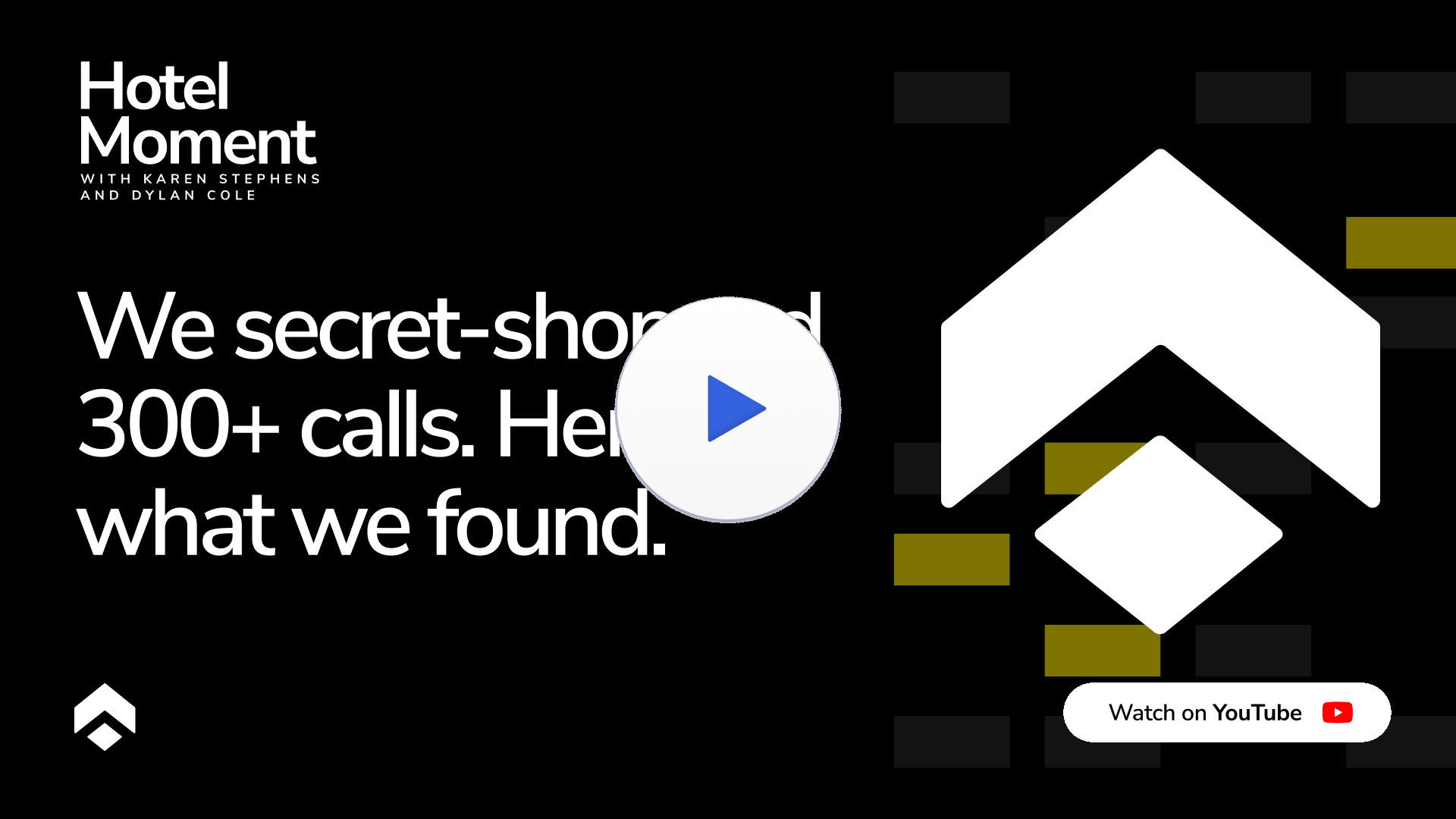
We secret-shopped 300+ calls. Here’s what we found.
What happens when a high-intent guest calls your hotel?
In this episode of Hotel Moment, we unpack findings from 308 mystery shopper calls across 135 luxury and upscale properties, and uncover where hotels are losing direct bookings on the phone.
From the 92% of calls that captured no guest contact details to after-hours calls ending in voicemail, the research reveals how small gaps in phone handling can turn valuable leads into lost revenue.
It’s a practical look at how better call routing, smarter sales processes, and semantic AI can help hotels turn more conversations into direct bookings.
This episode is a little different. We used AI to bring the research to life through a fully AI-generated conversation, demonstrating how AI can pull together complex findings and turn data into a story worth listening to.
Media
The importance of capturing email
Selling more than a room
A human agent’s job
Don’t let calls fall into the void

Meet your host
Karen Stephens
As Chief Marketing Officer at Revinate, Karen is focused on driving long-term growth by building Revinate’s brand equity, product marketing, and customer acquisition strategies. Her deep connections with hospitality industry leaders play a key role in crafting strategic partnerships. Karen has more than 25 years of expertise in global hospitality technology and online distribution — including managing global accounts in travel and hospitality organizations such as Travelocity and lastminute.com
As the host of The Hotel Moment podcast, she interviews top players in the hospitality industry. Karen has been with Revinate for over 11 years, leading our global GTM teams. Her most recent transition was from Chief Revenue Officer, where she led the team in their highest booking quarter to date in Q4 2023.
Watch the video
Transcript
[00:00:00] AI generated voice [female]: That ringing phone, inbound voice channel, it remains the highest-converting, most profitable asset a hotel actually has. But there is a massive caveat there: it is only profitable if it’s managed correctly.
[00:00:15] Karen Stephens: Welcome to the Hotel Moment Podcast, presented by Revinate. I’m Karen Stephens, Chief Marketing Officer, joining you from sunny San Francisco, California.
[00:00:23] Dylan Cole: And I’m Dylan Cole, Managing Director of Revinate Europe, calling in from Amsterdam.
[00:00:27] Karen Stephens: This is the podcast where we explore how technology shapes every moment of the hotelier’s experience. And more importantly, how the right technology delivers real outcomes for hotel teams and guests alike.
[00:00:38] Dylan Cole: From revenue strategy and guest communication to operations and marketing, we sit down with the people transforming hospitality around the world.
[00:00:46] Karen Stephens: Depending on the conversation, sometimes it’ll just be me behind the mic.
[00:00:50] Dylan Cole: And sometimes it’ll be me, bringing a European perspective and stories from across the global hospitality industry.
[00:00:56] Karen Stephens: Whether you’re a hotelier, a tech enthusiast, or just curious about where hospitality is headed.
[00:01:03] Dylan Cole: You’re in the right place. Let’s get into it.
[00:01:05] AI generated voice [male]: Picture this scenario for a moment: You know, you are a hospitality leader and you’ve just allocated, I mean, a massive portion of your quarterly budget to a highly targeted marketing campaign.
[00:01:17] AI generated voice [female]: Right. The really expensive stuff.
[00:01:19] AI generated voice [male]: Exactly. So you’ve got the pristine social media ads running, the search engine keywords are perfectly optimized, and those glossy digital placements are live all across the web. And the best part? It is actually working.
[00:01:32] AI generated voice [female]: Always a relief.
[00:01:33] AI generated voice [male]: Right. The absolute hardest part of the entire marketing funnel is complete. You successfully made the hotel phone ring. Right. Someone is on the other end of the line, like right now, holding their credit card, actively looking for a reason to book with your property. So the phone is ringing, but what happens next?
[00:01:55] AI generated voice [female]: Well that is the ultimate blindspot for so many properties, I mean, in our digital age, the industry spends just an incredible amount of time and resources spent obsessing over website conversion rates.
[00:01:59] AI generated voice [male]: Oh yeah, heat maps, click-throughs, all of it.
[00:02:02] AI generated voice [female]: Exactly. Yet that ringing phone, the inbound voice channel — it remains the highest-converting, most profitable asset a hotel actually has. But there is a massive caveat there: it is only profitable if it’s managed correctly.
[00:02:17] AI generated voice [male]: Right, of course.
[00:02:18] AI generated voice [female]: Because when a human being bypasses the booking engine and actually picks up the phone, they are signaling extremely high intent. I mean, they usually want reassurance, or they might have specific needs for their stay, but they are essentially ready to buy.
[00:02:32] AI generated voice [male]: And that brings us to the core of what we were looking at today on this deep dive, because we got our hands on the 2026 secret shopped call report.
[00:02:41] AI generated voice [female]: Yes, from the Revinate Hospitality Research Group.
[00:02:44] AI generated voice [male]: Right. And the methodology they used to get this data is what really stood out to me.
[00:02:48] AI generated voice [female]: Mm-hmm.
[00:02:49] AI generated voice [male]: They didn’t just send out a survey to general managers asking how they think their phones are handled. They went behind the scenes to establish a true objective baseline of how unmanaged voice channels actually perform under real-world pressure. So they placed 308 mystery calls to over 135 luxury and upscale hotel properties.
[00:03:11] AI generated voice [female]: And it is really worth noting that these were non-Revinate properties.
[00:03:14] AI generated voice [male]: Okay, gotcha.
[00:03:15] AI generated voice [female]: Yeah, they specifically targeted standard, unoptimized operations just to see what happens when typical industry practices take the wheel. The mission behind gathering this data is to uncover the massive revenue leaks happening right over the phone lines. And more importantly, we are going to explore the mechanics of how leadership can actually diagnose and fix these gaps.
[00:03:37] AI generated voice [male]: Right, because as the data from these mystery calls shows, the root of the problem is rarely what management assumes it is.
[00:03:44] AI generated voice [female]: Not at all.
[00:03:45] AI generated voice [male]: Okay, let me unpack this, because the very first finding in this report just completely floored me.
[00:03:50] AI generated voice [female]: It’s a big one.
[00:03:50] AI generated voice [male]: We just talked about that massive marketing investment required to get a potential guest to dial the number. Right. So we transitioned from that expensive digital ad spend to the very first seconds of the actual human-to-human phone call. And the most startling statistic leaps right off the page: 92.2% of these mystery calls ended with zero contact details captured.
[00:04:13] AI generated voice [female]: Nothing. Absolutely nothing. It is a sobering metric when you look at the raw numbers. I mean, out of all those hundreds of calls to luxury properties, the agents secured an email address only 4.7% of the time.
[00:04:25] AI generated voice [male]: That is just painfully low.
[00:04:27] AI generated voice [female]: Right. And they managed to capture a phone number just 5.4% of the time.
[00:04:31] AI generated voice [male]: I have to admit, when I first read that section of the report, I actually didn’t see the problem right away.
[00:04:35] AI generated voice [female]: Really?
[00:04:36] AI generated voice [male]: Yeah. Well, the researchers outline a very specific scenario to illustrate this, which they call the missed opportunity.
[00:04:41] AI generated voice [female]: Ah, yes.
[00:04:42] AI generated voice [male]: So a guest calls up and asks, “Do you have availability on October 15th for two nights?” And the agent checks the system and says, “Sorry, we don’t.”
[00:04:49] AI generated voice [female]: Mm-hmm.
[00:04:49] AI generated voice [male]: The guest says, “Okay, thanks for checking. Bye.” And the agent says goodbye. Now, if I’m a manager listening to that specific recording, my initial thought is, well, the hotel is booked, the agent was polite, and they answered the guest’s question quickly.
[00:05:03] AI generated voice [female]: Sure. It seems perfectly fine on the surface.
[00:05:05] AI generated voice [male]: Exactly. Why is a polite, efficient interaction classified as a failure?
[00:05:10] AI generated voice [female]: Well, the failure doesn’t lie in the agent’s tone. It lies in the math of customer acquisition. So we have to look at both what happened and why it matters to the bottom line. What happened was a polite exchange, yes, but why it is categorized as a massive failure comes down to marketing economics. Right. By hanging up that phone without securing a name, an email, or a callback number, the hotel has permanently lost the entire marketing cost it took to generate that inbound lead. Oh, wow. You paid for that caller’s attention, and now that lead has vanished into thin air. You’ve completely blinded your own remarketing engine.
[00:05:48] AI generated voice [male]: So it’s not just about that single stay on October 15th. Because they didn’t capture an email, that person can never receive a targeted campaign next month saying, you know, “Hey, we have an opening,” or “Plan your trip for next summer.”
[00:06:01] AI generated voice [female]: That is the core issue right there. You are left with zero CRM data to work with.
[00:06:06] AI generated voice [male]: That hurts.
[00:06:07] AI generated voice [female]: It does. And the report includes a rather sharp observation from Matt Juarez, who is the General Manager of Voice at Revinate.
[00:06:15] AI generated voice [male]: Okay, what does he say?
[00:06:16] AI generated voice [female]: He notes that if an agent hangs up without collecting a name, phone number, and email address, they haven’t just missed a potential booking; they have actively blinded the marketing engine. Wow. He goes as far as to say that at that point, an answering machine would have delivered nearly the same value to the property.
[00:06:32] AI generated voice [male]: Okay, that is a brutal comparison.
[00:06:35] AI generated voice [female]: That’s harsh, yeah.
[00:06:36] AI generated voice [male]: But when you break down the mechanics of it, I mean, the logic holds up. An answering machine is perfectly capable of playing a recording that says, “We have no vacancy.”
[00:06:45] AI generated voice [female]: Exactly.
[00:06:46] AI generated voice [male]: A human being is supposed to build a bridge for future business.
[00:06:50] AI generated voice [female]: A human agent’s fundamental job in that moment is to ensure every single caller becomes a marketable lead in your database. Right. The report contrasts that polite hang-up with the second scenario, which they call the opportunity captured.
[00:07:05] AI generated voice [male]: Okay, how does that one go?
[00:07:06] AI generated voice [female]: In this version, the agent answers and immediately asks for a name and a callback number right up front, just in case they get disconnected.
[00:07:14] AI generated voice [male]: Oh, that’s smart.
[00:07:15] AI generated voice [female]: Right. Then when the guest asks for October 15th and the hotel happens to be booked, the agent pivots the conversation. They say, “Unfortunately, we are booked for those dates. However, would you like me to get your email address so I can send you a notification if a cancellation occurs?”
[00:07:31] AI generated voice [male]: That changes the entire dynamic. Completely. Because the guest feels like they are being offered a premium service.
[00:07:37] AI generated voice [female]: Mm-hmm.
[00:07:37] AI generated voice [male]: But from the hotel’s perspective, they’re capturing a lead.
[00:07:40] AI generated voice [female]: And the guest almost always agrees, the marketing acquisition cost is instantly validated. You have taken a no-vacancy dead end and transformed it into a marketable profile in your CRM. The compounding value of capturing that data fuels your recovery campaigns, your seasonal promotions, and, well, your future booking revenue.
[00:08:02] AI generated voice [male]: But again, that proactive capture only happened in roughly 5% of the calls analyzed in this study.
[00:08:07] AI generated voice [female]: Just 5%.
[00:08:09] AI generated voice [male]: Here’s where it gets really interesting, though. Let’s move past the calls where the hotel is full. Let’s look at the scenario where we do have rooms available and the caller is actively inquiring about a stay.
[00:08:19] AI generated voice [female]: Right, the live sales opportunity.
[00:08:20] AI generated voice [male]: Exactly. Now we are getting into the mechanics of how these agents handle a live sales conversation. Because simply having a room to sell doesn’t mean we are actually selling the experience. The report frames this as the discovery and engagement gap.
[00:08:34] AI generated voice [female]: This is the exact moment where the human element is supposed to differentiate a luxury property from, say, an online travel agency, but the data shows it often falls flat.
[00:08:45] AI generated voice [male]: Yeah, the study found that 55.6% of calls featured absolutely zero discovery or qualification questions from the agent. Let’s put ourselves in the shoes of the caller for a second. I mean, imagine you are booking a luxury family vacation to the Canadian Rockies. Okay. You are looking at photos of turquoise waters, snow-peaked mountains, and you’re trying to figure out which activities are best for your kids. So you dial the number. But when the agent picks up, instead of acting like a relationship builder who asks what brings you to the mountains, you get a robotic rate quoter.
[00:09:19] AI generated voice [female]: Oh, I hate that.
[00:09:20] AI generated voice [male]: Right. You ask about a room, and they simply read you a list of nightly prices.
[00:09:25] AI generated voice [female]: What’s fascinating here is how that approach completely deflates the emotional momentum of the purchase.
[00:09:31] AI generated voice [male]: Yeah, it really does.
[00:09:33] AI generated voice [female]: Luxury hospitality is fundamentally about anticipating needs. And you can’t anticipate a need if you don’t ask a single question about the caller’s trip.
[00:09:41] AI generated voice [male]: No, you can’t.
[00:09:42] AI generated voice [female]: But the researchers didn’t just track the lack of questions; they segmented the data by the specific role of the person answering the phone.
[00:09:49] AI generated voice [male]: Oh, that’s interesting.
[00:09:50] AI generated voice [female]: Which tells a very revealing story about operational design. When front desk agents answered the phone, they asked zero discovery questions 74% of the time.
[00:10:00] AI generated voice [male]: 74%. That is almost three-quarters of all front desk calls resulting in a generic price quote.
[00:10:07] AI generated voice [female]: And those same front desk agents captured zero emails across the board. Oh man. But it wasn’t just the front desk. When the mystery shoppers reached an on-site reservation team, people whose primary job is supposedly handling reservations, those dedicated agents still failed to ask discovery questions 54% of the time.
[00:10:26] AI generated voice [male]: Wow. Even the dedicated teams.
[00:10:28] AI generated voice [female]: Yes. Even the off-site Central Reservations offices failed to ask any qualifying questions 40% of the time.
[00:10:35] AI generated voice [male]: Okay. I want to push back a little bit on the front desk numbers. Sure. Because I think we need to be realistic about what is happening in a hotel lobby, especially with current labor shortages.
[00:10:44] AI generated voice [female]: Absolutely.
[00:10:44] AI generated voice [male]: If I am standing at a front desk, I might have a line of three guests waiting to check in, someone is complaining that their room key stopped working, and the bellhop needs me to sign a luggage tag.
[00:10:54] AI generated voice [female]: It is chaos.
[00:10:55] AI generated voice [male]: Right. Amidst all of that, the phone rings. I am just trying to survive this shift. Can we really expect the front desk agent in the middle of a chaotic lobby environment to play travel agent and ask a caller about their turquoise water dreams?
[00:11:08] AI generated voice [female]: No, and you are bringing up a very valid operational reality. I mean, front desk agents are inherently overloaded and the data clearly reflects that. Right. A busy lobby is simply not an environment conducive to a nuanced, unhurried sales conversation.
[00:11:24] AI generated voice [male]: It’s impossible.
[00:11:25] AI generated voice [female]: However, understanding the chaotic environment doesn’t negate the financial impact.
[00:11:29] AI generated voice [male]: That’s true.
[00:11:30] AI generated voice [female]: The passive behavior forced upon that front desk agent directly damages your revenue pipeline.
[00:11:35] AI generated voice [male]: It’s like asking an emergency room triage nurse to consult with a patient about, like, elective cosmetic surgery.
[00:11:42] AI generated voice [female]: That is a fantastic analogy.
[00:11:43] AI generated voice [male]: The nurse’s only goal is to process the immediate critical need in front of them and move on.
[00:11:48] AI generated voice [female]: That perfectly captures the dynamic. The front desk is playing triage with the phone line, but because they are forced into that triage mindset, the study reveals a rather shocking outcome. Overall, only 22% of all the analyzed calls included a direct, proactive ask for the reservation.
[00:12:06] AI generated voice [male]: Wait, only 22% of the time did an agent actually say something like, “Would you like to go ahead and secure that room today?”
[00:12:13] AI generated voice [female]: Yes, just 22%.
[00:12:15] AI generated voice [male]: That is wild.
[00:12:16] AI generated voice [female]: In nearly 80% of the interactions, the agent simply stated the price of the room and then sat in complete silence, just waiting for the guest to take the initiative and volunteer their credit card.
[00:12:26] AI generated voice [male]: Just dead air.
[00:12:27] AI generated voice [female]: Dead air. They are functioning as order takers, not sales professionals. And in the luxury market, guests expect to be guided through a premium booking process. Right. Handing them a verbal price tag and meeting them with dead air creates immense friction.
[00:12:41] AI generated voice [male]: So if we have established that front desk agents are too busy playing triage to handle complex sales, the logical next step is to look at the infrastructure that is routing these calls in the first place. Because why is a high-intent booking call landing at a busy front desk? We have to look at the technology. What happens when the routing tech itself creates a bottleneck?
[00:13:02] AI generated voice [female]: This is where the friction really compounds for the potential guest. The study analyzed the technical infrastructure across these properties and found that 62.1% of them had automated call distribution, or ACD, active.
[00:13:15] AI generated voice [male]: Just to clarify the terminology for a second, ACD is the system that answers and says, you know, “Press one for reservations, press two for the front desk, press three for the spa,” correct?
[00:13:24] AI generated voice [female]: That is the one, yes. In theory, it is meant to route calls efficiently to the correct department. But the mystery shoppers documented that these automated systems frequently led to prolonged hold times, dead ends, or just fragmented paths. Instead of streamlining the guest experience, the technology was actively creating hurdles.
[00:13:44] AI generated voice [male]: There is a specific scenario detailed in the report regarding after-hours calls that I think perfectly illustrates this tech failure. They call it the evening traveler.
[00:13:52] AI generated voice [female]: Mm-hmm. This one is rough.
[00:13:54] AI generated voice [male]: Imagine you are a leisure traveler. You’ve had a long day at work, you’ve handled dinner, and you finally sit down on your couch at, say, 8:30 PM. You are ready to book that premium suite for your upcoming trip. You want to get it checked off your to-do list tonight.
[00:14:11] AI generated voice [female]: You have your credit card out?
[00:14:12] AI generated voice [male]: Yes. You dial the listed reservation line, you navigate the phone tree, and you hit a generic, sterile voicemail recording telling you to leave a message at the tone.
[00:14:23] AI generated voice [female]: This raises such an important question about how hotels view guest intent outside of standard business hours. When that traveler hits the voicemail, what is their most likely next step?
[00:14:34] AI generated voice [male]: I mean, speaking personally, I am not leaving a message.
[00:14:37] AI generated voice [female]: No.
[00:14:37] AI generated voice [male]: I am gonna hang up, go back to my search engine results, and click the very next hotel on the list.
[00:14:42] AI generated voice [female]: Exactly.
[00:14:42] AI generated voice [male]: Because I have my credit card out, and I want the transaction finished now.
[00:14:46] AI generated voice [female]: And the data backs up that exact consumer behavior. The study found that 26.3% of after-hours reservation calls dropped directly into a standard passive voicemail box.
[00:14:57] AI generated voice [male]: Over a quarter of calls.
[00:14:58] AI generated voice [female]: Yes. Think about the implications of that metric. For luxury and upscale properties commanding premium nightly rates, forcing over a quarter of your ready-to-buy after-hours callers into a voicemail loop is a guaranteed revenue leak.
[00:15:14] AI generated voice [male]: It essentially nullifies the marketing spend we talked about at the beginning of this deep dive.
[00:15:18] AI generated voice [female]: Completely.
[00:15:18] AI generated voice [male]: The marketing team successfully won the click, the guest made the effort to call, and the operations team sent them to a recording that can’t process a transaction.
[00:15:26] AI generated voice [female]: And this ties directly back to your point about the overwhelmed front desk. Right. At 8:30 PM, the dedicated on-site reservation team has likely gone home for the day. So the phone tree routes the call to the front desk.
[00:15:39] AI generated voice [male]: And the front desk is getting crushed, right.
[00:15:41] AI generated voice [female]: The front desk is busy dealing with a wave of evening check-ins, so they just let the call roll over to voicemail. The operational structure and the technology are completely misaligned with the guest’s buying intent.
[00:15:53] AI generated voice [male]: So what does this all mean? We have diagnosed three significant leaks in the revenue pipeline. We have the contact capture gap where 92% of valuable data vanishes. We have the discovery gap where agents are forced into acting like robotic rate quoters instead of relationship builders. And we have the infrastructure gap where evening bookings are just swallowed by a voicemail black hole.
[00:16:15] AI generated voice [female]: It’s a lot to take in.
[00:16:17] AI generated voice [male]: It is. If I am listening to this as a general manager or a revenue director, I’m probably feeling a bit overwhelmed. How do we actually fix these structural issues at scale?
[00:16:28] AI generated voice [female]: Well, the most encouraging takeaway from the Revinate report is their root cause analysis. They explicitly state that these widespread performance deficiencies are not a hiring problem.
[00:16:38] AI generated voice [male]: Really?
[00:16:38] AI generated voice [female]: Yeah, you do not have a baseline talent issue on your hands.
[00:16:41] AI generated voice [male]: So the solution isn’t to, you know, fire the front desk team and start over.
[00:16:45] AI generated voice [female]: Not at all. Your current team is likely very capable.
[00:16:48] AI generated voice [male]: Okay.
[00:16:48] AI generated voice [female]: These failures are the direct result of coaching blind spots and accountability gaps. Okay. The researchers point to technology-driven accountability as the fix. Specifically, they recommend deploying automated call scoring through AI platforms. Right. The report mentions utilizing tools like Ivy, which functions as an AI-driven text and voice concierge to handle basic inquiries and alleviate that triage pressure we talked about.
[00:17:13] AI generated voice [male]: Taking the load off the front desk.
[00:17:15] AI generated voice [female]: Exactly. And that’s alongside implementing structured methodologies like Reservation Sales, which is essentially a formalized system for training, guiding, and tracking the sales process specifically tailored for hospitality.
[00:17:28] AI generated voice [male]: Okay, I understand the theory, but I have a practical operational pushback here.
[00:17:33] AI generated voice [female]: Let’s hear it.
[00:17:34] AI generated voice [male]: If I am running a property, I have staffing issues, budget meetings, and guest relations to handle all day. I simply do not have the time to sit in a back office with a pair of headphones, manually listening to hundreds of hours of audio recordings every single week just to catch a mistake. Right. Just to see if my team asked for an email address or used the Reservation Sales methodology. But who has the time?
[00:17:55] AI generated voice [female]: Well, the reality is even if you had the time, the current infrastructure wouldn’t allow it. The data shows that currently only 41.9% of calls are even processed through a functional call recording system.
[00:18:07] AI generated voice [male]: Oh well, so you don’t even have the tapes.
[00:18:09] AI generated voice [female]: No, more than half the time there isn’t even an audio file to review.
[00:18:12] AI generated voice [male]: That’s crazy.
[00:18:13] AI generated voice [female]: But for the 41% that are recorded, you are entirely correct. Manual listening is completely unscalable. Right. And this is the exact bottleneck that automated call scoring is designed to eliminate.
[00:18:26] AI generated voice [male]: But how does an automated system actually grade a nuanced human conversation? Is it just, like, listening for keywords?
[00:18:35] AI generated voice [female]: What do you mean?
[00:18:36] AI generated voice [male]: Like if the computer hears the word “email”, it just checks the box on a spreadsheet. Because, I mean, guests say the word “email” all the time without actually giving one: “I’ll email you,” or whatever.
[00:18:45] AI generated voice [female]: Right. That is how the older generation of software worked, and it was highly inaccurate.
[00:18:50] AI generated voice [male]: Okay.
[00:18:50] AI generated voice [female]: Modern automated call scoring utilizes Natural Language Processing, or NLP, combined with semantic analysis. It doesn’t just listen for isolated words. It understands the context of the entire sentence.
[00:19:02] AI generated voice [male]: Oh, that’s wild.
[00:19:03] AI generated voice [female]: Yeah, the AI can differentiate between a guest passively saying, “I will email my wife about the dates,” and your agent proactively asking, “May I have your email address to send a confirmation?”
[00:19:14] AI generated voice [male]: Oh, that makes a massive difference. It’s actually analyzing the intent behind the dialogue.
[00:19:18] AI generated voice [female]: Exactly. Instead of a manager randomly sampling two or three calls a week, the system transcribes and analyzes 100% of the inbound calls. Yes. It automatically scores whether the agent adhered to the script. It grades the specific discovery questions used. It monitors if a proactive attempt to close the booking was made. Wow. And it populates all of this into a central dashboard without a human manager having to listen to a single minute of audio.
[00:19:47] AI generated voice [male]: So as a leader, I can just log in on a Tuesday morning and instantly see a diagnostic breakdown. I can see that Sarah is capturing emails on 90% of her calls, but John is struggling and only capturing them 10% of the time.
[00:19:59] AI generated voice [female]: If we connect this to the bigger picture, it gives leadership absolute clarity. You are no longer guessing about where the pipeline is breaking down. You know exactly which agent needs coaching and precisely what skill they need coaching on.
[00:20:12] AI generated voice [male]: That’s huge.
[00:20:12] AI generated voice [female]: When you combine that targeted training with professional overflow guardrails, such as routing those 8:30 PM calls away from a busy front desk and sending them to a dedicated, trained off-site team, you systematically plug the leaks.
[00:20:27] AI generated voice [male]: Yeah.
[00:20:27] AI generated voice [female]: You transform order takers into closers because you are finally providing them with structured expectations and automated fair accountability.
[00:20:34] AI generated voice [male]: It really shifts the entire paradigm. We started this deep dive looking at the massive amounts of capital spent on digital marketing to generate a single lead. And what we’ve uncovered is that making the phone ring is only half the battle. Barely half. We explored how 92% of valuable CRM data vanishes because the operational structure doesn’t prioritize asking for it. We broke down how a lack of guest discovery turns a highly emotional luxury vacation inquiry into, well, a sterile robotic transaction. And we examined how poor technical routing literally locks the door on guests trying to hand over their credit cards after standard business hours.
[00:21:12] AI generated voice [female]: But the ultimate takeaway for hospitality leaders shouldn’t be despair over these lost opportunities. No, it should be empowerment. The technology now exists to illuminate these blind spots.
[00:21:24] AI generated voice [male]: That’s very true. You don’t have to operate on assumptions anymore. Whether a property decides to utilize secret shopping audits of their own phone lines to establish a baseline or they implement advanced semantic AI to track 100% of their call volume, leadership can now see exactly where their revenue pipeline is leaking.
[00:21:44] AI generated voice [female]: And take immediate action to fix it.
[00:21:46] AI generated voice [male]: Exactly.
[00:21:46] AI generated voice [female]: I will leave you with this final thought to ponder regarding how we view the voice channels.
[00:21:50] AI generated voice [male]: Okay, let’s hear it.
[00:21:51] AI generated voice [female]: If your hotel’s website crashed, or if your digital booking engine failed to process a reservation 92% of the time a guest clicked “book now” — oh man — it would trigger an immediate five-alarm fire. The IT department would be working through the night, and ownership would be demanding immediate answers. It would be total panic. Exactly. So why is the industry so willing to accept that exact same failure rate from the human voice channel? It is time to treat every single phone call with the exact same analytical rigor and urgency that we apply to a digital click.
[00:22:26] Karen Stephens: Thank you for joining us on this episode of Hotel Moment by Revinate. Our community of hoteliers is growing every week, and each guest we speak to is tackling industry challenges with the innovation and flexibility that our industry demands. If you enjoyed today’s episode, don’t forget to subscribe, rate, and leave a review. And if you’re listening on YouTube, please like the video and subscribe for more content. For more information, head to revinate.com/hotelmomentpodcast. Until next time, keep innovating.
Episodes
Hotel Moment
WITH KAREN STEPHENS
Subscribe for updates on your favorite platform