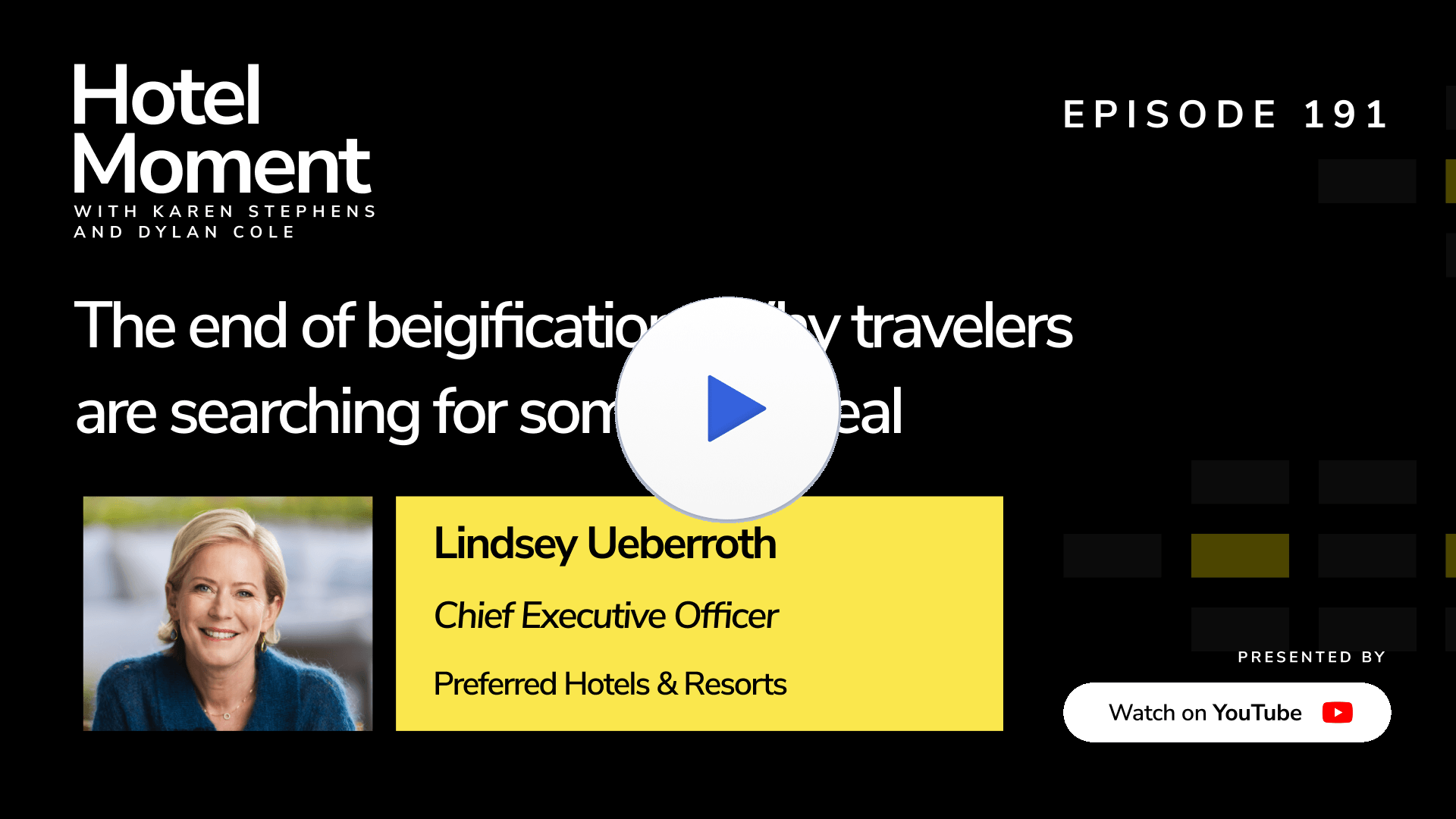
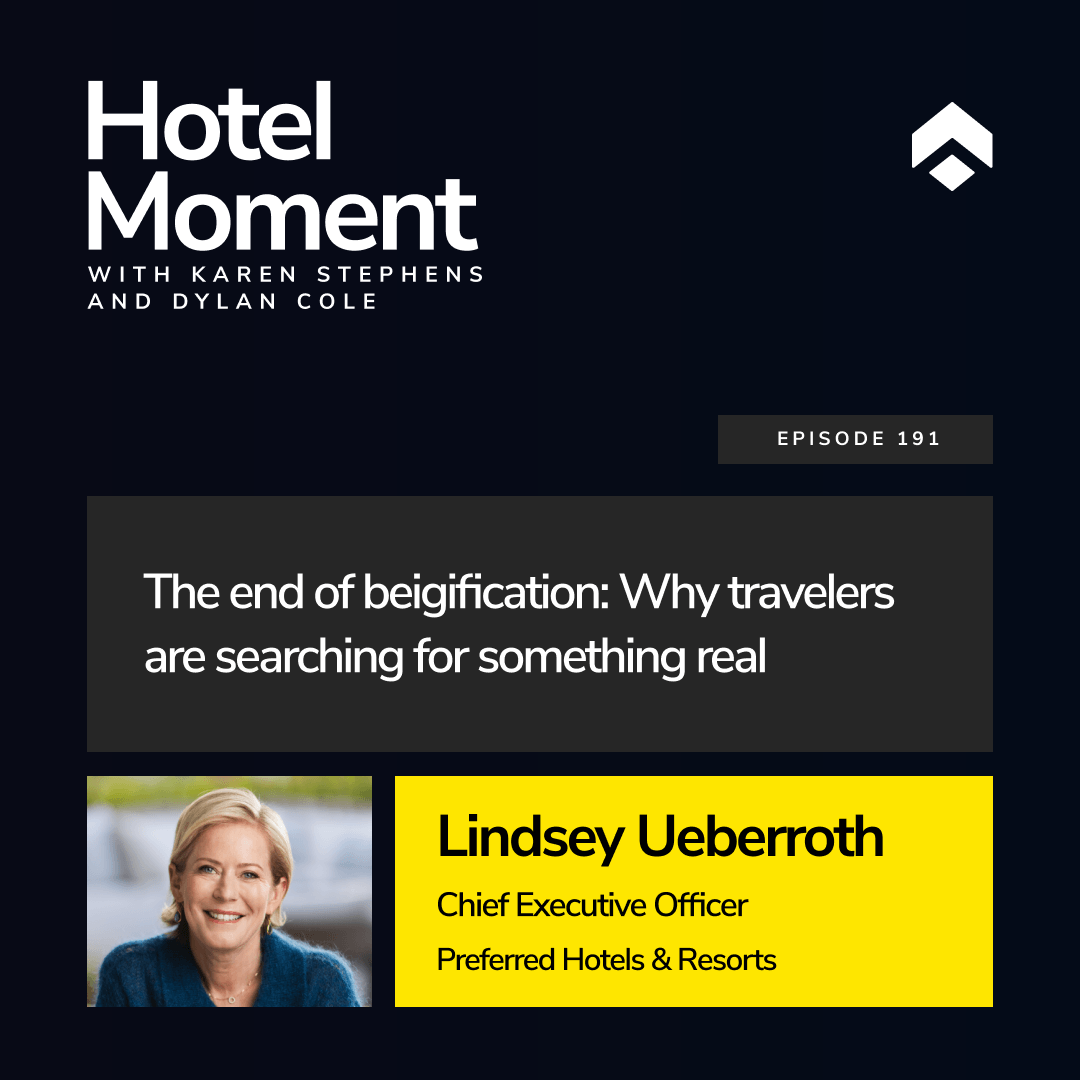
Hotel Moment
WITH KAREN STEPHENS


Episode 191
The end of beigification: Why travelers are searching for something real
The sameness that once defined hotel brands is becoming their biggest weakness.
Today’s travelers have more choice than ever, and they’re increasingly choosing hotels with personality, local character, and stories they can’t find anywhere else.
In this episode of Hotel Moment, Karen Stephens sits down with Lindsey Ueberroth, CEO of Preferred Travel Group, to explore why independent hotels are thriving in what she calls the end of “beigification.”
From heritage travel and hyper-personalization to AI visibility and the future of guest loyalty, Lindsey shares why authentic experiences are becoming hospitality’s greatest competitive advantage, and what every hotel can learn from independent brands.
Tune in to discover why the future of hospitality isn’t about being more consistent. It’s about being more memorable.
Media
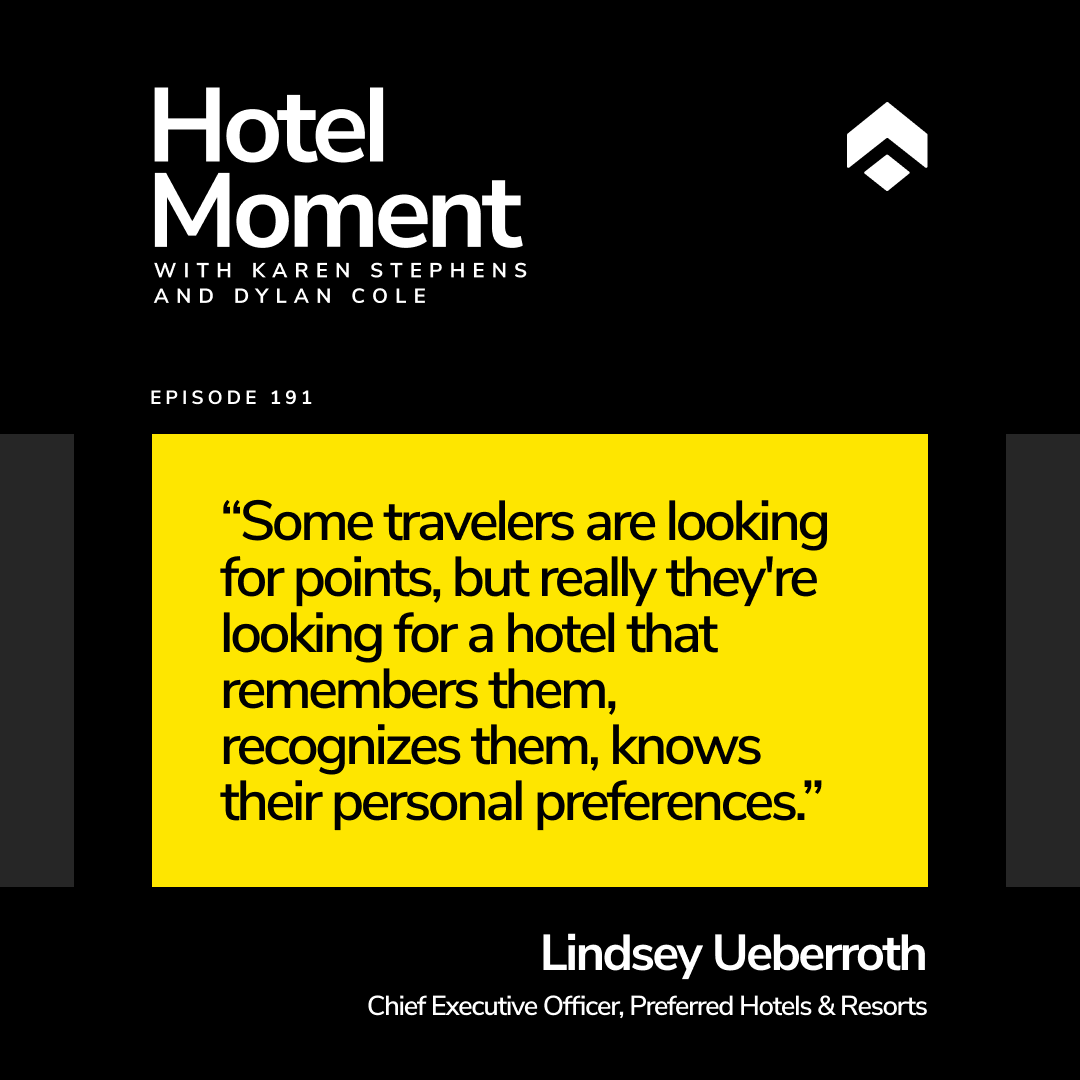
The key to creating more loyal guests
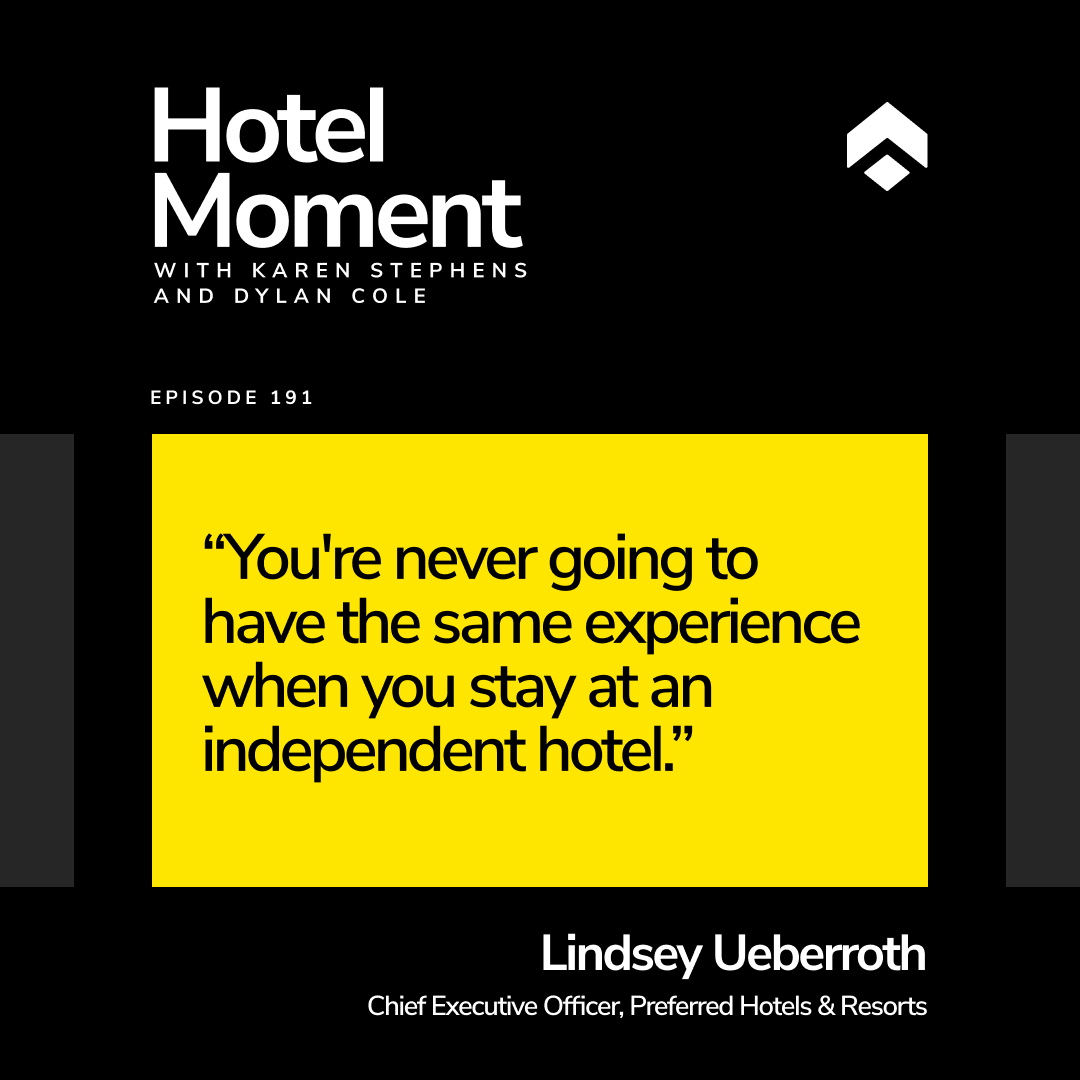
Independent hotels offer something unique
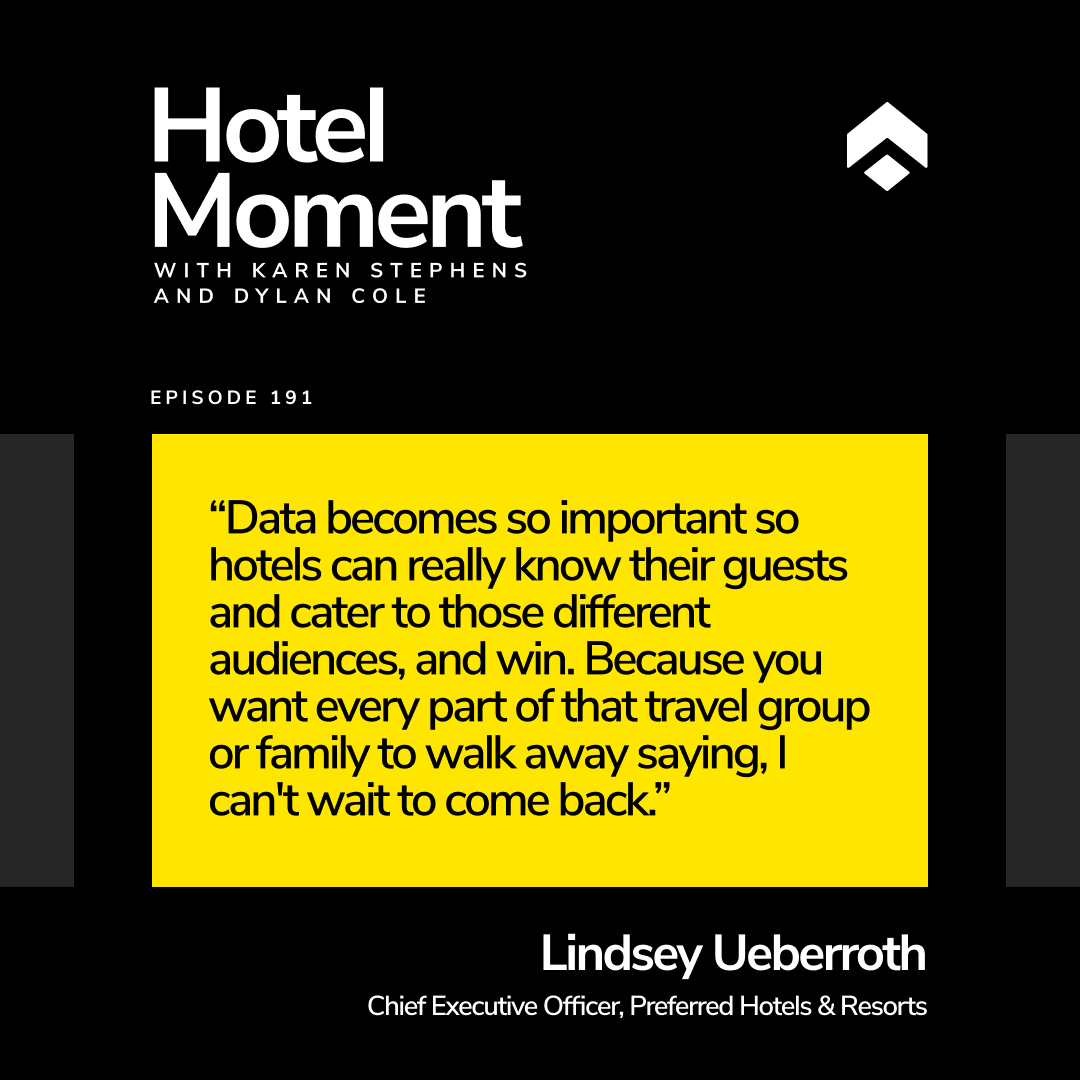
Why good data is AI’s best friend
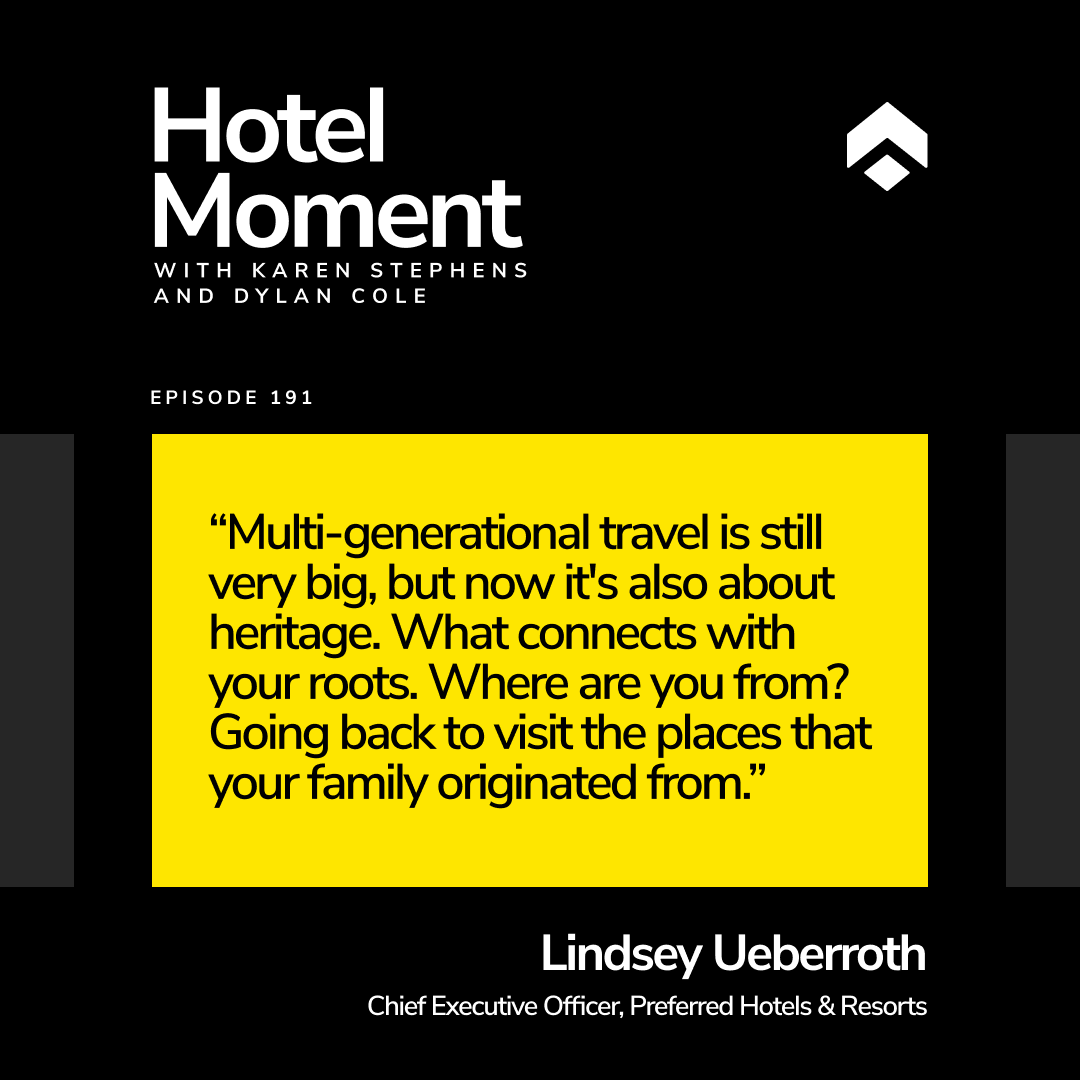
Guests are looking for heritage

Meet your host
Karen Stephens
As Chief Marketing Officer at Revinate, Karen is focused on driving long-term growth by building Revinate’s brand equity, product marketing, and customer acquisition strategies. Her deep connections with hospitality industry leaders play a key role in crafting strategic partnerships. Karen has more than 25 years of expertise in global hospitality technology and online distribution — including managing global accounts in travel and hospitality organizations such as Travelocity and lastminute.com
As the host of The Hotel Moment podcast, she interviews top players in the hospitality industry. Karen has been with Revinate for over 11 years, leading our global GTM teams. Her most recent transition was from Chief Revenue Officer, where she led the team in their highest booking quarter to date in Q4 2023.
Watch the video
Transcript
[00:00:00] Lindsey Ueberroth: Data becomes so important. So hotels that can really know their guests and cater to those different audiences, they win. Because you want every part of that travel group or family to walk away saying, I can’t wait to come back.
[00:00:14] Karen Stephens: Welcome to the Hotel Moment Podcast, presented by Revinate. I’m Karen Stephens, Chief Marketing Officer, joining you from sunny San Francisco, California.
[00:00:22] Dylan Cole: And I’m Dylan Cole, Managing Director of Revinate.
[00:00:26] Karen Stephens: This is the podcast where we explore how technology shapes every moment of the hotelier’s experience. And more importantly, how the right technology delivers real outcomes for hotel teams and guests alike.
[00:00:37] Dylan Cole: From revenue strategy and guest communication to operations and marketing, we sit down with the people transforming hospitality around the world.
[00:00:45] Karen Stephens: Depending on the conversation, sometimes it’ll just be me behind the mic.
[00:00:49] Dylan Cole: And sometimes it’ll be me, bringing a European perspective and stories from across the global hospitality industry.
[00:00:55] Karen Stephens: Whether you’re a hotelier, a tech enthusiast, or just curious about where hospitality is headed.
[00:01:02] Dylan Cole: You’re in the right place. Let’s get into it.
[00:01:04] Karen Stephens: Hello and welcome to the Hotel Moment Podcast. I am your host, Karen Stephens, the Chief Marketing Officer of Revinate. And today we’re excited to welcome Lindsey Ueberroth, Chief Executive Officer of Preferred Travel Group, home to the world’s largest independent hotel brand. Throughout her career, Lindsey has championed independent hospitality, helping distinctive hotels compete globally while preserving the individuality and personal service that sets them apart. Today we’ll explore why independent hotels are thriving, how they can compete with major global brands, what travelers expect from luxury today, and how technology, loyalty, and commercial strategy are shaping the future. So without further ado, Lindsey Ueberroth, welcome to the podcast.
[00:01:04] Lindsey Ueberroth: Thanks, Karen. It’s great to be here with you.
[00:01:04] Karen Stephens: I’m so excited to have you here. I have had the pleasure of attending a Preferred Hotel Group annual global conference a few years ago, and the energy that you bring to the group is so fantastic. So I’ve been waiting for this conversation for a long time, and it’s just truly a pleasure to have you on.
[00:01:04] Lindsey Ueberroth: Well, now I’m going to know which conference it was. Where were we?
[00:01:04] Karen Stephens: So we were in Boston. It was the first one after the pandemic, which was really cool. I mean, the energy — everybody was just so happy to see each other again and it was really cool.
[00:02:17] Lindsey Ueberroth: Yeah, you get a bunch of hospitality people together who haven’t been able to see each other — that just amplifies the energy that happens.
[00:02:24] Karen Stephens: It really does. So it was fantastic. And I know that it’s great every year, so it’s really good to have you here. So I have a lot of questions. First, I really want to talk about — you’ve had an unusual journey to reach the position that you’re in today. So many people in our industry don’t start with a consulting background. Can you walk us through your journey, your experiences at investor conferences and elsewhere?
[00:02:47] Lindsey Ueberroth: Sure. And I think most people that are in the hotel hospitality space went to hospitality school. And I’ll be honest, I had contemplated that, but really I’d say I was kind of born into this industry. Both my parents were in travel, so it was in my DNA. But to your point, I graduated from college and went to work for what’s now Accenture Consulting. I did change management consulting, which I think — I had a lot of life experiences that helped with that, because we moved a lot and we traveled a lot. And ultimately, I say I accidentally fell into this because my change management skills came in handy when my father was acquiring a bunch of travel-related businesses. But at that time it was really in incentive travel and large group travel. So I ended up going to work for him specifically to do change management, to work with processes and systems and bringing multiple cultures together as he was acquiring different businesses. And that’s when it hit me that travel was in my blood. I really loved everything about it. Up until that point, it had really just been for fun — I’d had summer jobs where I worked in travel. But then when my family ultimately went on to purchase Preferred Hotels and Resorts, that’s when I fell hook, line, and sinker. Again, a little bit on the change management side, I really started in the beginning spending a lot of time with my father and my parents, interviewing our hotel partners, understanding what was working, what was not working, and ended up going to work for the company — wore many, many different hats. I think I always have to remind people, I did not start in this role. It was not handed to me. I wore a lot of different hats and worked in a lot of different departments, which now, where I sit today, is really helpful, because I understand when people have challenges, or we’re looking at things, I can say, I remember when I was dedicated to working in some of those areas. So that’s the quick version of my journey to how I ended up in hotels and hospitality.
[00:04:34] Karen Stephens: Right, in hotels — and specifically with independent hotels. So can you talk a little bit about Preferred Hotels and Resorts and what drew you to that? I mean, obviously, as you said, you kind of were brought into that side of the business from your family, but what is it about independent hotels that you love?
[00:04:49] Lindsey Ueberroth: So Preferred Hotels and Resorts now represents over 625 hotels in 80 countries. And what I love about independent hotels is I think it’s a reflection of who we are as humans, right? We all want to be independent, unique, different than the person next to us, but yet you want to be connected and you want to be part of a community. And independent hotels — that’s exactly what they are. They’re one of a kind, very unique, but they’re part of their community. And I think that resonates with the traveler nowadays. You know, what used to be — I’ll call it safety and conformity, what we now call the “beigification,” where everything looks the same regardless of where you are — that has changed now, because there’s so much more access to information. And so now people are searching for something very different, very unique, very authentic. And independent hotels, they’re not shackled by a lot of rules. They can do very different things, very unique things that really cater to what that traveler is looking for now. So that’s what we love about it. Every single one of them is different. You’re never going to have the same experience when you stay at an independent hotel, but you’re going to have the quality — you’re going to have that quality experience, especially at the level at which our hotels are operating, at that luxury space.
[00:05:57] Karen Stephens: Yes, that’s right. So I mean, I’m sure all of our listeners are familiar with the group, but this — over 600 hotels that you’re talking about — are some of the most beautiful in the world. I mean, it’s really a curated, beautiful experience. And I do think that what’s so unique about the group is every single one of them is different, but they have the through line of that luxury. And Preferred Hotels and Resorts, you really provide a kind of platform for them to all work together and take advantage of loyalty and other things that are the through line. One thing that you just recently released is the Luxury Travel Report. And you also launched a well-being program with over 50 hotels to start that. So there’s a lot happening. Can you tell us about the trends that you’re seeing and about the report itself?
[00:06:39] Lindsey Ueberroth: Sure. So we did this report a little over a year ago, and it was great. I think it was just to reinforce what we were anecdotally seeing, but we really wanted to understand a little bit deeper what the consumer was looking for. So some things won’t surprise you — obviously this focus on multi-generational travel is still very big, but now it’s also about heritage, right? Wanting to connect with your roots — where are you from, going back to visit the places that your family originated from. That’s become a very big thing. This hyper-personalization is another thing. So everybody talks about experiences, but now when you travel — and this is where I think loyalty becomes an interesting piece — the loyalty piece is more than points and perks. So yes, some of those travelers are looking for those things as a benefit, but now they’re looking for a hotel that remembers them, recognizes them, knows their personal preferences, and is going to tailor that experience to it. And that’s where loyalty takes on another level. And that came out in the report too — that they’re looking for hotels that have loyalty programs, because they look at that as another checkbox on the quality-assurance level, right? You’ve got a loyalty program, therefore you’re going to know me better, and I’m going to get recognized and I’m going to get those benefits. Another interesting thing — and we talk about this all the time — everybody thought the travel advisor was going to die with the advent of the internet. It’s not. Now, with people wanting to travel further and farther and more internationally, the travel advisor is becoming what we now call the “power broker.” So having a really good travel advisor is becoming a really important thing. It’s saving people time, it’s saving them money. Even with AI, which can generate all these wonderful things, you need somebody who actually knows the destination and can fact-check — is that restaurant really open, or is it really an hour and a half away from where you’re staying. So their role is becoming even more important, and I thought that was a great trend that came out of it. And the beigification — we talked about that — the traveler really is looking for something different and unique. The chains are now getting into our space because of that. So people want something that’s different, and they’re moving away from that formulaic, branded, chain kind of approach. So those are a couple of the key highlights that came out of that report.
[00:08:40] Karen Stephens: Yeah, so you mentioned multi-generational. I’m just curious — were there things that you saw with regard to loyalty or personalization that are different from one generation to the other?
[00:08:50] Lindsey Ueberroth: It’s a good question. We didn’t dive into that, but I can share my own sort of perspective on it, and the answer is yes. So I think different generations value different things, but yet they all do want loyalty. Now, I’d say that the more mature audiences value loyalty probably even more. I think the younger generations are not as loyal, so what they’re looking for is a little bit different. And that’s where I think data becomes so important. So hotels that can really know their guests and cater to those different audiences, they win — because you want every part of that travel group or family to walk away saying, “I can’t wait to come back.”
[00:09:25] Karen Stephens: That’s really interesting. I’m curious — I think with younger generations, it’s so much about experience and about curating that experience and living life. And I think that’s another place — I’d love to hear your take on this — where independent hotels really have the advantage. Can you talk a little bit — you talked about beigification — let’s talk about curation, storytelling, and how they can really rise above the sea of sameness when you’re looking at a hotel stay.
[00:09:52] Lindsey Ueberroth: So all of our hotels have to meet quality-assurance standards. We have a program where they get inspected every year through a third party. We also have a quality-assurance program, reputation management — so we’re looking at those things every day. What I think is special about independents is they’re not bound by a certain set of rules. And I’d probably say 80% of our hotels are, in some ways, maybe family-owned or privately owned as well. So there’s a DNA that runs through it, and you can see that in the way that their teams and their employees treat their guests. They have a lot more autonomy to make decisions and do really unique things. And I could tell a hundred different stories about things that have happened when I’ve traveled. It can be everything from even the housekeeper who, when she does your turndown service, notices that somebody’s traveling with a stuffed animal, puts that somewhere unique, and writes a little note — does really personalized things, so it’s not just the traditional turndown. And I’ve been on a trip where I was walking out — we realized we weren’t going to make the ferry to go over to Bellagio — and the doorman saw how disappointed we were and said, “Come with me, get in my car, I’m going to drive you there myself.” I could give you a thousand different stories where they’re empowered to do things on the spot for that guest that you wouldn’t necessarily get at the chain, because that’s not part of the book — that’s not part of the driver’s manual, for lack of a better word. And I think you see a lot of that in independents. And the hotel GM who sees the family and finds out that the kids are really interested in cooking and takes them in the back of the kitchen and lets them go bake cookies with their pastry chef — I think those are the sort of things that you see a lot more of, and that’s what makes a stay beyond memorable and those are the differences.
[00:11:24] Karen Stephens: I love that example, because at the end of the day, hospitality is at the core of it — it’s the people who really want to give their guests the best experience possible. And when you get the right alignment there, you can’t teach that. It’s not something you can put in a manual, right? It’s kind of like you’re born with it or you aren’t.
[00:11:44] Lindsey Ueberroth: Yeah, and it really is paying attention, and that’s what makes that guest feel seen — that’s what makes them feel important. Room amenities are a thing — hotels love to send you these beautiful room amenities. What doesn’t resonate is when it’s something you don’t eat or drink. But for me, I love jelly bellies and I love Swedish fish. So if I show up at a place and they have that as the room amenity, I’m like, wow, they’re really paying attention — you know, I’ve either been there and they know that I like that, or they’ve made the attempt to go ask somebody what my preferences are.
[00:12:09] Karen Stephens: Right, to get it in there. So that is really interesting. And I think we can talk a little bit — I mean, we talk about AI a lot, because it’s top of mind for everybody. I’m curious to get your take though. I think what’s interesting — you have independent hotels, but if they’re part of a larger collective, like Preferred Hotels and Resorts, can you talk a little bit about how your technology platforms can help one hotel understand that the guest they’re seeing through the loyalty program likes jelly bellies and Swedish fish, or has a preference for red wine over white? So how do you help those hotels who are seeing this guest for the first time, but they’ve been in the group, do a better job with guest experience?
[00:12:45] Lindsey Ueberroth: Well, so there’s two different things. Obviously, because our hotels are independent, they can choose what sort of technology they want to use on property. So the way that we’re helping our hotels is really through — there’s two points. Educating them on best practices and systems or partners that can help them deliver this — so there’s that piece of it. We’re investing heavily in our loyalty platform, as well as the AI evolution. So as we evolve our loyalty platform, yes, they will be able to capture more of that information about that guest — whether they’re a repeat guest and we have them in the system, or whether they’re showing up at their hotel for the first time and they’re now capturing that information. So we’re building out that platform so they’re going to have a lot more access to that. As it relates to the overall AI evolution, at the brand level, we’re investing heavily in really redesigning all of our systems to be AI-friendly, and that’s where they benefit. Being part of a network helps, because then you become a trusted source. AI is looking for what it trusts — so they trust loyalty programs, they trust brands or membership, they trust awards and recognition. Those are the sort of things that they’re looking for. So we’re investing to make sure that our hotels are showing up, that the brand is showing up. And then it’s going to be easy for them to book. So we’re investing in AI agents — like on ChatGPT and the other AI platforms, we’re building in our own agents. They’re going to be able to do their own itinerary — so a lot of those things to make it easier for the traveler to find our hotels.
[00:14:13] Karen Stephens: To find the good match. Yeah, absolutely. And I think at the core of that is really — you have to have the right data, you have to have the right data set. And then you mentioned there’s credibility with, obviously, awards, recognitions — I think reviews is a big thing of that. And so, when you’re evaluating new hotels to join Preferred Hotels and Resorts, can you talk to us a little bit about what your evaluation criteria is? Because it’s important, as you bring a new hotel in, that they are of the caliber that’s going to keep everybody else floating. Can you talk a little bit about that?
[00:14:43] Lindsey Ueberroth: Absolutely. So kind of at the macro level, we’re looking at location and destination, and then we have our quality-assurance platform. So, obviously, we’re looking for places that the traveler wants to go, and then where they’re located. But really it’s the quality-assurance program that helps define that. And so that is a set of hundreds of criteria that are heavily weighted towards service, because obviously we expect the facilities and amenities to be at a luxury level. And so that does get inspected — daily and annually. So, as I mentioned, we’ve got our reputation-management partner that is really looking at reviews across — I think it’s the top ten to fifteen different review platforms in those markets. Every region has their own kind of review platforms. So we’re benchmarking that across our quality assurance. And then this two- or three-day annual inspection that is unannounced — so you’ve got an auditor who’s there and who’s evaluating against a set of criteria. And so that’s how we come up with what we call IQA, or Integrated Quality Assurance score. Hotels have to maintain a minimum on an annual basis. If they don’t, we do what any major chain would do — we put them on an improvement plan, and they’ve got time to cure that. And we really work with hotels — we want all of our hotels to succeed. Coming out of COVID, that was kind of a period where a lot of hotels had to shift and adapt. But now, with rates and things like that, the traveler expects the best. And so hotels really have to work hard to maintain — not just, like I said, the facilities, but really the service levels. And that’s what we’re heavily weighted towards.
[00:16:12] Karen Stephens: Absolutely. You know, I’m chuckling a little bit, because we’ve been in the reputation business, along with a lot of other things, for a long time. And we always see in the luxury sector that the value score — it is really hard to get a good value score, because when your rate is high, expectations tend to be higher. So hotels really need to rise up and make sure that they are delivering the service that justifies that rate. It goes way beyond the room.
[00:16:39] Lindsey Ueberroth: Absolutely. Again, I think that’s where technology can play a role. Hopefully it should make it more frictionless. Hopefully it removes a lot of those administrative things that they’re doing and allows them to be more customer-focused. So I think that’s where they win. But yeah, you’re right — if you’re paying over a thousand dollars a night for a room, you expect perfection.
[00:17:00] Karen Stephens: Perfection. And I want to make sure the audience caught it, because you talked a little bit about it — but AI should enable the staff — it should free up your staff to focus on what only they can do, which is deliver thatexperience. We were even talking about — I think you were talking about a travel agent effectively, but I forgot the word you used for it — what were you saying then? The power brokers?
[00:17:00] Lindsey Ueberroth: The travel advisors?
[00:17:00] Karen Stephens: Yes, exactly. That is another great example of, like, okay, we’ve got ChatGPT, we’ve got all these things, and you’ll be able to book the hotels. But the person who really knows what you should do when you get off the ferry in a certain destination, where you should go grab lunch — all of those things really is a human touch.
[00:17:39] Lindsey Ueberroth: Yeah, absolutely. I mean, I think travel advisors are using AI a lot, and it’s to help them do a lot of the stuff that was manual, right? Like, “help me put together a beautiful itinerary once I’ve already done all these things.” I mean, it just facilitates — it makes certain things faster. But I have definitely learned, because I’ve played with AI, and then you get this great little itinerary, and then somebody says, “yeah, but that’s closed during that period of time,” or “you said that’s forty-five minutes away, but this one’s fifteen minutes.” Those are the details that AI doesn’t know — those little personal touches.
[00:17:39] Karen Stephens: That’s right. And AI is very confident.
[00:17:39] Lindsey Ueberroth: Yes, yes, it is.
[00:18:09] Karen Stephens: It will hallucinate, make you think that’s the right answer, and it might not be. So I think it’s an interesting era for us as hoteliers to figure out how to navigate AI — to make processes better, to make our data cleaner, to make everything more accessible, but the guest experience is still going to be a human touch.
[00:18:25] Lindsey Ueberroth: Absolutely. You’ve talked about data, and it can give you so much information, but you still need a human to understand it. What are we going to do with this data? What are we doing with this report that still requires a human to then make decisions?
[00:18:37] Karen Stephens: I think that’s a great relief to everybody listening, because I think there was a lot of fear around AI, and now I think everybody’s starting to learn — well, I think there’s different kinds of aspects of it. First, I think there are going to be a lot of things that people apply AI to that don’t get any more efficient at all, and we can never quite pin that down. I think about when mobile apps first came out — mobile apps at a hotel, same idea. People weren’t going to typically open an app to order room service; they were going to go down to the concierge and talk to people at a hotel. Maybe different generations vary, but it was kind of this explosion of — now people will use a mobile app to make a booking, or to book a spa. But the guest experience, you know — so I think AI is similar.
[00:19:20] Lindsey Ueberroth: Yeah, I agree. Let’s make it — as I said — more frictionless. But we’re in a people business, so I don’t think it’s going to help eliminate jobs. I think it’s just going to make them more efficient.
[00:19:29] Karen Stephens: More efficient — and people focusing on what they really like to do, hopefully. So if you’re an independent hotel owner listening to this episode now, and could focus on improving just one part of your commercial strategy this year, what would you prioritize?
[00:19:43] Lindsey Ueberroth: Honestly, it would be in the AI space. I think hotels who don’t believe it’s a thing are going to be disappointed. So I think making sure that you’re doing all the things so that your hotel is going to show up and be bookable. And I’m pretty new at this — so when my team said, for example, if you have PDFs on your website, AI can’t read PDFs — so your spa menus and your restaurant menus, if they’re PDFs, it’s not going to find that. All the SEO searches are different. So really looking at that to make sure that you are going to show up, I think, is very important, because we’re seeing that shift every month in how people are searching and booking. So I do think that’s really critical.
[00:20:22] Karen Stephens: I think that’s great advice. Everything is changing so much, and AI really feeds off of content — original content. So the more that you can do storytelling and draw people to your own website — but to your point, you can’t just load stuff up and expect people to click it.
[00:20:36] Lindsey Ueberroth: Well, and reviews — you’re in the review business, that’s important. A lot of hotels don’t want to put reviews on their website. They should, because again, AI trusts it. Even if you have a negative review, if you’re showing that you’re responding to that, that’s great. So keeping those up to date — those are all those little things that previously hotels didn’t want to have on their sites, and now we’re saying, you know, you really should. That’s something you should be paying attention to and investing in.
[00:21:01] Karen Stephens: Absolutely. I want to draw an underline under that statement — it’s about responding to the review and showing that the GM is taking action: “thank you for giving us the feedback.” And then that becomes social proof that it’s a great hotel.
[00:21:13] Lindsey Ueberroth: A hundred percent. I mean, nobody’s perfect. No day is perfect, no person’s — no experience is perfect. But perfection to me is how you handle it. So I think that’s important.
[00:21:21] Karen Stephens: Yeah. So final question for you, Lindsey — on a personal level, when you think about the future of independent hospitality, what gives you the most optimism?
[00:21:29] Lindsey Ueberroth: I’m so optimistic. I mean, I think we’re really in the golden era of travel, and I think independent hotels are really at the precipice of it. Again, I think it’s what the traveler is looking for. I think people are prioritizing travel over other purchases. They’re really searching for those memories and those moments in time. So I think travel’s in a good place. I think independent hotels are in a great place. So as I look to the future, I just think there’s going to be a lot more of it.
[00:21:29] Karen Stephens: I agree with you. Thank you, Lindsey — it’s been an absolute pleasure to have you.
[00:21:29] Lindsey Ueberroth: Thank you for having me.
[00:22:05] Outro: Thank you for joining us on this episode of Hotel Moment by Revinate. Our community of hoteliers is growing every week, and each guest we speak to is tackling industry challenges with the innovation and flexibility that our industry demands. If you enjoyed today’s episode, don’t forget to subscribe, rate, and leave a review. And if you’re listening on YouTube, please like the video and subscribe for more content. For more information, head to revinate.com/hotelmomentpodcast. Until next time, keep innovating.
Episodes
Hotel Moment
WITH KAREN STEPHENS
Subscribe for updates on your favorite platform