Hotel Moment
WITH KAREN STEPHENS


Episode 181
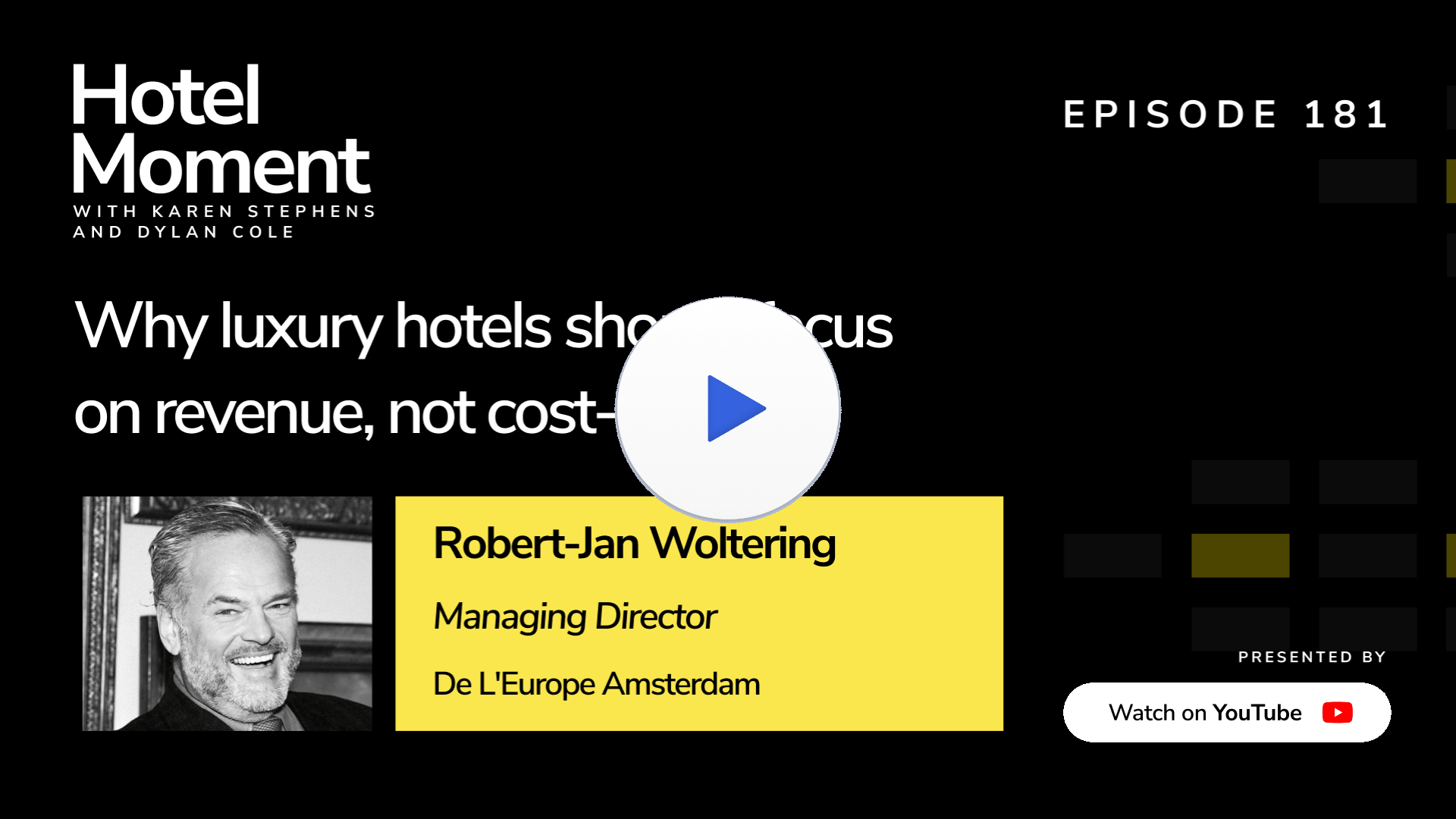
Why luxury hotels should focus on revenue, not cost-cutting
Budget-chopping might seem like an easy win, but in the luxury market, aggressive cost-cutting is a trap that quietly destroys your quality, your brand positioning, and your guest experience.
In this episode of Hotel Moment, Dylan Cole, Revinate’s Managing Director in EMEA, and Robert Jan Woltering, Managing Director of Del Europe Amsterdam, dive into why true luxury properties must shift their focus to driving and maximizing top-line revenue across every profit center.
As hoteliers navigate shifting market demands, the temptation to cut corners can be strong. The luxury brands that win won’t just manage expenses better, they will look to expand, elevate the product, and claim their leadership role in the market.
Tune in to hear why making cost management secondary to delivering an unforgettable, authentic guest experience is the best move.
Media
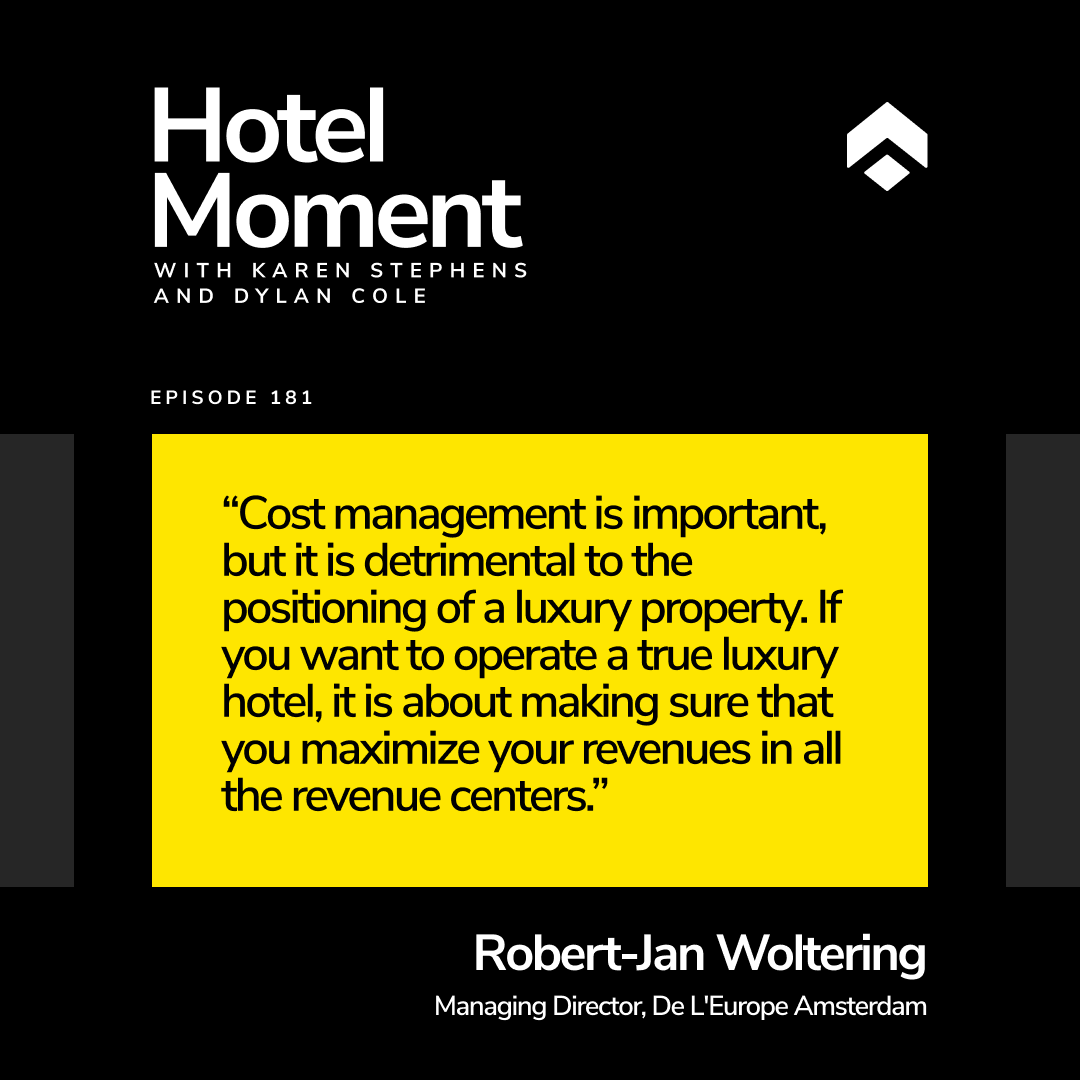
The path to maximizing your revenue
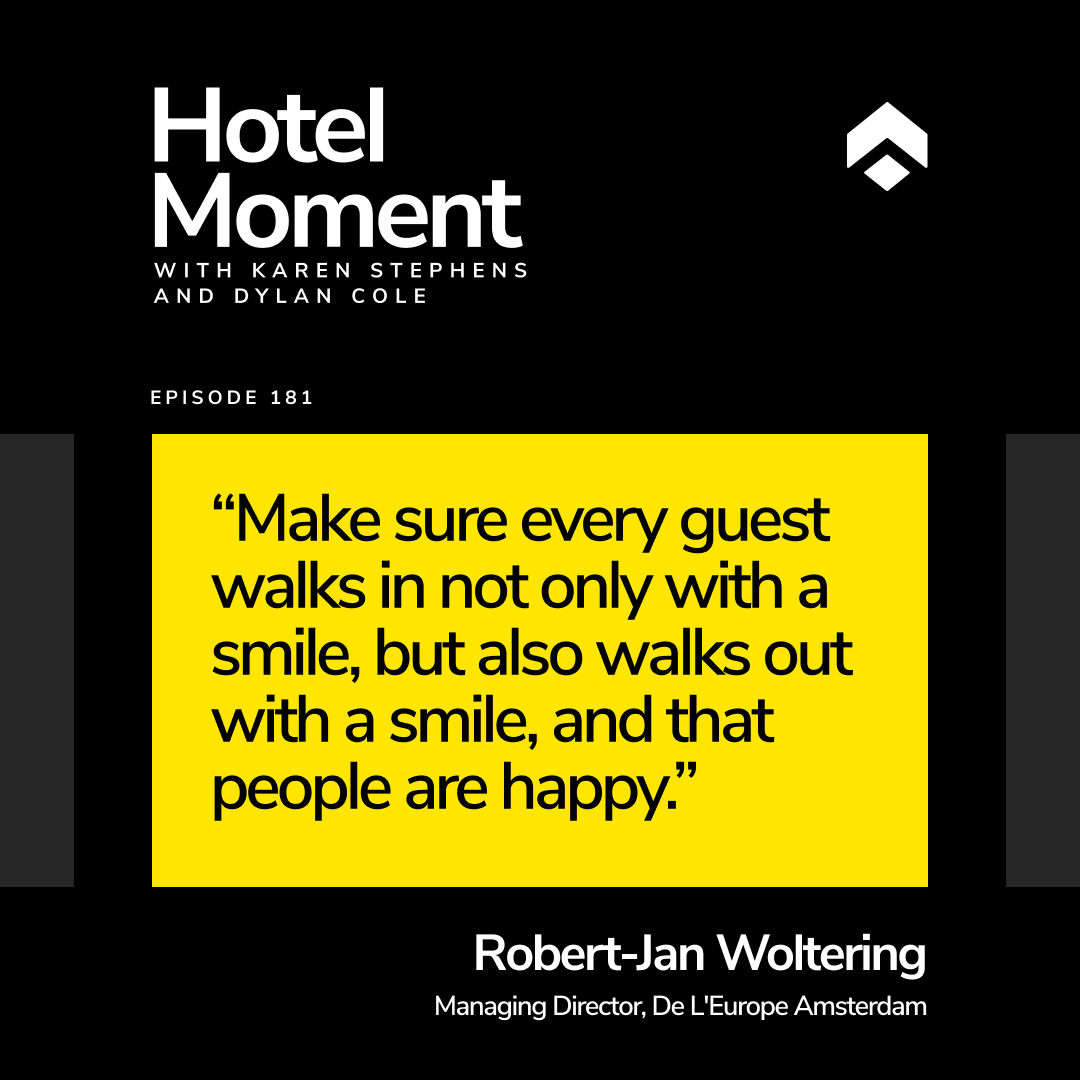
Guest happiness is the goal
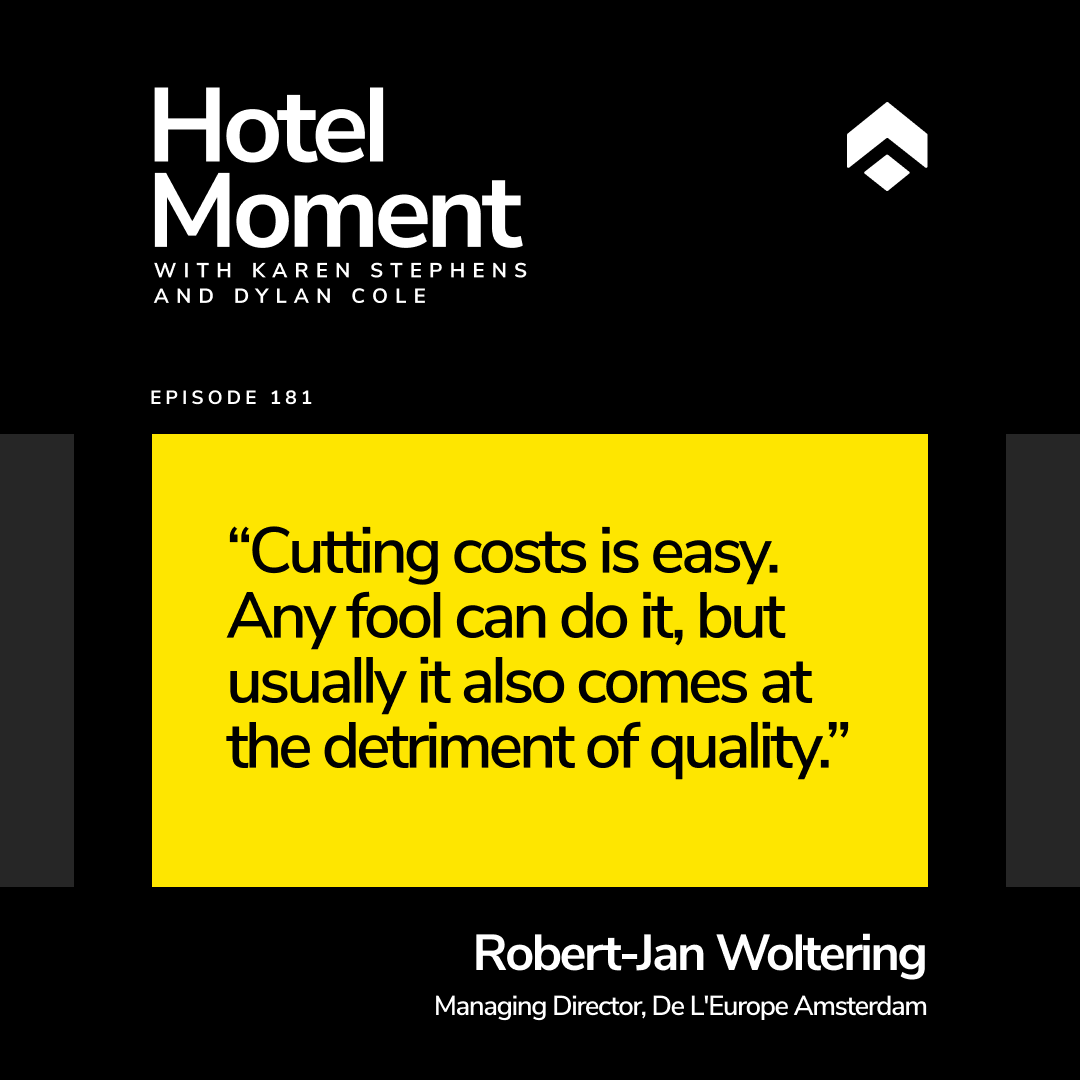
Why cost cutting isn’t the better option
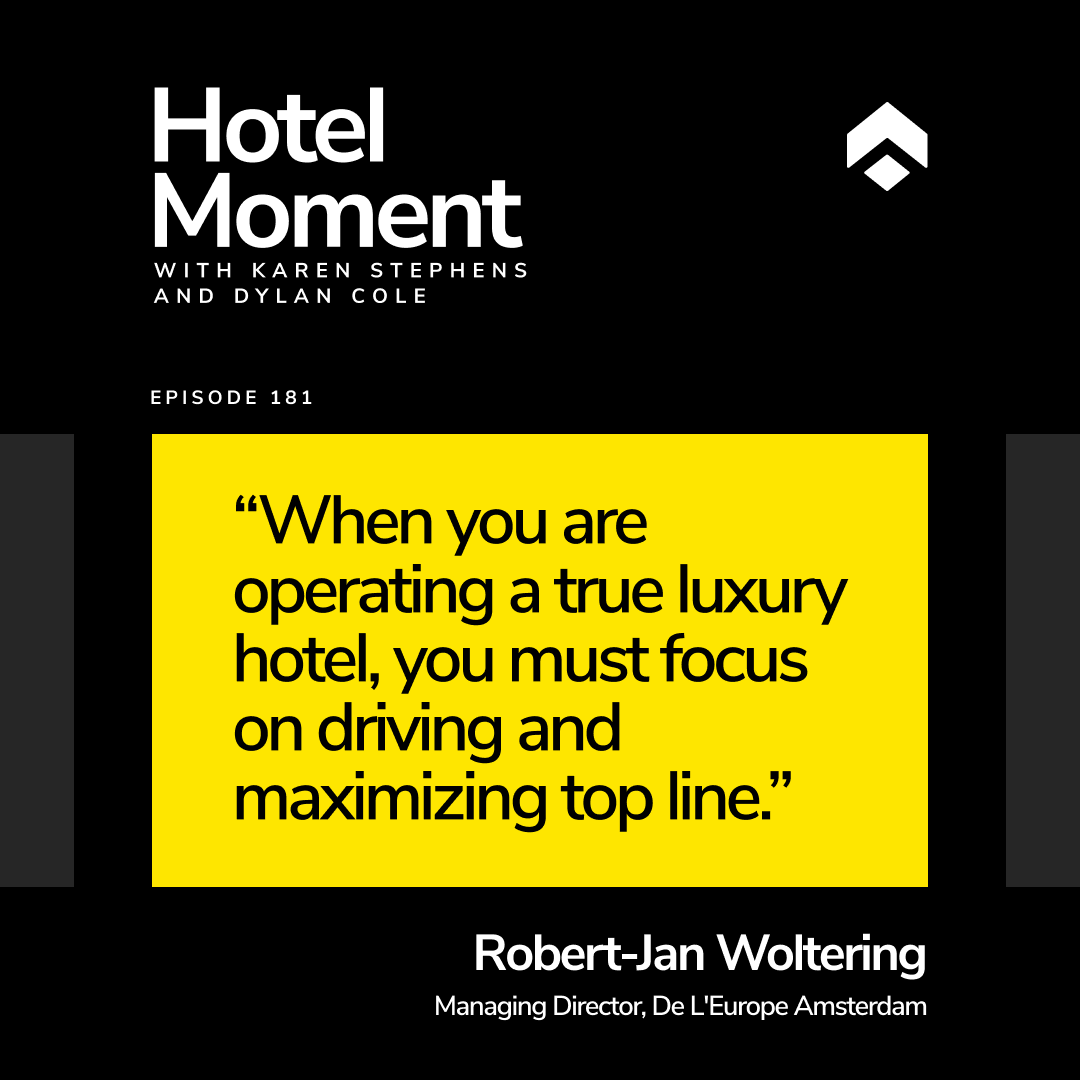
Maximize the topline
Meet your host
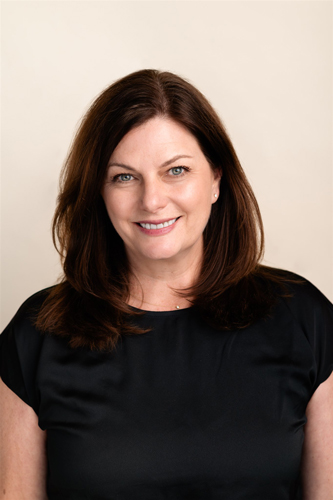
Karen Stephens
As Chief Marketing Officer at Revinate, Karen is focused on driving long-term growth by building Revinate’s brand equity, product marketing, and customer acquisition strategies. Her deep connections with hospitality industry leaders play a key role in crafting strategic partnerships. Karen has more than 25 years of expertise in global hospitality technology and online distribution — including managing global accounts in travel and hospitality organizations such as Travelocity and lastminute.com
As the host of The Hotel Moment podcast, she interviews top players in the hospitality industry. Karen has been with Revinate for over 11 years, leading our global GTM teams. Her most recent transition was from Chief Revenue Officer, where she led the team in their highest booking quarter to date in Q4 2023.
Meet your host
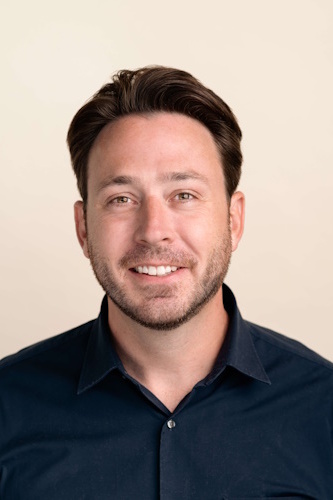
Dylan Cole
Dylan Cole began his career as a TV personality in South Korea. He then brought his love for travel and technology to Revinate where he played a vital part in establishing Revinate’s position in the US market, followed by the Asia Pacific region and now in Europe. Dylan is currently the Managing Director of Revinate Europe and is based in Amsterdam.
Watch the video
Transcript
[00:00:00] Robert-Jan Woltering: Cost management, yes, it is important, but it is detrimental usually to the positioning of a luxury property. If you want to operate a true luxury hotel, it is about making sure that you maximize your revenues in all the revenue centers.
[00:00:22] Intro: Welcome to the Hotel Moment podcast presented by Revinate. This is your podcast to understand how technology can shape every moment of the hotelier’s experience. Tune in to explore cutting-edge technologies and to hear from experts who are shaping guest experiences. It’s 2026 and I’m Dylan Cole, the Managing Director of Revinate Europe. Along with Karen Stephens, we’ll be bringing you a fresh perspective on what matters most to hoteliers.
[00:00:48] Dylan Cole: Welcome to Hotel Moment. Today we’re thrilled to have Robert-Jan Woltering, Managing Director of De L’Europe Amsterdam, one of Europe’s most iconic luxury hotels. With more than 30 years of international leadership experience across five continents, Robert-Jan has built a reputation for blending commercial performance with elevated guest experience, strong design sensibility, and people-first leadership. From repositioning luxury assets to maximizing owner value, he brings a sharp perspective on how hotels can grow top-line revenue without losing the soul of hospitality. So without further ado, welcome Robert-Jan.
[00:01:26] Robert-Jan Woltering: You can call me Mr. Woltering, Your Highness, Your Excellency. When I was in Maui at Fairmont, at the interim mission there as General Manager, about day two or three, one of the doormen came to see me and we had a chat. “Hey, how are you?” You know how it goes. And he says, “Tell me, what should I call you? Is it Mr. Woltering, or is it Robert, or Bob, or Rob, or Robert-Jan, or shall I call you RJ?” And I then said, “You know what? I kind of like RJ. Let’s do RJ.” And ever since, I’ve sort of kept that for my friends, and Dylan, you’re definitely a friend now, so you can call me RJ if you like, man.
[00:02:08] Dylan Cole: I am honored. I would love to call you RJ throughout this podcast.
[00:02:13] Robert-Jan Woltering: How is that for a kickoff of the podcast?
[00:02:16] Dylan Cole: Yeah, right? All right, RJ. Well, let’s jump into it. You know, you obviously have lived all around the world. You’ve had a lot of experiences, and obviously, I would imagine your baby, De L’Europe, is your favorite hotel today outside of this hotel. Okay, maybe not, but I was going to say, besides your current hotel, what is your favorite hotel and why?
[00:02:37] Robert-Jan Woltering: There’s a few, I think, but it’s always related somehow to heritage. I mean, I loved my time at the Raffles in Singapore for several reasons, but definitely, it’s a full-on heritage place with so much storytelling that there is just no end to it. I also spent some time as a guest, actually, at the Metropole Hanoi. Again, a beautiful landmark hotel. And here we are today in Amsterdam, a hundred and thirty years old, celebrating its birthday this year—its hundred and thirtieth—and it’s a hotel that I actually encountered when I was a young boy. I had lunch here with my godfather—an ignorant Dutch Amsterdam lad walking in jeans and a shirt. But I got nicely stopped at the door. They said, “Young man, where do you think you’re going?” I said, “I’m having lunch with my uncle.” And he said, “No, no, no, you’re not.” And they kindly handed me a tie and a jacket, and—yeah, really. Well, that was my first encounter, and I thought, hmm, this is kind of interesting. Maybe I should one day come back here. Never had I expected to come back to Amsterdam after twenty-seven years abroad in fourteen countries over five continents, but yes, here I am. Heineken gave me a call and asked me about three and a half, four years ago. He said, “Listen, Robert, we think it’s time to come back home.” And here we are, and the rest is history. It’s a great place. I love to be home. It’s really good to be back in the city. I was born in Amsterdam, raised by the world, but also the first twenty years in Amsterdam, and so it’s good to be surrounded by friends and family again.
[00:04:15] Dylan Cole: What a cool experience walking in, being told to put on a tie, and now managing the place. What a journey!
[00:04:22] Robert-Jan Woltering: And now wearing a tie every day. We don’t have that policy anymore for our guests, though.
[00:04:28] Dylan Cole: Yeah, I guess you can’t quite do that anymore these days, or it’s—I mean, the world just becomes so much more casual.
[00:04:33] Robert-Jan Woltering: You can. I think there’s a few hotels in London that still have that sort of rule you use. Well, maybe not a tie, but definitely a jacket, or you can’t walk into one of their restaurants with sneakers. But we’re in Amsterdam, so we’ve got to lay low and adjust to the environment of the coolness of the city.
[00:04:52] Dylan Cole: Sure. And to that point, like, you’ve obviously lived across five continents. You’ve now been in the industry for over three decades in luxury properties. Besides the experience of walking in and being told to put a tie on, what drew you into hospitality, and what’s kept you interested?
[00:05:10] Robert-Jan Woltering: What keeps me here is very simple. This is my passion, my life. This is who I am. I always jokingly call myself the innkeeper. But that’s also the essence of the story. It’s really making sure that every guest walks in not only with a smile, but also walks out with a smile and that people are happy, like a true innkeeper used to do in the 1800’s. I don’t know where the story starts. It probably started with my grandmother. She opened her last hotel at the age of sixty-five in Kitzbühel, Austria. My dad did hotel school, did hotels, worked on cruise liners, and did work with KLM. And here I am, generation three, and actually, generation four is already lining up. My son is currently doing his management training in the Capella Hotel in Bangkok—beautiful, magnificent place. So I guess it’s in the genes somehow, somewhere. I always wanted to be a pilot when I was a young kid, and then some doctor said, “Hey, you need glasses.” I wore glasses for six months and I came back to my next doctor, and he said, “Why are you wearing glasses?” In the meantime, I changed everything. I, you know, dropped science and chemistry and all that, and actually continued doing what I did best, which is hotel keeping, went to the hotel school, and it’s a passion. I just love it. I love managing the people, hosting the guests, creating the vision, doing ten thousand things in a day, making sure that the curtains are straight, but at the same time that our pricing is correct, that we know that we have the right distribution systems, and that we become the best hotel of the city. And that sort of all together, I just love my job.
[00:06:55] Dylan Cole: And you’re a social guy on top of it all. You couldn’t be in this role and not be a social person, right? It’s like it’s impossible.
[00:07:02] Robert-Jan Woltering: Dylan, you’re hitting the nail on that.
[00:07:06 Dylan Cole: Yeah. We talked about this a little bit before we even started the podcast, but you’re known for being very good at driving the commercial side of your business, right? But you care a lot about the guest experience. I think one of the trends you might see, especially in the way the world is today, is that a lot of owners start thinking more about managing costs instead of taking more of a top-line revenue growth strategy. But how do you feel about that? And what do you think about people taking that approach of cutting costs instead of sort of seeking more value and driving demand for their properties?
[00:07:41] Robert-Jan Woltering: Let me be very bold, and I don’t want to upset a lot of owners because truly I respect owners, and owners are the investors, and they’re taking the financial risks with their properties. But I must say, when you are operating a true luxury hotel, you must focus on driving and maximizing top line. Cost management, yes, it is important, but it is detrimental usually to the positioning of a luxury property. If you want to operate a true luxury hotel, it is about making sure that you maximize your revenues in all the revenue centers, and therefore, by doing that, the profit margin should be good, and therefore cost becomes of a, let’s say, minimal importance. And so driving the revenue, making sure that your employees, your teams are happy, are driven, have a vision, that they know the “why,” and that there is a sense behind every action that they do—that really drives profitability and drives the hotel. Cutting cost is easy. Any fool can do it, but usually it also comes at the detriment of quality.
[00:08:57] Dylan Cole: How do you think about that in your property when you think about making an investment and you want to share that with the owner to say, “Hey, look, this is a worthwhile investment that I believe if we take this risk will end up being a better outcome for our experience and our business.” Like, what is your approach to working with ownership to working through that?
[00:09:17] Robert-Jan Woltering: I am very blessed here. The owner of De L’Europe is Heineken. Heineken is a very well-known company, I believe.
[00:09:24] Dylan Cole: Never heard of it?
[00:09:25] Robert-Jan Woltering: It’s that beautiful green bottle with the amazing star in the middle.
[00:09:29] Dylan Cole: I think I might have donated a few funds to the business before myself.
[00:09:33] Robert-Jan Woltering: On behalf of the family, thank you so much for your loyalty. Well, absolutely, it’s an amazing beer. And Heineken is great in brewing absolutely fantastic beer, and I always say sometimes I think they’re even better in marketing. But they did employ me for managing their property. So yes, indeed, that’s the way I do it. We look at a project, we approach it from all different angles. We look at the financial risks and how much does it add to the profit of the hotel, and is it profitable as a standalone? And if all the answers to those questions are basically yes, yes, yes, and does it also enhance the positioning, of course? If those answers are yes, then usually I go and see my owners and present the project, and usually they say, “That’s a great idea. Let’s do it.” And that’s also—it’s the philosophy of Freddy Heineken, who was the ultimate entrepreneur of the family, who really grew the Heineken family through entrepreneurial leadership. And I believe when you are an entrepreneur, you’re looking at driving revenue, you’re looking at new profit centers, you’re looking at positioning further your company and taking that leadership role. And that’s basically what I do in all the actions that we undertake here currently at De L’Europe. But I must say what I’ve always done. That’s just between you and I, right, Dylan?
[00:10:55] Dylan Cole: Yeah, nobody’s going to hear this. But one of the things that I think about in my job, and I think about when we go into working with a new partner from Revinate’s perspective too, is I can see where trust is actually given to the people you put in positions. And I can see sometimes I talk to other directors or people in marketing roles and they want to use technologies or do different projects and things like that, and then the owners don’t give them the trust to pursue those projects. And then I could see it—not only does it lead to them not being able to do these initiatives to grow the business, but also leads to frustration in the job. And I imagine if you were in this role with these ideas and you weren’t entrusted to actually take action, I bet you’re the kind of guy that wouldn’t stick around very long in a role like that, I would imagine.
[00:11:43] Robert-Jan Woltering: Yeah, you’re probably right. But I do respect owners and I do respect their choices. And in the end, it’s their money, in the end. So let’s face it. I mean, when you own the money, you decide. But we are here to really advise the owner on maximizing their returns, but at the same time also, I believe, as a luxury entrepreneur, luxury hotelier, you want to also better the product. And I think that is my ultimate responsibility.
[00:12:12] Dylan Cole: And when you think about standards and having standards throughout your property, you have so much F&B running through your business. You have the hotel rooms. You have a lot going on within your property. How do you make sure that you continue to have a great personal experience for guests, that it’s unique, but then you also maintain standards? How do you approach that in your business?
[00:12:36] Robert-Jan Woltering: There’s two things. So there’s the hard and the soft. There are standards that are there in the hard, and they are non-negotiable. They have to be there, they have to be right, it has to be in tip-top, mint condition—indisputable, no discussion. That’s very black and white. And then there’s the soft, and the soft is really, I believe, what drives the experience. If you walk here into the hotel, whether it is in our two Michelin star restaurant, Flore, or in our Italian trattoria, if it’s not authentic, and if the experience is not authentic, and if the service, the welcome, the connectivity is not a genuine connectivity, if there’s no engagement between a client, a guest, and our people, it’s nil. We can provide the best beautiful, whatever steak, but if it doesn’t come with a smile and a bit of storytelling and a bit of engagement, then it will not taste the same.
[00:13:52] Dylan Cole: You just said something. So you said there’s like the non-negotiable hard elements, and then there’s like the soft things that I guess are more the discretion of the server or the employee. So what would be an example of like a hard, non—you know, “this is the standard”—and then something that’s soft that you leave a little bit more to the team?
[00:14:08] Robert-Jan Woltering: It seems to be true. It’s—I mean, you cannot have a hole in the upholstery, you cannot have a chip off the plate, you can’t have a scratch on the table. Very basic—may seem basic, but those things are truly non-negotiable. That’s it. It’s either black or white.
[00:14:16] Dylan Cole: Understood. And what would be an example of something like a soft thing that you might encourage your staff to do or be flexible on?
[00:14:16] Robert-Jan Woltering: It could be as simple as you walking through our corridor and me just stopping, maybe giving you a sign of acknowledgment like, “I’ve seen you, thank you for being here,” or maybe just saying, “Are you looking for the toilets?” And I believe people working in hospitality have a beautiful God-given gift, and that’s that we read faces very well. And we understand what you need. When you walk into my hotel, into this beautiful De L’Europe, I know what you want. And if you’re just looking around and admiring the art, I’ll tell you a little story about the art, or maybe you just want to be left in peace, and I know when that happens. Funnily enough, but it’s true.
[00:15:03] Dylan Cole: As we think about that, I guess more in a digital age, but also on property and relevant to people when you’re face-to-face, when you want to gather things like guest insights, information about guests, their preferences, data points about them that again might be used for marketing later or just for on-property experience—how do you guys go about collecting these insights without letting that interrupt the experience or feeling maybe intrusive to that guest? Is that something that you actively think about and work with the team on?
[00:15:39] Robert-Jan Woltering: Well, you mentioned Revinate, and there’s all the technical tools that you have where you can see what is your preference, whether it was in one of the other 144 Leading Hotels that we manage around the world or whether it was in the past here. Maybe, you know, we have our butlers that have their own system. Because we—yes, we do have butler service for our suites, and so we try to stay on top, but that’s maybe the only thing where—maybe a disadvantage of a family-led hotel is that those tools are maybe not as advanced as you may have them in a sort of centrally led branded property, let’s say, like, what have you, Four Seasons, for example, you know? They may have a very centrally based customer database where I know what kind of soap you prefer. We don’t go that far.
[00:16:35] Dylan Cole: Right. But ultimately through the tools you do have and through that recognition of knowing what people want—
[00:16:44] Robert-Jan Woltering: Yeah, and I believe that that’s the way forward. I mean, if you look at, okay, what’s going to change in the future, I think that will be one of the biggest changes. I’m quite sure that through tools such as AI, we’ll be able to dig in a lot deeper into your preference, and even with GDPR, I mean, there must be ways that corporations and companies and hotels will know more about your preference. And I think maybe you kind of like that. Or maybe not, because I also remembered this VP that we had in one hotel of a company that I will not share with you, but you can look at my CV and then you’ll figure out which company it was. In, unfortunately, one hotel he said, “You know what I really like? I really like always when I arrive in a hotel, an ice-cold Diet Coke in my room.” Guess what he received for the next twenty years in every hotel he arrived in? It can bite you in the you-know-where.
[00:17:43] Dylan Cole: Unless you still love the Coke after twenty years. Who knows? Yeah, a little creepy, and also, yeah, right, it’s totally up to somebody’s perception. They might think, “Wow, this is amazing,” or they might get a little spooked about how well everything’s being tracked.
[00:17:59] Robert-Jan Woltering: Right? Or you just mentioned to the waiter, “I really enjoyed that ice-cold Coca-Cola on arrival.”
[00:18:05] Dylan Cole: Yeah, right. Either way. I think, like, you’ll know this better than me, but we talk a lot with our clients about guest experience, and we have a lot of discussions about it. But I do see a lot of times folks really struggle to define what a guest experience would be at their property. And you did mention something early in our conversation. Not only did you say you want them to be happy when they’re on property, but you want them to have a great memory of their experience. So for you, if you think about a guest experience, in your opinion, what truly creates a great guest experience that people will talk about for years to come or go tell their friends about their experience at your property?
[00:18:48] Robert-Jan Woltering: The kind of stuff that you share with your family and friends and for the decades to come or generations. I mean, one of our baselines is “We are the true home of original Amsterdam luxury.” And that’s not a phrase that is just there. It’s truly everything we do oozes, radiates the destination, radiates the city, to the extent that we have developed a house, which is a sort of an extension of the hotel, where we have 14 designer suites. These 14 suites that we actually invited during COVID—we invited 14 Amsterdam creatives to come and work, live, and play there. So when I arrived, I reached out to these 14 people and said, “Guys, we really love what you do, but we need those suites back in inventory.” Owners, right? “But can we adapt that suite to your design, and then we will build it with our teams and we create a unique experience.” That’s how it started. And that was then driven to the next phase where we say, “Okay, let’s now create an in-suite experience and an out-suite experience.” So for example, we have created with the Vincent van Gogh Museum the very first Vincent van Gogh suite in the world. Co-created with the museum, ourselves, and the family—the Van Gogh family, I mean. And so the in-suite experience is that you get to choose between three of Van Gogh’s most famous paintings: Starry Night, the sunflowers, or the bedroom. And you choose your painting before you arrive. We send you an email; the butler says, “Which one would you like?” It’s like, “Do you want roses or tulips or Diet Coke in your room?” right? And so they choose the painting, and then you check in, and ding-dong, the butler rings the bell, and he’s standing in front of your suite with a big suitcase, and you unpack your Van Gogh. And together with the butler, you sort of hang that on the wall in your suite for your stay. And then the out-suite experience is a truly curated visit to the Vincent van Gogh Museum with one of their curators that gives you a private tour throughout the whole museum and, in certain times, even a pre- or post-closure private tour. So that’s kind of really truly unique. And so we have all these different suites, each of them with their own curated experience, and these suites are like—for example, we’ve got the Amsterdam Fashion Week suite which, again, it’s all related to fashion, but we’ve also got ADF, the Amsterdam Dance Festival. They have their own suite, and so on and so on and so on. And I believe that truly guarantees you an experience that you will never have at an idea hotel, 100% for sure, in my city in Amsterdam, but maybe in the world. I think it’s really quite unique.
[00:21:43] Dylan Cole: And at the end of the day, your property is in such a prominent position. It’s so well known, it’s beautiful already. If you simply didn’t do any of these things, you could fill the rooms anyway, right? Like, let’s be honest.
[00:21:56] Robert-Jan Woltering: I don’t agree. Yes, we definitely have the best location in the city of Amsterdam, you know, right on the Amstel River and so on. And the building is beautiful, it’s well kept and all that. But if that experience is not there, it’s not genuine, I don’t think it’s going to be the same, 100%. And that’s the feedback that I’m getting, whether it is from Michelin that just awarded us three keys. We are the only hotel in the Benelux with three Michelin keys. And part of their feedback was because of the authenticity of the experience of what we do, this is the reason why you truly merit three Michelin keys. We hear it from Condé Nast, I hear it from Travel + Leisure, I hear it from our guests directly. It is a defining part of your stay.
[00:22:44] Dylan Cole: Totally. And I guess I meant it in a sense just to clear my conscience—yeah, no, I—you’re right. But yes. And I guess what’s admirable about it is that you don’t rest on your laurels of that—you take it to the next level and truly make the experience better, make it a staple of the city, and make it a place that people want to stay. And whenever I’m taking people out on a boat, I always point out your property. It’s—I mean, it’s one of the most beautiful things you can ride by in the canals, you know?
[00:23:13] Robert-Jan Woltering: No, really. I mean, the challenge is what is going to keep us relevant fifty years from now. And that’s what I’m working on. And ideally, in my dream world, a travel advisor in the States is talking to one of his clients and the client says, “You know, I really want to go to Amsterdam,” and the advisor’s answer is, “If you want to go to Amsterdam, you must stay at De L’Europe because they truly understand the essence of Amsterdam, of the destination. And if you want to understand the city, that’s where you need to go and stay.” That’s a hard act to follow.
[00:23:49] Dylan Cole: I have a few closing questions that I want to ask you. There’s one thing I really want to ask you, again, based on your ability to balance this commercial aspect of your business but also the experience. And I think it’s about upselling. Like when you think about driving top-line revenue, but then also trying to not let your guests start feeling like they’re being like upsold at every corner, or that they’re just—now you’ve got them on property, so let’s try to take as much from—yeah, “you’re stuck now.” But how do you approach it? Like, how do you think about the right time for that? Or not being too pushy, or making sure the upsell feels like it’s a value add to the guest and not just a money grab? Can you talk me through how you approach it?
[00:24:29] Robert-Jan Woltering: Actually, funnily enough, we didn’t have a whole lot of upselling possibilities when I arrived here because technically we were not there yet. Now we do, so we are selling vouchers now online through our website, and so you can just buy a beautiful gift for your friend Dylan, why not? I mean, that’s a great opportunity for you. So not only can you buy a voucher for, let’s say, a beautiful dinner at our two Michelin star restaurant, but also when you’re reserving online, we’ll send you an email. Yes, we’ll offer you upsell opportunities, but that’s like, “Would you like to do a beautiful canal tour in a private boat and maybe have a butler on board, spoiling you to death, serving you a nice glass of champagne whilst you tour the city with your wife or somebody else?” And it’s that simple, but we’re definitely not going to push it. I think I don’t want to be a bling-bling, kind of “new money” experience. It needs to be authentic, and you need to want it, and then we’ll make sure that you get the very best of the experiences. But I don’t believe in that bar where you walk in and the girl, the barmaid comes to say, “Would you like a glass of water?” and then at the end you walk out and you’ve got an eight-dollar mineral water per person on your bar tab that you never really wanted because you came there for an ice-cold beer. I mean, that would be really insane.
[00:25:56] Dylan Cole: I think that’s a very short-term mindset because people know that feeling when they walk out, and they ain’t coming back. But trust me, it happens. It happens. But guess what? I don’t go back to those experiences, you know. So we’re getting towards the end, but I think there’s a really important question that a lot of folks would like to know, and that is: if you were talking to a young hotel leader today that was going to be entering the hospitality, the luxury hospitality space, and you could give them a piece of advice, what would you tell them? You’re talking about my son, or—yeah, okay, we’re talking to your son. Well, he’s definitely listening to this, and what would you tell him?
[00:26:35] Robert-Jan Woltering: I’ve already told him. So first of all, do whatever your heart tells you to do. You’ve got to follow your mind, but it’s your heart that drives your passion. And if it’s not coming out of your heart, it won’t work. Number one. Number two, go to Asia. Go and spend a couple of years when you’re young in Asia, because you can only work in Asia when you’re young, not when you are my age, maybe your age. But they very quickly start to ask for Asian experience. And it’s true, guess what? The Asian experience is a truly unique experience that is easier for you to absorb when you’re at a younger age and less risky for the owners and the management companies over there. So I think the Asian experience is fabulous. If you go and look today at the various hotels throughout the world, Hong Kong truly defines luxury. And I truly, really believe that.
[00:27:31] Dylan Cole: I just wanted to—I could dig slightly deeper on the Asia question. When you say that, are you saying because of the things you’ll learn from the way they do hospitality, or because so many travelers from Asia are coming, it helps you as they come to your property, or both, or something else?
[00:27:46] Robert-Jan Woltering: In the end, it’s both, but I believe that the humility—they’re so humble, it’s a value that we have sort of maybe lost a little bit in the Western world. And I’m not saying that luxury hotels is about bending over, and it’s on an equal basis, but a bit of humility, that being humble is a truly defining experience and also a quality. And I believe you can truly learn that in Asia, besides the fact that what you can see there in, you know, the hotels, the developments, the luxury, it’s just there. And I’ve done five continents, I’ve done them all, but in the Middle East, it’s sort of a different experience which is maybe more driven by money—the gold that drives the luxury over there—and Europe is based on old continental values and a little bit maybe more historically driven. But you can learn that Asian—you’ve got to do it when you’re young.
[00:28:42] Dylan Cole: Well, that’s great advice. So I think we can wrap it there, and thanks for taking the time for us and nice learning from you today.
[00:28:48] Robert-Jan Woltering: Absolutely. Well, listen, Dylan, it was a great experience. Thank you for hosting me on your show, and wishing you all the best and all the luck. And let’s make sure of one thing: drive revenue and drive guest satisfaction. And yes, work in luxury hotels. It’s the best experience.
[00:29:05] Dylan Cole: Done. Noted. And thank you so much. Have a great one. All right, you too. Thanks a lot. Cheers.
[00:29:14] Outro: Thank you for joining us on this episode of Hotel Moment by Revinate. Our community of hoteliers is growing every week, and each guest we speak to is tackling industry challenges with the innovation and flexibility that our industry demands. If you enjoyed today’s episode, don’t forget to subscribe, rate, and leave a review. And if you’re listening on YouTube, please like the video and subscribe for more content. For more information, head to revinate.com/hotelmomentpodcast. Until next time, keep innovating.
Episodes
Hotel Moment
WITH KAREN STEPHENS
Subscribe for updates on your favorite platform