Hotel Moment
WITH KAREN STEPHENS


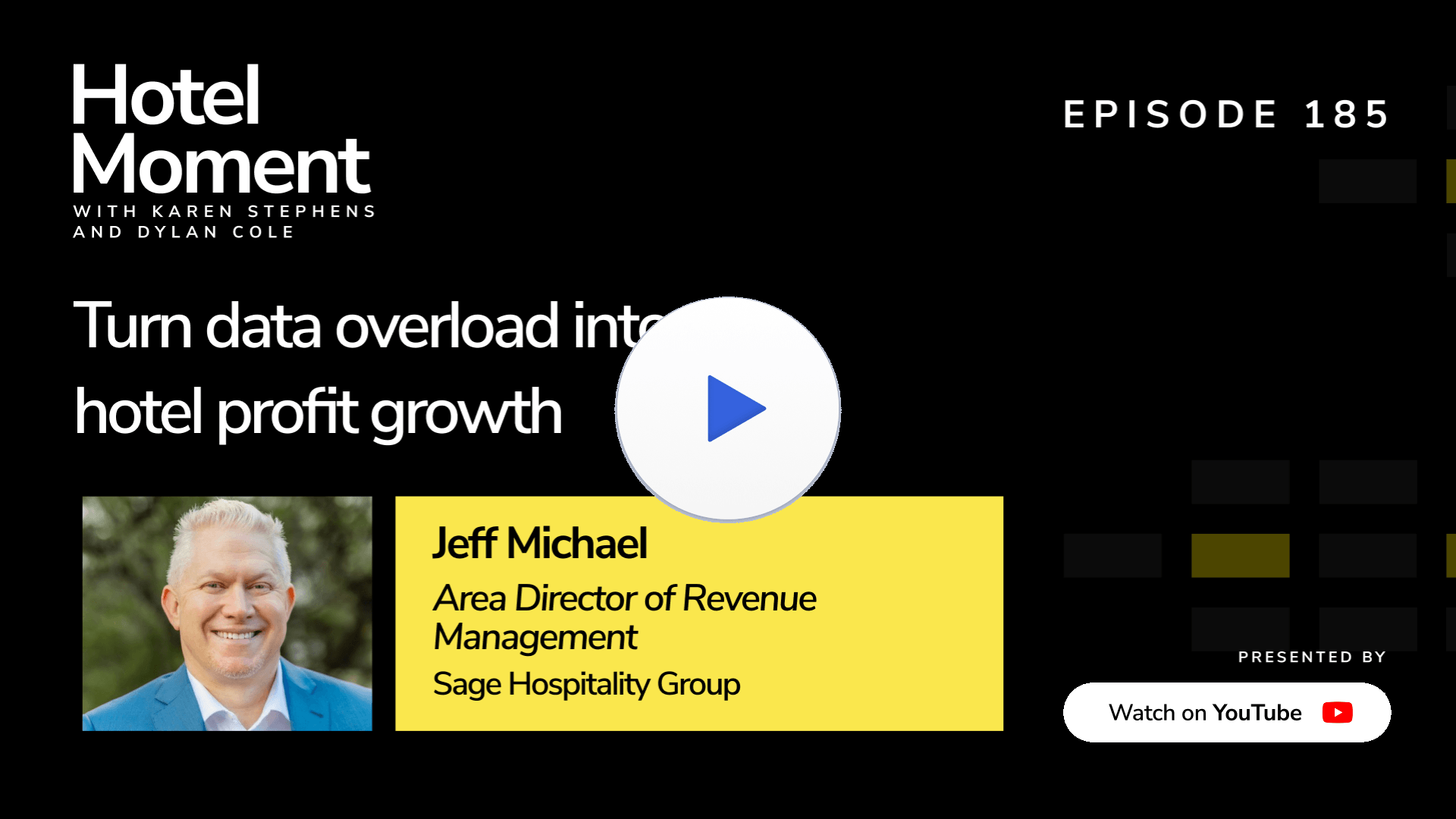
Episode 185
How hotels turn data overload into profit growth
Hotels have more data than ever before, but more data doesn’t always lead to better decisions.
In this episode of Hotel Moment, Karen Stephens sits down with Jeff Michael, Area Director of Revenue Management at Sage Hospitality Group, to discuss why commercial teams often get stuck in reporting instead of taking action.
Together, they explore how hotels can align revenue, sales, and marketing around profitability, use AI to make guest lifetime value more actionable, and turn data into a true competitive advantage.
Tune in to learn how high-performing hotel teams move beyond dashboards and focus on what drives growth.
Media
Align teams, clean data, boost profitability
Know a lot about everything
How AI will shape data application
Don’t drown in your own data

Meet your host
Karen Stephens
As Chief Marketing Officer at Revinate, Karen is focused on driving long-term growth by building Revinate’s brand equity, product marketing, and customer acquisition strategies. Her deep connections with hospitality industry leaders play a key role in crafting strategic partnerships. Karen has more than 25 years of expertise in global hospitality technology and online distribution — including managing global accounts in travel and hospitality organizations such as Travelocity and lastminute.com
As the host of The Hotel Moment podcast, she interviews top players in the hospitality industry. Karen has been with Revinate for over 11 years, leading our global GTM teams. Her most recent transition was from Chief Revenue Officer, where she led the team in their highest booking quarter to date in Q4 2023.
Watch the video
Transcript
[00:00:00] Jeff Michael: The data is there now and AI is going to help us harness that data and become better at personalizing and personalizing at a bigger scale so we can target every single individual that we know is looking at the hotel or considering booking.
[00:00:15] Karen Stephens: Welcome to the Hotel Moment Podcast presented by Revinate. I’m Karen Stephens, Chief Marketing Officer, joining you from sunny San Francisco, California.
[00:00:23] Dylan Cole: And I’m Dylan Cole, Managing Director of Revinate Europe, calling in from Amsterdam.
[00:00:28] Karen Stephens: This is the podcast where we explore how technology shapes every moment of the hotelier’s experience. And more importantly, how the right technology delivers real outcomes for hoteliers and guests alike.
[00:00:38] Dylan Cole: From revenue strategy and guest communication to operations and marketing, we sit down with the people transforming hospitality around the world.
[00:00:46] Karen Stephens: Depending on the conversation, sometimes it’ll just be me behind the mic.
[00:00:50] Dylan Cole: And sometimes it’ll be me, bringing a European perspective and stories from across the global hospitality industry.
[00:00:57] Karen Stephens: Whether you’re a hotelier, a tech enthusiast, or just curious about where hospitality is headed, you’re in the right place.
[00:01:03] Dylan Cole: Let’s get into it.
[00:01:05] Karen Stephens: Hello and welcome to the Hotel Moment Podcast. I’m your host, Karen Stephens, the Chief Marketing Officer of Revinate. And today we’re excited to welcome Jeff Michael, Area Director of Revenue Management at Sage Hospitality Group. Jeff is an experienced voice in revenue strategy and commercial leadership. With more than twenty-five years of experience, Jeff has seen firsthand how data and commercial strategy have transformed the hospitality industry. Today he joins us to talk about the evolution of revenue strategy, the growing importance of data and commercial intelligence, and what separates high-performing commercial teams from the rest. So without further ado, here’s Jeff. Jeff Michael, welcome to the podcast.
[00:01:44] Jeff Michael: Thank you. Happy to be here today.
[00:01:45] Karen Stephens: Yeah, so Jeff, you’ve worked through multiple eras of hospitality, from traditional revenue management to today’s more data-driven commercial environment. So I’m really curious what first drew you into the commercial side of hospitality and what has surprised you the most on how that role has evolved over the years?
[00:02:03] Jeff Michael: Yeah, so thank you for reminding me of my storied career. Makes me feel old, but so really the path of how I got into the commercial side was through operations. I always grew up wanting to be an operator in the hospitality industry, so I spent roughly the first half of my career in various operations roles. And really when I kind of evolved and got into the general manager roles, I realized that I had a real knack for the revenue management side of it, the top line side of it. And I also knew as a general manager that if I could get the top line revenue to come in for the hotel, like running the hotel was easy. It was really needing to have the revenue coming in, which just makes it all work. And so I always had this knack or real passion for making sure that the revenue side of the business came in. And that’s how we ended up in commercial. So after various general manager roles, when I was asked by the company I was working for at the time if I wanted to jump into a revenue management role. I’m like, huh, I hadn’t really thought of that. But when you look at it, it’s like this is what I really love about what I’m doing right now. So that’s how I ended up getting into commercial. And just really kind of evolved from there. And I’ve been in commercial ever since. So really the second half of my career has been in various commercial roles. And really how it’s changed from when I initially got back into commercial dozen or so years ago is that really it was, I don’t want to oversimplify it, but it was a much simpler process at the time because you didn’t have all the data that we have now or all the technology that we have now. I mean, it was truly working within hotel and extranets and, you know, manually changing prices and it, you just didn’t have the benefit of a lot of data. So you went off limited data points, you made decisions, and you also were really just dealing predominantly with pricing. And that’s just not how it is these days. These days you’re more of a commercial strategist. You need to know revenue management. You need to know marketing. You need to know sales. And you need to be able to look at the big picture and be able to pull all this data available to us now together to make decisions.
[00:04:03] Karen Stephens: Yeah, you know, you hit on a really interesting point. Well, it’s, you called it out. There’s access to more data today than ever before. So that has grown exponentially. But I think a lot of folks still struggle to make better decisions. So what is the difference between simply reporting on data and creating true revenue intelligence? What’s your view there?
[00:04:22] Jeff Michael: Yeah, it’s tough. I think this is one of the true challenges. It’s like back in the day we used to always say we need more data to make good decisions, and now we have this overload of data. And we’re almost in paralysis because it’s like, well, we need to look at all the data before we make a decision. And you end up being almost unable to make a decision because you’re bogged down really in the data of the whole thing. And really that is the challenge today. And what we have to make sure we’re doing is really looking at the data points we need and then making decisions based off that. So we don’t want to be reporting out all the time, which is a constant challenge. It really needs to be, look, let’s do the reporting we need, let’s use the data we need to make decisions and keep making decisions that help drive revenue for the hotels.
[00:05:07] Karen Stephens: Yeah, so what are some of the signs, because you work across a number of hotels now in your current role. So what are the signs that you’ve got a hotel that’s drowning in reports instead of using those insights strategically? Like what kind of tips you off that we’re in a data morass instead of being able to see how to execute and make a difference?
[00:05:25] Jeff Michael: Yeah, I mean it’s really when I see lack of action. So when you’re talking to a revenue manager and they’ll tell you about this is happening, this is happening, and really just they’re just kind of regurgitating data to me. I’m like, well then it’s like, well, what are we doing about it? And there’s a pause. It’s like, well, I don’t know, but I’m just looking at this data and this is, you know, and so when I see the lack of action, that tells me that we’re kind of drowning in the data or drowning in the reporting. And also, I mean it’s just a matter of looking at the structure of the revenue manager as well and making sure that we’re not drowning that position in reporting tasks. You know, I mean the position is about strategy, not about spending all this time reporting. And if you’re reporting, you’re not taking action and really performing the core function of your role.
[00:06:07] Karen Stephens: Right. And one thing, you know, when we talk about commercial strategy, which I mean I think has been around for a long time, but really became a buzzword over the last couple of years, which is really the alignment between revenue management, sales, and marketing. But in practice that can also break down quickly. So where do you notice commercial teams struggle the most to stay aligned and how do you make sure that the teams hold each other accountable? So you talked about action, but with action comes accountability and making sure you can rely on those other pillars. So how do you think about that?
[00:06:38] Jeff Michael: Yeah, so you’re right. Yeah, commercial strategy and commercial, the term has been around for a long time. I’m not sure we’ve really gotten it right a lot in many cases. But the key that I found is that, you know, a lot of times we say we’re a commercial team, but then you look at like the goals and objectives of each team and they’re completely different. So they’re not aligned. And a lot of times we say it’s alignment, we have commercial alignment, then we look at the incentives and goals of the departments and they’re completely misaligned. So really what has to happen first is an alignment of goals and incentives to make sure that the whole team is on the same page. So in my experience, that’s where it starts. So you have to bring the entire team together and you have to have the same goals. So in various roles when I pulled these commercial teams together, we sit the team down initially. It’s like okay, so what are the commercial goals for sales, marketing, and revenue? And they all align. So we walk away and they’re all aligned towards the same goal. They’re all driving top line of profitability, and we walk away knowing that we’re working together to get to these goals as opposed to having goals that are still siloed by department.
[00:07:43] Karen Stephens: I think that is really interesting. Because you’re right. Again, going back to the influx of data, there are so many data points that you have. And so if you’re looking as a department to say, well, what do we want to achieve as a KPI, you could pick a number of things that have zero impact to anybody else’s. So you just give me, I mean you kinda called some of it out there, but what’s the simplest example of, is it top line profitability? Is it net operating income? Like what do you see that you want to do, like, hey guys, this is our North Star? What do you typically look to?
[00:08:10] Jeff Michael: Really these days, it has to come down to profitability. And I think that’s a change in thought process as well. And you know, in the past it was, I mean, you’re looking at RevPAR, you’re looking at RGI, and again you’re kind of in a silo when you’re looking at the entire hotel. And now you’ve got to tie the goals back to profitability. Because at the end of the day, we have the commercial teams that need to be aligned, but the entire hotel has to be aligned and the whole goal of what we’re doing in a hotel for an owner is driving profitability. So you have to have that complete alignment and that’s why it comes down to profitability at the end of the day.
[00:08:46] Karen Stephens: So I would love to understand, for hotels that have, are you looking also at total RevPAR, everything that’s going on in the outlets, like how much the share of wallet you’re getting out of that guest? Like when you talk about profitability, obviously talking about all the expenses and revenue, but how do you look at that more broadly if you’re gonna motivate the entire team at a hotel?
[00:09:05] Jeff Michael: It is total profitability. So you’re looking at the outlets, et cetera, what ancillary we’re bringing in, and there are also expense considerations that have to be taken into account.
[00:09:15] Karen Stephens: Okay, so Jeff, guest acquisition costs continue to rise and loyalty is becoming harder to maintain. So how should hotels think differently about guest lifetime value in today’s environment?
[00:09:25] Jeff Michael: Yeah, and here’s where I think when we look at data, we’ve got the data around guest lifetime value. It’s hard, you know, in many instances we’re still struggling to always have that calculation. So this is an area where I think AI is gonna help us more and more, about helping us hone in on what guest lifetime value is. So I think this is gonna be a more important key metric going forward. But basically the need to understand guest lifetime value is going to become more and more important because it’s gonna help us improve the channel mix. It’s gonna help us focus on retention as opposed to just that single time booking and really help us with personalization and targeting as well. I think right now we do it, it’s not amazing, you know, but when we can get true metrics and information around guest lifetime data, we can identify the type of guests that we’re targeting or the segment. And really go after that segment. And at the end of the day, we want the guest that’s gonna continue to come back years and years and years, as opposed to the one time guest coming through the hotel. And so those are the guests, the retention is what we need to be focusing our efforts on.
[00:10:29] Karen Stephens: Yeah, I hear you kind of hit on two levels there, like the macro level of identifying segments and channel mix and how do these guests respond to certain activities, promotions, offers. And then there’s also the very one-to-one marketing of understanding who your best guests are and making sure that they keep coming, so that you know that business traveler that always likes the concierge floor, that values the Continental Breakfast more than the free parking, whatever it might be. So I think that’s a really interesting take, is trying to figure out how to kind of hit both sides of that.
[00:10:59] Jeff Michael: Yeah, and you do have to hit both sides of that to make it all work.
[00:11:03] Karen Stephens: Absolutely. So you’ve led both operational teams, as you mentioned, and revenue management teams. So what truly separates high-performing hotel commercial organizations from average ones? Is it talent, structure, leadership, communication? Like what do you see that secret sauce being?
[00:11:18] Jeff Michael: It is a collaboration of all of it. So you do have to have the right talent at the hotel. Now it doesn’t mean you need to have the most experienced person. You need to have the right talent that you can develop that’s a good fit for the team. And that’s really where you start. You got to start with the people. And then from there, it really comes down to the leadership and the leadership style. When I’ve been a part of these high functioning teams, it comes down to the team being one. There’s open communication. Everyone clearly understands what the goals are. And they clearly understand that each member of that team will do whatever it takes, regardless of what their title is, to help that hotel be successful. And when you’re able to develop a team like that, I mean you’re unstoppable. You know, you’re either gonna be the market leader, it’s just like you’re on a whole other level. And I’ve had the privilege of being a part of a few of those teams. And you know, it takes time to bring all of that together to build that trust level, open the communication, making sure that everyone holds each other accountable. You have to have that relationship amongst the whole team. And that’s the key. Once you have that, that’s the secret sauce, and you’re unstoppable.
[00:12:22] Karen Stephens: Yeah, and it’s so fun, right? I mean, that’s what, even hearing you talk about it, I’m like, oh yeah, I’d love to be on teams like that. You know, it’s like we used to say here, the people are the product, you know, because we really believe when you have great people then you’re gonna have great output. And yeah, even hearing you talk about that kind of a team feels inspiring to me. It’s fun. It’s fun to go to work, right?
[00:12:43] Jeff Michael: It is. And it should be fun to go to work.
[00:12:45] Karen Stephens: Yes, that’s right. So we talked a little bit about data, so it’s all over the place for every commercial decision inside a hotel, but looking ahead, how do you see data and technology continuing to reshape hotel commercial strategy over the next five years? And I mean things are moving so fast we could probably talk about the next five months, but you hit on some of it. What are you seeing if you could crystal ball it?
[00:13:05] Jeff Michael: Yeah, I think, you know, I mean yeah, five months, five years, and we’re already headed down that path, is a couple of things. Is that really we’ll use AI to get out from under the reporting and kind of the analyst tasks that revenue managers have now. And I think that’s a change that I’m already seeing and it’s only gonna get better. And so when we talk about this data paralysis and all this reporting, that’s the stuff that AI is gonna take off all of our tables. So now we can be true commercial strategists. And we’re all time starved. So that, I think, is going to be probably the biggest evolution we’ll see well before the five year mark. ‘Cause it’s already happening. But it’s exciting to me because I talk to revenue managers all the time and it’s always, well, I don’t have time to do this because I’m doing these reports, or I’ve got to do all these manual tasks that AI can do for us. So that’s going to be the biggest. And then I think we can get into some of the things that we’ve talked about as an industry for many, many years. So like we’ve talked about personalization for many, many years. Like are we great at it? I don’t think we’re great at it, but the data is there now, and AI is going to help us harness that data and become better at personalizing and personalizing at a bigger scale so we can target every single individual that we know is looking at the hotel or considering booking. And AI can automate that and use that data that we have that we haven’t been able to use great yet and help really fine tune that marketing task. And it’s also the total revenue optimization or total profitability of the hotel. Again, another thing that we’ve talked about for years, probably since I moved over to the commercial side, but we haven’t had the data or the bandwidth to do it. So now, you know, AI is going to be able to help us look at these new metrics like we just talked about, lifetime value or guest spend, acquisition costs, which we can kind of calculate, but it’s always a difficult calculation. AI is going to help us with this and help us make better overall optimization decisions in the future.
[00:14:59] Karen Stephens: So I’m curious, how are you thinking about training your team to use AI effectively? Because I think it’s coming down, for me, I know, having been obviously in the workplace for a while, that, you know, a lot of what I’m trying to work through is how do I get the prompts right? You know, like I know what I’m looking for, but training a machine to then give me the output quickly. So is that something that you’re working on with your teams or how are you thinking about it?
[00:15:22] Jeff Michael: Yeah, so in my current organization, we are looking at, it’s like just a base level AI competency. And so there is training that we have that rolled out just to get you kind of base level, comfortable with it. But from my perspective and what I can do, it’s like look, just get in there and play around with it, you know, and you’ll be amazed at, you know, what you learn just by asking AI a question. Or even just one of the tasks was recently, was okay, just ask it to look at your calendar for next week and tell me how I can optimize my week. And everyone came back blown away because it’s crazy. I mean it says, hey, look, this is, you know, you’re gonna get call fatigue because you’ve got calls lined up for three hours in a row. You need to separate that. This sounds like a low priority task. This is a high priority task. And it’s amazing. So I think it’s really just getting the team over the fear of AI. And any fear, it’s like, look, as long as you’re willing to evolve, AI is not taking your job as a revenue strategist. It’s going to take the things that you don’t need to be doing and make you a better revenue strategist at the end of the day. So please get in and play with the AI and start to use it in your day-to-day life, in your day-to-day functions. And you’ll just get better at it as you play around with it. That’s really what I’ve done. I mean I’ve taken some training, but the most effective I am in kind of picking up new skills is playing around with the prompts until I get it right. And it’s, uh, they go, oh, there we go. That’s exactly what I was looking for.
[00:16:42] Karen Stephens: I love it. And you realize how much time you save. It’s so funny. I’ll block out hours to do work on something and then I’ll pop it through AI. And I’m like, actually it’s pretty good. I just need to tweak this a little bit.
[00:16:52] Jeff Michael: This is crazy. Just saved me two hours.
[00:16:54] Karen Stephens: Yeah, it’s like, and now I can go do things I want to do, thinking, you know, using my brain, as you mentioned. A commercial strategist, that is a skill set that you develop over time and it requires intuition, it requires knowing the market, it requires way more beyond AI. So marrying those two together can get really interesting. So my final question for you, if you could give one piece of advice to a young revenue leader entering hospitality today, what would it be?
[00:17:19] Jeff Michael: Yeah, I’ll probably bend the rule a little bit here on just one. But you know, I think first off I’d say if you want to enter the hospitality industry today, no matter what your role, have a true passion for being in the industry. Because you love hospitality, you love, and you have a passion and career for creating experiences, because no matter what our title is or role is in the industry, hospitality at the end of the day is about creating experiences. And that’s whether it’s in a booking process or why they’re at the hotel, but that’s what we’re all about. So make sure you love what you do and kind of start out keeping a high level, work with good people and have fun. I see more and more, I think we get away from what the core of the hospitality industry is, and it’s about people. It’s about creating experiences for people. So you want to be a part of that. So as a revenue leader, make sure you embrace that before you do anything else. And then once you decide the hospitality industry is for you, you have to understand this industry is going to take you in a lot of different directions. So enjoy the ride. Learn as much as you can in your current roles and don’t be in a hurry to jump to that next role and get your next promotion. It’s all gonna happen for you, but you really wanna stay in the moment, learn what you can in those moments, and that kind of experience will be priceless moving forward in your career. And you’re gonna look back and say, you know, I’m really glad I stayed with that one. It was a great experience, great time. I learned so much, and you know, just make sure you enjoy the whole thing as you’re working through it.
[00:18:42] Karen Stephens: That’s great, Jeff. Thank you so much. Jeff, it’s been a real pleasure. Thank you for joining me today.
[00:18:46] Jeff Michael: Thank you all.
[00:18:51] Outro: Thank you for joining us on this episode of Hotel Moment by Revinate. Our community of hoteliers is growing every week, and each guest we speak to is tackling industry challenges with the innovation and flexibility that our industry demands. If you enjoyed today’s episode, don’t forget to subscribe, rate, and leave a review. And if you’re listening on YouTube, please like the video and subscribe for more content. For more information, head to revinate.com/hotelmomentpodcast. Until next time, keep innovating.
Episodes
Hotel Moment
WITH KAREN STEPHENS
Subscribe for updates on your favorite platform