Hotel Moment
WITH KAREN STEPHENS


Episode 180
Will guests trust AI with their travel plans?
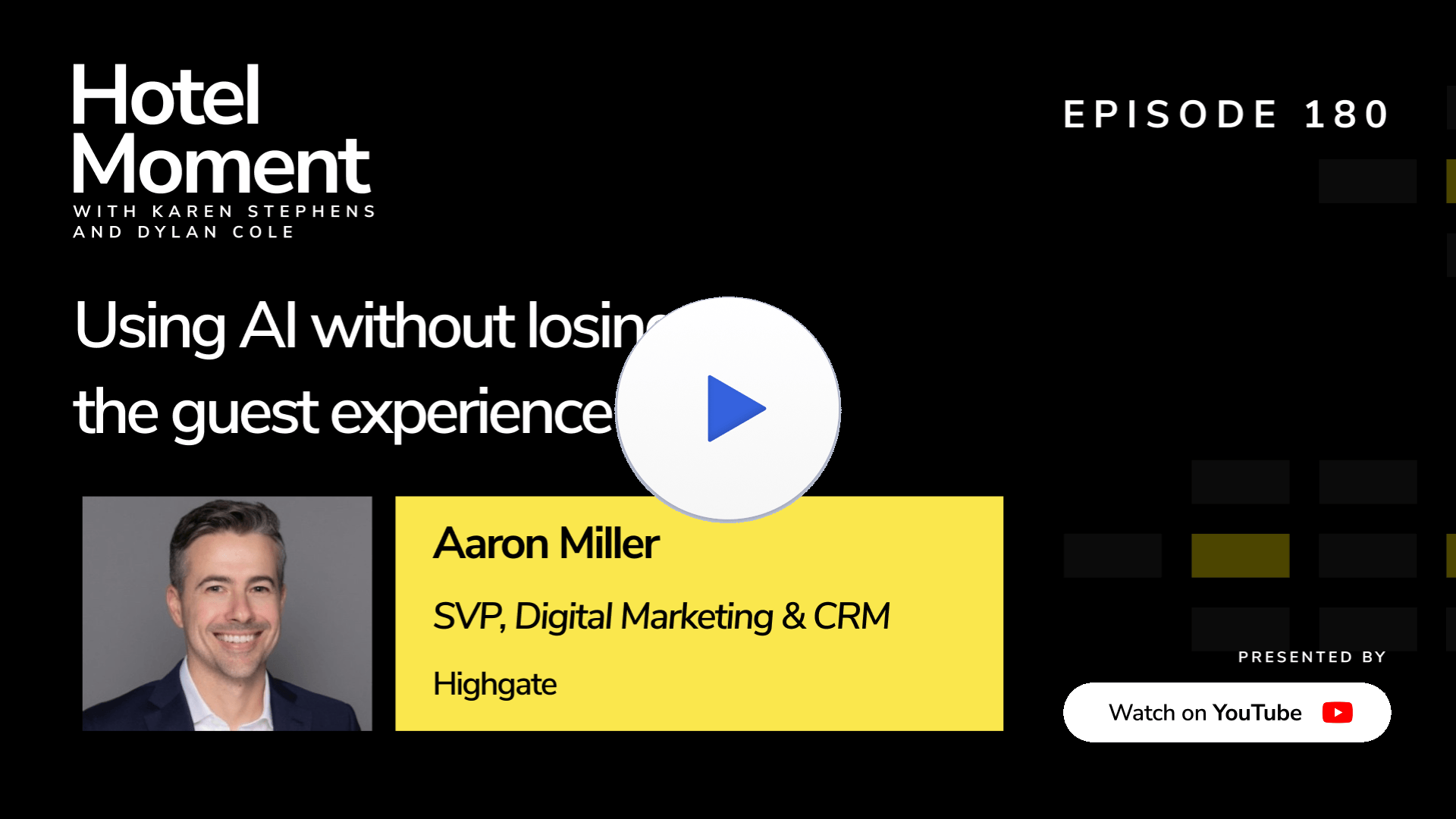
AI may be transforming how travelers search and book hotels, but the guest experience is still deeply human. In this episode of Hotel Moment, Karen Stephens, Chief Marketing Officer at Revinate, sits down with Aaron Miller, VP of CRM at Highgate, to explore how hospitality brands can embrace AI without losing the human connection guests expect.
From AI-powered travel discovery and the future of hotel search to personalization, convenience, and trust, the conversation dives into how hotels are navigating one of the industry’s biggest shifts yet.
As travelers increasingly use tools like ChatGPT to research and plan trips, hotels are adapting to a new era of discovery, booking, and personalization. This episode explores how AI is reshaping hotel search and guest engagement while reinforcing the importance of delivering a personal, human guest experience that drives direct bookings.
Tune in to hear why the hotels that win in the AI era won’t just automate faster, they’ll use AI to create smarter, more personalized guest experiences that still feel human.
Media
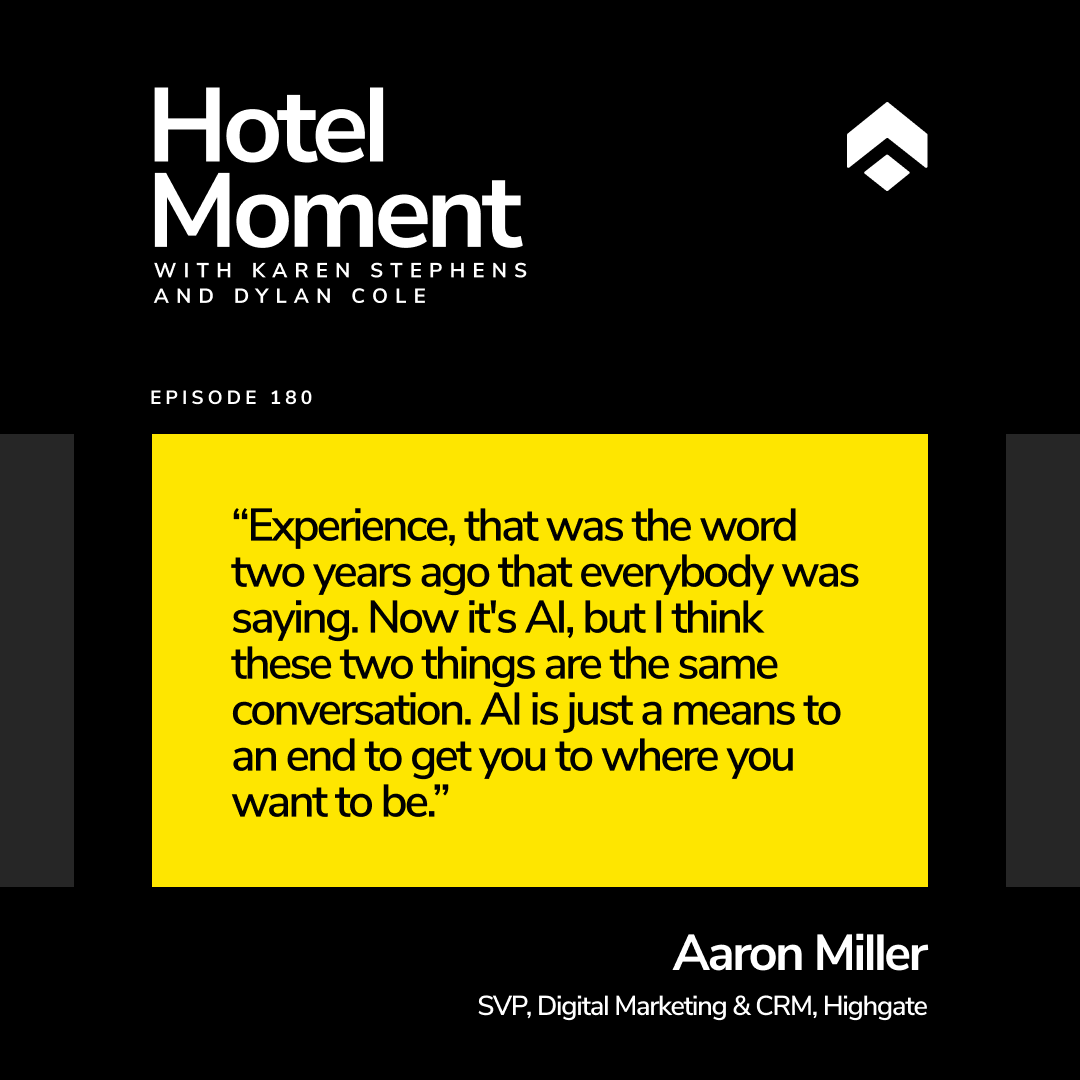
Why experience and AI are the same conversation
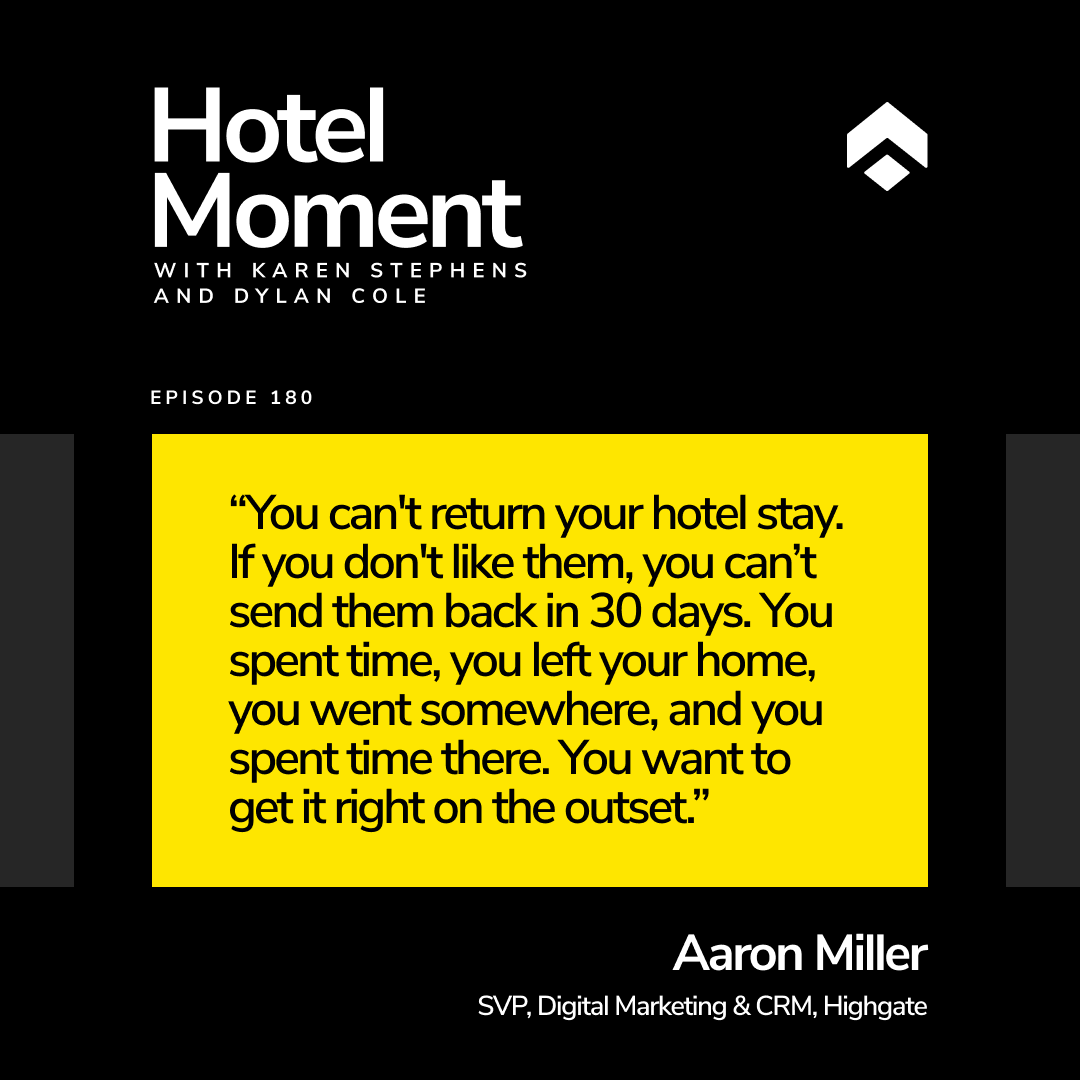
Get hospitality right the first time
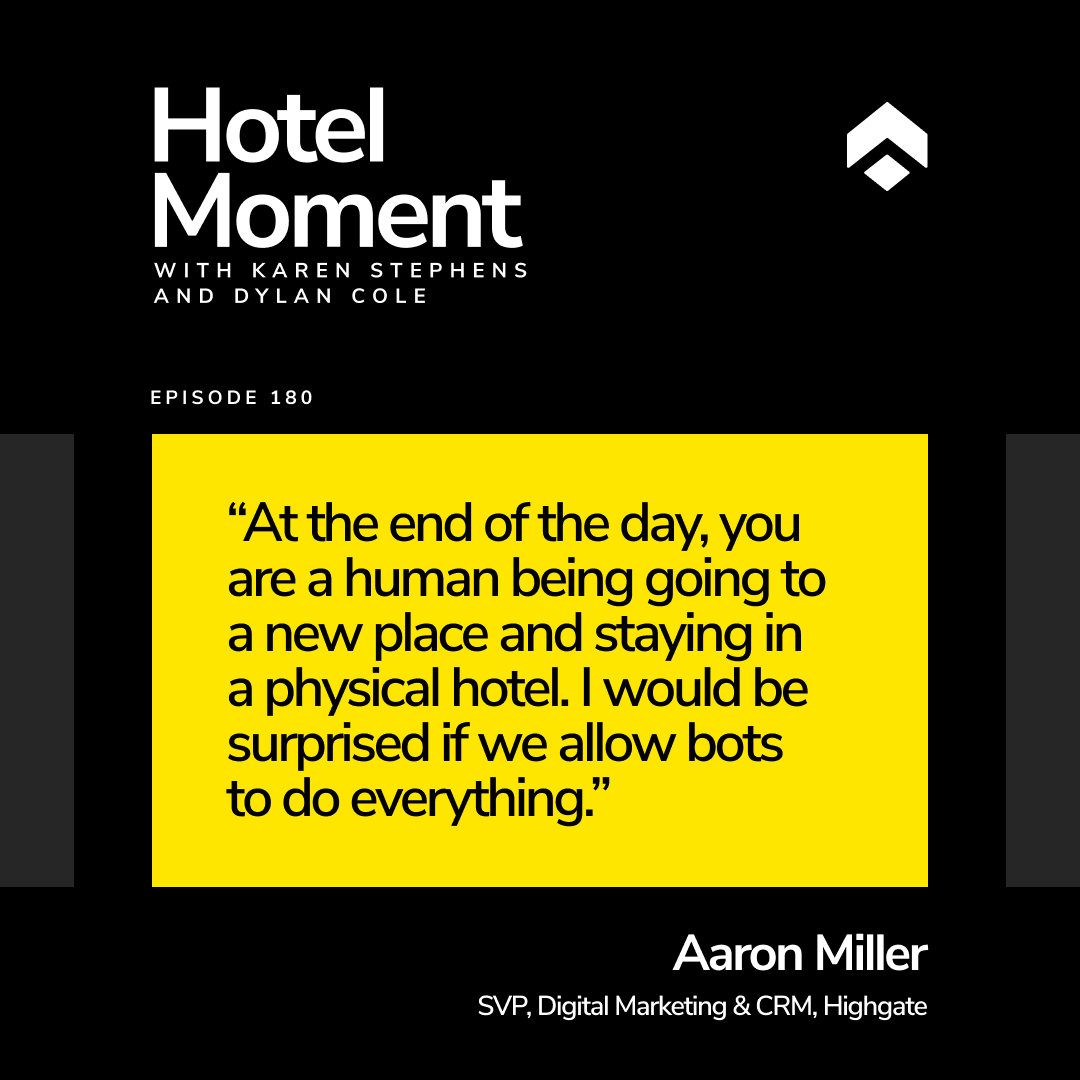
The human element of hospitality is irreplaceable
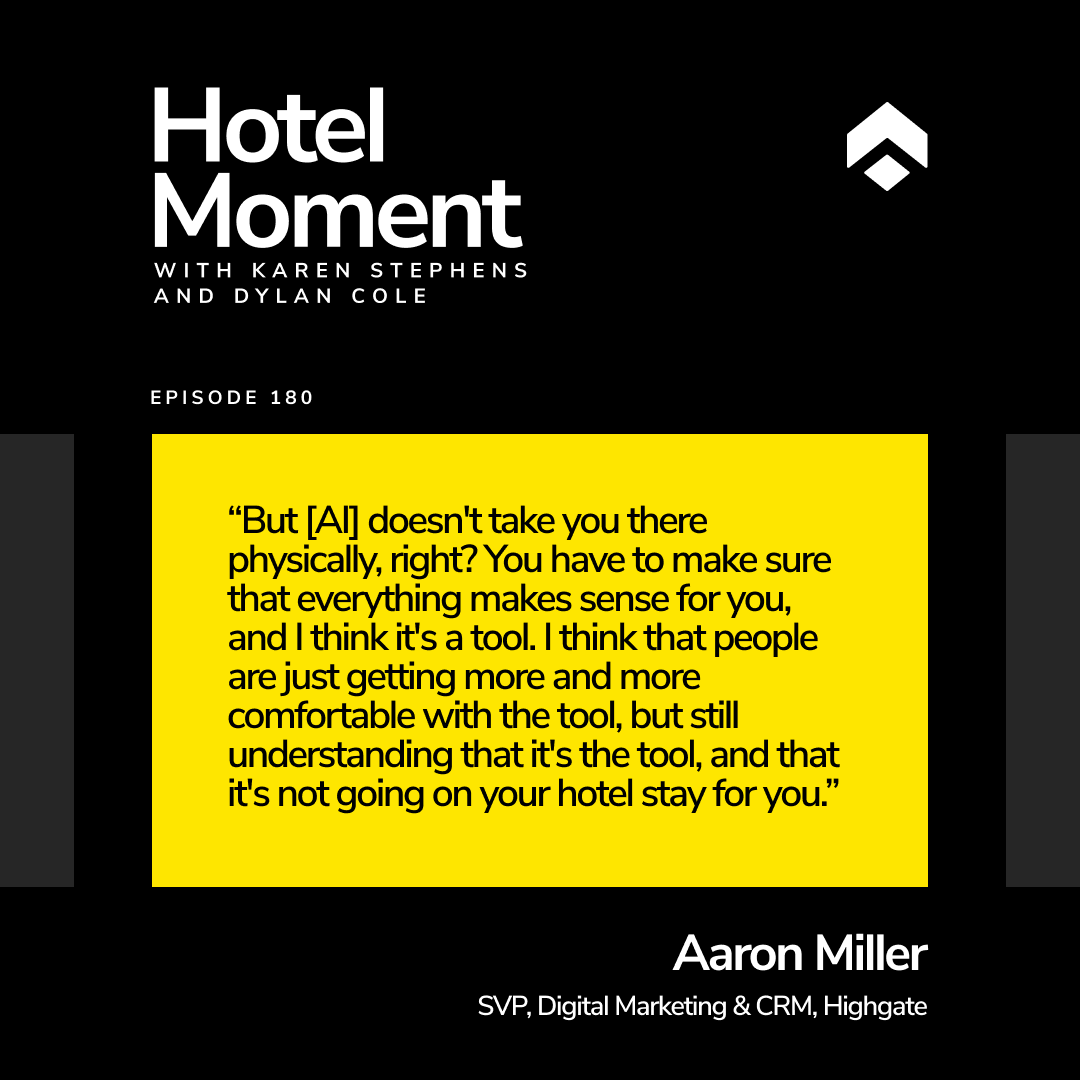
People are embracing AI

Meet your host
Karen Stephens
As Chief Marketing Officer at Revinate, Karen is focused on driving long-term growth by building Revinate’s brand equity, product marketing, and customer acquisition strategies. Her deep connections with hospitality industry leaders play a key role in crafting strategic partnerships. Karen has more than 25 years of expertise in global hospitality technology and online distribution — including managing global accounts in travel and hospitality organizations such as Travelocity and lastminute.com
As the host of The Hotel Moment podcast, she interviews top players in the hospitality industry. Karen has been with Revinate for over 11 years, leading our global GTM teams. Her most recent transition was from Chief Revenue Officer, where she led the team in their highest booking quarter to date in Q4 2023.
Watch the video
Transcript
[00:00:00] Aaron Miller: Experience. That was the word maybe like two years ago that everybody was saying. Now it’s AI, but a couple of years ago it was experience, experience, experience. I think these two things are the same conversation. AI is just a means to an end to get you to where you want to be, and it’s the wild west right now.
[00:00:19] Intro: Welcome to the Hotel Moment Podcast, presented by Revinate, the podcast where we discuss how hotel technology shapes every moment of the hotelier’s experience. Tune in as we explore the cutting-edge technology transforming the hospitality industry and hear from experts and visionaries shaping the future of guest experiences. Whether you’re a hotelier or a tech enthusiast, you’re in the right place. Let’s dive in and discover how we can elevate the art of hospitality together.
[00:00:47] Karen Stephens: Hello and welcome to the Hotel Moment Podcast. I am your host, Karen Stephens, the Chief Marketing Officer of Revinate. And today we are excited to welcome back Aaron Miller, Senior Vice President of Digital Marketing and CRM at Highgate, and one of the hospitality industry’s leading voices in guest engagement and digital strategy. With more than 20 years of experience across brands like The Venetian Resort Las Vegas, Sidell Group, Trump Hotels, and Turning Stone Enterprises, Aaron has helped shape innovative CRM and loyalty strategies that drive both revenue and guest experience. In today’s conversation, Aaron dives into the importance of leveraging AI, its usefulness, its pitfalls, and where hoteliers should exercise caution. We’ll also dive into what’s ahead for summer demand as the season approaches with tips on how hoteliers should prepare for travel changes, especially with events like the FIFA World Cup around the corner. It’s always a pleasure to have him. Welcome back to the podcast, Aaron. Nice to see you. So we just saw each other actually in real life about a month ago. Can’t believe it’s going that fast in Phoenix. So I would just love from the outset to get your impressions on the NAVIGATE conference. How’d you feel about it? Was it a good show for you?
[00:01:56] Aaron Miller: Yeah, I love it. It’s just a great opportunity to get a lot of people together that are doing the same thing in their own little silos and have these sort of bigger conversations about the products, the future, the team, pain points, areas that we really love, competing technologies, all these different types of things that we’re working on in our own little worlds. But it’s a good opportunity to get out there in the real world, talk about these things, and then not talk about that so much.
[00:02:24] Karen Stephens: Yeah, that’s great. Well, obviously for me it’s my favorite time of year, just bringing all our customers together. And I think it’s also cool to say, as you mentioned, the networking, it’s not just, you know, hearing from the Revinate team, but hearing from your peers across the industry. We have a lot of beautiful brands and customers. So for us, it’s really cool. So one of the things we hit on pretty heavy at NAVIGATE, which I think is a trend everywhere, is AI. AI, AI, AI. So I wanted to start by just asking you, I mean, you know, I’m a technology vendor. Admittedly, we have AI running legitimately on a lot of the systems, a lot more to come. But I would love to know as a buyer, because now you hear the phrase “AI-powered” throughout every single vendor, every single deck. So how much of that do you think is marketing glitz and glam, and how much of that is actually real? And how do you as a buyer kind of sift through to figure out the difference?
[00:03:19] Aaron Miller: I mean, I guess it’s a case-by-case basis like most things. I agree that it’s everywhere, but there’s very little question on whether it should be or should not be. I mean, where we’re at in this day and age, it is more apparent than ever that this is where things are trending. So when we’re looking at technologies and there’s references to AI-powered or AI technology, we’re no longer surprised. I mean, I guess you could say that it’s saturated, but it needs to be. So it’s just a big shift in how things are operating. And we are looking at so many different types of uses for AI, whether that’s powering technology, whether that’s for visibility for the traveler on their journey. So there’s just no doubt that everybody is using this from every angle. So whether we are a buyer of technologies that are using it or whether we are the end destination for someone making a trip and determining where they’re going to stay, we’re just trying to understand the landscape of this and meet people where they are with it.
[00:04:18] Karen Stephens: Yeah, you know, I think one of my favorite presentations at NAVIGATE was the McKinsey talk. So you might remember we had Ryan Mann from McKinsey talking. And he admittedly said, “Hey, nobody knows where AI is going to go. There’s a lot of different scenarios.” But what I thought was interesting was what he discussed, and I won’t get it right verbatim, but he talked about a few different scenarios. One of them being, you know, that the OTAs and huge major brands continue to be dominant. On the other side of the scale, you have like actually agent-to-agent booking, which is very forward-looking, but it’s like, okay, Aaron’s got an AI bot in the world and you don’t even interact really. Like the bot just comes back and says, “Here’s where you’re going on vacation,” right? And then there was a scenario called the Direct Booking Renaissance, and I thought that that one was really compelling. And that was all about hoteliers actually taking control of their data, understanding how to interact with AI, and then really getting into that booking journey. And I think that that’s kind of what you’re talking about, right? So to be able to leverage LLMs to get the buyer to come direct. What did you think about that discussion?
[00:05:25] Aaron Miller: I thought it was great, and I thought it was an eloquent way to look at it, and I thought it was a very transparent discussion. You know, the element of maybe in the future the bots will just be talking to themselves. But that may be unlikely. You know, it’s possible, but is that the way things are going to go? I mean, it’s hard to know, but it seems like there will be some ceiling, some limits to this journey. And there will still be some human agency involved with making a decision based on travel, which is ultimately guided through various technologies along the way. But at the end of the day, you are a human being going to a new place and staying in a physical… you know, we’re in hotels. So we’re staying in physical spaces. So I would be surprised if we just all allow bots to do everything. I do think there will be, and we are starting to see it now, this collaboration between a prompt and the content being returned, and how everybody on both ends are trying to optimize that, right? We’re going through so many processes and pilots and trying to understand, you know, how do we get our hotels to show up when somebody’s looking to book a hotel in New York City? It’s the new version of search in so many different ways. I’m hopeful that there is that Renaissance. Hopefully, it’s not even a Renaissance. Hopefully, people love to book on your website, but making sure that it’s just you’re found. It’s easy to book, and you get off the bot and you go to a beautifully curated website to really get the feel for it because you’re only going to get so much on the chat itself. And ideally, just like I talk about with email campaigns. I mean, my goal of any email campaign is to get somebody onto my website. You can’t book your room on email. And maybe we’re talking about booking a room through ChatGPT or what have you, but I still think that there’s going to be that link out. Even if it’s inside the app and the browser version and all that, I still think that most users, for a little while longer, want that same type of experience that they’re comfortable with and familiar with. It’s a big deal to book travel.
[00:07:35] Karen Stephens: Yeah, you know what, I agree 100% because it is the hotel that owns the experience, the guest experience when they show up on property. And before they get there, it’s also the hotel that should own all of the content that tries to explain to that customer what kind of experience they can expect. So I think that’s very poignant. It’s making sure that you stay in control of that content. And when people click through, they are clicking through to your website, making that booking direct. I think the point is some of the things that McKinsey were talking about, if you think about the way that OTAs have taken such a large share of distribution, it’s because they have the breadth of content in any given market, right? Billions of dollars that they can spend now optimizing for AI. So when we kind of step back as Revinate and look, we’re like, hey, how do we help hoteliers make sure that all of their content and data, everything that we know about their hotels and everything that we know about their guests, is synthesized and ready to activate, whether that’s within our ecosystem… and what I mean by that is through email or voice or messaging, or externally through AI. But that’s a journey though, obviously. That’s as you mentioned, it’s like from here to the bots doing everything is a journey. But I think you hit it on the head that people are still going to want to… you know, my one vacation or two vacations a year is like the most important thing in my life. So I want to make sure, or in the top ten, right.
[00:08:55] Aaron Miller: It might have been that same McKinsey talk or maybe one of the other talks, but I’m pretty sure it was at NAVIGATE where somebody said you can’t return your hotel stay. Pair of shoes that you get on a whim and say, “If I don’t like them, I’ll send them back in 30 days.” It happened. You spent time. You left your home. You went somewhere and you spent time there. You want to get it right on the outset. There’s a lot of trust that we put in there, but at the end of the day, I think it’s all about convenience. What AI is bringing to the traveler, I think, is convenience to say, tell them, you know, a longer prompt. I want to stay at a New York City hotel, you know, not far from Central Park. I can walk to Broadway. You know, you give this long string. But it doesn’t take you there physically, right? You have to make sure that everything makes sense for you and I think it’s a tool. And I think that people are just getting more and more comfortable with the tool, but still understand that it’s the tool and it’s not going on your hotel stay for you.
[00:09:51] Karen Stephens: That’s right. That’s a good point. You cannot return the stay. Once you take off and you’re on your way, that’s it. That’s the trip. Okay. Well, I’d love to shift gears and just talk about AI impacting you as a marketer and your team. This is something obviously that’s my position too, so we’re always like, ah, how do we start to incorporate what your team does? So obviously your team writes the copy, they build the journeys, they build the website, they run the campaigns. So AI now puts a lot of that within anybody’s reach with building different things using AI. So how is the role of the marketing team actually changing? How do you think about that and how that’s going to impact what you’re doing?
[00:10:27] Aaron Miller: Like many things, I think it probably depends. I think you can look at it from a number of angles. Copywriting comes to mind first because that’s the most straightforward text-based version of creative for a marketer. And yeah, I can even remember maybe even like this time last year where you could tell something a little bit had that tone of voice. You know, you can kind of pick it out if you’re savvy and say, “Oh, this looks like ChatGPT wrote this,” or whatever. Now it’s a little less obvious and I think most people are a little less nervous about it. I will see, you know, uh we’ll start working on a new hotel. And we have, you know, 15 room types because of the construction. And we say, okay, we have to kind of like come up with something that’s snappy. We got to make sense. We have to make this easier on a traveler. Why not start with ChatGPT or Gemini and format it from there? So text-based with email or website creation or anywhere you need like decent copywriting, I think, is a fine use of the tool at this point, day and age. I think it gets a little bit trickier when you’re talking about imagery, because it’s one thing to speak very highly of something and it’s another thing to utilize it with imagery. I think that we’re still seeing some hesitation there. Number one, because it’s not perfect, but number two, you’re starting to display something that’s not necessarily actually there. If you have a picture of your hotel awning and you want to remove tourists, you know, that’s one thing. But if you are showing your awning and you want to make it cleaner than it actually is or something like that, now you’re kind of utilizing… AI can do it, but should you do it? So I think that there’s still some precautions and hesitations that we need to take. But I’m hopeful that most marketers, you know, in the hotel space, at least that I’m working with can use it and can make sense of it and know what it’s good for and know how to reference a lot of different things that they weren’t able to reference just a couple of years ago.
[00:12:29] Karen Stephens: Yeah, that’s right. I think it’s great, as you mentioned, for the genesis, the beginning of the idea, the beginning of how we want to maybe structure something. But we know from what we’ve seen, at least for just Revinate’s marketing of Revinate, is still having that original content, still making sure that the thought leadership is written by a human and sounds authentic. But certainly we want to understand like we can do a lot with trying to understand what are the key themes that we want to run through. And also when we talk about our products, we have long documents that we then have the team put into Gemini to figure out how you talk to certain people. So I see it as something that you can leverage to make your team more efficient, but not necessarily a replacement of the team.
[00:13:09] Aaron Miller: Yeah, and that’s just on the creative end, right? There’s the whole back-end side of things with analytics that we’re being able to do and say like, okay, we have these big roll-up reports and we want to synthesize this and get some commentary and understand, you know, what we could do better and who dropped off and why, and do that in a matter of minutes where before it would take us days or weeks to kind of like really comb through things and make sense of it all. And again, like I think that there’s a convenience element to this that is important and that we treat it as the tool that it is and meet somewhere in between to say like, okay, well this is… you know, the comparison to the calculator that comes to mind. You know, okay, well this arithmetic used to take us some time. Now we have a calculator. It’s going to speed things up, but you can’t expect the calculator to do everything for you, if that makes any sense.
[00:13:59] Karen Stephens: Yeah, it does make sense. And it’s actually, it’s fascinating because as you mentioned, with the evolution, if you talk about spreadsheets and all the data that hoteliers are trying to weed through to make decisions, now you can pop all of that into AI and it takes some… I think one of the skills that most people need to develop is how do you prompt properly? How do you get the prompts right? But you do start to think about, wow, how much can this replace out of a tech stack for people trying to process stuff when now we can just do it quickly with AI?
[00:14:27] Aaron Miller: I totally agree. I think that it’s very useful, more useful than not useful. I think that we’re at an interesting time with it, but I also think that we’re in an interesting industry with it because like I said a couple of minutes ago, we’re talking about travel and in a lot of … you know, wellness and a lot of these experience-based activations and all these fun F&B concepts and all this. And almost at its basis, it has nothing to do with AI once you’re actually there. Once you’ve actually made your booking, once you’ve actually gone through the travel, once you’re actually there, hopefully you are in the real world and experiencing the friction that AI is the antithesis of.
[00:15:07] Karen Stephens: Right. I love it. Digital detox. Like that’s the whole reason. Hotels exist… I mean obviously we have hotels for business reasons and all of that, but focusing on the leisure segment, you’re going to want to step away from all of that. So I love that. So speaking of leisure, let’s switch gears. Summer is coming on strong. We’re coming around the corner. So it’s an interesting season. Like normally we head into high season. Obviously you have hotels as Highgate in all major markets. You’ve got a vast portfolio of beautiful independents, chains, etc. So I’d love to hear first of all, let’s talk a little bit about FIFA. So, you know, obviously we’re seeing a lot of articles now. First FIFA was like, oh my gosh, it’s going to be this huge boom for hotels. So what are you seeing now in the markets as we get… I mean, I think we’re four or five weeks away.
[00:15:52] Aaron Miller: I mean, I think that that timeline is part of the story, right? I think that a lot of this has to do with that lead time. And we’re optimistic to continue to see pickup as things get closer to the games. There’s just so many factors at play that are out of the control of the hotel industry. Whether that’s jet fuel prices or anything else going on that’s affecting inflation, and it just makes it complicated for travel for a number of reasons. But again, like there’s still that optimism. You know, I’m in the New York area, so that optimism of having that pickup as we get closer to the games is still there. And it’s not necessarily what we expected it to be at the outset, but we’re trying to pivot and navigate through it anyways.
[00:16:34] Karen Stephens: So when you talk about pivoting, are your hotels targeting markets that are not international? Like how are you trying to… because I assume originally, I’m just assuming here, especially in New York, you’re probably expecting a lot of inbound from Europe and other places. Now that we’re seeing, as you mentioned, the jet fuel prices, there’s a lot of uncertainty in the world. How are the hotels pivoting to try and get that pickup from other places?
[00:16:56] Aaron Miller: Well, ideally, like you said, like getting it from local markets too, right? And hopefully that can sort of overlap and say, okay, well, if there isn’t this influx of inbound that we were hoping for necessarily in the first place, that is understood by the local market to say like, okay, well there’s still tickets available and I wasn’t planning on going to a World Cup game, but now I might be able to have that opportunity and to book a staycation and do that, you know, from living an hour away, versus anticipating it all to be full from countries around the world. So kind of like deviating and making sure that your content is speaking to this. You’re offering staycation packages and free parking and all these different elements that might appeal more to a local customer. We’re just trying to amp that up, but we’re always trying to do that too, right? Like this isn’t necessarily pick one or the other. It’s just making sure that you have that relevant offer to the relevant market where it makes sense. So we’re trying to do both. It doesn’t necessarily mean we’re inhibiting any long-distance travelers from staying in any of the hotels for any of the games or anything like that.
[00:18:00] Karen Stephens: Yeah, I think the key is you’ve got to be able to make sure you know how to segment your database and act appropriately, act accordingly, right? So it’s like, what are the offers? We’ve also heard too that packaging is huge. You know, that’s a great way for the hotel to kind of make that extra offer, make it special. So I’m glad to hear that they’re doing that. And I think that hotels can think about it differently if you’re coming internationally as, as you mentioned, more of a staycation for someone who might be driving in, so to make that parking… you know, whatever you can do to make it really attractive to come spend the time in the hotel.
[00:18:31] Aaron Miller: Yeah. And especially in New York where parking’s not too easy, right? It scares a lot of people off. So incorporating that into your package or even a breakfast package to say like you don’t even have to worry about this, we got you covered. You can just head right out to your game from the building instead of finding somewhere. You know, these things go a long way for travelers, even local travelers.
[00:18:48] Karen Stephens: Yep, they do. Think about everything because I think too, like I was just saying to my friend, because of… I mean, I live in California, so because of all the flight costs, I am looking at more kind of drive-to destinations because I still want a summer holiday, right? So I’m a perfect target for hotels that are within, call it, two to four hours of me. So here I am if anybody wants to hit me with an offer. Okay, so a couple more things coming up. So HITEC is around the corner. That’s going to be in San Antonio next month. So I know you’re attending. What are you looking forward to at HITEC? Or do you have a plan of attack there or just seeing what’s on the market?
[00:19:23] Aaron Miller: That’s a great question. I mean, it’s an exciting conference as always, so I’m not necessarily looking for one thing by any means. If anything, it’s sort of the opposite. I’m ready to be wowed by new types of technologies and platforms and groups that have come up with something that it may be worth learning about. I mean, they’re going to put the AI in HSMAI. But I imagine that I’m going to see something that I’ve never thought about before. And that’s kind of like the goal. I’m always looking for like a technology that seems like, “How did nobody think about this before?” kind of thing, right? That aha moment. And we’re seeing that, you know, with a handful of technologies that we’re piloting out there with our independent portfolio. But this is the place to be, right? Going to this conference in San Antonio, I’m hopeful to see something that I have yet to see that doesn’t feel like it’s just joining the pack late, that it might be leading a new pack that nobody’s thought about before.
[00:20:16] Karen Stephens: I love it. Early adopters. I love that about Highgate because you’re obviously a huge management company, but I think having the independent portfolio and testing and trying and looking for new things really benefits. That’s the whole benefit of coming onto a management company like that where you’re an independent, in my view. You get to maintain your identity, but you also get to leverage what the management company is doing to find those new technologies. So that’s super cool.
[00:20:40] Aaron Miller: Yeah, absolutely. I mean, that’s my bread and butter, right? Is an independent portfolio for the most part, to maintain that brand identity, like you said. I mean, I think that that just kind of segues back to what we were talking about. You know, you want this type of experience. And I think that that was the word maybe like two years ago that everybody was saying. Now it’s AI, but a couple of years ago it was experience, experience, experience. I think these two things are the same conversation. AI is just a means to an end to get you to where you want to be. And it’s the wild west right now. So going to a conference like this, maybe there’s somebody out there that says, we can display this, we can get you there, we can show you what you haven’t seen before, so that people can still unplug and go about their business when they’re actually at your hotel.
[00:21:21] Karen Stephens: Yeah, that’s great. Well, obviously Revinate’s going to be there and, you know, our whole thing consistently over the years has always been get your data, get your data right, get your data clean and in one place, and then once you have that, then you can activate it and you’re ready for whatever comes next. Because the worst thing you want to do is plug AI into something that’s not synthesized, and then you’ve got hallucinations and all kinds of wacky stuff. So that’s… but we’ll be there. We’ll see you there. One last question for you, Aaron. So what are you looking forward to? You’ve got the second half of the year. What’s kind of on the docket between now and… I know we’re heading into budget season. It’s scary to think, but it’s around the corner. But what are the big things you’re looking forward to kind of for the back half of 2026?
[00:22:04] Aaron Miller: That’s a good question. I mean, thinking about budget, tying all these things together, right? So thinking about all these new technologies, thinking about the budget process, thinking about how we can benefit our visibility for these non-branded hotels, trying to fit that in to say like, okay, we know that something new is going to come along, and trying to make sense of that throughout the end of the year because, like I said a second ago, it’s the wild west and we want to make sure that we’re prepared for everything. But at the same time, don’t forget the fundamentals of like why people would want to stay at these properties. So I am excited for the HSMAI conference. That’ll be an interesting time. I’m excited for what fall ends up looking like after the summer’s over and after FIFA has come and gone, and see what we’re looking like towards the end of the year. And then hopefully a little bit of travel myself so that you take part in all these fun new technologies.
[00:22:56] Karen Stephens: That’s right. Well, the adventure continues. Thanks so much, Aaron. Always a pleasure talking to you.
[00:23:01] Aaron Miller: I appreciate it.
[00:23:06] Outro: Thank you for joining us on this episode of Hotel Moment by Revinate. Our community of hoteliers is growing every week, and each guest we speak to is tackling industry challenges with the innovation and flexibility that our industry demands. If you enjoyed today’s episode, don’t forget to subscribe, rate, and leave a review. And if you’re listening on YouTube, please like the video and subscribe for more content. For more information, head to revinate.com/hotelmomentpodcast. Until next time, keep innovating.
Episodes
Hotel Moment
WITH KAREN STEPHENS
Subscribe for updates on your favorite platform