Hotel Moment
WITH KAREN STEPHENS


Episode 187
How AI uses personalization to beat pricing and win bookings
Personalized pricing based on a guest’s ability to pay is headed toward regulation, but that doesn’t mean hotels can’t personalize an offer based on a guest’s unique preferences.
In this episode of Hotel Moment, host Karen Stephens, CMO of Revinate, sits down with Chris Anderson, Professor at Cornell University’s School of Hotel Administration and a leading expert on revenue management, pricing, distribution, and commercial strategy. Chris has spent more than two decades working with hotels, airlines, and technology companies around the world, and in this conversation, he brings that perspective to bear on one of the most consequential transitions the industry has faced.
Tune in to understand the importance of the shift from keyword search to AI-powered travel discovery and how that will affect hotels now and in the future.
Media

Surveillance pricing will be regulated
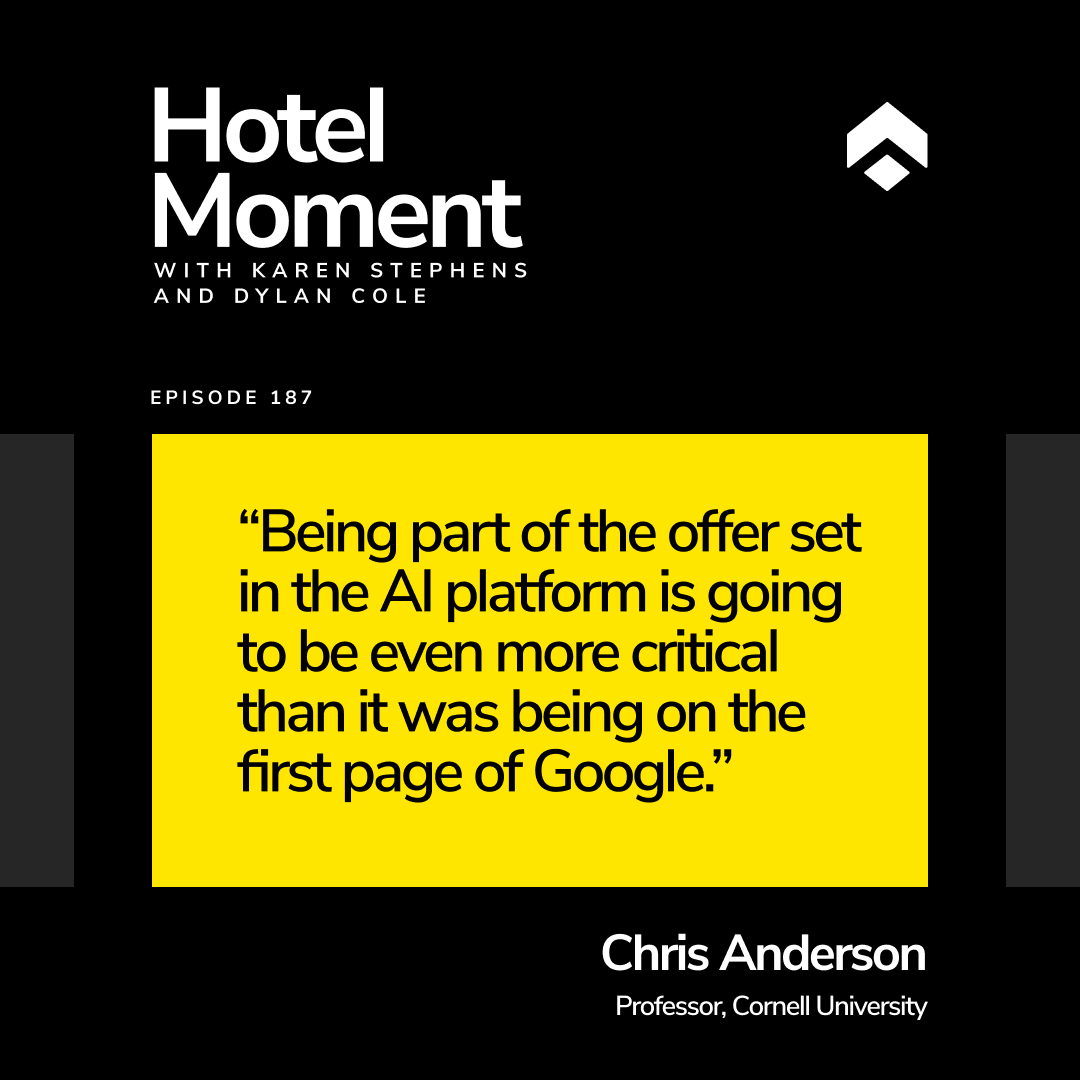
More important than page one on Google
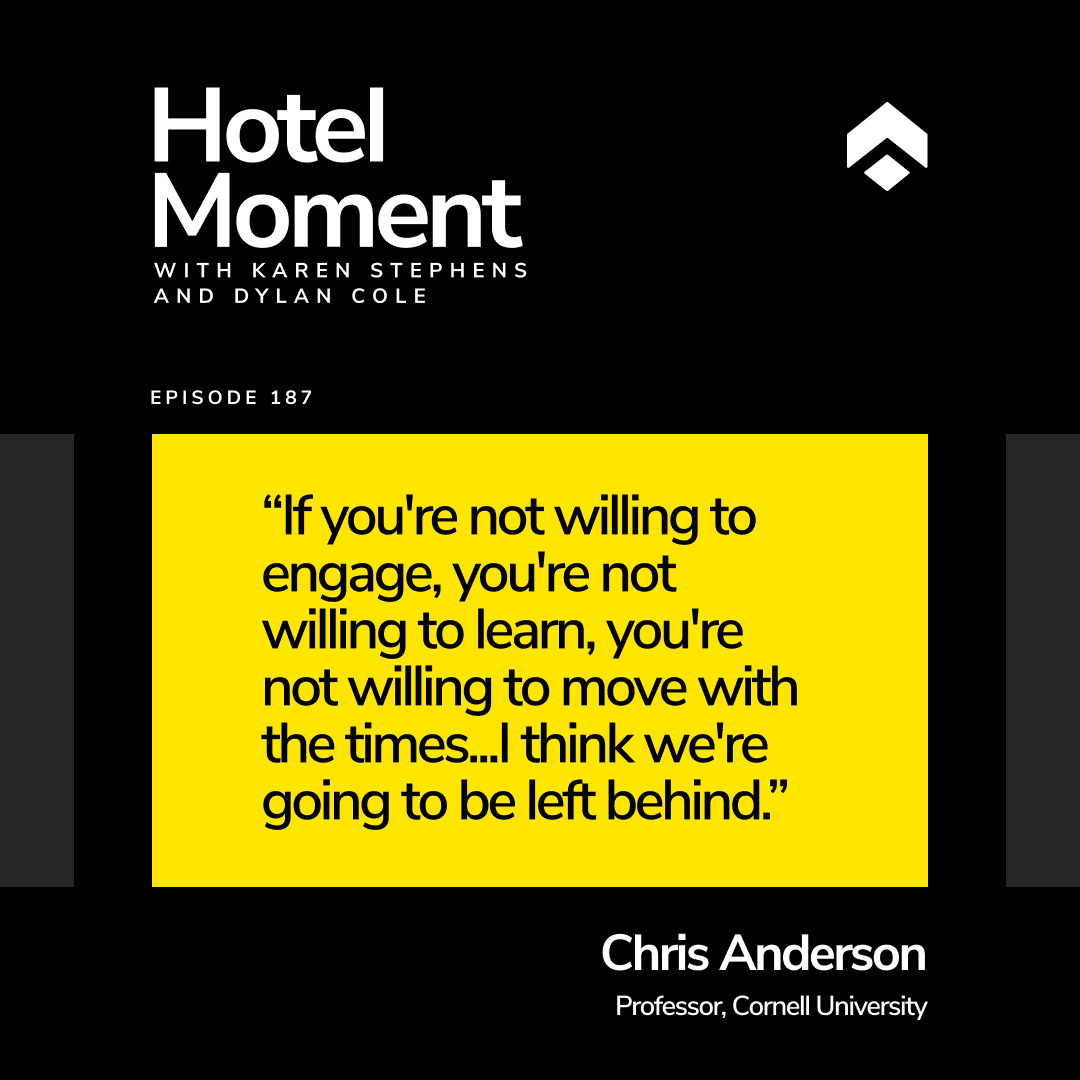
Adapt to AI or get left behind

Guests will forgive you for trying new things

Meet your host
Karen Stephens
As Chief Marketing Officer at Revinate, Karen is focused on driving long-term growth by building Revinate’s brand equity, product marketing, and customer acquisition strategies. Her deep connections with hospitality industry leaders play a key role in crafting strategic partnerships. Karen has more than 25 years of expertise in global hospitality technology and online distribution — including managing global accounts in travel and hospitality organizations such as Travelocity and lastminute.com
As the host of The Hotel Moment podcast, she interviews top players in the hospitality industry. Karen has been with Revinate for over 11 years, leading our global GTM teams. Her most recent transition was from Chief Revenue Officer, where she led the team in their highest booking quarter to date in Q4 2023.
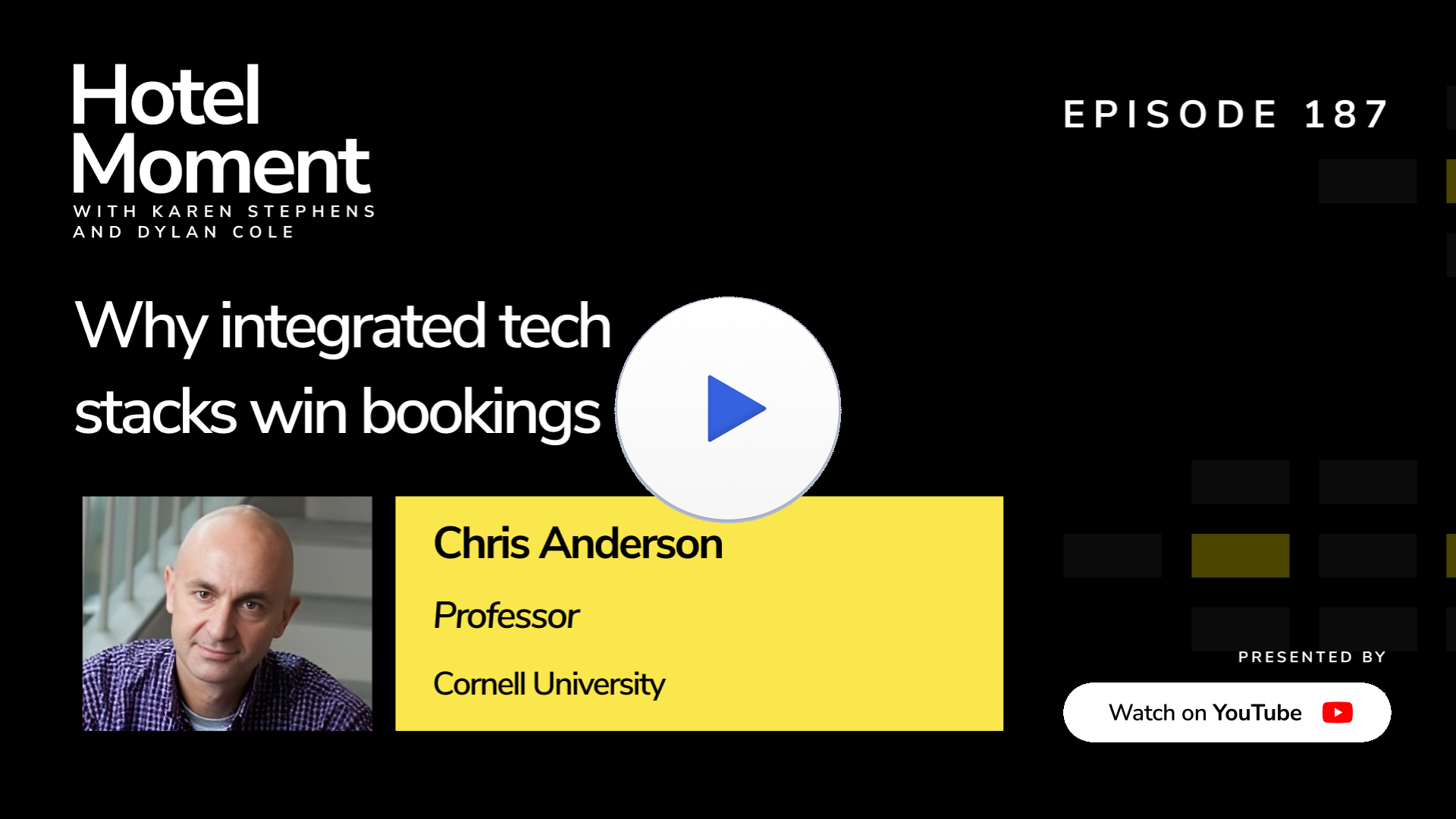
Watch the video
Transcript
[00:00:00] Chris Anderson: Once they decide what the model is, then I’ll sort of get in line. That’s not going to work here, right? You really gotta be learning as you go and adapting and test and learn, just be willing to sort of spend resources to keep abreast of this change because it is going to be very different.
[00:00:19] Karen Stephens: Welcome to the Hotel Moment Podcast presented by Revinate. I’m Karen Stephens, Chief Marketing Officer, joining you from sunny San Francisco, California.
[00:00:27] Dylan Cole: And I’m Dylan Cole, Managing Director of Revinate Europe, calling in from Amsterdam.
[00:00:32] Karen Stephens: This is the podcast where we explore how technology shapes every moment of the hotelier’s experience. And more importantly, how the right technology delivers real outcomes for hotel teams and guests alike.
[00:00:42] Dylan Cole: From revenue strategy and guest communication to operations and marketing, we sit down with the people transforming hospitality around the world.
[00:00:51] Karen Stephens: Depending on the conversation, sometimes it’ll just be me behind the mic.
[00:00:54] Dylan Cole: And sometimes it’ll be me, bringing a European perspective and stories from across the global hospitality industry.
[00:01:01] Karen Stephens: Whether you’re a hotelier, a tech enthusiast, or just curious about where hospitality is headed.
[00:01:06] Dylan Cole: You’re in the right place. Let’s get into it.
[00:01:09] Karen Stephens: Hello and welcome to the Hotel Moment Podcast. I am your host, Karen Stephens, the Chief Marketing Officer of Revinate. And today we’re excited to welcome Chris Anderson, professor at Cornell University’s School of Hotel Administration, and a leading expert on revenue management, pricing, distribution, and commercial strategy. Over the last two decades, Chris has worked with hotels, airlines, and technology companies around the world, helping shape how the industry thinks about revenue optimization. Today we’ll explore how revenue management is evolving in the age of AI, what algorithms are really changing inside hotel commercial strategy, and why the next revenue revolution may be much bigger than pricing alone. So without further ado, Chris Anderson, welcome to the podcast.
[00:01:53] Chris Anderson: Thanks. My pleasure for being here.
[00:01:55] Karen Stephens: So Chris, you’ve spent years studying how pricing, distribution, and revenue management shape the hospitality industry. What originally drew you into revenue management? And did you realize at the time how dramatically the field would evolve?
[00:02:09] Chris Anderson: Yeah, you know, I mean it’s fascinating. I started really in revenue management back in kind of the mid-90s. And at that point in time, I was really working on airline pricing models—and really not pricing models. We were really working on, okay, the prices are for the most part kind of fixed by product class. And then we were basically doing pretty straightforward optimization to figure out, okay, if I’ve got 12 different fares on this route as a function of time and seats remaining, when should I close out the lower priced ones? So pretty straightforward. Back in the nineties, we were still in the early days of the internet. A lot of people were still buying tickets through travel agents or offline. So customers didn’t have full knowledge of prices or competitor prices. And as a function of that, they tend to sort of, if they wanted lower prices, they bought early. If the price kind of met their needs, they purchased. And for the most part, we looked at a firm as a monopolist. By that I mean we weren’t necessarily cognizant of what the other airlines were doing. We were really focused on our prices, our inventory, and our routes. And so it was, for the most part, a complicated optimization problem, especially as airlines added hub-and-spoke networks where now they would bring in connecting traffic to larger airlines and then ship people out on bigger planes. And then fast forward maybe about eight years and when I came to Cornell and I really started to focus more on the lodging side and less on the airline side. And then once we’re into sort of the 2000s window, all of a sudden online travel agents are much more popular, the internet is more pervasive in travel shopping, and all of a sudden competition is everywhere. And so it was a completely different puzzle kind of between 2000 and 2010, right? It was just a really exciting switch from, kind of a very simple kind of monopolist framework to a much more competitive framework we see today in hotels.
[00:04:22] Karen Stephens: Absolutely. I think that’s a great point because even if you look at the hotels thinking about competition back in the day, you would just be looking at your comp set within your city, who’s down the street. And now you’re really competing for that customer that’s searching on the internet for a vacation just about anywhere. But I’d love to go back to the pricing algorithm thing. So obviously airlines, as you said back in the day, and I think they were always the first movers. Like today I would love to just understand as a consumer — I understand if I’m like logging in with a certain IP address, I might be looking at a different price than somebody logging in somewhere else. So can you talk a little bit about the airlines? But then how is that transferring over to hotels? And what should hotel companies be thinking about?
[00:05:03] Chris Anderson: So for starters, there’s almost no price customization. So you mentioned like logging in with one IP address versus another. And at some level, we’re very fortunate because right now, both through the New York State Assembly and Senate, there’s a whole new bill focused on what we call surveillance pricing, which is about price customization where Chris and Karen are looking for the same thing at the same point in time, and we might get different prices, right? That is probably in the very near future going to be against the law. It’s fine for firms to, we’ll call it, actively price or dynamically price where they’re adjusting prices to market conditions, available inventory, all these factors that are driving demand. So dynamic pricing is very pervasive and firms are active pricers. But for Chris and Karen to get different prices solely based on their willingness to pay, that, historically, firms have not really done a really good job of that. And I think we’re fortunate because now we’re basically going to be precluded from doing that.
[00:06:16] Karen Stephens: So that’s interesting. So I think it’s always been something that people have kind of not aspired to, but you dream about being able to oh, if I know that Chris is on my site and he likes certain things, I can maybe price the packaging out. Never really did it well. Now with AI, we actually might have a shot at it, but regulatory — which I think is a good thing, frankly. I mean, I think that guests want to give over data so they can personalize an experience, but I certainly don’t want my data to be used against me to pay higher prices. Right?
[00:06:44] Chris Anderson: Right. And I think the real cool thing that’s in front of us now is the assortment part. So historically, we’ve had to spend countless hours finding what we’re looking for, right? So I did lots of work in the last sort of ten or fifteen years about how people search online to discover travel, all the travel sites they go to, all the websites they visit. So I think over the last ten or twenty years, consumers have had to exert a lot of effort to make sure they were getting good value and they were going to a real cool place that sort of satisfied their needs because platforms and suppliers weren’t really doing a good job of kind of narrowing the choice set to what a consumer was looking for. To me, that’s all gonna change with AI because now I’m in my chatbot and I’m talking away and maybe I’m doing stuff for work and looking for clothes for my kids or whatever that might be in my chatbot. So my chatbot knows me really, really well, basically now that most of today’s models have reasonable memory to remember about Chris. And so now when I’m in that chatbot looking for travel, it knows who I am. And then also I don’t just say ‘pet-friendly hotel in Ithaca’. I just write a novel. So I’m sort of saying this is everything I’m looking for. And so I’ve expressed intent into the AI model. And so now that the model knows what I’m looking for and knows who I am, then it can do a really good job of curating that choice set — so not changing the price for me versus somebody else, but getting rid of all the fluff that I’m really not interested in and narrowing down on that choice set. So I think we’re going to see customization not in price, but in offer set.
[00:08:35] Karen Stephens: So we have this conversation a lot with hoteliers and I’d love to get your take. So we know that the chatbots are doing a great job, as you mentioned, with individuals to understand who I am, what I like. What can hoteliers do to make sure that they’re in that consideration set? What are your thoughts on how we meet the chatbot where it needs to be, depending on where I am as a hotelier?
[00:08:56] Chris Anderson: Yeah. So first and foremost, you’ve got to be reading a lot because if I would have answered this question a year ago, I would have given you a very different answer than the answer I’m going to give you a year from today. So things are really changing really quickly. And so for starters, there’s no like silver bullet that’s going to work today, tomorrow, and the next day, right? You’re gonna have to keep on top of how technology is changing and how we are using that technology. But at some level, search results on AI are going to be fundamentally similar to search results from Google, Yahoo, or Bing given that you’ve properly designed your web architecture to sort of include that kind of information. So basically we’re not going to reinvent the wheel, we’ll just refocus, all right, and polish up the wheel that we’re using for that. But there is this need to get connectivity. So basically the biggest difference here is connectivity to AI models and how that’s going to sort of happen. You know, I think unfortunately for most hotels, online travel agents are going to have a leg up on this than smaller independents. Brands, will do a good job of getting connectivity and making sure that that information is available to AI chatbots. The real tricky part here is that the monetization model is very different. So for the last couple of decades, we’ve relied on search. Google has indexed the world and does a really good job of matching my keyword search to how it’s indexed the internet and it does that really, really quickly, really, really efficiently. And so because of that, it can return a lot of results really quickly. We’ve probably heard a lot about AI and data centers, that cost impact on the grid. So AI is much more power-intensive than regular search. And it’s obviously getting more efficient than it used to be, but there still is energy consumption as a result of your prompt. And because of that, what the prompt returns is going to be finite. And so it’s not going to be as exhaustive as would have been easy to sort of scroll down on Google. So that really means being part of the offer set in the AI platform is going to be even more critical than it was being on the first page of Google. So without a doubt, you will be able to pay for position, pay for placement, pay for eyeballs, right? So all these platforms, we’ve seen them everywhere, whether it’s online travel agents, whether it’s search, whether it’s social, right? So that’s still gonna happen in AI. What the monetization mechanics are, we’re still working through that.
[00:11:58] Karen Stephens: I can say as a technology company leveraging AI for, we have different platforms and tools, but it’s really hard. It’s interesting to try and price that for a customer because our prices are moving up and down all the time, the way that we’re being charged. And so hoteliers are used to and love — and they have the right to — steady pricing. This is how much it’s gonna cost me for the year, it goes into my budget. As you start to leverage some of these tools, your vendors don’t even know what’s going on. So it’s a very interesting playing field. And then one other thing I just want to hit on, if you’re a hotelier, I think you’re right that OTAs, aggregators, they’re all going to have a leg up because it’s something that a model can use. So you do have to make sure you get your data straight. And then going back to the very beginning of Revinate, we just turned 17 years old and our first product was reputation, online reputation management. Nobody ever talked about that for years. It was kinda like, yeah, whatever. And now it’s like, oh my gosh, everywhere that you appear on the internet you have to make sure your content is accurate, that it has all the details so that wherever they’re pulling this data from, you are in the consideration set.
[00:13:02] Chris Anderson: Yeah, I mean what’s really fundamentally different here is AI likes to avoid hallucinations and likes to avoid being wrong. And so that means it relies increasingly more on verified, validated content. And so in the early days of SEO, we used to talk about links, right? So when other websites link to your website, that’s like a thumbs up from the interwebs. I think all that is now amplified even more when we think about AI because AI is going to look for like this validated content that confirms that it’s factual and right and honest, and we just can’t make stuff up. Because it’s on your website doesn’t necessarily mean it’s sort of the best source. So things like reviews and engaging with those and online reputation, we’re gonna get right back into that space again, right? It’s no longer a pet-friendly hotel. What’s the best hotel for a night out where there’s childcare? All these kind of things that were hard to match in our old days of search, but now these are fundamental amenities and attributes that I can ask for in the AI world. And so I mean the upside of that is for hotels, these are all going to be at some level things that you can use that can be monetized easier. ‘Cause it’s gonna be easier to get a sense of what are features and amenities that people are looking for. So again, like all this sort of technological change, it’s like so much fun because it’s just a really great opportunity for those who are willing to engage and learn. If you’re not willing to engage, you’re not willing to learn, you’re not willing to move with the times, then, I mean, I think we’re gonna be left behind that much quicker than we were with the WWW world, right? So I think if there’s anything we’ve learned is you’ve got to move with the times. And I think unfortunately with AI, the times are moving and changing very quickly, but that doesn’t mean you just can’t wait until something gets sort of, you know, all right, I’m gonna wait until it all kind of washes out and what’s the end product, right? Once they decide what the model is, then I’ll sort of get in line. That’s not gonna work here, right? You really gotta be learning as you go and adapting and test and learn, just be willing to sort of spend resources to keep abreast of this change, because it is going to be very different.
[00:15:33] Karen Stephens: Very different. You think about different technology adoptions. We always used to talk about the early adopters and then there’s the next round. So you could, to your point, in the past, you could kind of wait and see. You could see those early adopters do what they do and then we’ll come in later. And now as we talk about it’s moving so quickly and nobody really knows what the answer is. There is no answer. It’s constantly evolving. So if we step back and think about revenue management, let’s just take one of the roles. Basically, if you think about commercial strategy, you’ve got revenue, you’ve got sales, you’ve got marketing. Let’s just look at revenue management, which I think some people could argue, hey, that’s a target for AI, pricing automation, understanding all this stuff. How do you see that role really evolving or where we are now anyway?
[00:16:15] Chris Anderson: Yeah, so at some level the impact of AI on revenue management as a core discipline is really going to be much less than how AI is going to impact other aspects of commercial, largely because we’ve been using machine learning and the fundamentals of today’s AI models to do pricing for years slash decades. In the RM world, we were just working on numbers and we were using the same kind of machinery that we have today. It’s just that today’s machinery is really good at working on non-numbers. It’s working on text and images and voice. So at some level, when we think about all this change, I think where revenue management is going to change is that, you know, we’re going to be able to do more of that marketing stuff in more real time and tap into customers’ kind of preferences in real time much more so than we have historically. So this idea of customization and assortment sort of offerings, those are, I think, revenue management is going to get much broader as sort of a discipline because we’re going to be able to pull in a lot of, kind of the non-number part that we haven’t been doing historically. And then we layer in the ability of generative AI to help us with things like automation so we can just do it quicker at scale. And so the actual mechanics of pricing are not necessarily going to change, but the information, the speed at which things I integrate, that is all going to sort of make pricing sort of a little more scientific, I would say.
[00:18:00] Karen Stephens: I think it comes back to if you talk about data, it’s really deeply understanding who your guests are and you have the ability to do that now more than ever—really deeply understanding why they buy your hotel. Right? To your point, it’s more than just the pricing. It’s more than just the room. Now we look at TRevPAR, like everything, right? What are the amenities? Where are you sitting in a city? And what is cool about that? So that’s a really interesting kind of take on how it evolves.
[00:18:26] Chris Anderson: Yeah. There’s nothing more frustrating than being like a loyal sort of brand XYZ customer and that you’ve stayed hundreds slash thousands of nights with the brand and the first thing they say to you is, “Welcome, Mr. Anderson. Have you ever stayed with us before?” Right? I’m going like, “You should be telling me that,” right? And I think historically it’s been complicated because there’s like Chris Anderson, there’s Christopher Anderson, there’s C. Anderson. Sometimes my wife makes the reservation, so I’m just another additional member. Sometimes I use my Gmail. Sometimes I use my work email. So there’s all these ways that Chris Anderson is known to brands. And that’s one of these things that’s been hard for hotels to sort of get their stack around, but generative AI is great at that question. So it’s super easy to sort of put internal-facing tools on top of legacy data structures that can answer questions really, really easily. So maybe not to automate the price offerings to Chris, but really easy for front desk agents to know more about Chris that I can’t necessarily get from a simple look in that property system. So I think to me that’s the exciting part is when we think about the data and how we use and collect and aggregate data, the speed at which we do that is just going to be so much faster than what we’ve done historically. Now, that said, the early adopters may face some hurdles. We’ve probably all experienced an AI chatbot or an AI sort of text messaging system that, oh, this is cool, they’re like using AI to respond to me, but it’s still really, really clunky. But I think today’s consumer is much more accepting of you as a brand, you as a firm, trying things out and realizing that it is a bit clunky. So, I mean, I have massive tolerance when I engage with like electronic communication with firms because I just think it’s them trying to figure it out. It’s fast-moving, you gotta move with the times.
[00:20:37] Karen Stephens: You absolutely do. I think you hit on it, but one of the key core issues of hospitality is data silos — legacy systems that all have data silos. And so our kind of ethos at Revinate is getting identity resolution right at the base layer of your data so that AI can actually access that data and use it. So you don’t have hallucinations because it’s horrible when someone doesn’t recognize you at the front desk. It’s worse if they think you’re somebody you’re not or you act on that. But it’s all coming together so quickly, it’s really interesting.
[00:21:09] Chris Anderson: Yeah, historically our space has been like this best-of-breed model. So I’ve got all these different things, and I’m just going to pick the best PMS, I’m going to pick the best CRS, I’m going to pick the best RMS. And I think in today’s world, we’re starting to recognize that kind of the gains don’t come from the best at something. They come from getting something talking and integrated with everything else. And so I think we’re probably going to, as an industry, be much more open to having kind of a complete stack as a solution, even though each piece of the stack is kind of mediocre. So no longer needing to sort of be the best at this sort of thing, as long as it’s functional. If I’m functional across the whole stack, then I become really great at engaging with that customer. And we see that with a lot of the firms out there just acquiring pieces and buying lots of different parts of the stack so they can sort of have a whole enchilada offering to hoteliers. So we are gonna see, I think, some big changes in the tech stack for hotels.
[00:22:23] Karen Stephens: One hundred percent. Because it has to work together. Whether you do that all with one vendor or the vendors agree to work with one another, but APIs and being able to synthesize that data is, you know, that’s what you have to do. So I’d love to talk to you a little bit about distribution. So if you were starting a hotel company from scratch today, how would you think about OTAs, Google — like if you were starting from the baseline? Brand new, any tech stack you want.
[00:22:49] Chris Anderson: That’s a great question. I think at the end of the day, I think as hoteliers, we tend to sort of talk about the costs of these things versus thinking about where are the consumers. So I think you have to sort of start, okay, where is the consumer? Where are they going to go in the face of these changes to technology? And then how do you make sure that you’re competitive in that location? And so we used to design a website and get a channel manager and connect to all these different places. So we worried about connectivity first. So part of it is really understanding who is your consumer and where are they at, and then from there backing into distribution. It’s really hard to be everywhere for everyone. And when I say hard, I mean expensive. At the same time, it’s a tough slog to sort of not be part of, sort of the platform ecosystem. So the days of just thinking that everything’s going to be direct and I can sort of pick and choose how I use platforms, I think that’s going to increasingly be less the case. And then you need to think about, all right, so eventually consumers are even going to be lazier. And by that I mean they’re just going to talk to devices. They’re going to talk to their platform. And that agent is basically going to talk to other agents. So we have to sort of realize that today we’ve had like the consumer at Expedia engaging with that platform. But now we’re going to basically get Chris engaging with his piece of technology, talking about his trip that he’s planning, and then that agent is going to talk to probably other platform agents. We do see some of the platforms doing a good job of putting agents on their websites. So to me, an agent is different than a trip planner. So people think about trip planners and AI trip planners as kind of where things are going, and I don’t think that’s the case. I do think what we’re gonna have is an agent where the agent is basically interacting. And so I think if you look at a great example, it’s when Priceline launched Penny on Priceline.com. Penny, obviously built on years of brand equity starting with William Shatner and then into Penny as they transitioned their spokesperson, but now you’ve got an agent that’s kind of just learning how to sort of connect with inventory. And it’s kind of clunky for trip planning, but it’s really getting ready for that agent to interact with other agents. And that’s again just learning. And so to me, that’s kind of cool to think about how to do that. Obviously, other firms are putting semantic search on their websites to make search easier. That’s a great interim solution as we kind of learn how people go through the back and forth of finding what they’re looking for. Obviously semantic search at some stage is also going to go away because it’ll just be an agent that’s doing that. But these are all things that brands and firms, platforms need to do to learn the mechanics of helping somebody find what they’re looking for.
[00:26:11] Karen Stephens: Absolutely. All right, a final question for you. So on a personal level, when you look at the future of hospitality, pricing, distribution, commercial strategy, all of it — what excites you most about where the industry is heading?
[00:26:24] Chris Anderson: Oh, you know, to me it’s just like I said, in the nineties I was really an airline and rental car person, right? The arithmetic was straightforward, the monopolistic nature of those industries was fairly easy. And so it matched really well with my training as a math professional. I think today everything is so integrated, so different. This marketing is as important as pricing; having the right price really doesn’t do you any good unless you’re sort of getting in front of the people at the right time. And so for me, everything, it’s just the fact that it’s so different today and will be so different tomorrow that, you know, part of this is because I’m an academic, I’m always learning. And so I think that’s what’s really so exciting here is that I’m gonna be teaching myself different new things next year and then the year after that. And so we’re at this sort of breakneck pace and so you’re never gonna be bored in this space. To me it’s just a really great space to be in. And if you’re bored, it’s just because you’re not sort of inquisitive enough, because there’s just so much to sort of play around with and do.
[00:27:38] Karen Stephens: I love it. Exciting times. Well, thank you, Chris. It’s been a real pleasure. Thank you for joining me today.
[00:27:43] Chris Anderson: My pleasure.
[00:27:48] Outro: Thank you for joining us on this episode of Hotel Moment by Revinate. Our community of hoteliers is growing every week, and each guest we speak to is tackling industry challenges with the innovation and flexibility that our industry demands. If you enjoyed today’s episode, don’t forget to subscribe, rate, and leave a review. And if you’re listening on YouTube, please like the video and subscribe for more content. For more information, head to revinate.com/hotelmomentpodcast. Until next time, keep innovating.
Episodes
Hotel Moment
WITH KAREN STEPHENS
Subscribe for updates on your favorite platform