Hotel Moment
WITH KAREN STEPHENS


Episode 174
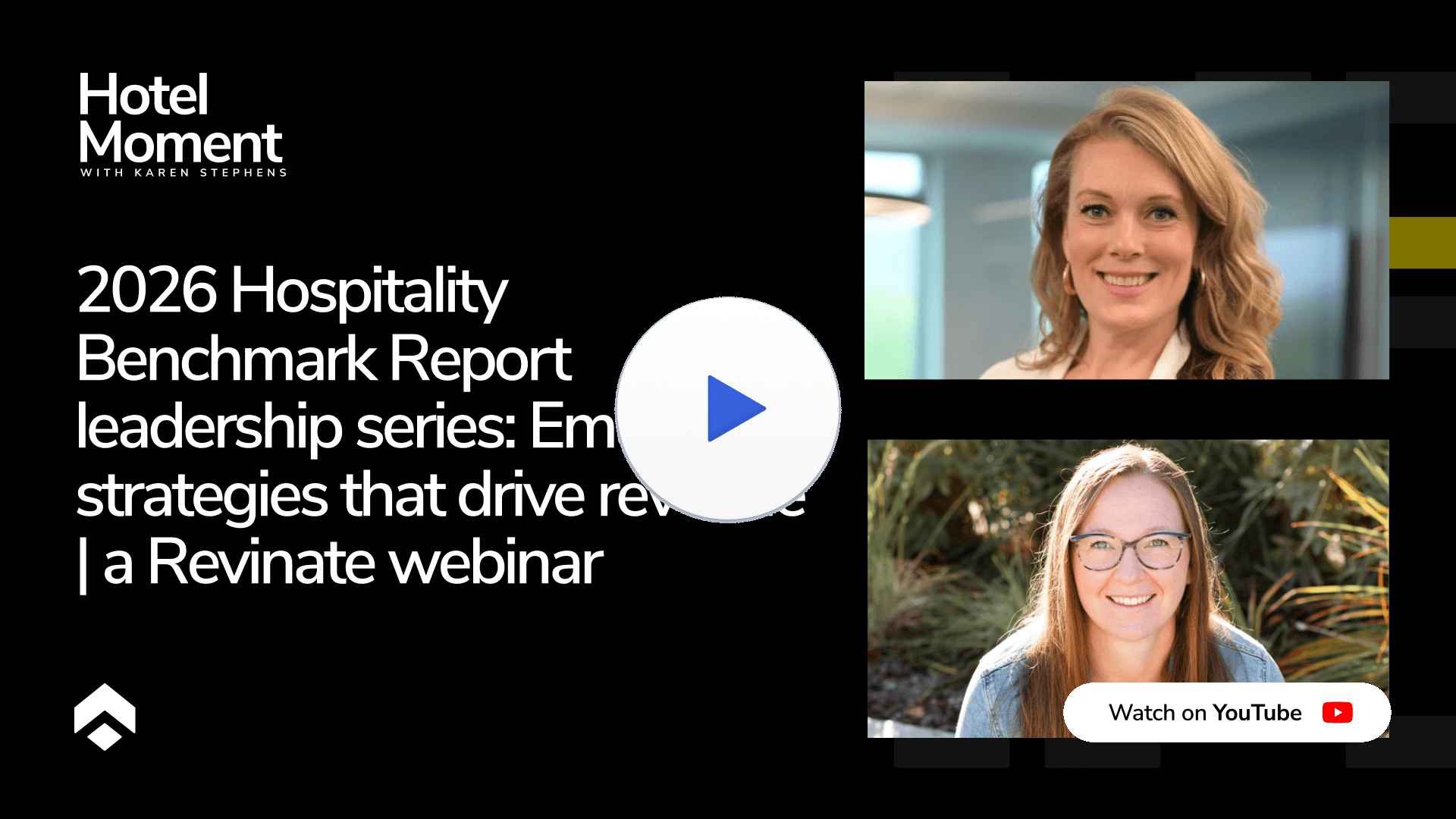
2026 Hospitality Benchmark Report leadership series: Email strategies that drive revenue | a Revinate webinar
Are your emails driving revenue or adding noise?
Hotels using targeted campaigns see dramatically higher conversions, while generic sends can perform up to 10x worse. Because if your message fits everyone, it converts no one.
In this episode of Hotel Moment, we’re featuring a webinar from our 2026 Hospitality Benchmark Report leadership series — revealing why mass email blasts are falling short and what’s replacing them. From cart abandonment emails to behavior-based targeting, the most effective campaigns reach the right guest at the right moment, without manual effort.
Stop guessing. Your data already knows what works. The hotels winning in 2026 are the ones using data to increase direct bookings and stand out in crowded inboxes.
Listen now to start turning emails into revenue.
Media
Automate when it matters
Avoid noise
Every channel deserves clean data
Listen to your guests

Meet your host
Karen Stephens
As Chief Marketing Officer at Revinate, Karen is focused on driving long-term growth by building Revinate’s brand equity, product marketing, and customer acquisition strategies. Her deep connections with hospitality industry leaders play a key role in crafting strategic partnerships. Karen has more than 25 years of expertise in global hospitality technology and online distribution — including managing global accounts in travel and hospitality organizations such as Travelocity and lastminute.com
As the host of The Hotel Moment podcast, she interviews top players in the hospitality industry. Karen has been with Revinate for over 11 years, leading our global GTM teams. Her most recent transition was from Chief Revenue Officer, where she led the team in their highest booking quarter to date in Q4 2023.
Watch the video
Transcript
[00:00:00] Bailey Yeats: One thing that we have learned and you, over many years, have learned over marketing is that your data is useless if it is just sitting still. The most successful North American hoteliers are continuing to move away from that e-blasting behavior and they’re moving towards hyper-personalization and segmentation. And they’re finding that it’s giving them the higher conversion rates.
[00:00:29] Intro: Welcome to the Hotel Moment Podcast, presented by Revinate, the podcast where we discuss how hotel technology shapes every moment of the hotelier’s experience. Tune in for our guest episodes, where we explore the cutting-edge technology transforming the hospitality industry and hear from experts and visionaries shaping the future of guest experiences. Alongside our conversations with guests, we have episodes for you, hosted by Revinator Brenna Turpin, on resources available to you all. These resource-packed episodes have granular advice on overcoming industry and operational challenges so you can emerge as a hotel superhero. Whether you’re a hotelier or a tech enthusiast, you’re in the right place. Let’s dive in and discover how we can elevate hospitality together.
[00:01:15] Bailey Yeats: Hello everyone and welcome. We are back for another Hotel Moment deep dive. Today is all about the 2026 Hospitality Benchmark Report Leadership Series. Now, what this series is, is a series of webinars that we are hosting for hoteliers just like you. And the focus for today is the email channel. We do have upcoming, the guest database, as well as the voice channel, but for today it is all about email. Specifically, we’re going to be uncovering the most important email metrics to be tracked, offering you different strategies of how to improve your email marketing performance this year so that this year is even better than last year. So my name is Bailey Yeats and I am a marketing manager here at Revinate. Joining me today is our industry leader for the email channel and all things digital marketing, Christine Malfair. Christine, you and I have crossed paths so many times over the last few years, few, ten, fifteen years. You know, the insights that you bring to the hospitality marketing industry has been so invaluable to myself and to others in the industry itself. I always enjoy reading your LinkedIn posts. They’re always so funny and insightful. And I really enjoy hearing what you have to say about topics. My favorite topic that you talk about is really the ultimate battle to win that market share back over the OTAs. So I love it. Keep it going. It’s always great to hear from you. So thank you for being here and welcome.
[00:02:40] Christine Malfair: Thank you, Bailey. Thanks for the invite.
[00:02:42] Bailey Yeats: Yeah, of course. So on the agenda, we are going to be going through some introductions first off, and then we’re going to be digging into that report, the 2026 Hospitality Benchmark Report. Then we’re going to go through our email metrics that really matter to hoteliers just like you. And lastly, of course, we’re going to provide you with the strategies to move the meter to become better marketers in your email marketing. So to kick it off, Christine, I would love to hear a little bit from you. Tell us a little bit about yourself and your business.
[00:03:19] Christine Malfair: Thank you, Bailey. Yeah, my name’s Christine Malfair. I started Malfair Marketing in 2010 after being a hotel GM myself for — I think it was 10 years, nine years. So it’s interesting coming in from both sides and I haven’t really removed my general manager’s hat, I guess you could say. Very much still approach marketing from the lens of what actually works for operations, which is why I mostly work with independent hotels. So I help independent hotels with all things marketing and more recently with AI strategies and marketing systems.
[00:03:52] Bailey Yeats: Amazing. Well, I am so excited to have you here today. Like I said, I love learning more from you, chatting with you, and the conversations are always so valuable. So thank you for joining us. All right, here it is. It is the 2026 Hospitality Benchmark Report. It’s landed. It’s potentially already in your inbox if you signed up for it. And if you are managing any sort of revenue, guest experience, digital performance — any of the above for a hotel — this is really mission critical intelligence for you and your colleagues. And for 11 years, Revinate’s been publishing this report to help hoteliers benchmark their performance. You know, either looking for their revenue opportunities, they’re looking to make strategic decisions based on real behavior and not just a survey that you might put out. So this edition is actually our most comprehensive one yet, which is super cool, and I’m excited to be discussing it today. This year, we actually analyzed 2.8 billion emails, 4.3 million phone calls, 22 million text messages, and 28 million guest reviews globally throughout 2025. That is a lot of communication channels and that is a lot of data to be digging into. But what it did was it gave us industry insights on, you know, guest communications, database quality, engagement rates, review responses, revenue per contact, and even your ratings by property size. So all of this data that we cover in all of the communication channels and data considerations — you know, we have the ability now to dig into email, voice, web capture, and database health. If you have not had a chance to download this report and you’re following along with us today, I would encourage you right now, before we really get into the numbers, go ahead and scan that QR code or head over to our website and find the Hospitality Benchmark Report and follow along with us as we go through this because you’re going to want to see the data in real time as we look through our reports and as you look through the reports in your own software tools. Christine, if there is one thing that we have learned and you many years have learned over marketing is that your data is very useless if it is just sitting still. If you are not actioning that data. And you know what we found is that the most successful North American hoteliers are continuing to move away from that e-blasting behavior and they’re moving towards hyper-personalization and segmentation. And they’re finding that it’s giving them the higher conversion rates. So we’re going to start with those conversion rates, and then we’ll dive into things like segment sizes, email types, you know, the metrics, upsells, and other things that are driving the return on investment for improvement in 2026. Our first chart here is our one-time campaigns in North America. So I would say this is probably one of the most common questions that we’re asked is, you know, what should my open rate be? What should my click-through rate be? And we’re going to highlight today a couple of different campaign types, but I would say newsletters and room offers are probably the most prominent types of campaigns that we see being used. Wouldn’t you agree with that, Christine, for your clients? Yes. And so newsletters with a 33.8% open rate, 2% click-through rate, and 0.1% conversion rate — those are pretty big numbers. When you consider 33.8% open, that’s — it’s huge. Room offers, 28.7%. So I guess the big question is, what does this mean to hoteliers? What we find is that marketing teams are telling us they’re using these metrics as KPIs to track how their revenue marketing efforts are performing. They’re measuring against their effectiveness of one-time campaigns from the initial engagement all the way through to the final booking. And so what makes this impactful for hoteliers? The email rates, the open rates, the click-through rates — these statistics are commonly used as industry benchmarks and they evaluate overall success for a lot of owners and GMs and leaders in general. So Christine, tell us a little bit about the marketing metrics like open, clicks, and conversion rates and what they mean for your team. How does it inform them of the next right move in their jobs?
[00:08:18] Christine Malfair: Yeah, solid question. But just one step back, tiny step back — is like right now with AI search, there are so many metrics that are changing, especially where the website is concerned. But email is really not changing in that way. And so we’re able to stay true to looking at the benchmark report as those are really the lighthouses that you’re aiming for. So when you think about your open rates, mostly everybody knows that’s an indicator of: did you deliver value in that one subject line? And that subject line — I heard it said, I think it was by David Ogilvy — if you had a dollar to spend, 80 cents of that dollar should be spent on the headline. And that is true for — that’s your subject line in your email. So when you think about everything that’s in everybody’s inboxes and everybody’s going after email, you know, as a capture, as data has become so important, as the direct guest relationship — how do we have that directly with all of our guests? — that’s even more important. So subject lines were once like important and now they’re like hyper important. Like you really spend a lot of time thinking about your subject lines. They’re not necessarily an afterthought. And then when you’re thinking about click-through rates, that is validating how valuable your content is. How valuable does it resonate with the people? Are they actually moved to take action? And then conversions — that really says, did the email do the job? Did it do the job? Did it achieve the outcome?
[00:09:53] Bailey Yeats: Yeah, that’s exactly it. And, you know, these strategies in general to improve those overall open, click, and conversion rates are really the gold in how you move that meter when we look at the benchmark report, right? You look at your performance and you see, oh man, my performance is very poor when it comes to my click-through rates. What is it that I need to do? They’re opening the email, but they’re not actually doing anything with that content. So as you said, the open rates are typically determined by — first of all, is the sender name who I signed up for? We can take this all the way back to deliverability and look at whether or not they actually have signed up to receive your emails. The subject line, the preview text even, is really important. And I think it’s often overlooked because people don’t necessarily understand where that preview text sits. And so when you look at an inbox, you see sender name, subject line, and then preview text. And oftentimes people won’t add that preview text in, and then it pulls up the first text from their email into their preview, right? Yeah. And that can be the “view in browser” as their preview text. So small opportunities like that, I think, will really help to improve those open rates. Looking at click-through rates — as you said, what’s the content of your email? Is this something that your users or your recipients are excited about? Is the layout good? Is the offer or the call to action button — are they any good? What do you find with the higher performing campaigns that you send in regards to click-through rates? What is it that people are looking at for your types of customers?
[00:11:33] Christine Malfair: Well, everybody loves a good promotion, but they really — one of my rules, I guess I could say — is like, it always needs to be about them. And you’ve heard me say this before, Bailey, like, it’s about that “what’s in it for me” thing. And people want to be rewarded for their time and they don’t want their time wasted. And so getting them to take action really has to be high value. So I love to geek out a little bit on calls to action. That’s your little button. And buttons perform better than text — have you seen that as well? So consistency in terms of — like just put an action word on that button, tell them what they’re gonna get, tell them what’s next after you click this thing.
[00:12:16] Bailey Yeats: And yeah, something that’s very important to you is what happens next — that comes into the conversion rate. So if you’re asking them to check your rates and it takes you to their restaurant page or to a different location, this is a problem, right? We want to make sure that there’s no friction in between that button and the actual booking process, making sure that it lands where they would expect that button to land. So something else that I want to highlight is A/B testing. Now I personally love A/B testing. I think it is such a valuable tool. Something that I have been challenging more and more people to test out with A/B testing has been something like a dollar figure versus a percentage, right? Are they getting $50 off their stay or are they getting a percentage off their stay? And you can A/B test that in Revinate Marketing, and then you can determine — looks like this specific segment, this database, says that a percentage off is more valuable to them than a dollar figure.
[00:13:21] Christine Malfair: Yeah. Step one of A/B testing is to make sure that you’ve actually got an A and a B — like an apple and an orange, not two oranges that are slight variations of orange. Yeah. If that makes sense, right?
[00:13:34] Bailey Yeats: Yeah. Make sure there’s a difference. And the other part is we’re not sending out an entirely different campaign. We’re sending out a campaign with a different button — not an entirely different offer — because then you actually don’t know what you’re testing. And that’s not very helpful either. Okay, so before we move on from these open, click, and conversion metrics, are there any times that you have had sort of a flop with any of your content that you’ve released or that your team has released, and or maybe even that, you know, a hotel that you’re working with has said, this is what we want to do, and it was a big flop. Have you had this happen? Have we figured out what it was that made it flop?
[00:14:16] Christine Malfair: There is one that comes to mind as you ask. And it was a test. It was, let’s see what happens. I mean, when you start a marketing experiment in a way — like marketing is testing all the time. You don’t test for the sake of testing, you test a hypothesis, an assumption that you make. If you remember back to science class, it’s kind of that, but more fun. So you have this thing that you’re thinking, I wonder what would happen if. And so in this case, what I did was I resent to non-opens out of curiosity because it was like, let’s see — we’re testing timing. So let’s see what happens if we resend to non-opens so we can capture those folks that didn’t see it. Maybe it went out on a Tuesday and their email open day is on Thursdays. That kind of thing. And yeah, I actually think in the end, it hurt deliverability because they didn’t open it twice. So I was like, okay.
[00:15:23] Bailey Yeats: Where — as you were telling the story, I was hurting inside, knowing that, yeah, that’s ultimately going to be the result, right? Sending to those engaged audiences — those are the ones that are going to really help the deliverability. But we have to have these lessons learned and we’ve all done it. There you go. You don’t — everybody listening, you don’t — you know, have to test that, right? We just help them out with not having to worry about testing that because it doesn’t work.
[00:15:49] Christine Malfair: That’s right. But it’s things like that where you’re like, I wonder what. And I think that that curiosity makes for better marketing — through some fails, you’ve got to step in it from time to time. Yeah, you do.
[00:16:02] Bailey Yeats: Next is our top performing recurring campaigns. So in 2025, we found that the top performing campaign was cart abandonment at a whopping 63%. That is a big, big open rate. You know, 13.5% click-through rate and a 6.8% conversion rate — these are big numbers. Qualification campaign, we do give it an honorable mention as well because it had the highest booking value of $1,563 on an average of seven room nights booked. So it’s right up there as one of our winners. But I must say cart abandonment is definitely there. Now, cancellation recovery, you’ll also see, is at 51.4%, 14.1% click-through, and 5.8% conversion. Honestly, cancellation recovery is the secret weapon. It is the tool that is going to help people convert those people who maybe weren’t quite ready for their stay, but they’ve shown this very high intent of wanting to stay. They’re a very warm lead, a hot lead — they might even be a hot lead, I think. And so being able to retarget these guests that have canceled with a “hey, we saw you had to cancel, we’re so sorry you weren’t able to make it, but we’d still love to have you come back in the future” — I think those are big opportunities to be setting up some wins here. So the impact for hoteliers behind these recurring campaigns — what I love about them is that they require very little people power to maintain, right? We can use the term “set it and forget it,” which I don’t love. However, it kind of is set it and forget it, but just kind of come back to it once in a while and take a look. Make sure it’s still relevant. The nice part about these recurring campaigns is that you’re feeding your CDP with fresh data all the time. And that in turn is going to be ensuring that your guests are receiving the right campaign when they should be receiving it — you know, right campaign, right time, right place. So Christine, in our pre-call, we talked a little bit about recurring campaigns, why they provide so much value for hoteliers. Can you tell us a little bit about what they mean for you and your clients?
[00:18:14] Christine Malfair: Well, I like that cart abandonment one — that isn’t unignorable. So if that isn’t something you’re doing, there’s the numbers to support why you would do that. I think when I look at the intention of every single one of those — so like cart abandonment — when you think about the guest who made a purchase, who got down the funnel, who got into like “ready to book” and then backed out, they’re invested, right? So that makes sense that it is high. And here’s the thing that makes it really easy — you’re floating in an email, yeah, you can be the email hero, right? Save the vacation, kind of. But that intent of matching their intent and really speaking to them in a way that captures what it was that they were feeling when they left — and sort of — it’s a great place to handle objections. So you may be thinking, or you may be wondering — those are some fun things to have in your cart abandonment email.
[00:19:14] Bailey Yeats: With the cart abandonment, we can actually segment based on what they had tried to book. So did they try and book one of your luxury suites? Did they try and book during a specific time? Right? So being this — I like this holiday hero theory — it’s like you could go back and remind them using segmentation or using merge tags to say, “we saw you were interested in the luxury suite,” and then offering them some of those benefits of why that luxury suite is so great for their upcoming vacation. Yeah. So these are all really great points. Yeah. Awesome. Okay, so let’s move into my very favorite slide. This is my favorite slide Revinate has ever created. Back when I was a customer of Revinate’s and a marketing manager, I used it all the time. It’s one of my favorite slides, and I think it’s so helpful to be able to paint a picture for hoteliers for what the next right step is. So if you were to come in here and put a little circle around everything that you have going at your hotel — from inspiration all the way through pre-arrival, on property, and post-stay — where are your areas of opportunity? So Christine, where do you think right now you find that your customers get most stuck, where you know that they need to implement a certain campaign and they’re just not quite ready? And what is that stickiness? What causes them not to?
[00:20:40] Christine Malfair: Well, first off, applause to having a guest journey because I too have worked with Revinate for some of my clients, and this is — I agree — very valuable, because oftentimes marketers will jump into the tactics and miss how does this fit with what the guest actually experiences. And that understanding of when and where and what do they want to hear from us about — all those things. So when I look at it, the one that stands out is on property. I often feel that we feel like we do the job in hotels to get the guests to — like the pre-arrival is to let the guests know, hey, here’s all the cool things. But really behind it, we really don’t want them to cancel, right? And in the inspiration phase, we really want them to book. We want them to be inspired to come, but we really want them to book. And so there’s this guest goal, property goal that exists in those two things. And when they’re on property, we kind of say, yay, they’re here, right? But there are all these other opportunities to help them make the most of their time. And my approach has always been guest-centric — as you know, I like to think about the guests. What are they experiencing at this time in these moments? And really understanding that — when you understand that in a way that you can say, here’s what they need in the morning, you know, maybe they need to order lunch to take on their excursion — there are all these lovely opportunities throughout their stay. If you just maybe spend some time with your team to say, where could we do this? Now you don’t always want to be selling in those emails. You want to also say, like, there’s a free this happening at this time. So delivering that value, but really making that — because when you get to the post-stay and you ask for that survey, you’ve done this great job of a fabulous experience. So then, of course, I think the highest leverage is in the on-property — to have a direct answer, that’s what it would be.
[00:22:37] Bailey Yeats: Yeah, I would tend to agree. I think a lot of the times when I was in customer education, I would work with customers where we would go through this slide top to bottom and we would put circles around everything that they had versus where the opportunities were. And, you know, to talk about cart abandonment earlier — cart abandonment is one of the easiest low-hanging fruit items to set up. And that’s going to send them that automatic email — “you forgot that trip in your cart” — when it’s recurring. So it’s not even something that they need to continue to manage. So these tasks of, you know, just simply looking and finding out where the opportunity lies at your properties is going to be a very, very valuable tool. Now we talk about strategies to actually improve that customer journey. I think number one really here is making sure that you’re reviewing your performance — you know, auditing and analyzing it regularly, checking it against tools like the benchmark report — to see, is this performing how I would like it to be performing, or am I simply checking a box? We have all sorts of different — as you saw in that slide, there’s all sorts of different campaigns that are recurring that we can check the performance against. And you can use the tactics from the one-time campaign slide that we spoke about and those strategies to improve them. So your subject line doesn’t just work for your one-time campaigns, it works for all of your campaigns. Your content within the campaigns and your click-through rates — this applies to all of your different campaigns. So make sure that you’re optimizing for those numbers using those strategies that we’ve provided for both of these different styles of email marketing. You know, making sure that you’re implementing the best practices. So Revinate actually has a very comprehensive help desk full of best practices. We have put lots of time and years into developing best practices for things like your open rates, your click-through rates, but also into creating this ultimate customer journey. So use those resources. They’re available to you. You know, you have people like Christine in the industry. You have our education team who’s constantly helping our customers be successful with their products — use what you have available to you. And then making sure that you have data flowing consistently coming in, right? This is what’s going to help your automation be more successful — is by adding more to that database constantly. So you can confirm whether you have an API connection set up between your website signup form and Revinate CDP to make sure that you have that continuous data input from these potential guests, right? And then of course, using things like your leads, your high-intent leads from reservation sales. So if you’re a reservation sales or voice channel customer of Revinate, you know that your reservation agents are creating those experiences for your guests as well. So when they call in, if you have your toll-free number connected to your email campaign, your agents are going to pick up the phone already knowing what their guest is calling for, and they’re able to really paint that experience for them. And, you know, these leads are high-intent leads because they’re making that phone call. Not everybody makes a phone call, Christine. They’ve gotta be real committed. They’re gonna be real committed if they’re gonna be making a call. So, you know, they’re able to actually leverage that data from the CDP and build strong relationships. They can use their sales expertise to get more deals and drive more revenue. So this brings us into some pretty important information when it comes to actual segment sizes. Because you know, you talked about — I’m a busy marketer, I need to get this done. And I think oftentimes we get it done without consideration of: could it have been done better? Could there have been more optimization? And it is actually segment sizes that are under 5,000 recipients that are performing much higher than those of the others. So segmentation and list quality are far more critical than we actually understand. We know that high-volume e-blasting is a very outdated way of working, but what we also know is that large volume spikes actually negatively impact a hotelier’s sender reputation and their overall deliverability. So this is twofold, right? And plus our data right here shows that the conversion rates are ten times lower if you are not doing targeted sends. So what is the impact for hoteliers to have this information and to know about the overall segmentation list criteria? What we found is that our large volume spikes — like I said — they negatively impact that sender reputation. So when you are sending large volume to lots and lots of guests, you’re actually making more work for yourself later on down the road because you’re going to have to go through Gmail jail and you’re going to have to deal with this sender reputation issue. And really, it not only affects deliverability, but like I said, the data shows that it is far more impactful — ten times more impactful — to be sending to these smaller size segments. So Christine, you’ve been in the hotel marketing realm for over fifteen years. You’ve been working prior as a GM. I mean, you’ve been in the industry a long, long time. So in the last, say, fifteen years — what is it that you’ve seen with segmentation and its impact?
[00:28:20] Christine Malfair: Yeah, so I’ve been around long enough to know the glory of the list size, right? And, you know, when ownership or even upper management hears like, “oh, we’re sending this out to X number of people,” it sounds big, it sounds effective, it sounds like you’re making an impact. And that’s changed. And to your point, Bailey, around the smaller segments — we use the term segments in email marketing, but I love the idea of them being like mini communities or audiences in themselves. So if we think of them as a little community of people that love skiing, right? Or they love food and wine, or they love beach vacations — they’re not gonna come, you know, during the off seasons. Talk to what people love. Talk to them about what they like. Because the fact of the matter is that emails, when you understand the segment, are so much easier to write. You don’t have to be generic. You can say “hey skiers” in the subject line. That stands out in an inbox of a skier beside everything else they have. So it’s things like that where we’re looking at micro segments. And yes, that involves a bit more work, right? You’re producing a few more emails around that time, but the fruit of that labor is much better. You’re getting engaged guests, you’re getting actual people who you’ve said, they’ve taken time to care about who I am, my identity, or however it may be, to deliver this special offer or to tell me something that’s new. So I think, yeah, segmentation used to be this thing. There used to be like no segmentation. Segmentation is for those people who have tons of time — and now it’s not optional.
[00:30:05] Bailey Yeats: You’re right, it’s not optional. And to your point, it doesn’t have to be hard, right? It’s not that we’re reinventing the wheel, right? So we’ve got a couple of examples here on the screen now. Family travel within two years — that’s as easy as putting a criteria condition on that says they traveled with children and they visited us in the last two years. It’s a very easy way to just target someone with a kid eating an ice cream cone or riding a horse, right? These are things that children love. And so it makes it that much easier. And you can take that same campaign and send it to your couples that are drinking daiquiris by the pool instead. The offer can be the same — it can still be twenty percent off — but your subject line talks differently. Your content speaks differently. And that is where the real revenue is generated, is in that personalized messaging. Right. And we’re not talking personalization as in, “hi, Christine.” Right? That’s what personalization used to be. Used to be. That used to be a merge tag — used to be a real hit. But now we’re talking, no, I want you to know who I am as a traveler. And I expect you to know who I am as a traveler. You know, restaurant guests — well, if they have visited your restaurant and you served them — maybe they came last year for their Valentine’s Day dinner. If you reach them on email letting them know that you have an upcoming Valentine’s Day special, that’s going to be really important to them because you know that they loved coming last year. Like loyal guests.
[00:31:41] Christine Malfair: I feel like we could geek out on the segments or audiences or however you want to look at it. But NPS is a big one too. Like, yeah.
[00:31:50] Bailey Yeats: That is. And that’s a great point. And, you know, if you have those guests that have stayed within a couple of years and you’re also adding the criteria of “and they liked their stay” — that’s much more impactful than just “they stayed,” right? Of course, we know that if they’ve stayed, that’s going to help your sender reputation because they’ve been engaged in your recent emails. But if we also know that they really had a great time during their stay, then that’s going to be just as special. And we actually have the ability coming up to be able to segment by specific questions on the segmentation criteria. So being able to say, “you know, did you enjoy the restaurant? Yes, great, we’re going to target you with restaurant promotions in the future.” And then of course you’ve got your deal seekers. This is really optimal if you’re using Revinate’s reservation sales, the voice channel. So an agent — I might call in as a caller and say, “you know, I’m looking for the best deal you’ve got.” And I am turning the property down because of a rate resistance issue. I’m then added into a list of people that are deal seekers, right? I’m added into a segment of deal seekers. And the next time that we have a promotion running, of course you’re going to serve me with an email that invites me to come at a discounted rate because you know that I’m a deal seeker. So these are just some little low-hanging fruit that I think are quite easy and could be quite impactful. So as we love to give out tools to be able to be more effective with your marketing efforts — we’re providing you with these six segments that you can go ahead and create. And like Christine said, I think we could sit here all day and talk about different ideas. But for today, we would love for you to take away just one of these and start implementing it into your everyday. Your local drive market — being able to say guest location is within a certain amount of distance. Guests who stayed during the holidays, maybe last year, and they are keen to come stay again this year. Guests who have stayed during a low or high demand season — equally as valuable, right? Obviously those low ones are harder to get. So if you know that people are staying during low season, or maybe even that they’re staying midweek — that could be very valuable. And you can target those people in the Revinate segmentation tool. So as Christine said — number four here — guests who are promoters on their past survey. So did they enjoy their stay? You know, you can talk to them saying, “we know that you loved your stay and we loved having you. Here’s what we have coming up again soon.” Restaurants, spa, or golf guests from Data In — so Revinate offers a Data In connection where we have an API that runs to your restaurant software, your golf software, and your spa software, and we’re pulling in that data so that then you can turn that around and market to these specific guests. And then of course we love the high-value guests because they help drive that bottom line very, very well. So any guests who booked a premium room in the past, or maybe they spent a minimum amount of dollars on their stay — we can target them as well. Anything to add here, Christine? I mean, segmentation — like you said — keeping your sender volume steady and maintaining your sender reputation and segmenting your database — there’s so much. It can sound like a lot of work. But do you have anything to offer, without giving away your secrets, that kind of helps teams manage this a little bit more easily?
[00:35:15] Christine Malfair: I think once you get started with segmentation, then ideas start bubbling up. I think that’s what happens when you start realizing your micro audiences within your database. But the one thing that I’ve found is that sometimes the assumptions you’ve made about segments aren’t correct. And so going back and looking at it and saying, “oh, you know, I thought that would really do more than it did,” right? Or maybe the segment’s right, but the messages need to shift. Or maybe just going back and looking at it and saying, what did I think was true that might not be true?
[00:35:48] Bailey Yeats: Yeah, we’re wrapping back around to this — going back and looking at it again and making sure you’re reassessing. I love that. Okay, to wrap up today, Christine, we’re going to talk about our upsell revenue by campaign type. So this year in the Hospitality Benchmark Report, we found that your confirmation emails and your pre-arrival emails are the best place to be adding an upsell option. You know, $93 per booking on your confirmation emails, $95 on your pre-arrival emails — these are low-hanging fruit wins for me, right? They’re the easy way to add that incremental revenue, give yourself a little uplift, and it’s a pretty easy thing to do. So these types of emails generally see about a 55% to 66% open rate — so that’s a big open rate. We know that guests are eagerly waiting for a confirmation email when they’ve made a booking. People are excited. They just booked a holiday or booked a trip and they want to make sure that they can verify those details that they’ve booked. We also know that in a pre-arrival email, they are anticipating this upcoming stay, and that makes it really, really exciting for them to open up their email and find out that maybe there’s some sort of special offer within. So I think that overall, that is the impact for our hoteliers. They are finding this hidden revenue that lies within each of these different campaign types. And it’s revenue that you might not have otherwise thought you could have added to your bottom line. So, Christine, when it comes to your confirmation and your pre-arrival emails — tell us a little bit about the impact that you’ve seen at the properties with a well-positioned upsell. And what does a well-positioned upsell mean?
[00:37:38] Christine Malfair: A well-positioned upsell — when you think about the guest journey again, they’ve made the booking or they’re preparing for an arrival. So when you think about what have they done in their journey so far — they’ve chosen the destination or location, they’ve chosen your hotel, they’ve booked it, they’ve taken action. Now what would they be thinking next, right? And if they know that your spa is really busy and it’s hard to get into, that would be an obvious one to deliver. If they’re thinking, “where do I go eat while I’m there?” — it’s again going back to the guest journey and thinking about that. And I think the lovely thing about upsells is that by and large, a lot of people think in the hotel industry that upsells have to be this big offer. It has to be this big offer. But I like to think of it as what would be the next easiest yes. So they’ve picked the destination — yes. They’ve picked the hotel — yes. They’ve booked it — yes. What’s the next yes? Is it maybe — it’s not a big get — a twenty-five dollar dining credit? Maybe it’s a free dessert. And then that gets them in. Like it’s not an immediate upsell, but it’s just something that you can offer them that might be a next best yes. Ten dollars towards breakfast — they can get that in advance, they have something there. Or maybe it’s buy breakfast in bed. Like it really depends on who your guest is, but thinking about that next best yes is where I would go with upsells. It doesn’t always have to be the $50 room upgrade or the $50 late checkout or early checkout. I think people already know that that exists in the industry. So this is also a moment to surprise and delight and introduce something that they didn’t know about your property. Yeah, I like that.
[00:39:30] Bailey Yeats: Adding more value to the stay overall — even though they’re gonna pay for it, it still adds more value to their stay. So when it comes to these strategies for high-performing upsells, I think that obviously we know that placement of your upsells is really important. We’ve learned that the confirmation and the pre-arrival are the place to put them. These are the highest performers — they have really high open rates, they’ve got great click-through rates. But what enhances those rates, right? So once they’ve opened them, how are you enhancing your click-through rate? We’ve talked about how you enhance a click-through rate on the one-time campaigns and the recurring campaigns. But I believe that the upsells is kind of next level, right? You’re asking them to take another action, so they better have a really good reason to take that next action. But as you said, what’s the next yes? So ensuring that your verbiage is compelling and experience-focused. Something like “upgrade now” is kind of boring, right? It’s boring to say, “well, sure I’ll upgrade, I guess, I don’t know — you want me to spend more money? Great.” But “enhance my stay” evokes emotion, right? This makes people think, “ooh, yeah, I could enhance my stay. I can make this stay even better than it was already going to be.” And I think using things like the smart button features or the smart headers for inspiration is really helpful because, to your point earlier, headings can make a very, very big impact on the results of an email campaign. So make sure you use these tools that are available to you within the composer in Revinate and they’re going to help you get that next right yes every time. The other thing is improving conversion. So once you get them into your upsells page, what is it that you’re offering them? Are you offering the right upsell category for these specific guests, or are you offering something that’s irrelevant to that guest? Making sure that the images and the descriptions — everything is enticing. What have you found with your clients that are using upsells when it comes to categories, Christine?
[00:41:36] Christine Malfair: Yeah, it goes hand in hand with segmentation. It just has to make sense. You know, a family traveling with small kids — do we really want the romance package? Yeah. It’s not a fit. It also erodes trust, which is a huge concern in confirmation and pre-arrivals. It’s like, well, how well are they paying attention at this stage? Because people know what technology is capable of now and they just expect better. So show that you’re paying attention.
[00:42:04] Bailey Yeats: That’s very true. And like you said, it comes back to this segmentation, personalization — however you want to look at it. They expect you to know what they want. And when it comes to upsell categories, the benchmark report shows that in 2025 — and this rang true in 2024 as well, so it is still a very hot item — food and beverage, anything food and beverage related, sits at the top. It’s 34%. The global upsell strategies comes down to food and beverage. Early check-in, late checkout — as you said, people kind of expect these things, but I do still see some hotels out there that are not optimizing that revenue driver. They’re not charging for this upsell of early check-in or late checkout. You know your guests are gonna ask for it, right? So anticipate the need — they’re going to need an early check-in if they’re traveling with children. Most people want an early check-in. You know that if you’re a front desk agent, the first thing you’re gonna let a family know is where the closest restroom is. They’ve been in a vehicle for hours, and for sure they’re gonna ask you where the closest restroom is. Talk about building trust, right? We’re gonna trust these people that know what we need as a traveler. So check-in, check-out, they come in really close behind food and beverage. And then of course the activities and special campaigns — you know, 16% and 15% respectively — they combine for nearly one-third of the efforts. So really, when you look at it, that’s also pretty big. Activities — what are your activities that are on property that are unique to your property? If you have things like horseback riding, if you’ve got a golf course — whatever it might be, there is something in there to be able to find an upsell opportunity. And back to what Christine said about segmenting it — we have the ability to create different campaigns and to segment out these guests based on what they’re traveling for. So use that, build the trust, and help them find — like you said — find that next right yes. Amazing. Well, thank you so much, Christine, for your time today. This was a great conversation. I always enjoy our chats. We always get down to business and you know it’s always in the deep end and I like that. So I want to remind everyone that you can download the benchmark report at revinate.com/hospitalitybenchmarkreport. You can also just reach out to us if you need anything. We’re always here to help and we’d love to make sure that you have the tools that you need. And savvy hoteliers — they’re the ones that are going to be collecting that guest data. They’re the ones that are using these insights to lead the charge in the market. And they’re the ones that are going to be changing their conversion rates from 2025 to 2026 according to what the benchmark report is showing. This is a three-part series for this webinar. Our next session is going to be all about guest data. So we’re going to be speaking with GT Hernandez from Casa de Campo on March 25th at 10 a.m. So we would encourage you to sign up for that as well. And Christine, I hope to see you there at that one too because I think you’d also love the conversation there. Thank you so much again for being here and for joining us today, Christine, and to our audience, thank you for joining another Hotel Moment webinar here today.
[00:45:19] Christine Malfair: Thank you.
Episodes
Hotel Moment
WITH KAREN STEPHENS
Subscribe for updates on your favorite platform