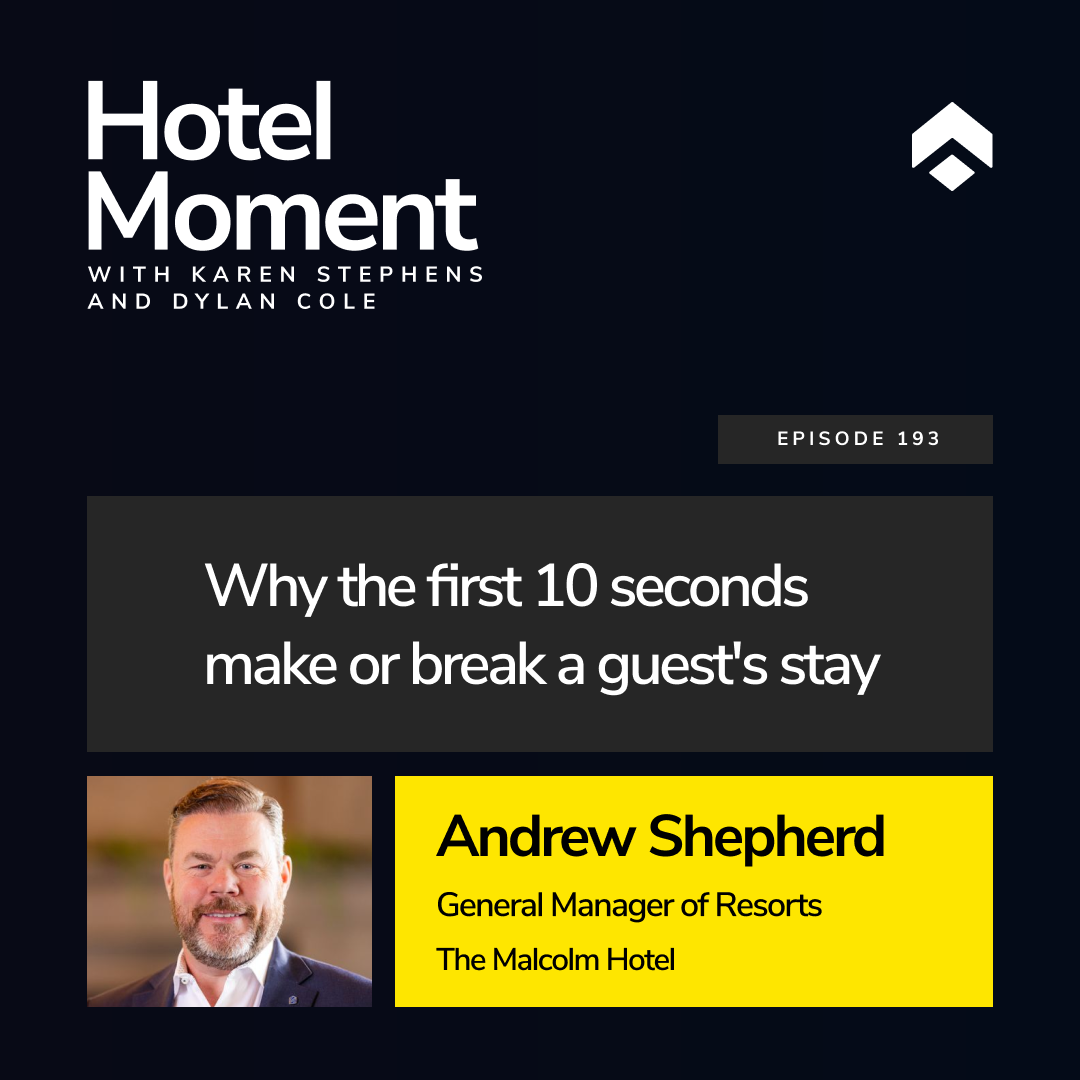
Hotel Moment
WITH KAREN STEPHENS


Episode 193
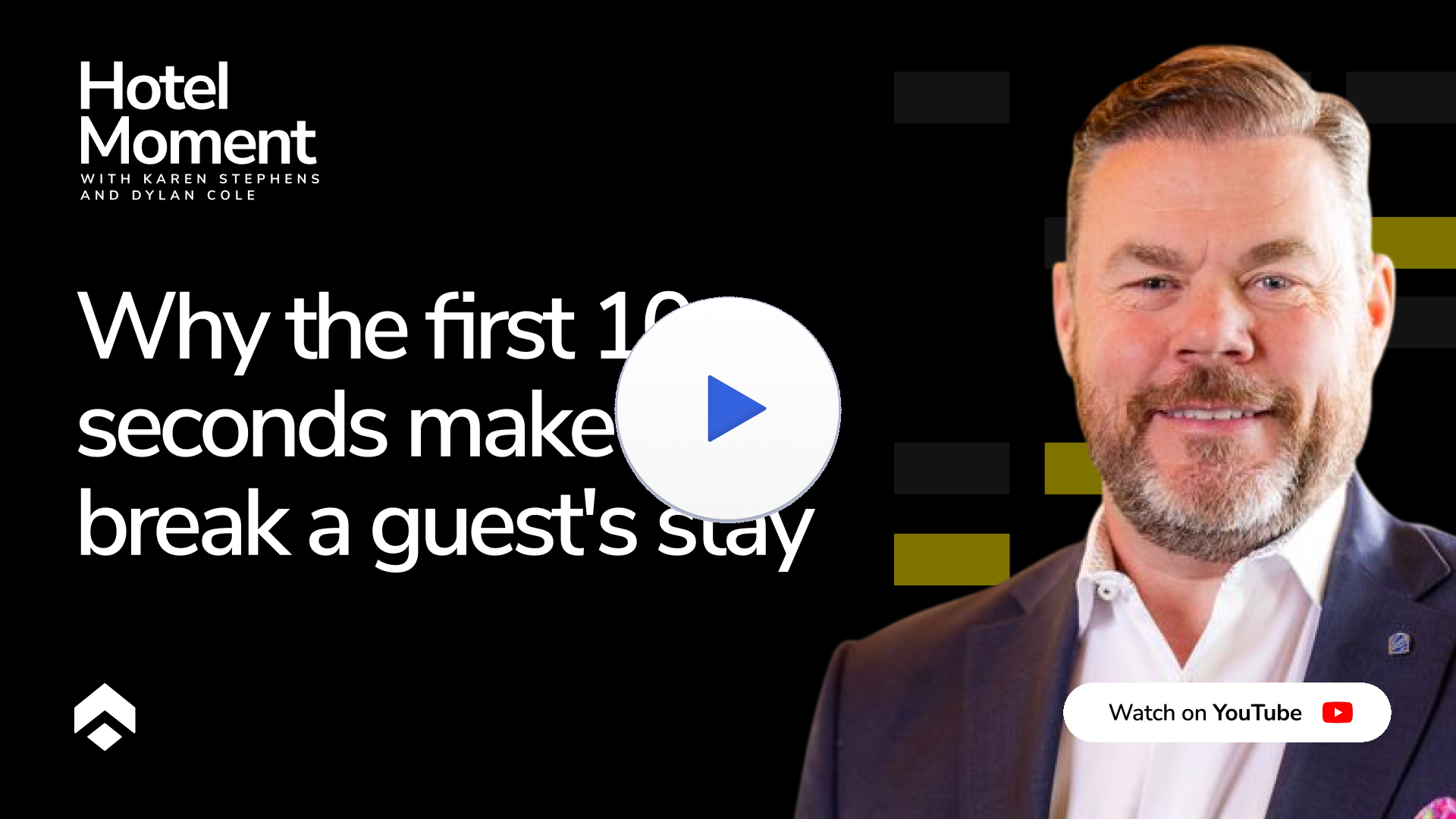
Why the first 10 seconds make or break a guest’s stay
You have 10 seconds to make a guest feel taken care of.
In this episode of Hotel Moment, Karen Stephens sits down with Andrew Shepherd, General Manager of Resorts at The Malcolm Hotel, to talk about what happens when teams stop waiting for guests to ask and start paying attention to what they actually need.
Andrew shares how his team reads body language within those first 10 seconds, uses guest preferences to create thoughtful personal touches, and gives frontline employees the confidence to solve problems on the spot.
He also gets into a challenge that every resort knows well: finding and keeping great people. At The Malcolm Hotel, that meant investing in 154 staff housing units to help build a stronger, more stable team.
It’s a practical look at how small observations, smarter use of guest data, and empowered employees can add up to experiences guests remember.
Media
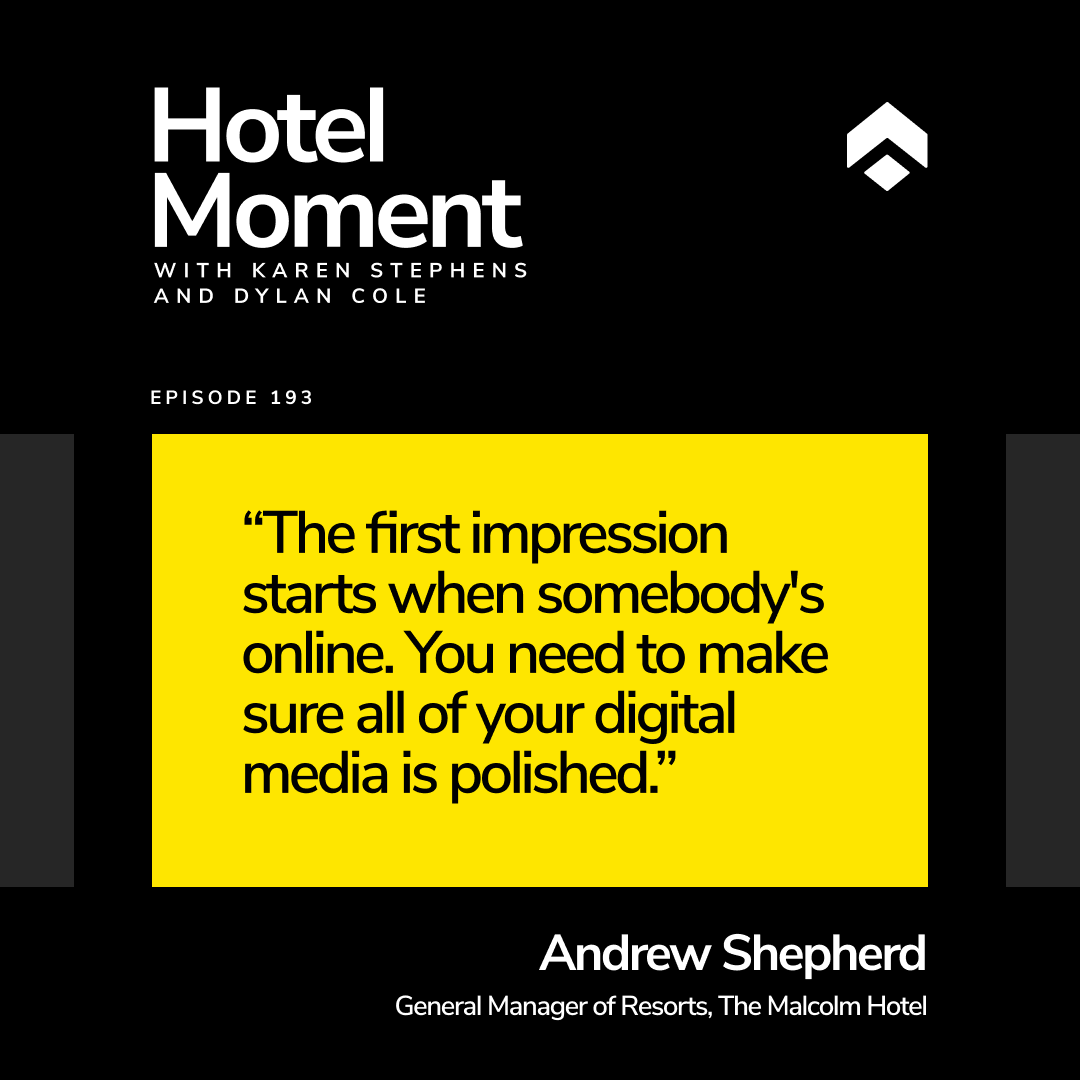
No second chances on first impressions
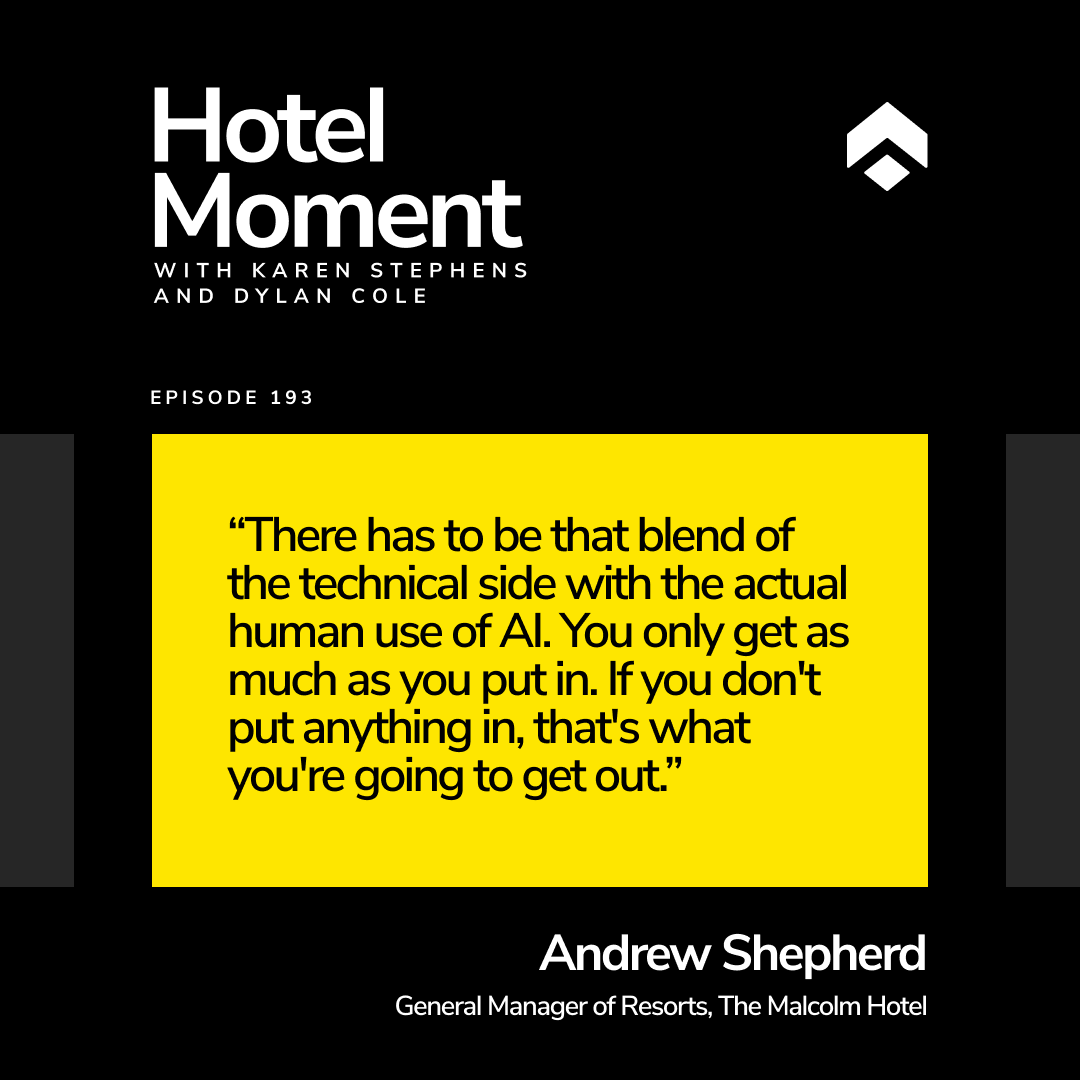
The human element in AI
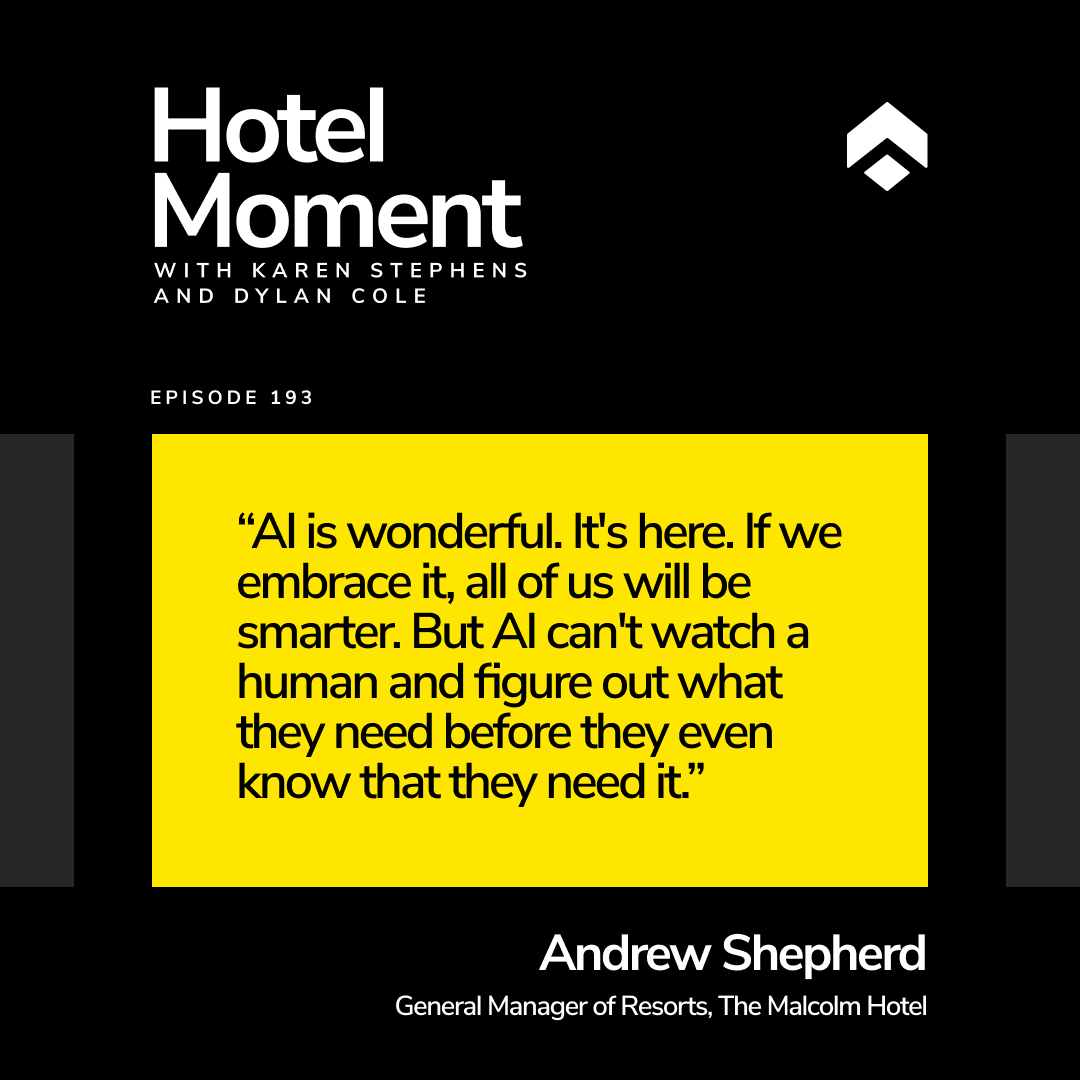
AI can’t anticipate human needs
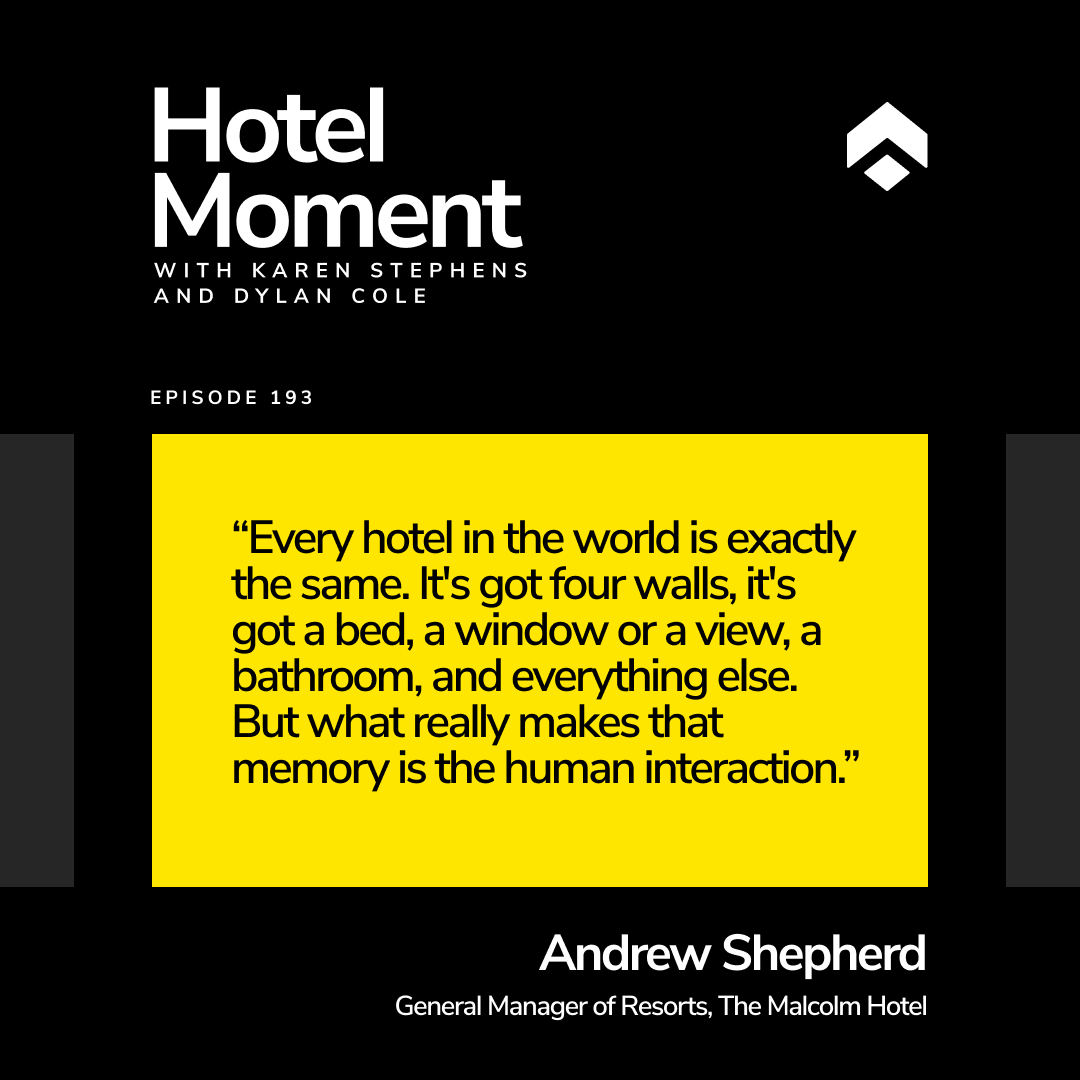
Stand out from the crowd

Meet your host
Karen Stephens
As Chief Marketing Officer at Revinate, Karen is focused on driving long-term growth by building Revinate’s brand equity, product marketing, and customer acquisition strategies. Her deep connections with hospitality industry leaders play a key role in crafting strategic partnerships. Karen has more than 25 years of expertise in global hospitality technology and online distribution — including managing global accounts in travel and hospitality organizations such as Travelocity and lastminute.com
As the host of The Hotel Moment podcast, she interviews top players in the hospitality industry. Karen has been with Revinate for over 11 years, leading our global GTM teams. Her most recent transition was from Chief Revenue Officer, where she led the team in their highest booking quarter to date in Q4 2023.
Watch the video
Transcript
[00:00:00] Andrew Shepherd: We need to make sure that we’re kind of giving them what they need before they know that they need it. And that’s where we make the biggest impact. And that’s not even within the first five minutes, that’s within about 10 seconds or 20 seconds.
[00:00:12] Karen Stephens: Welcome to the Hotel Moment Podcast presented by Revinate. I’m Karen Stephens, Chief Marketing Officer, joining you from sunny San Francisco, California.
[00:00:20] Dylan Cole: And I’m Dylan Cole, Managing Director of Revinate Europe, calling in from Amsterdam.
[00:00:25] Karen Stephens: This is the podcast where we explore how technology shapes every moment of the hotelier’s experience, and more importantly, how the right technology delivers real outcomes for hotel teams and guests alike.
[00:00:36] Dylan Cole: From revenue strategy and guest communication to operations and marketing, we sit down with the people transforming hospitality around the world.
[00:00:44] Karen Stephens: Depending on the conversation, sometimes it’ll just be me behind the mic.
[00:00:48] Dylan Cole: And sometimes it’ll be me, bringing a European perspective and stories from across the global hospitality industry.
[00:00:54] Karen Stephens: Whether you’re a hotelier, a tech enthusiast, or just curious about where hospitality is headed.
[00:01:00] Dylan Cole: You’re in the right place. Let’s get into it.
[00:01:03] Karen Stephens: Hello and welcome to the Hotel Moment Podcast. I am your host, Karen Stephens, the Chief Marketing Officer of Revinate. And today, we’re excited to welcome Andrew Shepherd, General Manager of Resorts at The Malcolm Hotel in Canmore, Alberta. With more than 25 years of leading hotels, resorts, and casinos, Andrew has built a career around creating exceptional guest experiences through strong operational leadership and people-first cultures. Today, we’ll explore what great hospitality looks like from the moment a guest walks through the door, how technology should support rather than replace human connection, and what the future holds for Canadian hospitality. So without further ado, welcome to the podcast, Andrew. It’s nice to have you.
[00:01:44] Andrew Shepherd: Beautiful to be on. Thank you for the invite.
[00:01:46] Karen Stephens: Absolutely. So Andrew, you’ve built a career spanning hotels, resorts, casinos, asset management, and large-scale operations. Walk us through that journey. What ultimately convinced you that this was the industry where you wanted to build your career?
[00:02:00] Andrew Shepherd: I don’t know if there was one part that said this is the path, but I’ve been in hotels and resorts since I was about 14 — way back when you’re allowed to kind of work underage and stuff. I did that as well, of course. But officially on paper, I started when I was 14. And you just kind of went through it, and you worked your way up, and you kind of fill in the education as you can on the way up. And the biggest thing is people. And I found I really wanted to be around people, and I wanted to make impacts along the way. I wanted to be able to kind of shape and mold the staff that I worked with, but also the guests that I served as well. And so I think that’s kind of what drew me to it was just the impact that you have on guests, but also on staff. And hopefully, one day when the staff get a little bit older and established in their careers, you get a nice little postcard from them saying, “Hey, we worked together 20 years ago. Now I’m a general manager of a Ritz-Carlton or a Waldorf or an island in the south somewhere.”
[00:02:51] Karen Stephens: I love that answer. So tell us a little bit about the property where you are now, The Malcolm Hotel, just so our listeners who aren’t familiar might understand what that is.
[00:02:59] Andrew Shepherd: Absolutely. The Malcolm Hotel is a four-star resort. It’s a luxury resort in Spring Creek, which is a part of Canmore, Alberta, in Canada. So what The Malcolm is, is a Scottish-themed hotel, because Canmore, the city, was basically named after Canmore meaning “big head.” And King Malcolm was one of the ones that created many things, and one of those being the Highland Games. And he created the Highland Games to basically create soldiers, the biggest, the strongest of the Scots. And what he did with that was he used them in his empire. And so Malcolm comes from the King Malcolm name, who was also in Macbeth, and that’s why the hotel is named The Malcolm Hotel, after King Malcolm in Canmore, Alberta. So we offer many things that traditional hotels don’t. A lot of the modern hotels are going for space only, with no grand lobbies, no extras and things like that, where The Malcolm has a grand lobby, a grand fireplace — kind of old school, but it’s very much welcomed because nobody’s really building hotels like that anymore. So it’s quite nice in that aspect.
[00:04:01] Karen Stephens: Right. And the surrounding areas, for those not familiar, Canmore, Alberta is in the Canadian Rockies and you’re near Banff, is that right? So, I mean, breathtaking is an understatement in terms of the scenery.
[00:04:12] Andrew Shepherd: Exactly. The view from our windows — people always want to see the mountains. We’re like, “What side of the mountains would you like?” And we’re situated in a small valley. And The Malcolm Hotel is right in between two creeks as well. And these are spring-fed creeks, so they are absolutely crystal clear. You can watch ducks swim, you can watch fish go by. A rooftop pool with two rooftop hot tubs as well. It’s quite serene. Banff, of course, is a legendary destination, and it’s about 12 to 15 minutes away from The Malcolm. And the best thing about The Malcolm is it’s in Canmore, and there’s no park fees associated with that because we’re just outside the park. It’s all the same mountain ranges, it’s all the same water bodies. It’s a beautiful place to be.
[00:04:51] Karen Stephens: Wow, it sounds amazing. So we all know that hospitality starts way before the guest reaches their room. It sounds like at The Malcolm, it happens in the grand lobby. Can you give us an idea of how much is won or lost in the first five minutes of that stay? So when someone walks through your front doors, what are your front desk associates looking for beyond just the reservation?
[00:05:11] Andrew Shepherd: Well, a lot of people say the first impression starts at the front door, but I disagree. The first impression starts when somebody’s online or somebody hears a friend say, “You’ve got to go here, you’ve got to try that.” And so we have to make sure all of our digital media is polished. We have to make sure all of our reviews are almost perfect. If they’re too perfect, people don’t believe it. So a little four-and-a-half-star review once in a while is okay. But after the first impression, because they already picked you, once they come into the lobby, then it turns a little psychological when, you know, we have maybe a large Suburban, a rental Suburban roll up with Saskatchewan plates on it, and you see the mother and the father get out with five children, and they look exhausted. The front desk have to pick up on that and say, “Would you like a cold bottle of water? I see that you have this. Would you like a reservation for two in the restaurant, and the kids can have room service?” These little anticipatory cues that we can see from our guests, that’s what makes the experience. And I mean, let’s be honest, every hotel in the world is exactly the same. It’s got four walls, it’s got a bed in there, perhaps a window or a view, it’s got a bathroom and everything else. But what really makes that memory is the interaction. It’s the human interaction, and that can’t be replaced by anything. AI is wonderful. It’s coming, it’s here. If we embrace it, all of us will be smarter. But AI can’t watch a human and figure out what they need before they even know that they need it. So we really have to watch kind of the body language of people coming in, the guests, through the doors. We need to make sure that we’re kind of giving them what they need before they know that they need it. And that’s where we make the biggest impact. And that’s not even within the first five minutes — that’s within about 10 seconds or 20 seconds. And that’s kind of what we try to pride ourselves on.
[00:06:53] Karen Stephens: A recent guest on this podcast said AI can’t read the room, and I think that that is exactly what you’re talking about. True guest experience is an interaction — a human interaction. So I love that. You also mentioned digital marketing and driving people to the website, and the guest experience starts in the planning and the dreaming about the stay. So personalization, I think, is really at the core of that, and it’s become one of hospitality’s kind of big buzzwords. But what does it really look like in practice for you beyond remembering the name and all of that? How do you think that that starts?
[00:07:25] Andrew Shepherd: I guess with personalization, you really need to ask questions, and likely remember the answers is a really good thing. We have all these fancy property management systems and everything else, and we have guest notes. And I can only imagine some of the notes — everybody wants to know what people write about them and stuff — but just little notes. Maybe when two people check in, they say, “Oh my gosh, we just drove in, we’re on a 12-day road trip, and we’ve been having fudge everywhere we go.” And just the small mention of fudge — and so they go out for the day, and when they come back to the room, maybe there’s a plate of fudge in their room. And they go, “Wow, how did they know?” Well, it’s because we have two ears and one mouth for a reason. And if we’re able to kind of record that and kind of make that personalized experience, that’s what really hits home to a lot of people. If we know that the birthday is in February and we put it on file, and maybe they’re coming here in February and they don’t tell us about their birthday, we know it’s their birthday. If they’re taking Grandma out for her 80th, we let them know, “Hey, say happy birthday to your grandmother,” and they’re like, “Oh my gosh, how do they know?” — without crossing the line of being a little too far past. But just these little things are kind of, I guess, what makes a personal experience into a memory. So we really like to do that. Digital helps a lot, but you have to have somebody to enter the digital. You have to have somebody to listen first.
[00:08:42] Karen Stephens: Yeah, I’m curious. So I know that you’re a customer of Revinate, so you have a lot of our platforms. Do you use things like asking for guest preferences pre-stay, and is that something that your team does as part of that? Or another system? It doesn’t have to be that, but I’m curious about how you operationalize being able to get all this information in front of your staff to make the experience amazing.
[00:09:03] Andrew Shepherd: We do. I wouldn’t say that we’re perfect at it. We can always do better, and that’s one thing that we always focus on, is just a little bit better each day. Revinate kind of makes it easy for us in the fact that it enables us to enter as much or as little information as we want, but also we can segment it. So if I want to see anybody with a birthday in the next six months, anybody with an anniversary, somebody who hasn’t stayed with us for a year, things like that — those are really interesting cues to be able to use. We have to remember to stay on the human side of it, though. Nobody wants a message saying, “Dear Mr. Blank.” We want to say, “You know, last time you were here, we noticed that you really loved the chocolate cake. We’ve got a new recipe. We’d love you to come and try it.” You know, a platform that’s able to do something like that — now that’s powerful. But at the same time, it takes a human to be able to do it. But the CRMs, if we’re able to put as much effort into them as the developers or the programmers did, that would be a wonderful thing. But we must remember that programmers and developers create the software, and they may or may not be hospitality people who have been in the industry a while. So there has to be that blend or that meld of the technical side with the actual human use side of it as well. And so basically with those, you only get as much as you put in. If you don’t put any in, that’s what you’re going to get out, right?
[00:10:18] Karen Stephens: Absolutely, nothing happens if you don’t. Garbage in, garbage out; goodness in, goodness out. Same deal, right?
[00:10:24] Andrew Shepherd: Exactly, very much so.
[00:10:26] Karen Stephens: Yeah. So let’s talk a little bit about some other technologies out there. There’s a lot going on, right? There’s self-check-in, there’s mobile keys, there’s some AI concierge functionality — they’re all becoming more common. So where do you think that technology genuinely improves the guest experience? We talked about the human side, but what are you seeing out there that really is kind of helping the staff and improving guest experience at the same time?
[00:10:47] Andrew Shepherd: Well, I think technology is something to be — you know, we can’t fear it, we have to embrace it. And every generation or every age group embraces it in different ways. Some people, they don’t want to be speaking to somebody at the front desk to be checked in, so hence we have keyless check-in. You know, with Spring Creek, we have The Malcolm Hotel, but we also have Spring Creek Vacations. Spring Creek Vacations, we have many, many luxury condos, penthouses, things like that. And so some of these guests are families or groups of four, six, eight people. They get a code on their phone, they never see our front desk, they check in. It’s still a luxury experience, but there’s nobody handing you a card key or saying, “Would you like to know where to go for dinner tonight?” Whereas at The Malcolm, we do have keyless check-in, and it’s not used as much as anywhere else, because when people are coming to a luxury property, I think it is the people that really make the luxury better or more pronounced. When somebody can say, “May I make a reservation for you tonight for two? I noticed it’s your anniversary.” Keyless check-in can’t do that. But the people that do want to have the convenience of keyless check-in after they’ve checked in, we notice people doing that. So rather than having a physical card, they want to use their phones. Everything’s on our phones nowadays anyway. So I think they want a combination of both. The other technological advances that we have is just the guest comments — being able to keep track of them, being able to have them segmented, being able to know that we can plan an itinerary. We have a concierge department at The Malcolm, and I know that AI is a wonderful tool that they use, but at the same time, it’s not always right. Sometimes it’s a bit too creative, and sometimes the times are not correct either. So using it to free up your time, but you still have to fact-check it. As a human, you still have to go through it.
[00:12:40] Karen Stephens: That’s right. AI loves to hallucinate, so we talk about this a lot. You have to make sure that whatever AI is accessing is clean and is the correct information. But even with that, I do think having somebody, especially if it’s an itinerary, something very crafted for a guest, for the best guest experience, still comes down to people. So along those lines, often employees need to feel empowered to deliver that guest experience. And I know you’ve described yourself in things that I’ve read on LinkedIn as a people-first manager. So can you explain a little bit about how you feel about giving your frontline staff the autonomy — how much should they have to be able to deliver the best experience?
[00:13:17] Andrew Shepherd: I can. A lot of the times when we’re in a situation, it’s easy to say, “Ooh, I have to call my manager, I have to talk to my manager.” And that’s good in some instances where you need to have a bit of a break, a pause in the situation, and that does create that. But a lot of the time, if somebody can jump into it, it guides the conversation in a bit of a better way. So if there’s a difficulty in the restaurant or a difficulty at the front desk or something, and the team member can say, “I feel for you, I understand you, I empathize with you. What I can do is I can do this.” The problem with different times of the year is we get different travelers in, whether they’re international or North American. And every culture or society has a different way of — they almost call it bartering if they want to complain. And so what happens is if they talk to the first person, the first person says, “Here’s 10%,” or “Here’s a free drink,” they want more. And so that’s where you have to have that separation of, “Well, I’m not able to do that, but let me talk to a manager and go from there.” And then throughout history, there’s these amazing hotel companies that have limits that they give to their staff: you can spend up to X amount on a guest to resolve the problem. And as long as it’s a reasonable amount, we empower our agents and our servers to be able to make those calls on the spot. And I think that goes a long way with the employee, knowing that there’s the trust, but it also goes a long way with the guest as well. So when we’re able to empower, as you put it, the employees with that — not of a no limit, but some decision is better than no decision. And so when they’re able to do that, it really kind of completes the guest experience that we’re really trying to resolve any situation that may arise. And it doesn’t just go for the bad situations, but it’s for the good situations as well. If an employee knows that something is coming up and maybe a bouquet of flowers or maybe rose petals or maybe chocolate cakes enter the room or a certain wine, and they’re able to do that without asking per se, then it really helps the experience because we can’t be around every minute of the day. So we do trust our employees to make the right decision. And if you do make a decision, there’s very little repercussion — unless that’s a very, very wrong one, which is very rare if everybody’s working together cohesively.
[00:15:27] Karen Stephens: Right. So as the general manager of a hotel, and I think this is the same situation we have going on in the United States, but Canadian hotels continue to face labor shortages, you’ve got rising operating costs and changing guest expectations. So how are those pressures affecting, kind of, your operations, how you deliver guest experience? I’d just love to get your take, because I know this is something we’ve been talking about for a while. There doesn’t seem to be any pressure letting off in those areas.
[00:15:53] Andrew Shepherd: Well, yeah. Labor shortages is a real thing. It’s a big thing. And not to put my name out there as going against government in any way, but the government’s not making it easier with some of our immigration policies, our work visas and things like that. Where we are in Canmore, it’s a very remote area in comparison to a larger city like a Toronto or Vancouver or Calgary. Housing is a difficulty here. It’s a very expensive place to live. And so all these factors, they come into it. And so as an employer, what we’ve done is we’ve built our own staff housing. We have 154 units of staff housing for us, but that’s at our own cost. If we didn’t have that, we wouldn’t be able to operate because we couldn’t get staff. The staff couldn’t afford to live here. And so that’s kind of a crisis that we’re working with. We’re fortunate enough that we have an owner that sees the bigger picture, the end goal, and he sees that we are a luxury property. We need luxury people working with us and for us and around us. And so we’ve done that. There is a labor shortage around, but the labor shortage isn’t necessarily for people — it’s for skilled people. And hospitality really needs to be seen as a career. It needs to be brought up as — perhaps as I was when I was younger, I saw hospitality as a career, not just a job. And there has to be progression in that. With that being people-first, the leaders in our industry need to be able to take their talents and invest that back into the younger up-and-comers that are in the business. So we have to make hospitality a career. It has to be supported. It has to be respected by maybe the governments and maybe by the education systems and everything else, so that we can create all these new employees that are coming up through the ranks. There’ll always be a labor shortage in most parts of the world, especially North America, and it’s just kind of how we get through them. And I think a lot of the managers and executives in the industry really need to focus on showing that hospitality is a career. It’s not just a job that you can work for six months and pay your way while you’re backpacking or traveling or being a tourist in somebody else’s backyard, but just — they really need to put that effort into making it a career instead of just a job.
[00:17:57] Karen Stephens: I love that comment, and I think you’re exactly right. And when I think about good careers, good jobs, I think about culture. So it also has to do with what is the culture at the hotel, how do the staff interact with each other, how do they feel supported. So I’m just curious, with all your years of experience, when you walk into a hotel, how can you tell whether or not there’s good culture? How long does it take you to size up what’s going on in there and if that’s related to the culture?
[00:18:21] Andrew Shepherd: Usually about a minute or so. And we’ve all gone to that bar or that nightclub or something, probably when we should have left the conference and gone to bed, but everybody’s like, “Let’s just go out.” And you go into that one bar, and the air just doesn’t feel right. You feel that bad vibration. And it’s the same thing as when you walk into a property or a hotel with good culture. You can walk in, and the air just feels different. There’s a snap to it. There’s an electricity to it. And we’ve all walked into a hotel where everybody’s walking fast — it’s a frantic pace. And it’s not necessarily — people think that you need to move fast to show that you’re efficient and everything else, but sometimes slow is fast. And so sometimes when you see the confidence in people where they’re not running, but they’re walking briskly, it’s a different feel. And so to be able to see that vibe is basically what the managers have set — the managers of each department. You know, the restaurant might have a quicker clip to their walk than maybe the front desk. Maybe the houseman walks a little bit faster than a housekeeper. But nothing’s frantic. If things are frantic, something is not going right. But if everybody has a confident walk, if everybody has good posture, if everybody has a beautiful smile, then it really does — maybe not necessarily come from the top, but it definitely comes from around. I think once you get that critical mass of culture rolling in the workplace, it’s very infectious and everybody wants to be a part of that culture. Tough to get going, but once you have it, you really need to focus on keeping it.
[00:19:47] Karen Stephens: So I have one more question for you, and I’ve loved this conversation, Andrew. So on a personal level, when you think about the future of hospitality, what gives you the most optimism?
[00:19:57] Andrew Shepherd: What I look at when you ask that question is, to be an optimist on that, I think that we really have to look at blending technology with — and I don’t want to say old-school people skills because there’s old-school people skills that we should completely abandon, and then there’s new-school people skills that we need to just polish up a little bit more. But if we can combine the technology and the learning of the different generations now, and use some of the older generations of manners and respect and everything else, and meld those two together with the advantage of the technology to help us, I think that’s what gives me the optimism — is that we’re going to be able to see kind of that perfect blend where it’s not technology versus people, where it blends together and we’re able to use that technology just to help us on that. So I’m not sure how we do that. It seems that throughout the generations, there’s different people that focus on the people side and people that focus on the technology side. We just have to figure out how to blend that seamlessly. And I think that’s where it’s going to come from. You know, the young talent loves the apps and the computers and things like that, whereas the old talent is more concerned with telling us stories of, “Back in my day,” and everything else. Those need to go away. We need to forget them. We need to use the knowledge that we gained, but we have to stop telling people, “What I was doing when I was 14,” or “What I was doing this,” because those days are gone. But we can create tomorrow. We can’t change yesterday, though.
[00:21:23] Karen Stephens: I love it. We can create tomorrow. Can’t change yesterday, but let’s remember what works, right?
[00:21:27] Andrew Shepherd: Absolutely.
[00:21:28] Karen Stephens: Yeah. Andrew, thank you so much for being my guest today.
[00:21:31] Andrew Shepherd: Thank you so much for that. It’s an honor to be on your show.
[00:21:38] Karen Stephens: Thank you for joining us on this episode of Hotel Moment by Revinate. Our community of hoteliers is growing every week, and each guest we speak to is tackling industry challenges with the innovation and flexibility that our industry demands. If you enjoyed today’s episode, don’t forget to subscribe, rate, and leave a review. And if you’re listening on YouTube, please like the video and subscribe for more content. For more information, head to revinate.com/hotelmomentpodcast. Until next time, keep innovating.
Episodes
Hotel Moment
WITH KAREN STEPHENS
Subscribe for updates on your favorite platform