Hotel Moment
WITH KAREN STEPHENS


Episode 177
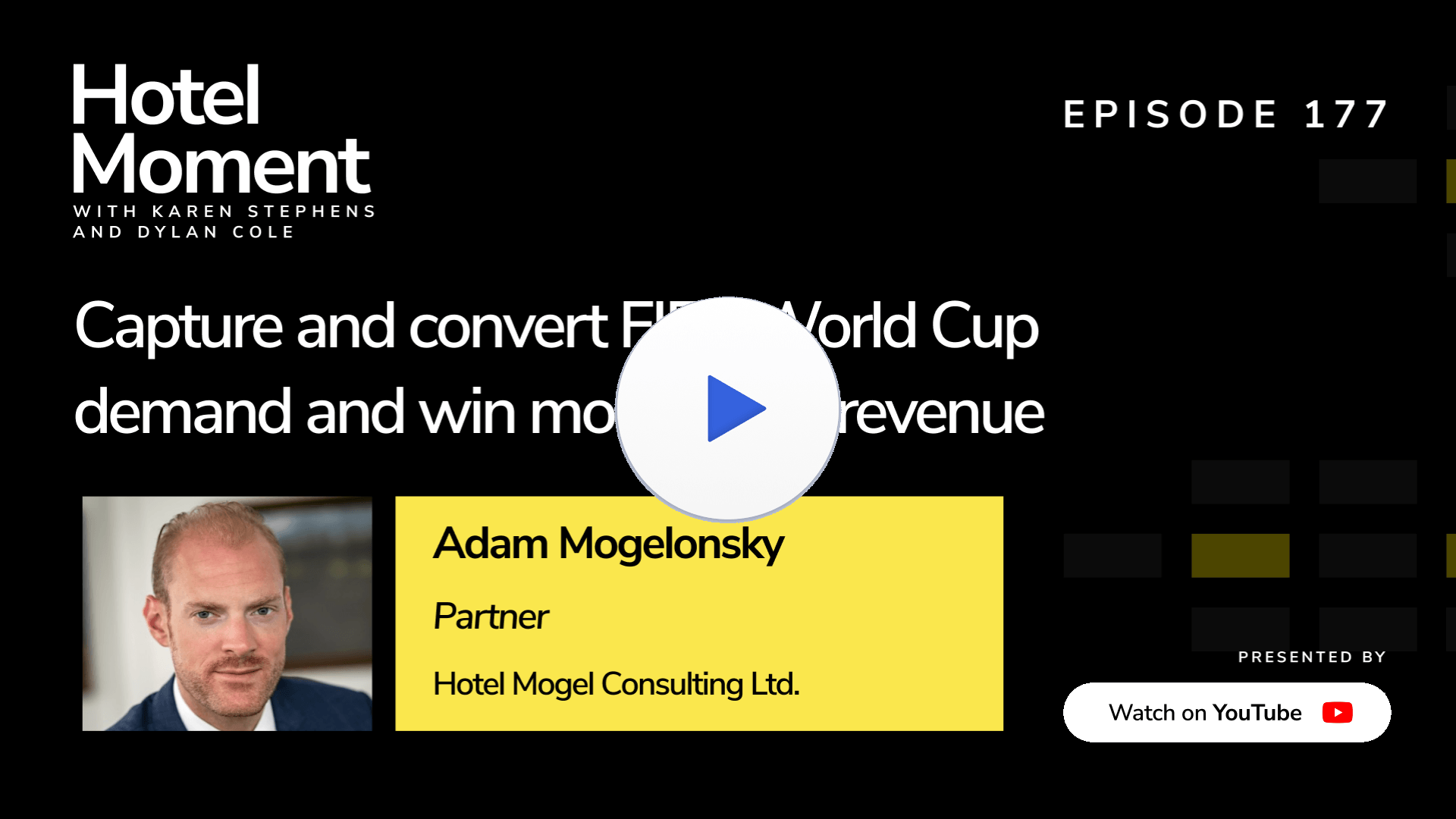
Capture and convert FIFA World Cup demand and win more direct revenue
In this episode of Hotel Moment, Adam Mogelonsky breaks down one of the biggest misconceptions in hospitality: that global events like FIFA are just short-term demand spikes.
Because while the surge in bookings is real, Adam argues the bigger opportunity is what hotels build around it, and how those strategies can drive revenue long after the event ends.
As guest booking behavior evolves, with shorter booking windows and higher expectations for flexibility, many hotels risk leaving revenue on the table by relying on outdated pricing models and over-dependence on third-party channels. But there’s a smarter path forward — one that blends rate strategy, direct booking optimization, and better data capture.
From mastering the balance between refundable and non-refundable rates to unlocking the hidden potential of the voice channel, this episode explores how hotels can turn high-demand moments into long-term growth engines.
Tune in to discover why the hotels that win during FIFA 2026 won’t just capture demand — they’ll convert it into lasting direct revenue.
Media
Save money, reduce commissions
Do the things that capture demand
Cleaner data, better personalization, more revenue
What guests expect

Meet your host
Karen Stephens
As Chief Marketing Officer at Revinate, Karen is focused on driving long-term growth by building Revinate’s brand equity, product marketing, and customer acquisition strategies. Her deep connections with hospitality industry leaders play a key role in crafting strategic partnerships. Karen has more than 25 years of expertise in global hospitality technology and online distribution — including managing global accounts in travel and hospitality organizations such as Travelocity and lastminute.com
As the host of The Hotel Moment podcast, she interviews top players in the hospitality industry. Karen has been with Revinate for over 11 years, leading our global GTM teams. Her most recent transition was from Chief Revenue Officer, where she led the team in their highest booking quarter to date in Q4 2023.
Watch the video
Transcript
[00:00:00] Adam Mogelonsky: This is a one-off event, something where we don’t know when FIFA will be back in the host cities in North America, but as a process, as part of a system for every hotel, there’s tons of things that we can do to capture as much demand as possible for this one-off event and then apply those systems and processes to any future event that goes forward.
[00:00:26] Intro: Welcome to the Hotel Moment Podcast, presented by Revinate, the podcast where we discuss how hotel technology shapes every moment of the hotelier’s experience. Tune in as we explore the cutting-edge technology transforming the hospitality industry and hear from experts and visionaries shaping the future of guest experiences. Whether you’re a hotelier or a tech enthusiast, you’re in the right place. Let’s dive in and discover how we can elevate hospitality together.
[00:01:12] Karen Stephens: Hello and welcome to the Hotel Moment Podcast. I am your host, Karen Stephens, the Chief Marketing Officer of Revinate. And on today’s episode, we are joined once again by Adam Mogelonsky, who has been on the podcast several times and continues to be one of our go-to voices on hospitality innovation and commercial strategy. Adam is a partner at Hotel Mogel Consulting Ltd, where he works with upscale and luxury hotels and resorts on business growth, equity raises, and technology planning. With over 15 years of industry experience, he focuses on revenue modeling, margin optimization, and integrating emergent technologies and wellness-driven guest experiences. He also serves as an advisor with Growth Advisors International Network, GAINE, where he contributes strategic insights on commercial expansion and tech-enabled transformation. Given his deep expertise in demand forecasting, real-time data utilization, and building future-ready tech stacks, Adam is especially well-positioned to help us unpack what hoteliers should be preparing for as major global events like the FIFA World Cup approach. In this conversation, we’ll explore what the surge in demand could mean for operations, pricing strategy, and technology readiness across the hospitality landscape. Adam, welcome back to the podcast. It’s great to have you here.
[00:02:26] Adam Mogelonsky: Yeah, thanks.
[00:02:27] Karen Stephens: Absolutely. So lots going on in the world, Adam. I mean, so for our audience, we were having a little chitty chat before we started recording here. So I wanted to check in. The focus of today’s podcast is going to be on the FIFA World Cup, which I think a lot of people get excited about. But I also think with everything going on, it’s not just all sunshine and rainbows coming into this World Cup. So love to get your perspective on a lot of this stuff.
[00:02:52] Adam Mogelonsky: Yeah. So I mean, you know, before we hopped on the call, I was all doom and gloom because that’s part of my job — is to prepare for the worst and then to enable the best. Because as we know with history, no one can really predict the future, but it favors the well-prepared. Or as Eisenhower said, plans are useless, but planning is essential. And that’s really what we’re talking about with FIFA, is that yes, it’s easy to look at this as a one-off event, something where we don’t know when FIFA will be back in the host cities in North America. But as a process, as part of a system for every hotel, there’s tons of things that we can do to capture as much demand as possible for this one-off event and then apply those systems and processes to any future event that goes forward.
[00:03:39] Karen Stephens: Yeah, I love that. And that’s why we were really looking forward to having you on the show. So in your normal work life here, your main core job is to consult with hotels on how best to prepare. And that has everything to do with technology platforms and strategies. So let’s dive into this because we’ve got FIFA coming in. So just for everybody’s knowledge, we’re talking about 11 markets in the United States that are going to have host cities for games. We’ve got three in Mexico and two in Canada. So overall, as of today, we’re looking at host cities to drive RevPAR by just under 13% and ADR premiums over 72% during the key matches. So what from an operational standpoint would a spike look like in these host markets? So all of a sudden you’ve got an influx. Operationally, what should they be thinking about?
[00:04:26] Adam Mogelonsky: Well, the first thing to address operationally is the increased volatility and lead times that we’re seeing across the board. And this is a megatrend insofar as that volatility. And it goes all the way back to the pandemic, where when we look at the confluence of internet-born bookings, digital bookings, combined with relatively easy refundable policies — that all came about during the pandemic and have been carried forward — we’ve essentially trained a lot of our guests to expect that as the norm. And from there, with all the news that’s out there and things are changing every single day and it’s thrown in our face with the combination of social media and the 24-hour news cycle, et cetera, people have been trained to book relatively close to the intended date. I myself, for context, am a Virgo. It gives me anxiety when I don’t have a trip fully booked six months ahead of time. That’s me. Other people are not like me. They are more whimsical and they somehow don’t get anxiety when they have their flights booked and they’re meant to arrive in destination and they don’t have anything booked — not even, you know, let alone hotel rooms, but experiences and ancillaries — upwards to a week or a few days before they arrive. That’s not how I travel, but it still is how a lot of other more whimsical people travel. And I mention this context for lead time volatility because the ricochet of that is that it makes it hard to forecast labor. And it makes it harder to forecast additional opex. And where that comes to a head is that when you see such a large ADR premium from landmark events like FIFA, there is an increased expectation for service quality. Everyone knows that the city will be more expensive, but at the same time, they’re going to be looking at it and going, well, you know, I’m staying in this branded hotel, I’m paying $700 a night when regular rates after that week are $300. What else am I getting? You know, you arrive at the hotel and the check-in lineup is ten to twenty minutes long, which then delays their experience from checking in, settling down, and going out to a potentially FIFA-related event or another event. And then are there any arrival amenities — things to augment, tell them that they’re welcome there for FIFA — like whether it’s something just at the dollar store or something else you can pick up to really welcome them for that increased rate they’re paying. These are all operational challenges that are all downwind from having that predictability from revenue on the books.
[00:07:13] Karen Stephens: Well said. I mean, first of all, I want to pick up on a couple things that you said. So first of all, you talked about the flexibility with cancellations that became an expectation after COVID. So now you’re in an environment where travelers expect that. I do think the booking window is definitely shortened because people have a lot of nerves. I mean, we know that the biggest fans for soccer — what we call soccer here in the US — are typically outside the US. So you’ve got a lot of international inbound. So how should hotels be thinking about cancellation policies, you know, to your point, to get that revenue on the books and have some security around it? Or do they have to maintain those liberal cancellation policies to even — you know, you’re kind of like, well, maybe it’ll make me feel better because I have more occupancy, but at the end of the day, that’s not guaranteed. So how should they be thinking about that?
[00:08:01] Adam Mogelonsky: Well, the whole idea of non-refundable versus refundable rate — it is scientific, it’s also a bit of an art form. Insofar as essentially you want to incentivize the non-refundable rate by making it more attractive in terms of a price discount. But you don’t want it to be so far that it pushes your cancelable rate out of competition with your comp set. And there are a lot of tools to help you out with that — namely your revenue management system that can give you a lot of great data, and then as well additional signals that you can pick up, such as associating any sort of guest sentiment with the rate that they paid and then doing a comparative analysis there. And of course the harmonization of data and the cleansing of records to properly associate how somebody felt about their stay, what else they spent on stay with the rate plan that they were under, is rife territory for innovation that can be decided by the commercial team.
[00:09:04] Karen Stephens: Okay, so you mean innovation post-stay? I mean after the event is over, or do you mean targeting guests coming in, or both?
[00:09:12] Adam Mogelonsky: We could do some near-term pivoting. FIFA right now — we’re recording, it’s April 23rd — and FIFA starts less than eight weeks away. So you could upgrade your rates and revise your rate structure and push that out to various channels. But that still needs to be aligned with the long-term strategy. A lot of hotels have put in certain restrictions around the dates when FIFA games are played, and they’ve done other restrictions such as minimum night stays, which is a great one, as well as only putting certain inventory towards certain channels, which is a great one as well. So it’s part of a concerted strategy. And then there’s a lot of learnings that can be done to apply a long-term net benefit from this one landmark event.
[00:09:59] Karen Stephens: Right. I’d also love to talk about — because you are driving rate, and obviously there’s a lot of demand in theory around those dates — what about packaging? You mentioned, you know, some of the amenities on site and the rest of that. So can you talk to me about that as a strategy to make your hotel stand out? Or how can you kind of bundle things together to drive rate and also maybe keep people in the hotel for certain things?
[00:10:20] Adam Mogelonsky: Okay. So the main thing with looking at packaging, of course, is going back to that channel optimization. And the way you have to look at it is, of course, if you ask any hotel, they’ll say, yes, I want to maximize total revenue and revenue per guest. Because every hotel fundamentally knows that the more a guest spends on site and the longer a guest stays with you, the more satisfied they are. Therein, the issues are: number one, can you deliver on any packages that you promise? That’s going back to the operational issue. And then number two is the sticker price, where if you’re pushing packages up front, it can potentially introduce another point of friction in terms of securing that booking. Particularly when you’re looking at very price-elastic channels such as the OTAs and metasearch.
[00:11:18] Karen Stephens: Okay, that makes sense. So it might be a great offer for — if it inflates the price even more than the 72% that you’re driving above, then that can be problematic.
[00:11:28] Adam Mogelonsky: Yeah, I mean, but there’s the ever-present call to book direct. So direct bookings are the best way forward for every hotel in terms of reducing commissions and then either having that net revenue gain flow through to GOP, or to enhancing service to thereby enhance guest satisfaction and potentially build out your return guest profile and loyalty.
[00:11:55] Karen Stephens: Obviously what we talk about at Revinate is getting that direct booking. And I’m just thinking if I’m sitting in a host city and I have my database straight, I could figure out who is coming in. I understand the matches that are happening in my city. If I’ve ever had any inbound from those markets before — which, likely, if you’re sitting in San Francisco, New York, LA, Boston, Philadelphia, Miami, you will have had foreign guests or people from outside the US come in — so if you can target those folks with a package, the number one thing with OTAs is you have to offer parity on your website and on what you show on an OTA. If you’re targeting those guests directly, that’s what we could call a fenced offer. And that’s where you have the opportunity to really give the best available rate, knowing that you’re going to pay 10 to 20% to an OTA. So you can even offer — you can still be ahead of the game with a lower offer, including breakfast, doing all those things that we know foreign travelers love — directly, right? Using your database.
[00:12:53] Adam Mogelonsky: I mean, yeah, you stole the words right out of my mouth with uh a fenced offer and looking at the cost arbitrage between indirect channels like the OTAs and what you can do to incentivize the direct channel while still having a net gain for GOP. And a lot of hotels have already done that as part of a long-term strategy, but it can use even further refinement insofar as what you can bake into a direct booking with that increased ADR built around landmark events like FIFA. And you could even do it where you’re pushing — you know, via rate parity, you’re pushing rates out to the OTAs, and then they come on, they can see the exact price on direct, but then there’s package inclusions that are already listed there for that same price. So guests know, and there’s high visibility around that direct booking incentive. There is so much more that can go into it in terms of mapping out the pre-arrival journey — in terms of not necessarily trying to get packages booked upfront, but then trying to sell people additional services during that pre-arrival flow, let’s say, whether that is via the guest experience management system, then an omnichannel inbox with email, WhatsApp, and all other channels. And then also developing SOPs around the check-in procedure to make that extra special.
[00:14:19] Karen Stephens: Right. Maybe a VIP line or something where you feel like — okay, again, if there are operational issues, you’re at the front of the line, which is great. So another thing that we really bang the drum on around here at Revinate is when you’re using call center software. So we have software for a reservations team — it’s called Rez Force. And the real value of that is not only in being able to make that booking, but it’s also capturing all the people who didn’t book. So can you talk a little bit — and you kind of alluded to it at the beginning of this — but you are gonna get into situations, hopefully, where you’re starting to get oversold or you don’t have the room and people are still calling in. So can you talk to us about the importance of data capture when you might not be able to make that booking?
[00:15:02] Adam Mogelonsky: Right. So just to backtrack here, I’m a huge fan of the voice channel because it is the most data-rich channel still, but the least harmonized or structured in that data. So the way I look at any sort of call center or reservations department operation is, of course, you know, you can track things like abandoned calls, close rate, time on call, et cetera. But from a data perspective, the gold mine going forward will be recording that call, transferring it to an audio file, summarizing or doing speech-to-text and then summarization, and then picking out the key questions that were on that call, as well as other opportunities to enhance close rate and upsells — independent of anything AI-generated like these voice AI assistants. But therein, the way you have to think about the voice channel is that humans are way better talkers than we are typers. So therefore, this whole movement with AI-driven automation is moving us back towards what’s called conversational commerce. So the voice channel is at the cusp of this, in terms of saying, well, somebody just wants to have a conversation. You know, it can be preloaded with the voice assistant to answer repetitive tasks before passing them through to a live agent to complete that booking on the CRS, or it can be straight into the res team or the flow-over call center for off-hours. So all that can be done. And then you have all these audio files, whether they book or not. And especially if they don’t book, you want to know in some sort of structured way what questions did they ask. And from there, you can take those questions and say, well, how do we make this information more readily available on the website — in a FAQ, in a storytelling manner — so that way the calls that are arriving are more high-intent or confident bookers. So that way you can move them closer to that close. And as well within the booking engine to have that in a more structured format. And of course, that then draws a direct connection between the voice channel and how well the hotel is optimized for AI search, because AI search is looking for channels that are high trust. And if you have a lot of structured information according to a FAQ or Q&A manner, you’re building out that trust, which means that the AI search is then going to prioritize the direct channel for information sourcing as well as give your hotel a higher ranking when people are looking for hotels in the region. So there’s so much that goes into this from a process standpoint, and simply saying, well, how are we capturing those audio files from those calls, whether they book or not? How are we transferring that into text? How are we then structuring and rating those text-based summarizations to then inform upgrades that we can pass off to the marketing team as well as the sales team — if it is a call that’s for sales or anything group or corporate related.
[00:18:19] Karen Stephens: Right. No, you’ve hit it on the head. I mean, basically this is exactly what we strive to do here, right? So that we have everything flowing into a central data source. It’s a CDP that gets synthesized — and the whole reason it’s — when we built it before, and you and I have had multiple conversations about TRevPAR and being able to see total spend and all the outlets. But the real value of that is synthesizing to a single guest profile that can then be activated no matter what channel you’re in. So a reservation agent can see when they pick up the phone how many times they’ve been on property, what they spent last time, what they like — so that you can have a real conversation. And of course we know that obviously AI is going to be huge, agentic AI — yes, of course you’re going to talk to bots for repetitive questions — but we’re seeing a real bifurcation with that luxury traveler, or even just anybody coming over for FIFA. You’re coming into a hotel, you’re spending thousands and thousands of dollars, not only on the hotel stay, but on the match. You want to talk to somebody. You want to understand everything that’s going on. So just that delivering of service. And then of course the real value in those non-book leads. So you talked about — we’ve got restrictions on — I’ll just give a simple example that I’ve heard many times. So you have a minimum length of stay restriction. Let’s say you’re requiring three nights. And then as you get closer to the event or the time period, you’re down. And you might have had people that didn’t book because they couldn’t do three — they could only do two. Well, now you’ve got a list of people to call back. Instead of freaking out, dumping your rates, going to the OTAs, you can call those people back and say, hey, good news, we’ve got availability.
[00:19:54] Adam Mogelonsky: Yeah. I mean, if you had that policy from the outset, somebody who’s calling in and only wants two nights — you could say, I’m sorry, but FIFA’s four months out. We’re only opening up two-night stays if available one and a half months out. Can we call you back then? Or email you? And people, if they haven’t booked anywhere else, they would really appreciate that. The one-to-one or one-to-many communications in the best sense. I wanted to pick out one note you said there about the split between luxury and non-luxury hotels. And I’ve come to look at this a little bit differently. Yes, I work with luxury and ultra-luxury hotels. And what I want to do is introduce, I guess, a term here — called story-driven guest.
[00:20:41] Karen Stephens: Ooh. Experience?
[00:20:42] Adam Mogelonsky: Okay, what’s this? I mean it’s a little bit more ambiguous than just luxury, because luxury in essence is more of a rate term. Where, you know, relative to market, what is luxury? And then, you know, are you abiding by Forbes Five Star, Forbes Four Star? So it has more of a structural meaning behind it. Story is emotion. And this is an underpinning for the split now between luxury and ultra-luxury, as well as incorporating boutique properties that can’t necessarily be called luxury because they don’t have a spa or their fitness center is the size of my home office, which is a 10 by 10 cubby, so to speak, right? But therein, when you think about a story-driven hotelier and story-seeking guests, it is — they don’t want the standard experience. They want to truly live or embody something that’s unique to them. And a part of that uniqueness can be design, it can be F&B or other amenities, it can be funky rooms — which goes back to design — it can be the whole wellness side of things in terms of health is the new wealth. It can be rate-driven because if the ADR is $2,000 or higher, then you know that the person who’s sleeping next to you is also of a like-minded mindset who can afford that. And of course it can be driven by low key count. Low key count — where anything under, let’s say, 50 to 80 keys — means that the hotel naturally can deliver more bespoke service, but also because the headcount is going to be lower for the team, it also means that those team members will have multiple interactions with the guests. And that’s a huge point in terms of beyond just driving on-site experience through that sense of community.
[00:22:38] Karen Stephens: Right. And I love that term because it really is about experience. And I’m thinking about some of our customers as you’re talking, like AutoCamp, for example — which is a wonderful experience. It’s so unique. And of course they also have reservations teams, they have the whole nine yards. But people go there to escape from technology and get out to camp, but not really in a tent — it’s still a pretty luxurious camping. But I love that term. And I think you’re absolutely right. It applies to boutiques, it applies to a unique experience. And that’s where people do, I think, want more — they call in for curated, they want to understand exactly what they’re getting and how it works, right?
[00:23:15] Adam Mogelonsky: Exactly. They want to understand exactly how things work. And already if they’re calling you, they may have looked at the website or couldn’t find information there. So that’s a clue for augmenting the website and AI search — or GEO derived from that, generative engine optimization, fun new buzz term. But also there is the stringing together of calls — that maybe the calls they don’t book the first time, then they call back. And from there we can derive signals about why they called back to book, insofar as what additional questions they asked. And then in essence, trying to get at the core of it, which is: what story attracted them and motivated them to book? Who are the people that were driven by our story to pay an above-market rate for this luxury boutique or ultra-luxury hotel? And then how can we find more guests like them — lookalike audiences? And it’s a marketing challenge, but it’s a fun challenge in that there’s so much opportunity for growth.
[00:24:18] Karen Stephens: You hit it on the head. And I think it’s — if you’re a hotel out there and you’re still taking reservation calls and you’re not connected to anything, you’re really missing a trick, right? Even if it’s just coming into the front desk and people are making reservations and that’s your voice channel — there are ways to optimize that and you need to get it connected into the overall database, because that’s where you really get down to the nitty-gritty. You named some of the things, but is there anything else that comes to mind for guests that are trying to book during a peak period and aren’t able to book? What other data should people be grabbing besides why you didn’t book today? If they can’t get the reservation for any reason, what should you be making sure you get a hold of for your CRM for marketing later?
[00:24:59] Adam Mogelonsky: Well, I mean, let’s start with the basics — name, email, phone number. You know, it still is a challenge today. The challenge is largely with the third parties that try to mask that information. But for all you know, that person who called and who didn’t book can be associated with a past guest who then recommended that hotel via word of mouth. And so there’s just that core element of those aspects. From there we could throw a carrot at it and say, hey, you know, we’ll give you a private promo code for people calling in who don’t have that intent — to then, if they call back via voice and they mention something for a future stay and they’re able to color that with some additional aspects about who they are — source market, occupation, type of stay, occasion — things that are very core to each individual story-driven hotel stay — then from there you’ve already done a great job and you can pull out so many additional patterns that may inform little marketing tweaks that can win you an additional 5% across different segments.
[00:26:03] Karen Stephens: Yeah, I love that. One other thing came to mind just where you were talking there — is that we have a customer who just presented at our Navigate conference, Pacific Hotel Group. They have a collection, the Meritage Collection. But they drive their loyalty program — they enable their Rez Force agents when they pick up the phone to be able to offer 10% off right out of the gate. Join our loyalty program, 10% off. So I think also empowering agents when they do get people on the phone — to give those offers, get that information out of them, and then say, hey, maybe you didn’t book today, but I’m going to put you in our loyalty program so that next time you go to book, 10% off right off the top. So it’s another opportunity to kind of drive that direct booking.
[00:26:43] Adam Mogelonsky: Yeah, and of course when we’re talking about the Meritage properties, we’re talking about highly experiential stories. I remember way back, we were looking at their Napa property, which I believe has a nice corporate dining or group dining setting that’s built into a wine cave into the side of a hill — and just a majestic property. And, you know, that’s something where if you identify somebody from the corporate sector, they may want to come back as a leisure stay or have some different type of context for their staycation that could be targeted against by getting them to re-sign up or re-subscribe to their loyalty program. Just an idea, but that’s a great client example.
[00:27:20] Karen Stephens: Yes. Stay Golden is the name of that program, and it’s very cool. Okay, so going back to FIFA now. What advice do you have to give hotels that are just outside the FIFA market? So what about — we need to get drive-ins into the markets, but what if I’m sitting outside Philadelphia or Boston? Any strategies for those folks to try and capitalize on demand?
[00:27:42] Adam Mogelonsky: Well, the demand capture — people who are coming in for FIFA, they’re most likely going to want to stay close to the venue. That’s my hypothesis and we could find some data to back it up or refute it. There’s nothing you can do about that — you know, location, location, location. So we have to first acknowledge that we are limited in our opportunities. But therein there’s a little bit of what I call counter-programming, where you could say, hey, you know, you’re coming into New York or Philadelphia for a game, you have your tickets, but the city really isn’t the place to be because it’s gonna be just hectic. You want to go in for the game, but then you want to get out of there and see real America. So you could target people that way. That can be set up through paid search, bidding against certain terms. Or you could even target people for staycations to get out of the city — a whole other segment.
[00:28:39] Karen Stephens: That’s what I love. You know, again, if you can segment your database and find out who you have from New York, San Francisco, Miami, etc., and then say, hey, this is going to be a logistical nightmare for you — why don’t you come to Napa? Or, you know…
[00:28:54] Adam Mogelonsky: So you talk about logistical nightmare, and this goes back to the delivery upon expectations or the operational challenges around compression events like FIFA. One of those points of friction that hotels can help out with is shuttle services. If somebody’s coming in for a FIFA game, generally speaking, they may not be renting a car. They’re using this lovely service called Uber to go from the airport to their city hotel and back. And the expectation is — I’m staying close, I’m maybe within walking distance of the stadium, but the stadium’s downtown, or I’m just going to Uber out and stay in the heart of the city so I can enjoy the heart of the city. In this instance, you could have a rack rate and within the booking flow, you can offer shuttle services to say, listen, you know, the real America’s in the countryside or outside of this destination. We have all these great local attractions for you to see the local, authentic American experience. And we will handle the shuttle services — going into and out of the FIFA game so that way you arrive on time, you’re able to experience any sort of tailgating or pre/post-game experiences, and then we’ll pick you up — door-to-door service, all handled. Here is an add-on, or we could target them with that during a pre-arrival.
[00:30:13] Karen Stephens: I love that. What a great idea. I think even whether you’re in the city or outside of it, but providing that transportation — that kind of cool party bus on the way in…
[00:30:23] Adam Mogelonsky: Yeah, I mean, a nice Suburban, right? Big comfy car, you know, bottles of water, some snacks, maybe a little cap, you know, some merch — and it’s peace of mind.
[00:30:32] Karen Stephens: It is, especially if you’re again visiting from outside the United States or even, you know, going into New York City — like, I don’t want to deal with any of that. You know, how can you get me there? Yeah.
[00:30:41] Adam Mogelonsky: I mean, yeah, like let’s take it for international arrivals into New York — great destination. Getting out of JFK and going into the city is a nightmare, as is LaGuardia. Newark’s a little bit easier, particularly because you could take the train into Penn Station. But it’s a nightmare on Long Island, and I believe the games are — you correct me if I’m wrong — but they’re at the stadium which is on Long Island in Suffolk County, I believe. Actually, not sure. I mean, I haven’t checked, I don’t have my tickets. But it’s one element to play into, because if people are just coming into the game in the tri-state area and they’re staying in the tri-state area, you can target them as hotels that are very close to the stadium that may be on Long Island. You can target as just being a hotel in the city, which — you know, New York rates, they are what they are, and you’re gonna charge appropriately because it’s New York City. It is an incredible destination any time of year and any time of the day. So that’s the city, but then of course the operational challenges of going, well, I have to get from the city to the stadium — do I take the subway or do I have a car, etc.? Or even, you know, if you’re arriving in JFK, staying in the Hamptons or some other rural resort and then going into the city for a game — there’s plenty of opportunities, right? And it’s all a matter of that top-level awareness so that way guests know that your hotel exists, and then capturing that demand with the appropriate paid search funnel to do some retargeting, some paid ads, some metasearch cleanup, some GEO, some AI search, and then getting people into that booking flow. And then having those fenced rates and the packages to then properly get as much as you can.
[00:32:31] Karen Stephens: Yeah. I love it. I think if we could net it out for our listeners — at the end of the day, you want to make things as easy and as pleasant as possible for people coming in for a major event. And you can probably, you know, drive rate — you can get the appropriate revenue off the back of that — but I believe firmly that customers will pay for a VIP experience, they will pay for knowing that they have a shuttle and transportation guaranteed, they will pay for operational excellence. And that’s what you have to be thinking about. Um, yeah, so to close this out, Adam — you know, as we started this call, there’s a lot of uncertainty out there. So what is — and I know nobody has a crystal ball, but I think we all know what’s happening with fuel prices, we all know what’s happening with everything else going on in the world right now — so what is your best advice to hoteliers who have some anxiety right now about not only preparing for FIFA, but for the summertime coming around the corner, people in leisure destinations — is there any advice you can give to hoteliers to kind of prepare themselves to navigate what’s coming up?
[00:33:39] Adam Mogelonsky: Right. I mean, before we get into hotelier actions, the first is from the guest point of view. So right now with the fuel crisis, there in the news cycle are daily cancellations. And that of course is feeding back into lead time volatility because guests are maybe reluctant to book if they don’t know that the flight will even be available when they get around to their intended day of departure. Most likely because those prices have already been baked in with the transoceanic flights — those routes will not be canceled. There are enough fuel reserves to lead us into FIFA. But it nevertheless plays into the overall concern. So where hoteliers come into this is, again, that peace of mind. Sending out bulletins or even just one-to-one messages saying, hey, the crisis is what it is — it’s beyond any of us, but we are here for you, and we’re ready to welcome you regardless of how things look six to eight weeks from now. So that’s number one. On the hotelier side, it’s a matter of process and it’s a matter of freeing up time to be more nimble around a lot of the last-minute bookings that people can expect, because of that uncertainty and just the training that goes back to the pandemic around this booking time volatility.
[00:35:07] Karen Stephens: Yeah, I think that’s great advice. And the one thing I’ll add onto that as well is — if you’re using your CRM properly, hopefully you can identify folks who are closer to your hotel, ’cause it might be that people get into summertime and they’re thinking, I’ll do something close that I can drive to, take a train to.
[00:35:23] Adam Mogelonsky: We’re already seeing that in a lot of markets in terms of people like me wanting to plan ahead four to six months and deciding, well, if I can’t take a vacation across the Atlantic or Pacific, I’m gonna keep it north-south within the US. And that means that the key beneficiaries of this crisis have been the Americas. Toronto, where I currently am — and from my terrace, I can see the field where they’re going to play the games here in Toronto — it is pacing for a huge June and July. And that is a combination of Europeans and Americans taking advantage of the currency exchange, in addition to FIFA, in addition to a lot of MICE, in addition to Pride, in addition to home games for the Blue Jays — our baseball team that, let’s be honest, should have won the World Series. But that’s a whole other podcast. But Toronto is seeing a huge gain. March 2026, the Caribbean had a record month. We’re seeing increased intent and bookings for other destinations in the Americas. And I do believe that despite this volatility and this inability to predict, there will be very, very, very good occupancy for a lot of US host cities this summer, and as well the drive-to traveler — which is a whole other market slash staycation — and then as well just domestic travel within the US.
[00:36:55] Karen Stephens: Love it. Well, thank you for that, Adam. We’ll net it out — be creative, know who your guests are, know how to target them directly. And I hope everybody has a great summer. Thank you so much, Adam. Appreciate your time.
[00:37:06] Adam Mogelonsky: Thanks for having me, Karen.
[00:37:11] Outro: Thank you for joining us on this episode of Hotel Moment by Revinate. Our community of hoteliers is growing every week and each guest we speak to is tackling industry challenges with the innovation and flexibility that our industry demands. If you enjoyed today’s episode, don’t forget to subscribe, rate, and leave a review. And if you’re listening on YouTube, please like the video and subscribe for more content. For more information, head to revinate.com/hotelmomentpodcast. Until next time, keep innovating.
Episodes
Hotel Moment
WITH KAREN STEPHENS
Subscribe for updates on your favorite platform