Hotel Moment
WITH KAREN STEPHENS


Episode 176
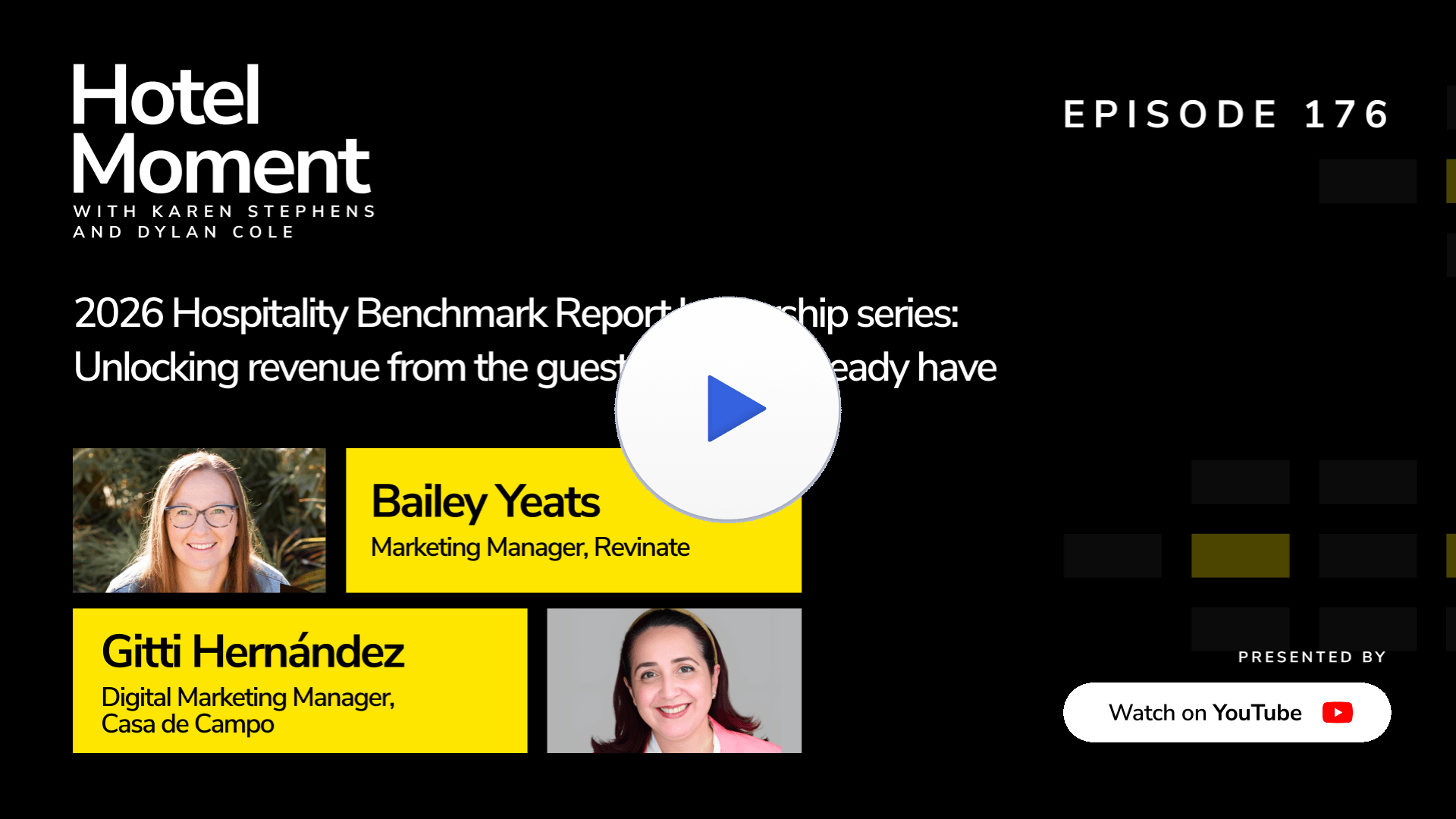
Hospitality Benchmark Report leadership series: Unlocking revenue from the guest data you already have
You’re likely sitting on your hotel’s next major revenue driver. It’s hidden in the guest data you already collect.
When guest data is fragmented, you miss the chance to recognize returning guests and grow repeat revenue. But when that data is unified in a single profile, every interaction becomes an opportunity to build loyalty.
In this episode of Hotel Moment, Bailey Yeats (Revinate) and Gitti Hernandez (Casa de Campo) share how leading hotels unify their data to power smarter segmentation and stronger guest recognition. Learn how to turn guest profiles into a reliable engine for repeat bookings.
Listen now to unlock the value in the data you already have.
Media
Guest recognition = guest loyalty
Guests’ pain points
What better data management looks like
Why guests book through OTAs

Meet your host
Karen Stephens
As Chief Marketing Officer at Revinate, Karen is focused on driving long-term growth by building Revinate’s brand equity, product marketing, and customer acquisition strategies. Her deep connections with hospitality industry leaders play a key role in crafting strategic partnerships. Karen has more than 25 years of expertise in global hospitality technology and online distribution — including managing global accounts in travel and hospitality organizations such as Travelocity and lastminute.com
As the host of The Hotel Moment podcast, she interviews top players in the hospitality industry. Karen has been with Revinate for over 11 years, leading our global GTM teams. Her most recent transition was from Chief Revenue Officer, where she led the team in their highest booking quarter to date in Q4 2023.
Watch the video
Transcript
[00:00:00] Gitti Hernández: We were able to really create a segment of those Ultra VIP, really important guests because we had a cleaner database. We were able to see who had been here really for multiple times.
[00:00:28] Intro: Welcome to the Hotel Moment Podcast presented by Revinate, the podcast where we discuss how hotel technology shapes every moment of the hotelier’s experience. Tune in for our guest episodes, where we explore the cutting edge technology transforming the hospitality industry and hear from experts and visionaries shaping the future of guest experiences. Alongside our conversations with guests, we have episodes for you, hosted by Revinator Brenna Turpin, on resources available to you all. These resource-packed episodes have granular advice on overcoming industry and operational challenges so you can emerge as a hotel superhero. Whether you’re a hotelier or a tech enthusiast, you’re in the right place. Let’s dive in and discover how we can elevate hospitality together.
[00:01:14] Bailey Yeats: Hello and welcome everyone. We are back with another Hotel Moment deep dive. So today is going to be our Hotel Moment webinar series dedicated to our leaders in the industry who are pushing the boundaries of what it means to be successful in 2026. The focus for today’s webinar is going to be all about database health. So specifically, we’re going to be talking about how to actually unlock your revenue from the guest data that you already have, and use that to improve your performance from 2025 into 2026. With me today I have my friend Gitti Hernández coming to us all the way from Casa de Campo in the Dominican Republic. Gitti, welcome. Thank you so much for being here today. Very happy to have you and excited that we’ve crossed paths quite a bit over the last few years. Whether it be NAVIGATE or a training session, whatever it might be, I love discussing best practices with you. You’ve always got such great insights in the industry, and bringing it together from a different area of the world than I’m in, which is always so unique for me. So welcome. Thank you for having me. This is exciting. Okay. Today we’re going to be talking about a few things on the agenda. Number one is going to be some introductions. We’re going to talk about the benchmark report. We’re going to hear a little bit from Gitti. And then we’re going to get into the actual data and metrics that matter when it comes to database health. And then finally, we’re going to talk about the metrics that actually move the meter when it comes to database health. It’s great to know the information. It’s even better to know how you can improve it for next year. So Gitti, why don’t you kick us off here and tell us a little bit about yourself and tell us a little bit about Casa de Campo?
[00:03:03] Gitti Hernández: Well, I’ve been Digital Marketing Manager for Casa de Campo for a little over ten years now. This is my first hospitality job actually. I come from the advertising, social media, marketing world, and it was a real challenge when I decided to come to this resort that it’s an icon in the industry, not only for the Dominican Republic, for the region, for the Caribbean. It was the first luxury resort in the entire Caribbean when it opened more than fifty years ago. Today we’re a resort and residential community that spans over 7,000 acres. We’re actually a small resort, a small hotel with three hundred and fifteen rooms only, but such a massive property. We are home to three golf courses, a private beach, equestrian center, marina, racket center. Altos de Chavón, like the crown jewel. It’s a small village inspired by a Mediterranean 16th century village. And we are really a destination on its own. Not only a community, not only a resort, not only a hotel, not only a concert venue, but a destination like a small city. It’s what we like to call it actually.
[00:04:32] Bailey Yeats: Like a community for sure. Yes. These photos are absolutely stunning and I didn’t realize that you were one of the first resorts to open in the Caribbean, that’s very interesting to hear. Tell me a little bit about this photo in the middle.
[00:04:46] Gitti Hernández: Oh, that’s the Altos de Chavón Amphitheater — a six thousand seat amphitheater, a Greek style amphitheater. It opened in 1984 with a concert with Frank Sinatra, Old Blue Eyes. It was a concert organized by HBO, Concert of the Americas. And Frank Sinatra performed the first night, then we welcomed Heart, Carlos Santana, and an array of other artists, huge artists back then. And since then, Altos de Chavón has welcomed some of the biggest stars in the world, from Andrea Bocelli, Marc Anthony, Jennifer Lopez, Heart, Carlos Santana — we’re gonna be welcoming Maroon 5 in May. Yes, not gonna remember all of them.
[00:05:38] Bailey Yeats: Too many to remember. Too many to remember. What a remarkable property that you have and so vast and so many different outlets to be managing for you all, and you know, different types of guests. I feel like this conversation around database health is so appropriate with Gitti, just because — for many reasons — but for just the fact of how vast your database must be when it comes to different types of guests that are checking in and checking out of your property every single day. So with that, we are going to be talking about the hospitality benchmark report. This report has been around for 11 years. We’ve been publishing this for about as long as Gitti’s been in hospitality marketing here. And so it is really, you know, a benchmark for hotels to be shooting for. In our last session with Christine Malfair, we were talking about email database health and she said this is like the lighthouse for hoteliers, right? It’s something for them to be aiming for. And so we are really excited because this is our most comprehensive edition yet. We actually analyzed over 2.8 billion emails, 4.3 million phone calls, 28 million guest reviews and 22 million text messages throughout 2025 globally. So these are huge, huge numbers of industry-leading insights on guest communications and database quality, engagement rates, even right down to the property size and class. And so in this webinar series, we are covering all of these communication channels that are included here. And like I said, we’re going to be kicking things off today in webinar number two here with our database health. Before we do that, I’d like to just quickly touch on the benefits of this benchmark report for hoteliers. So something that we found in the industry was that if you’ve been around for a while, you understand the feeling of being busy doesn’t always mean profitable, right? You can be busy and not profitable. Anybody can be busy. So, you know, finding a report that actually gives you facts on how to move that needle is really what’s separating hoteliers that are being successful from those that are just being busy. And what the benchmark report does is it gives them a good definition of good and excellence, right? It’s going to separate those two from just doing a good job to doing an over and above job and making sure you’re reaching those data-driven goals. Number two is it’s identifying those invisible revenue leaks. So this is especially true in things like our voice channel, you know, where we have actionable line items to be able to move that meter towards collecting more data from your guests to erase those leaks — or maybe not even just band-aid the leaks but actually fix the bucket. And then finally, showcasing data health and what you need in order to win the race for guest ownership. And that really is the ultimate battle. So if you haven’t quite done so yet, please go ahead and head over to our website or scan this QR code, and that will give you access to the benchmark report for 2026. And you’re welcome to follow along here today as we go through each of the different metrics. All right, Gitti. Database health. This is it. It’s a big topic. As you mentioned, you know, you have a vast number of guests that are coming in and out of your property all the time, that are interested in your property. And with that amount of data that’s collected and, you know, all of the different integrations that are possible, it can seem like a big job to keeping it all straight. And I don’t think it even is just a big job. I — or it doesn’t seem like a big job. I think it might just be a big job. And so what we want to do today, you and I — I would love for us to help guide our viewers through a conversation about some of these main data health metrics, and the metrics that actually matter to people that are in similar roles to you that are dealing with database health every single day. And to do that, we’re going to start with our first chart. Database growth by hotel room count. So what we’re seeing here on this chart is that in North America, we are consistently demonstrating a very robust database growth. And it ranges anywhere from 21 to 26% across all different types of property sizes. So the average here is about 24% for database growth year over year. And that significant growth of your database actually provides properties and marketing managers like yourself the opportunity to activate that guest data and monetize it, right, through your marketing efforts. So Gitti, I have a list of things here about the impact of what different hoteliers find valuable within this data and the impact of it all. But I would really love to hear more about what data capture has done for your team at Casa de Campo, why it’s so important.
[00:10:43] Gitti Hernández: I would say that the most important thing for us right now, after so many years, really paying attention to it and making changes and implementing different things, is personalization. Segmentation is very important. In the beginning — when I say the beginning, I mean a couple of years ago, eight years, seven years ago — we really understood that we needed to grow our database and start bringing all the different systems that we had that no one talked to each other. How to bring them together and start capturing more data and what are we gonna do with it? And I’m not even gonna talk about how to clean it and keep it clean because that is an ongoing effort. It’s a daily thing. But you mentioned a couple of minutes ago, we are a very big hotel and we have so many different types of guests. We have the golfers, but we have the people that only come for our dining experiences or tennis and now pickleball, or the people that only — the guests that only come to be at the beach or for the marina or equestrian. There we have guests that come every year just because of the polo season. They play polo and they want to watch the matches and that’s all they do. So we had to find a streamlined way to differentiate all those guests. And that has been our biggest challenge and our biggest task. How to really identify them and then create a different segment with all those guests. How to talk to the golfers — the golfers that come every year and the new golfers, the ones that only book tee times, the ones that book day-of tee times. That is, we have multiple, multiple factors to segment those guests.
[00:12:39] Bailey Yeats: Yeah. So I mean I hear segmentation and personalization over and over and over again as you talk through this, right? It all comes back to that strategic personalization — the ability to have it, right? You can have all the guest data you want, but it’s actually activating and using that data. So when we talk about actually growing your database, I mean obviously we still want to continue to grow the database as we move forward because that’s how you grow as an operation, but what are the strategies that your team uses to actually grow your database? I mean, we have options like PMS integration, you know, every time that a guest is making a reservation, that data is automatically flowing from the PMS into Revinate. You also have the voice channel. Norberto’s team does a fantastic job making sure those reservations are coming in. So utilizing tools like that. We’ve got, you know, an API contact list. So with all of these guests that are coming, maybe not staying on property, but that are attending specific events — what are you doing with that data? Are you collecting that data and bringing it in through an API contact list, or how are you collecting that to grow your database?
[00:13:55] Gitti Hernández: If it doesn’t come through a PMS or the reservation sales portion, it usually comes through a contact list. We have — for example, we do multiple events outside the property. If we sponsor a golf tournament in another country, for example, in Latin America or Spain, we gather all those contacts of anyone that engaged with the experience that we took to that event. So that’s a contact list that we then integrate with our Revinate lists. If we — for example, one source that has proven very valuable to us is those lead campaigns on Meta. Once in a while we would do a campaign for wedding leads or golf or MICE, whatever. Weddings and villas are the most successful. So then we capture all those emails and then we add them to a specific segment that we already created — Villa leads — and then we start emailing them. But our main source is our website. Not only the users that land on our website that sign up to our newsletter, but the users that complete one of our forms: villas, weddings, MICE, golf, vacation planning, contact us. We have a very long list of different forms and we gather all those emails and then distribute to a specific Revinate list. And then we start engaging with them depending on the different content that we’re gonna send them.
[00:15:28] Bailey Yeats: Right. And I mean, like I said, you have so many different ways of collecting data, different options of ways to collect data, which is great for growing your database. And the nice thing too about setting it up with a contact list — whether it be an API through your website that’s automatically coming in, or whether you’re uploading a CSV — is that you can always turn on, you know, a double opt-in campaign if you wanted to ensure that those guests had given the right consent for marketing to them, right? So these are great options to be able to connect with your guests and grow your database. A couple of other strategies that we see our customers using. We’ve got the data in, so we now have the connection or the ability to connect non-PMS systems like your spa, your golf, your restaurant, and we’re bringing in the data from those software systems into Revinate. And then being able to actually use that to market specifically to them and their needs, which has been proven very fruitful for our customers. The other tool that we talked about quite a bit in our last webinar was cart abandonment. Cart abandonment is such a valuable tool. You know, it’s got that 63% open rate when somebody forgets their vacation in their shopping cart and we get to go recover those lost bookings. So it’s a critical opportunity for hoteliers to be able to utilize that feature. And one little hot tip here that I had added, Gitti, was making sure that there is a standard operating procedure around data collection best practices. So can you talk to that a little bit? Does your team have a strategy for what their SOP is — or standard operating procedure — for collecting data?
[00:17:08] Gitti Hernández: Yes. We have worked extensively with the reservation agents, with the front desk agents — of all the information that a guest can provide, what are the top ones? What are the most important? Because we don’t want to overextend the check-in process, for example. We don’t want to overwhelm the guest. If they don’t want to provide their information, it’s okay. So they know what is the most important information that they have to request and try to get. If they don’t want to give it, then that’s okay. So they don’t extend that conversation too much. And then how it has to be captured — if it has to be like no typos, it has to be capitalized, you have to add the salutation if it’s a Mr. or Mrs. I mean all the salutations, those things are important. And then they have to be aware, mindful of how they capture that data. We have worked also with the reservation agents on how to follow the lead form and then try to get all the fields that it’s possible to get. So then when we work with all the other sources I mentioned, it’s me and my team. So we know how to download the CSV, how to upload it to Revinate, so that’s easier. And then we manage it ourselves.
[00:18:27] Bailey Yeats: That’s great. It’s always great to have some sort of best practices for your team so that everybody’s on the same page. And that’s not to say that other hotels are going to have different ways of doing things — as long as your whole hotel is on the same page, that makes a big difference. Okay, so next up is our database records with valid email addresses and phone numbers. So when we look at the benchmark report, North America actually leads globally with email capture specifically. And so it’s actually outperforming, sitting in between 81 and 90% for all of the different hotel room count options here. And then phone capture, there is a little bit more of a growth opportunity across all property sizes here, which is around 48 to 58%. So what does it mean — you know, hotels in North America are doing a great job of email collection, but there’s definitely room for opportunity or improvement on phone capture. And so what is the impact of having both email and phone? So when we look at email, email has the more marketing and logistics impact. So direct bookings, targeted offers, operational alerts — making sure that having that ability to reach your guests is there and available for you. When it comes to actually collecting phone numbers, this is more of kind of an immediate and direct channel. And so using things like Ivy for automated responses to be able to accommodate questions at your front desk that would otherwise take a front desk agent off the desk is really, really helpful. It’s also great for being able to perform outbound calls, right? How is a reservation agent supposed to make a phone call back to somebody if they don’t have their phone number? So Gitti, what is the impact for Casa de Campo for collecting emails and phone numbers? How does it improve your guest experience and your team overall operationally?
[00:20:24] Gitti Hernández: I think it has improved the experience of our guests in a very substantial way. A couple of years ago — I would say seven years ago — our guests would arrive to the front desk with no reservations made. No dining, no activities. And sometimes we would get guests on their third day, their fourth day of their stay, and then they found out that we had a shooting center. And they were leaving the next day. So they lost that opportunity. So when we started enforcing and really paying attention to capturing the email prior to their arrival — because I do have to say that we have a lot of guests that come through travel agents. Our direct business is much better than ever, but we do get a lot of travel agent business. And then we took it as a mission to make sure that ninety percent of our guests arrive with an itinerary. How do we make sure of that? After they make the reservation, we email them. A vacation planner assigned to that guest would email that guest and say, hi, I’m so-and-so, I want to help you create your itinerary. That improved our guest satisfaction by forty percent. Because then they can make changes, they can add activities or experiences, but at least when they came, they already had half their stay ready, ready to go. So if we didn’t have emails, we couldn’t have done that. So it goes beyond making the reservation, sending the guest or the website user the offer, the percent off, the resort credit information. It goes beyond that. It goes to how to make sure that your experience is the best one. So that for us, I always say that’s the biggest impact for the email capture. Then the phone number — we weren’t really paying that much attention to the mobile phone number because the phone number with reservation sales, it had to be there. And our agents are very good at complying to the report and that was very good. As you say, Norberto’s team, they do a great job with it. When we implemented Ivy, then we noticed we had no one’s mobile number. No one. We had landlines. Because, you know, golfers sometimes they’re a little on the older side. But we had no one’s mobile number. No one’s. So then that became part of our benchmark. We started working with the agents, with the front desk, with the activities, concierge — how to get the phone numbers so we could use Ivy. So we could launch Ivy. And now it’s really a very important part of the experience on property. As you say, guests write to Ivy, text Ivy — I want more ice, I want to change my dinner reservation, how do I get more towels? How do I get to the beach because I’m lost? Because this is such a big property that guests get lost. And that has helped a lot, really.
[00:23:35] Bailey Yeats: Wow, that’s so great. And as I listen to you talk about your resort, is there anything you can’t do at Casa de Campo? It sounds like there’s just — well, you can’t scuba dive. Okay, well there you go. That’s one thing. That’s one thing. You know what? Having the vacation planners, being able to connect with them, that’s a really, really nice personalized touch. And I’m certain it makes them feel so special when they’re checking in and when they arrive. So well done to your team. So let’s talk a little bit about the strategy that you — that you know we have for best practices here to use and that you’re using for improving your overall guest database. So we’ll go through each of the different stages here and talk about opportunities to improve the collection of things like email addresses, phone numbers, every stage. So when it comes to the booking stage, and you touched on the SOP, it’s empowering your reservation agents with the tools, right? Giving them the tools and the training can make sure that they’re able to actually input the correct data into the lead forms and so that they are not making incomplete lead forms that then don’t fulfill the fields that are required within the CDP, right? Using the compliance report to pinpoint where the agents are requiring a little bit of additional support, and making sure that during a sales call they are collecting all of that foundational guest data that will feed into their rich guest profile. One of the things that I found when I was working with the training team is that, uh, I would oftentimes see these opportunities where agents or whoever it was was collecting email addresses just to fulfill a field. And it wasn’t necessarily the right email address. And I think that that is a practice that we’ve really tried to hone in on. The fact that if they don’t want to give the email address, that’s okay. The system is built to be able to notify you of that down the road, right? And try again to collect that. So the next phase is checking in, collecting their direct email address. Now, maybe they didn’t want to give it to you originally when you were making the reservation, but now they’re more willing to give you that direct email address or phone number at check-in because you’re actually clearly identifying what the benefits are of having that information on file. And I think that’s really important for properties like yours where there is a very big reason for you to have that data and it’s for their own experience. So letting them know of the benefits for receiving special offers, or even just to be able to text Ivy and find out where they are on property — these are all really great points. And then obviously when they check out, this is the final phase of collecting that information before they depart. And we see customers using things like the departures report in Revinate Marketing to identify which guests have still yet to provide that data and, you know, making sure that they get that on their way out. So without giving away kind of the secrets that you have, Gitti, are there a few tips you can offer our viewers for collecting the email and phone throughout these three stages? And yeah, just any kind of insight into efforts they could put forward.
[00:26:48] Gitti Hernández: Well, at check-in — I think after the booking stage, check-in is the most important — because the reception agent will provide reasons to kind of get your email: so we can notify you prior to your checkout if you want to receive your bill, if you don’t want to come through the front desk. So most times guests will provide it if they haven’t already. So that’s important — that the reception agent gives them peace of mind that that’s why we need it. And they usually provide it. We do have a couple of other touch points throughout the property. For example, when they do any activity, they will be asked to complete a satisfaction survey right at the activity front desk. So most guests do it, others don’t. But then at checkout, we try to keep it very brief, and most guests — they don’t want to spend a lot of time at checkout. So we do send them a pre-checkout letter, 24 hours prior to their checkout, and we tell them at check-in that they’re gonna be receiving it. So that’s when they mostly give their email if they haven’t — when they are told that they will be receiving this letter to book again if they want to, or whatever. So that’s when we usually get them. A checkout collection doesn’t really happen that much for us.
[00:28:20] Bailey Yeats: And I mean when there’s something in it for them, right? There’s something in it for them to be providing this information. I think that’s really helpful — being upfront and open about why they should be offering this information.
[00:28:33] Gitti Hernández: When they ask, for example, to get a dinner reservation that they didn’t have, the concierge will ask them, do we have your email address? Do you want to receive the reservation confirmation? And they usually ask when they don’t see an email in the guest profile, in the PMS. So then usually the guests will provide their email address. Yes, yes, I know. Yes, send me the confirmation. And that’s how we get them.
[00:28:58] Bailey Yeats: Concierge is an excellent kind of add-on to this that a lot of properties will overlook — the fact that they have this tool — because they’re often the ones that are making reservations for them in different areas, and they’re a great place to be collecting that information.
[00:29:12] Gitti Hernández: And in Casa de Campo you need the concierge to make any change or any reservation that you didn’t have when you arrived.
[00:29:20] Bailey Yeats: No, that’s great. I like that a lot. Okay, our next chart is our database records with OTA masked email addresses. So in North America, 12% of email records are masked by OTAs. So what this means is that for every 100 guests in your database with an email address, 12 of them are unreachable due to an OTA booking. And so if you took that number and you scaled that up to your full database, add a couple of zeros onto the end of that. That might mean that you have a lot of guests that are unreachable. It’s even higher in other regions in the world. In APAC, it’s 15% and EMEA, it’s 34%. But even the 12% in North America, it really does demonstrate this strong need for a direct booking strategy. So what is the impact for hoteliers? Having masked email addresses provides you with only a temporary way of communicating with them. So you can reach them before they check in through this masked email address. And then you can reach them for a limited amount of time after — and that’s this hard expiry. So they do expire — up to twenty to thirty days. We don’t really know for sure at this point. It seems to change all the time and get narrower and narrower for that window. But basically, what it means is that you have a missed opportunity for relationship building with those guests and for any chance of rebooking them in a direct way. So Gitti, when we talk about masked profiles or OTA bookings, tell us how your team navigates around that or through that. I think OTAs do provide an excellent opportunity to bring bookings into your property — there’s no doubt about that, into many people’s properties. However, it’s what they do with them once they have them that’s really important. So tell us a little bit about what your team does.
[00:31:15] Gitti Hernández: Well, I have to confess this is one of the last automated letters that we implemented. I think we did it after we came from the last NAVIGATE. That’s when I said we’re gonna do it. We’re definitely gonna do it. So we created the OTA win back letter. I think it has performed very well. I think we have more emails than I thought we were gonna get. Because you never know with OTA guests — you don’t know if they really want to sign up to your newsletter. That’s how we get them. That’s the invitation that we send: do you want to know more about Casa de Campo news? Make sure you never miss one of our emails, or whatever. So it doesn’t include an offer. I said, let’s try it for a year without an offer. Let’s see how it performs. And then we’ll see if we add an offer. So right now it’s just: sign up for our newsletter.
[00:32:05] Bailey Yeats: If it works. Yeah, it sounds like it works. And I mean you can look at the reporting and how you’re doing on the benchmark. I would actually welcome you to connect with me at NAVIGATE this year because it’ll have been a year and we can go through it and see what the performance is like. That would be really exciting for me. I would enjoy that a lot.
[00:32:23] Gitti Hernández: Yes. And it’s now more important than ever because for hotels, it’s even harder on a daily basis to talk to that OTA guest. Because even in their private platforms you can’t see their contact information. So it’s more important each day.
[00:32:42] Bailey Yeats: Yeah. So we talk about different strategies for OTA bookers, converting them into, you know, loyal direct bookers. And I think that proactive data capture, of course, is definitely at the top — making sure that if they do come through an OTA, that we are recognizing that upon arrival. Like you said, your agents at the front desk do a fantastic job identifying them through whatever means necessary, but those means might be through the arrivals and departures report in Revinate, right? So if you look at the arrivals report the day of arrival, and you notice that you have all of these exclamation marks in the email field, that’s a really good indicator that you’ve got lots of OTA guests coming on property. And I think that if you’re actually able to provide them good reasoning for why they should be a direct booker next time, we will see your campaigns perform even better. And I’m not suggesting that they need to have an offer, but what is the benefit of them being a direct booker versus being an OTA guest? Right. So finding out what your benefits are and talking to your team and understanding that a little bit better. The other thing is the enhanced data quality. So you talked about your agents. We know that agents are doing the very best they can to fill out those lead forms and they do a really good job on your team. I think they’ve had some good training, I must say. So I think making sure that those lead forms are filled out to maximize the effectiveness. And like I said before, I’ve come across email fields that say no-name at forgottoask.com or at oops-didn’t-ask.com. I’ve seen these fields filled out like that. And that is doing such a disservice to your overall database and your overall efforts. So you have tools at your disposal to use. You can use your database insights report to go in and take a look at all of the different domains. And if you find someone who is using did-not-ask at no-name.com over and over and over and over, you can then take that information and approach that person or find out what it is that they need to be more successful in capturing that data. The other thing is exactly what you’re doing — utilizing that OTA win back campaign. So leveraging the post-stay communications, making sure that you’re providing those benefits to help win them over for their next stay. So I think that when I looked at your account, Gitti, it appears to me that you’re doing a fantastic job of winning your guests over. You’ve got lots of merged profiles. So that tells me that when your guests are booking, even if they’ve booked one time through an OTA and another time through a direct method, we have enough data to be able to merge them together. And so I think your team is doing a great job. So kudos to them. But is there any other strategies that you would offer here to use to turn those bookers into loyal guests?
[00:35:39] Gitti Hernández: I think it’s exactly what you just said. We need to find out what it is that makes them book through an OTA. What is the benefit that we are not providing? Is it the package, the hotel and flight? Maybe that’s one benefit. But in the end, we’re giving them the same room type, the same amenities, the same access, so we have to find out — and if you’re doing it correctly, you have rate parity. So we need to dig deeper and find out what is it that they are finding with the OTA that they don’t find with us directly. Maybe it’s just convenience, maybe it’s just this is the way I’ve been doing it forever and I don’t want to risk it, maybe. But we need to find that out and then tell them — if it’s that, I don’t want to risk it — give them that peace of mind that you can book directly with us, you’re not gonna miss anything.
[00:36:34] Bailey Yeats: And it might even be something like your planning team that you have — you’re providing itineraries, maybe that only happens if they’re not an OTA booker. Maybe OTA bookers don’t get that, right? So well, I think we have to think outside the box as to — like you said — what is it that makes them book through the OTA instead of booking direct? Yes. So yeah, all really great points for sure. And the last one we have here is our merged profiles per database. So this kind of goes back to what we were just talking about, merging those different profiles together. And in North America, 11% of profiles are successfully merged through Revinate’s identity resolution. So what this means is databases are growing across all regions — you can see it here. But investing in that profile merging and data unification software is ensuring that when you do get a new record, you are contributing to a richer, more actionable profile. And I think for your team at Casa de Campo, it sounds like that impact is very high because if you have guests that stayed multiple times, one trip they golfed and then the other trip, you know, maybe they didn’t golf, maybe they did something else, maybe they went horseback riding. Right now they look like two different guests, but if we merge them together, they’re actually a guest that enjoys a lot of different activities on your property. And so unifying that data and eliminating those duplicates is really, really important. It also gets down to being able to have a better story about your guests. So like I just said, maybe they do enjoy multiple facets of your property. And you know, having those deep insights into their spending habits about what they’re doing while they’re on property is really, really valuable. The other thing is just the general marketing and operational impact, which is pretty obvious, right? When we have the ability to merge them together and see the real identity of these guests, you can have better personalization, better targeting, you can deliver a more personalized guest experience. So, Gitti, before we talk about some strategies to help people get their profiles merged together, tell us about the impact of merging profiles for you. Maybe I got it wrong, but I think that that would be very valuable for Casa de Campo.
[00:38:47] Gitti Hernández: When we were able to start merging all those profiles, we really saw the light of day. Because for me, one of the biggest pain points for guests is when they arrive — not necessarily here, to any hotel — but they have been multiple times before, and the front desk tells them, oh, welcome — and they welcome the guest as a first-timer. And I know how that feels. That’s terrible. Last year we celebrated our fiftieth anniversary — the year before. We were able to really create a segment of those Ultra VIP, really important guests, because we had a cleaner database. We were able to see who had been here really for multiple times, played golf. We created a profile of who that ideal guest was to celebrate our 50th anniversary. And if we didn’t have all those merged profiles where we could see — I don’t think we would have been able to create that specific segment. Because we either just had to go with: stayed two times or more, spent X amount of dollars. We wanted to go a little further — someone that really had experienced most of what Casa de Campo is. And before we had merged profiles, we had duplicates all over. Profiles all over — like once, three times, four times, the same person had multiple profiles, just because one had a period, one had a period at the end, one had an extra character — it was crazy. So Revinate helped us with all those points.
[00:40:34] Bailey Yeats: I’m so pleased to hear the results of that for you, and congratulations on your anniversary. Happy belated anniversary. What a great milestone. And that’s a great example of why this is so impactful because you’re right, there is nothing like going to a property and being recognized for having been there before. That feeling is something that is irreplaceable. You can’t change that feeling. So that’s great. The last thing here are strategies to help merge those profiles. So I think we’ve talked about a lot of these already as we talked through the content of our webinar today, but just to kind of bring it all around — inputting clean validated data. And while we do have this very robust identity resolution tool, starting with really clean, accurate data minimizes all sorts of different kinds of errors and improves match rates tenfold. So making sure that we’re using clean data. This point comes back again to never using a fake placeholder for email addresses. We don’t need to do it just to satisfy a field. Do it because the data is accurate and true. And if it is not there and available for you, let Revinate’s tools do their job and let you know that this guest needs an email address upon arrival. And then structuring your data correctly. So when you’re inputting contact lists — and I’m sure you could write a whole talk on this — inputting contact lists and making sure that your first and last name fields are separate and in distinct fields, because when you go to use a merge tag like Ms. Hernández, if you have Gitti Hernández in the full name criteria field, that’s not going to work, right? You’re not going to be able to address that guest as Ms. Hernández, right? Really just making sure that the data that you are entering into your fields is correct and usable. I’ve seen it many, many times where someone uploads a contact list that has a field or column that has something that is completely irrelevant to what they’re trying to achieve. So get rid of that column altogether. It might be a yes or no for something, and it’s not even something you’re ever going to use. So please just be aware and only input the data that you’re actually going to use. Gitti, tell us a little bit about what these strategies are for your data inputs with your team.
[00:42:55] Gitti Hernández: Well, the number one is making sure they understand why these things are important. Because just adding a placeholder in a field — completing the field because I’m supposed to complete this field — that is the biggest problem. So making sure they understand why. Not just because you’re gonna complete the field to make me happy or make your boss happy, but why is it important, how it connects with everything else, and how it will break something else if you do it wrong. So I think that has been the most important thing. Before we started doing that with the team, it was, oh yeah, yeah, I’ll do it — but if you don’t understand, you don’t feel on board. You don’t see the impact, you don’t feel that you are part of the success. So for me, that has been the most important thing. When we get those contact lists from the different events — like you say, we need to make sure fields that we don’t need, columns that we don’t need, just get rid of them. We found, for example, when we did golf events, we would always get the contact list with a handicap number. Sadly, we don’t have any use for the handicap, so we don’t include that. We keep the original in case we ever need it, but we have no use for that specific information. So we remove it. But they all come with it because that’s important in a tournament, but not at this level. So that’s something that was important for us — to make sure what is the data that we’re going to be using. First we did some research, we reviewed all our marketing efforts, because if you don’t know what you’re gonna do, you don’t know what you don’t need. So until we realized what information we are effectively going to use, then we said, okay, these are the fields that we need — and just staying on top of it. Going through all the reports myself.
[00:44:55] Bailey Yeats: That is — I really like that last point about teaching your team the impact of their role. I think reservation agents are the ultimate foundational piece to everything that you do when it comes to guest data, because they are the first touch point. They create the base of the house to build on, right? So it’s really important. And it’s neat to watch them see the fruits of their labor as well. So kudos to the team. Well, Gitti, you sound like a very busy lady. So I’m so appreciative of your time. Thank you so much for joining me today to talk about database health. It’s been a wonderful conversation. And I love learning more about Casa de Campo and what your team is up to there. It sounds really, really remarkable. These benchmarks are really going to be for the savvy hoteliers who want to collect guest data and they want to take action on it. And so if you haven’t downloaded the report yet, now’s the time to head over to the website and get access to the 2026 Hospitality Benchmark Report. As I mentioned, this is a three-part webinar series. We had our first one last week — that was all about email marketing, and that was with Christine Malfair. And next week we are having our voice channel session with Amanda Wask-Brown from Old Edwards Hospitality Group. So be sure to put it on the calendar and we’ll hope to see you all at that one as well. Gitti, I’m very excited to meet up with you at NAVIGATE in just a couple of weeks. I can’t wait to see you and Norberto. And I cannot wait to dig into your OTA win back campaign in person with you and dig into the real numbers. So thank you so much. Thank you for joining us, Gitti, and thank you everyone who joined us here today.
[00:46:38] Gitti Hernández: Thank you.
[00:46:43] Outro: Thank you for joining us on this episode of Hotel Moment by Revinate. Our community of hoteliers is growing every week, and each guest we speak to is tackling industry challenges with the innovation and flexibility that our industry demands. If you enjoyed today’s episode, don’t forget to subscribe, rate, and leave a review. And if you’re listening on YouTube, please like the video and subscribe for more content. For more information, head to revinate.com/hotelmomentpodcast. Until next time, keep innovating.
Episodes
Hotel Moment
WITH KAREN STEPHENS
Subscribe for updates on your favorite platform