Hotel Moment
WITH KAREN STEPHENS


Episode 147
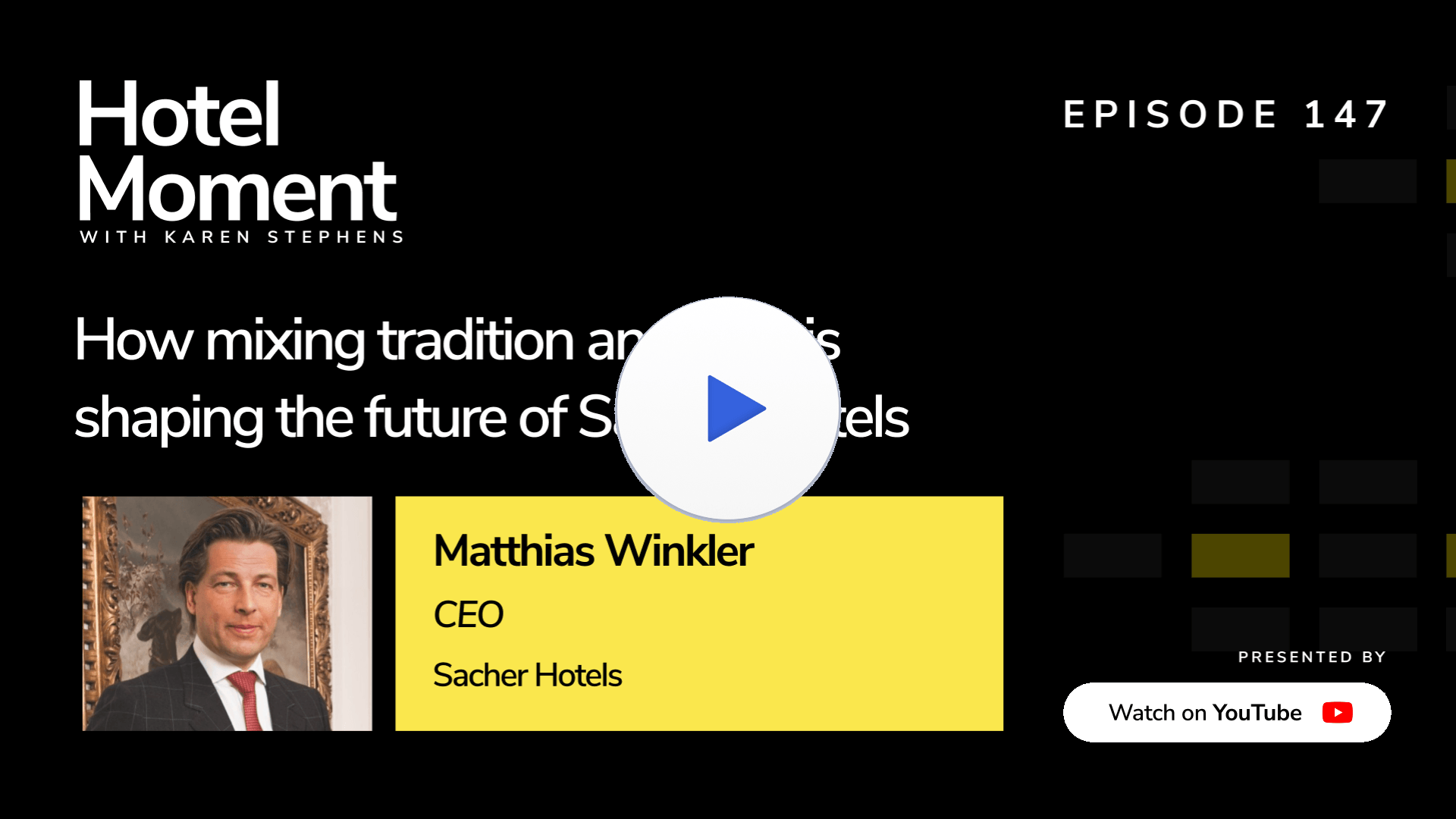
How mixing tradition and tech is shaping the future of Sacher Hotels
In this week’s episode of Hotel Moment, Matthias Winkler, CEO of Sacher Hotels, joins Revinate CMO Karen Stephens with guidance as to why hoteliers should pay attention to the speed of change at their hotel. Specifically, he shares how you should be using technology as a tool for transformation without leaving behind all that makes your hotel unique.
Matthias advocates for technology as the “great helper,” if it’s leveraged to support business goals and deepen relationships with guests. Technology champions progress, but guests crave authenticity, and Matthias explains how to strike the balance between the two to keep the guest experience alive and well.You’ll also hear the cherished history of Sacher Hotels and the legacy Austrian hoteliers have left in the hospitality market with their unique amenities infused from the local community.
Tune in to find out how to keep up with the digital revolution and deliver tremendous value to guests.
Media
Make tech easy to integrate and easy to train
Make the guest experience personal
Do more than sell the guest experience — bring it to life
Implement what works now
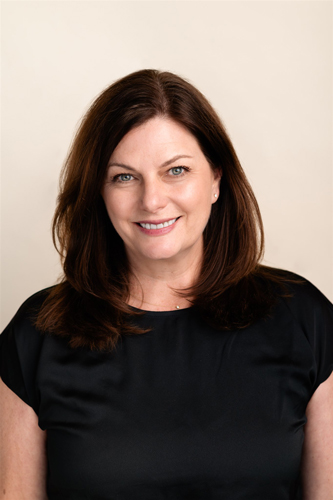
Meet your host
Karen Stephens
As Chief Marketing Officer at Revinate, Karen is focused on driving long-term growth by building Revinate’s brand equity, product marketing, and customer acquisition strategies. Her deep connections with hospitality industry leaders play a key role in crafting strategic partnerships. Karen has more than 25 years of expertise in global hospitality technology and online distribution — including managing global accounts in travel and hospitality organizations such as Travelocity and lastminute.com
As the host of The Hotel Moment podcast, she interviews top players in the hospitality industry. Karen has been with Revinate for over 11 years, leading our global GTM teams. Her most recent transition was from Chief Revenue Officer, where she led the team in their highest booking quarter to date in Q4 2023.
Watch the video
Transcript
[00:00:00] Matthias Winkler: How can we make evolution happen without revolution? Because if you’re too fast, if you’re too quick – might be as harmful if you are too slow or too steady. So that’s for me a question of finding the right speed for change.
[00:00:22] Karen Stephens: Welcome to the Hotel Moment podcast presented by Revinate, the podcast where we discuss how hotel technology shapes every moment of the hotelier’s experience. Tune in for our guest episodes where we explore the cutting edge technology transforming the hospitality industry and hear from experts and visionaries shaping the future of guest experiences. Alongside our conversations with guests, we have episodes for you hosted by Revinator, Brenna Turpin, on resources available to you all. These resource packed episodes have granular advice on overcoming industry and operational challenges so you can emerge as a hotel superhero. Whether you’re a hotelier or a tech enthusiast, you’re in the right place. Let’s dive in and discover how we can elevate hospitality together.
Hello, and welcome to the Hotel Moment podcast. I am your host, Karen Stephens, the Chief marketing officer of Revinate. And today, we are excited to speak with Matthias Winkler, the CEO of Sacher Hotels, a renowned luxury group that includes the Hotel Sacher in Vienna and Hotel Sacher in Salzburg, along with other prestigious properties. With an extensive background in hospitality, Matthias is passionate about combining tradition with innovation to elevate the guest experience. Under his leadership, Sacher Hotels has embraced a forward thinking approach while remaining deeply rooted in its rich heritage. As a member of the executive committee of Leading Hotels of the World. Matthias is deeply involved in shaping the future of hospitality, particularly around sustainability and family business values. With a vision to enhance guest experiences through personalized offerings and selective tech adoption, Matthias has been at the forefront of redefining luxury hospitality. And my friends, you are in for a treat today. Matthias is the CEO now of Sacher. It’s a family owned business, as I mentioned, and it’s, the first hotel originated in the 1870’s. So you’re really listening to someone who fully embraces the legacy of the past while also making sure to integrate the modern world. So I think you’re in for a treat. Here’s Matthias. Matthias welcome to the podcast. It’s a pleasure to have you here.
[00:02:31] Matthias Winkler: Thank you for invitation. Looking forward to meeting you online.
[00:02:35] Karen Stephens: Nope. Isn’t that nice? That’s right. Everything’s so virtual today. So it’s wonderful. So I think we wanna start out. I would love for our audience to understand a little bit about Sacher Hotels and the portfolio, where they’re located. It’s a beautiful portfolio. So tell us a little bit about it.
[00:02:50] Matthias Winkler: Well, we are located in the heart of Europe in small Austria. Lot of people know about both, either the mountains and on the other side, a lot of culture. And we have two hotels. We own and run two hotels, one in Salzburg and one in Vienna. And we are, in Vienna, actually the only five star hotel that’s still run and owned by a family, and in Salzburg, actually the only one. So we are kind of, a very unique and very traditional on the one hand, and on the other hand, a very authentic modern way to not only be tourists in our hotels, but to become Viennese or to become a Salzburger for your stay.
[00:03:31] Karen Stephens: That’s really incredible. So you mentioned family owned. How far back does that hotel go?
[00:03:36] Matthias Winkler: Well, the family has always been family owned, and our family goes back to 1876 when the hotel was first founded. Then the Sacher family was running and owning the hotel. Finally, they got bankrupt in the thirties of the nineteenth century. And since then, our family is in power, so to say.
[00:03:57] Karen Stephens: Wonderful. So, Matthias, you’ve had a remarkable journey in the hospitality industry. Could you share with us how your experience in communications and leadership at various organizations has shaped your experience and your leadership at Sacher hotels?
[00:04:11] Matthias Winkler: In Austria, we have a lot of tradition. And one of the traditions is, how did I become a CEO? By marriage. So the company is owned by my wife and by my brother-in-law, and I had a lot of experience outside tourism. And I was working for the finance ministry, and I was at McDonald’s being responsible for marketing and sales, and I have been working for online gaming. Bwin was the company. I had my own companies in PR and lobbying affairs. So I had an interesting journey before I finally got married and I finally got invited to run the company. My predecessor was my mother-in-law. So quite an interesting story, and I finally landed in tourism fifteen years ago, took over a very well functioning company. We have been number one, and so I had pole position to start the race. As all of our listeners and followers will agree, I think we have an interesting competition between family owned companies and all the big brands’ international chains. So that’s probably, on first side, the biggest challenge we have. Till today, the last numbers I got this morning, we’re still number one in Vienna and in Salzburg.
[00:05:31] Karen Stephens: That’s wonderful. So how do you compete with the big brands? You know, you mentioned, obviously, brands, OTAs. There’s a lot of marketing dollars. There’s a lot of awareness. So how do you make sure that guests and people are aware of those hotel brands? Is it maybe somebody who hasn’t been to Austria before? How do you kinda float up within all of that?
[00:05:48] Matthias Winkler: The answer is very short and simple, simply by being number one in quality. And, again, as everybody who is now listening, that sounds easy, but it’s pretty tough to do. So we focus on our people. We focus on quality. We focus on being the first. We focus on all that stuff because we exactly know we can’t compete with international brands, their PR network, their money network, their sales network. So the only chance we have is simply be better in operations, have the better ideas for social media because we won’t have the money, but we have the ideas.
[00:06:29] Karen Stephens: You have the ideas. You also have a strong affiliation with Leading Hotels of the World, which, of course, everyone knows is a beautiful collection of independent hotels. Can you talk a little bit about how that organization also helps to kind of help with those really unique properties globally to get more exposure?
[00:06:45] Matthias Winkler: As I mentioned before, we have a smiling on our face when we say that we’re we’re worldwide known in Austria. So 92% of our guests are non Austrian. More than 70% of our guests are not German, Austrian, and Swiss, which are the neighboring countries. So we have more than 100 nations traveling to small Austria. So one of them, the major questions is, how do we get to Korea? How do we get to Los Angeles? How do we get to Mexico City? And being a small company, being family owned, having the structure, we need international partnerships. And we call booking.com. We call all these OTAs partners because they help us to reach people outside of our borders. But the biggest partner, of course, is Leading Hotels of the World because we don’t only find sales and marketing and PR network. We also find kind of a family because Leading Hotels is a group of more or less family owned, family run hotels with sometimes long stories, families in the third or fourth generation. So it’s both, it’s marketing PR sales, and it’s kind of a family of people who think alike.
[00:08:06] Karen Stephens: Yes. That’s wonderful. I mean, we’re long time partners with Leading Hotels of the World, and I’ve always been impressed with the quality of hotels within that organization. And I’m sure, obviously, you’re five hotels, but the standard that you deliver to be able to have peer groups within that organization of similar hotels is really neat.
[00:08:23] Matthias Winkler: Absolutely. And I’m a board member since almost nine years, so I kind of have some insights, which, obviously, I can talk about on this podcast. But what I see since these nine years, there is one major goal that’s quality, quality, quality. Simply be best in class and try to make our guests dream. And that’s what we’re working for, and that’s what the family of more than 400 luxury hotels do.
[00:08:51] Karen Stephens: That’s wonderful. So let me ask you. How do you balance tradition with modern evolution of technology? So you mentioned your hotel, Sacher, has been around since the mid nineteenth century. And how do you balance that quality, that tradition with the modern world and what travelers are expecting today? So can you talk to us a little bit technology evolution?
[00:09:09] Matthias Winkler: Maybe that’s the biggest task we have. How can we make evolution happen without revolution? Because if you’re too fast or if you’re too quick, might be as harmful if you’re too slow or too steady. So that’s, for me, a question of finding the right speed for change. And, of course, you mentioned it, technology is our biggest helper. And I’ve met so many traditional families and hotels which have very different approach to technology. They probably are afraid of, might harm the business, etcetera. We have a completely different view on that. We think that whatever brought us here might not bring us further. So whatever we did today to reach to the position of being number one, if we would stop here or if my mother-in-law would have stopped, like, twenty years ago, we would not be number one anymore. So we need to have evolution every day. And evolution without technology, I don’t think that’s possible in today’s times. So technology is our big, big helper.
[00:10:18] Karen Stephens: So what’s your approach to integrating that technology in your hotels, and how does that align with your vision for guest services when you talk about maintaining that quality?
[00:10:27] Matthias Winkler: Whatever is available for our guests offline should be available online and vice versa. That’s basically the idea we try to follow. So, of course, we use ChatGPT. Of course, we use Revinate. And, of course, we use many other technologies always trying to help customers’ experience to make it as personal, as individual, and as fast as possible. So whatever helps our goals and technology can provide, we immediately implement. We don’t use technology for technology reasons. We always have business reasons. We always have ideas. What do we want to provide as a guest experience? Is technology there to help us? Then we implement it.
[00:11:19] Karen Stephens: That’s fantastic. So you mentioned a little bit about OTAs, about booking.com and some other OTAs that I mean, absolutely 100% agree that to get that first customer, initial guest experience, initial booking onto property is important. And certainly, when you operate in Austria, you have travelers that are coming globally. You need the footprint. How do you use technology then when the guest comes on-site? Because, obviously, OTA bookings are rather anonymous. So can you just talk to us about how that gets married up once that guest comes on-site so that the repeat booking comes direct to the hotel, not just for the commercials of it, but for the guest experience behind it.
[00:11:57] Matthias Winkler: I mean, we have various touch points, and it’s always guest decision. Does he want to use a conversation like we have now, or does he want to have conversation with our chatbot? Does he want to call the concierge, or does he want to chat with him? So whatever channel can be used, we provide for our guests because our experience is, you know, sometimes people are afraid of using their language or probably if English is not there or even German is not their mother tongue, they’re probably sometimes not too self secure and use these languages and are more happy to use chats, to use their language, and AI translates it in real time. So there might be many reasons for many different channels. So the first thing we do is customer experience first, and whatever technology can be used, we provide. At the end of the day, we always have our people down at the lobby helping as a person, but anything different, we provide for our guests.
[00:13:02] Karen Stephens: So it’s really the true definition of omnichannel. However that guest wants to interact with you, in person, chat, phone.
[00:13:09] Matthias Winkler: Exactly. It should be his decision and whatever reason. I just tried to point out one of the reasons why people probably don’t wanna talk from person to person. And there are many more reasons. It could be language. It could be culture. It could be whatsoever. So I think technology is a big helper, especially in translating language 24/7, 365 to whatever helps the guest experience. We provide technology for that.
[00:13:37] Karen Stephens: So let’s talk a little bit about on property amenities. So I think part of the guest experience is also making sure that when customers aren’t when guests are on property, that it’s the best they can be. And I know that sustainability is a big thing for you as well. So can you talk about some of the amenities that you provide at Sacher and how that layers into a guest experience?
[00:13:57] Matthias Winkler: Absolutely. For example, on our tables, you will find these QR codes, and we have a multilanguage menus. And in these menus, we provide even the recipes, maybe a video, maybe a photo, what materials we use, how we do it, including the recipe, etcetera. So this helps us, for example, full transparency, a lot of information if you simply want to know more about your Wiener Schnitzel or even more about your Sacher Kate. That’s one of the examples we, for example, use. And there are many more where we provide on-site technology and use your smartphone to get the information and to get whatever you try to get.
[00:14:41] Karen Stephens: Right. I think that is really cool because, I mean, I know as an American has traveled extensively in Europe, especially when I was young, you walk into these beautiful churches, hotels, different things where there’s such a rich history there, and you don’t have any clue what you’re really looking at. Or as you said, is this the Wiener Schnitzel or it’s a different dish that is traditional? And if you just order something off the menu, you don’t have any idea. So I love it that you make available to people the ability to understand a little bit more in their language what they’re actually experiencing.
[00:15:12] Matthias Winkler: Absolutely. Another example would be we have in a long, long history. Starting Queen Elizabeth, we had foreign ministers of The United States. We have Mark Zuckerberg. We had so many people staying with us, and some of them signed their photo. And we have a beautiful and nice gallery. And we also have an an online guide that leads you in your language and shows you who has been our guest, what time, what was special about him, etcetera, etcetera. So you get a lot of information, which without technology, it would not be possible.
[00:15:47] Karen Stephens: That’s right. It wouldn’t be possible, and it’s kind of I wanna say the word blissfully unaware. You’re in a beautiful hotel, and that’s amazing in and of itself. But without knowing who had been there before or the history behind it, you’re missing so much of the story. It just sounds like such a lovely experience. It’s way beyond a hotel stay. Right? It’s infinitely beyond a hotel stay.
[00:16:07] Matthias Winkler: Absolutely. Correct.
[00:16:09] Karen Stephens: That’s so cool. So how do you think about now, I mean, you know, there’s a lot going on in the world, macroeconomics, a lot going on with politics and all of that. So you have these beautiful hotels, you’re top of the market, you serve the luxury class, but even with that, there’s still some uncertainty to navigate. So how do you think about that as the CEO of your organization, particularly in the times that we’re in?
[00:16:31] Matthias Winkler: There are so many sad things happening. Actually, we can influence them. We can try to be good and nice people in our surroundings, but, honestly, and, actually, we cannot change all the wars that happening on all the other crisis. So as a company, we stop talking about these things. We focus on what can we do to change and make things better. So I think uncertainty is, in times like ours at like today, uncertainty is member of our board. It’s always there. And we can discuss, is this good or is this bad? But uncertainty brings us to being more flexible, being faster, and all these things. So we try to make the best out of these situations, and I think uncertainty will be our partner in the future. It this will not change. Digital means more information for more people. We know much more about this crisis, and we have broader information backgrounds, but it also means everything goes much faster than we were used to. I’m 56 now, and the speed we have at the moment is it feels like minimum double speed, social media included, etcetera. Whatever happens today in New York, minutes later, we know it globally. And what we try is to use all these things happening around the world and make the best out of it. So if we see that security is getting more and more important and we experience that from our guests, people would prefer traveling to secure hotels and secure cities, cleanliness, sustainability, whatsoever. We can immediately react by telling the stories to influencers, telling the story through the web, so to say. And that’s how we try to focus on what are the things we can do, what are the things we can change, and we focus on doing that, but discussing all the crisis with no outcome.
[00:18:36] Karen Stephens: I think that that’s a good point. As a leader in that position, trying to make sure that you can maintain a sense of stability and tradition, and you’re not ignoring the change. We had a speaker at our conference who said, things are moving really quickly these days, and I don’t think they’ll ever be this slow again. Right? Like, it’s like it’s it’s an exponential
[00:18:56] Matthias Winkler: I’ve heard this sentence a couple times on many conferences, and I think it’s true.
[00:19:01] Karen Stephens: Yeah. That’s right. So what role does family culture play in the success of your legacy hotels, and how do you see the Austrian hotel industry adapting to changes in hospitality trends?
[00:19:11] Matthias Winkler: We see or I have to explain that the most Austrian hotels are family owned. Many of them or, I would say, more than 90% are in the countryside. So there are very few hotels family owned in the cities. As I said at the beginning, we’re the only five star hotel in Vienna that’s still run and owned by a family. So I think in times like these, people traveling to Europe, people traveling to Austria, people traveling to Vienna, they try to get the most authentic experience they could probably get. And I have stayed in many Marriott hotels, and they are wonderful supplier, but I think the Sacher gives a more authentic experience about Vienna. So I think families, especially in the luxury traveling business, have a big chance by being the local source for information, the local place to stay and become Viennese for three days. This is possible in a family hotel because you literally come to our place where we live. You come to our home. And whatever your experience at the Sacher, both in Vienna and in Salzburg, could be it will be a local with local experience, local expertise, and you have many best schnitzels in Austria. But probably you have the most Viennese one at the Sacher in Vienna and the most Salzburg one in Salzburg. And I think that’s our secret, and that’s what we can do for the business. Yes. Of course. The other side is we are competing in a global market, more than 100 nations. We don’t have the money. We don’t have the networks like the big chains have. So this is the tough part of the business for a family owned. But that’s why we have the networks. That’s why we have podcasts like yours, Karen, to tell our story to a global traveling community and convince them. If you go to Vienna, you have to be at the Sacher, and you have to taste the schnitzel, and your dessert has to be the original Sacher cake recipe going back to 1832, then you have been in Vienna.
[00:21:26] Karen Stephens: That’s right. And you know what? I just have to say, Matthias, that is the stuff that money can’t buy. The culture, the history of the hotel, the family legacy of the hotel, Obviously, you can buy a sack of cake, but I know you know what I’m saying. There’s not enough PR dollars, website. Like, what a wonderful opportunity to lead a portfolio of hotels that has that legacy. So wow. Fantastic. So my final question for you, what are you seeing for the next, call it, five to ten years as you think about going forward into the next, call it, decade with these hotels? What is top of mind for you in terms of continued success?
[00:22:05] Matthias Winkler: I will be very honest. I have no idea. And I learned from the last years, especially during COVID time, there are so many things that can happen that to have a plan for more than three to five or up to ten years, it doesn’t make sense because it will be different than whatever we expect. But I have a very clear opinion about the next months and then probably two or three years, and that is especially experience is more important than product. And I think that especially the next generations, all of them are hungry to conquer the world. So I think tourism has a perfect basis for good business for the next years. And second thing is I see quality, quality, quality. So people are very carefully looking on what do they buy for their money or what do they get for their money. And I think it’s our duty and our task to provide the best quality, the best experience for their money. And I think only being expensive is not a concept. So at the Sacher, we try to be very individual, very personal, very authentic to the places where we live since generations. And I think that is the recipe, and that is what our business will be focusing on the next years. And that is not only true for Austria. I think that will be true globally.
[00:23:32] Karen Stephens: I think you nailed it on the head there. The continued excess success of the brand is what you’ve always done, which is deliver that quality and that legacy and that true guest experience. You know? Well, you’ve convinced me. I wanna go, I wanna go to Austria and experience these hotels for myself. So thank you so much.
[00:23:49] Matthias Winkler: I will right now go down to the front door, inform our concierge that Karen is about to come, and we will wait for you. So thank you very much, Karen. Was a great pleasure to talk to you.
[00:24:00] Karen Stephens: Matthias, it is my pleasure. Thank you so much.
[00:24:02] Matthias Winkler: Thank you.
[00:24:07] Karen Stephens: Thank you for joining us on this episode of Hotel Moment by Revinate. Our community of hoteliers is growing every week, and each guest we speak to is tackling industry challenges with the innovation and flexibility that our industry demands. If you enjoyed today’s episode, don’t forget to subscribe, rate, and leave a review. And if you’re listening on YouTube, please like the video and subscribe for more content. For more information, head to revinate.com/hotelmomentpodcast. Until next time, keep innovating.
Episodes
Hotel Moment
WITH KAREN STEPHENS
Subscribe for updates on your favorite platform